| HSS Forum HSS Blog Ami's Blog - Walking By The Way HSS on Facebook | ||||||
| about us |
what's new
|
unit studies | unit study helps |
fiar resources
|
indexes | lapbooking |
Volcanoes Unit Study
and Lapbook
Unit Study by Lynn Pitts
Lapbook Templates by
Jacquelyn
Binger
To add some hands-on experiments to this study, Lynn
has written her lessons to include Myrna Martin's
Volcanoes Hands-on Activities. It currently
sells for $27 at
this website.
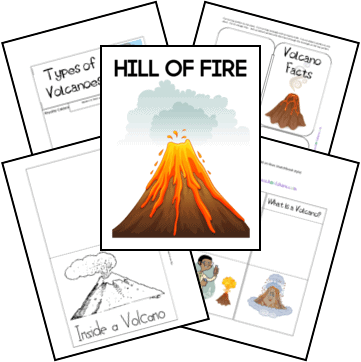
Check out our literature based unit for
Hill of Fire (another
volcano study & lapbook).
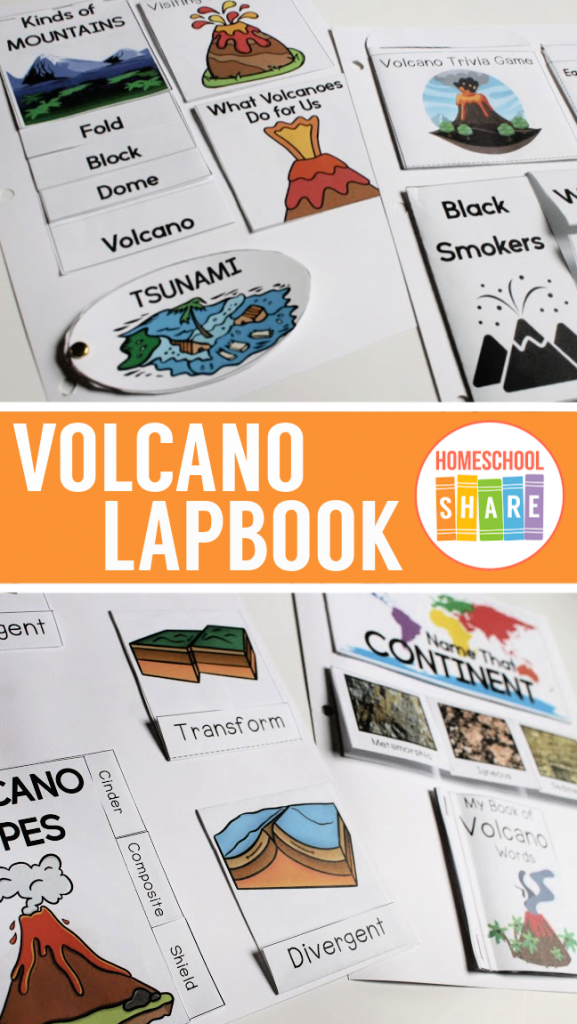
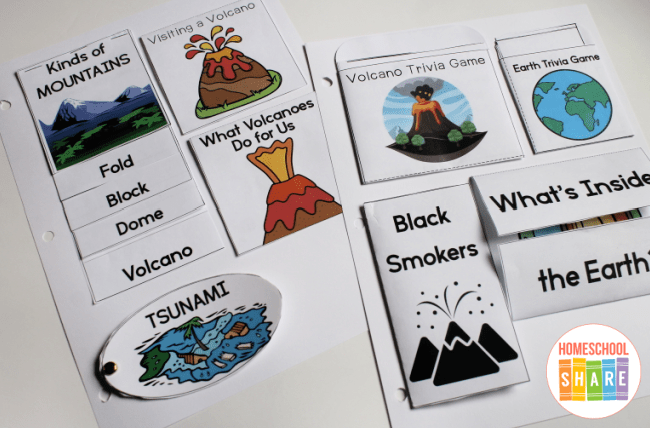
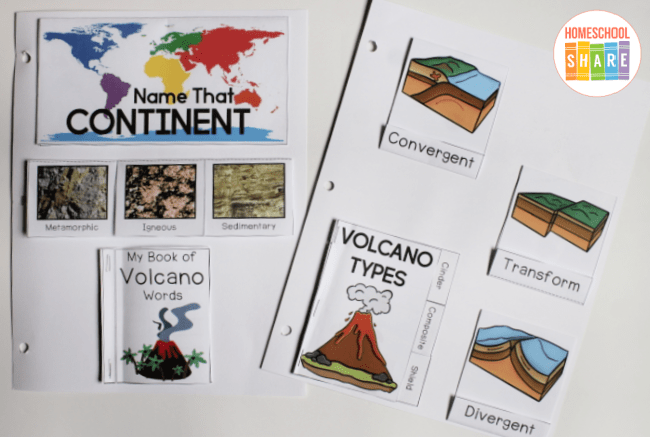
Lapbook Templates
Vocabulary Words and Definitions
Aa lava: a crumbly, lumpy type of lava that moves
slowly and can form tall flows.
Ash: very small, fine particles of larva that can
block out sunlight.
Basalt: most common kind of volcanic rock, made from
very runny lava.
Black Smoker: volcanic vent on the sea floor that
belches out hot minerals.
Core: the metallic center of the Earth.
Crater: part of a volcano that connects to the main
chimney and out of which lava and ash erupts.
Crust: the hard, outer layer of the Earth.
Dormant: volcano that has not erupted for a long
time, but could again.
Eruption: When lava, ash or gas explodes out of a
volcano.
Extinct: a volcano that can’t erupt again.
Fault: a crack in the Earth’s crust where rocks have
moved.
Geyser: a place where under ground water, heated by
magma, spurts into the air.
Fissure: a crack in the ground that runny lava oozes
out of.
Hot Spot: a place where rising magma burns through
the Earth’s crust.
Hot Spring: a place where hot water from under the
ground bubbles to the surface.
Lava: the name for magma that has erupted to the
surface.
Mantle: part of the Earth’s interior.
Magma: rock deep in the Earth that has erupted to
the surface.
Metamorphic Rock: rock formed from other rocks that
are under intense heat and pressure.
Pahoehoe Lava: hot, runny lava that moves freely in
shallow flows.
Plate: the moving part of the mantle and crust.
Rift: place where two plates are pulling apart to
create a crack in the crust.
Ring of Fire: area in the Pacific Ocean that
includes many of the world’s most active and violent
volcanoes.
Seismograph: machine that measures movement of
Earth’s surface.
Tsunami: destructive sea wave that can be caused by
underground volcanic eruptions or earthquakes.
Volcanologist: Scientist who studies volcanoes.
Day 1
Activity 1- Vocabulary
Introduce the following vocabulary words:
*Core
*Crust
*Mantle
*Metamorphic Rock
*Magma
Lapbook Template:
Vocabulary File Folders
Activity 2- Earth's Crust
Lapbook Template: Types of Rock Flap
Describe what Sedimentary, Igneous and Metamorphic Rock means.
Earth’s crust is made of loose rocks and dirt.
Sedimentary rock are made from bits of rock stuck together.
Igneous rocks made from magma that has cooled.
Metamorphic rock made from squashed rocks.
The Earth is made up of many layers, just like an onion. Instead of an onion,
the Earth’s layers are made of rock and metals.
Activity 3- What’s
Inside The Earth
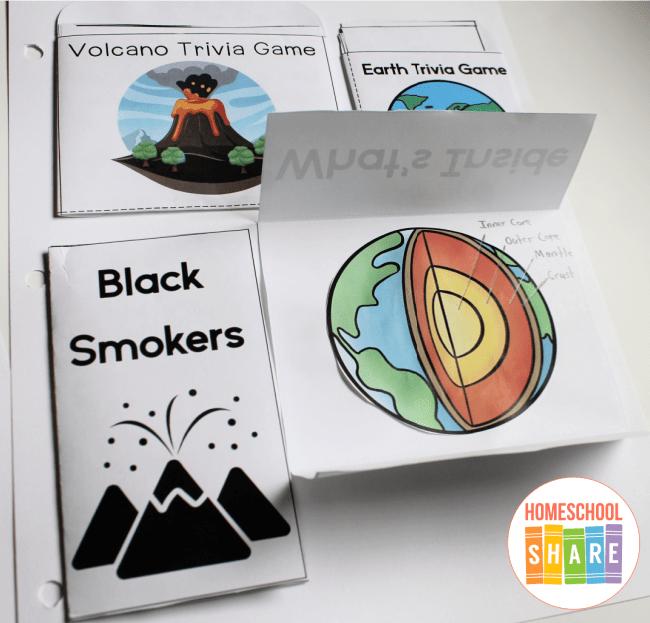
Lapbook Template: What's Inside the Earth? Shutterfold
Draw Circle to represent the Earth. Then draw four inner circles to represent the crust, mantle, inner and outer layer. Label each part of the Earth.
Crust: made of lighter rock; the layer of rock between 35-42 miles thick
Mantle: Layer of hot, melted, moving rock below the crust
Outer Layer: below the mantle is the outer core, a thick layer made of hot liquid iron and nickel
Inner Core: a
very hot solid ball of metal; the temps of the inner core can reach 8,130
degrees F
Experiment 1- Egg Like Earth
Items
Needed:
1 Hard Boiled Egg with Shell
Knife
Cutting Board
1) Take hard boiled egg and place on cutting board.
2) Cut egg in half with shell on.
3) Look at egg. Do you see layer’s inside? What are they?
4)Yolk is inner core and outer core.
White is the mantle.
Eggshell is the crust.
Day 2:
Activity 1- Add to Vocabulary Template
*Lava
*Extinct
* Dormant
*Eruption
*Basalt
Activity 2- Earth Trivia Game
Lapbook Template:
Earth Trivia and Pocket
1) What is the estimated age of Earth? A: 7,000 years old
2) Earth is one of how many planets in our Solar System? A: 9
3) What are Earth’s four basic layers? A: Inner core, Outer core, Mantle, Crust
4) Earth orbits around what star? A: Sun
5) In most of Earth’s surface covered by water or land? A: Water
6) Earth’s land is divided into how many continents? A 7
7) At least how tall must a mountain be? A: 2,000 feet above sea level
Activity 3- Inside A Volcano
Lapbook Template:
Inside a Volcano Diagram
Beneath the ground , melted rock is called magma. When out on Earth’s surface it’s then called lava. Magma moved toward the surface inside the volcano. The gas it contains starts to bubble. Magma and gas start to rise faster, pushing their way upward.
Activity 4- What’s The Difference?
Lapbook Template:
What's the
Difference?
Composite or Stratovolcano: Made up of alternating layers of ash and lava.
Shield: made of many layers of lava. It’s very fluid when it flows out of the
volcano.
Cinder Cone: has many layers of broken rock and ash.
Lava Dome: made of only a thick mass of lava which came through an opening. Lava
piled up and formed the dome.
Experiment 2
Complete the Layered
Volcano Experiment found on pages 2-3 in
Myrna
Martin’s Volcanoes: Hands on Activities
Day 3
Activity 1-Add to Vocabulary Template
* Aa
lava
* Pahoehoe lava
* Volcanologist
* Hot Spring
* Fissure
* Hot Spot
Activity 2-Ropes, Pillows and Clinkers
Lapbook Template: Ropes, Pillows, and Clinkers Matchbooks
Two common types of lava have been given Hawaiian names.
Aa
(pronounced ah-ah)
Rough and jagged lava with tiny spines. They are also known as clinkers. Rough
surface is hard on feet. If you slip and fall you would cut hands, feet or
clothes.
Pahoehoe (pronounced pa-hoy-hoy)
Often looks like coils of thick rope. After cooled the surface is smooth and
easy to walk across. When the pahoehoe cools under water it may look like
pillows.
Activity 3- What’s That Continent?
Lapbook Template: Name that Continent Simple Fold
Label the map: Africa, Antarctica, Asia, Australia, Europe, North America, South America
Experiment 3
Complete the Comparing
Lava Flows Activity found on pages 4-5 in
Myrna Martin’s
Volcanoes: Hands on Activities
Day 4
Activity 1- Vocabulary
*Ash
*Black Smoker
*Crater
*Geyser
*Fault
Activity 2- Ring of Fire
Ocean plates and
earth plates rub together in a circle of volcanic mountains called Ring of Fire
which is found on the edges of land surrounding the Pacific Ocean. Some are
active and some are dormant.
Lapbook Template (choose one):
Ring of Fire File Folder
Ring of Fire Blank
Learn more from Enchanted Learning
Activity 3- Active Verses Dormant
Flap
Book: write word on flap and definition on inside
Lapbook Template:
Who's Going to Blow?
Active- They erupt currently and often
Dormant- Sleeping but could erupt again
Extinct- No loner erupts
Experiment 4
Complete the Magma
Chambers Activity found on pages 16-17 in
Myrna Martin’s
Volcanoes: Hands on Activities
Day 5
Activity 1- Vocabulary
*Ring
of Fire
* Seismograph
*Tsunami
*Rift
*Plate
Activity 2- Kinds of Mountains
Lapbook Template (choose one): Kinds of Mountains Layer Kinds of Mountains Layer Blank
Fold-
When 2 of Earth’s plates push against each other.
Dome- When hot volcanic magma can’t break through Earth’s surface. Magma pushes
rocks towards the crust into a dome shape.
Block- Earth’s crust heave a block of land up.
Volcano- When magma, rock, gas and ash gradually build up in a cone shape around
an eruption.
Activity 3- Volcano Trivia Game
Lapbook Template:
Volcano Trivia and
Pocket
1) What
shoots out gases, hot molten lava, ash, and rock pieces from deep inside Earth?
A. Volcanoes
2) What happened to the 2,000 people who lived in Pompeii, Italy, in A.D. 79? A.
Mt. Vesuvius erupted and the people of Pompeii were buried in 20 feet of ash.
3) Mt. St. Helens’s 1980 eruption spread volcanic ash as far away as Minnesota
and was as powerful as how many atomic bombs? A. 500 atomic bombs
4) Volcanoes have shot fountains of fire as high up as how many feet? A. 300
feet
5) What are scientists who study volcanoes called? A. volcanologists
6) Erupting volcanoes are called___________? A. active volcanoes
7) Volcanoes are found on what other planets? A. Mars, Jupiter and Venus
8) Volcanoes that might erupt are called__________? A. Dormant Volcanoes
Experiment 5
Complete the Popcorn
Volcano Experiment found on pages 8-9 in
Myrna Martin’s
Volcanoes: Hands on Activities
Day 6
Activity 1- Plates
Label
where the plates are located.
Lapbook Template:
Plates (Label a Map)
Volcanoes occur because the outer layer of the Earth is in constant motion. The earth’s outer layer is divided into plates like a jigsaw puzzle. These plates average about 50 miles in thickness. They move as if they are rafts on liquefied rock. As the plates move, they collide or pull apart. When plate collide, one plate scrapes under the other plate, in an area called the subduction zone.
Torn rock from both plates melt and create new magma for volcanoes. Other volcanoes occur in the middle of plates, over places in the mantle where the magma is super hot. As a plate moves over a hot spot, the magma melts through it.
There are 7 major plates which move like conveyer belts.
1)Pacific
2) South American
3) North American
4) African
5) Antarctic
6) Eurasian
7) Indian Australian
Experiment 6
Complete the Squeeze Dome
Volcano Experiment found on page 30 in
Myrna Martin’s
Volcanoes: Hands on Activities
Experiment 7
Complete the Bottle Top
Eruption Experiment found on pages 24-25 in
Myrna Martin’s
Volcanoes: Hands on Activities
Day 7
Activity 1- Plate Movements
Lapbook Template: Plate Movements Side by Side
Most volcanoes and earthquakes occur along edges of plates, where they meet. There are four different plates.
1)
Sliding Plate:
This movement is similar to Earth’s plates sliding past each other. Where
Earth’s plates rub against each other like this, earthquake’s can happen.
2)
Divergent Plate:
This is like 2 Earth’s plates separating. When plates in the ocean separate,
underwater volcanoes occur.
3)
Convergent Plate:
When 2 plates come together or slowly collide.
4)
Subduction Zone:
When 2 plates move toward each other and one slips under the other is called
subduction zones. Increased earthquakes and volcanic activity occurs here.
Activity 2- Richter Scale- What is Magnitude?
Richter
scale measures the amount of energy released by an earthquake. This scale is the
most common measure of a quake’s power.
Lapbook Template:
Richter Scale Flap
Suggested websites:
http://www.schools.manatee.k12.fl.us/601MBLEICHER/catastrophes/richter_scale.html
http://www.geography-site.co.uk/pages/physical/earth/richt.html
http://www.seismo.unr.edu/ftp/pub/louie/class/100/magnitude.html
Experiment
8
Complete the Cotton Ball
Eruptions Experiment found on pages 18-19 in
Myrna Martin’s
Volcanoes: Hands on Activities
Day 8
Activity 1- Earthquakes: Fact or Fiction?
Template: Earthquake Fact or Fiction
1) The longest recorded earthquake lasted 4 minutes? A. Fact
2)
There are hundreds of earthquakes every year?
A. Fiction- There are thousands of earthquakes each year.
3) Some animals behave strangely before earthquakes? A. Fact
4) A pyramid-shaped building is not very sturdy in an earthquake? A. Fiction
5) A moonquake occurs on the moon? A. Fact
6) It is important to duck and cover in an earthquake? A. Fact
7) A repeater is a machine used to measure Earth’s plate movements? A. Fact
8) The Richter scale measures the power of an earthquake? A. Fact
Activity 2- Under The Sea
Under the sea, hot magma, chemicals, and minerals burn their way through thin spot’s of the Earth’s plates.
They bubble to make homes for sea life. Minerals rise to the ocean floor and quickly harden into a chimney shape. These are called black smokers. Colorful tube worms live on black smokers special bacteria live inside the worms, which change the chemicals into food.
Most black smokers are more than a mile below the surface
Animals
living near black smokers include mussels, clams, and crabs.
Lapbook Template:
Black Smokers Flap
Activity 3- Lava
Diving
Magma cools down
quickly underwater. Scuba divers can get close up look at small undersea
eruptions since it moves slowly and cools quickly. It allows scientists to learn
more about how islands are formed.
Lapbook Template:
Diving
Experiment
9
Complete the Volcanic Islands
Experiment found on pages 10-11 in
Myrna Martin’s
Volcanoes: Hands on Activities
Day 9
Activity 1- Tsunami
Tsunami starts
when a volcano erupts on the ocean floor, or an earthquake takes place. At
first, the displaced water is almost invisible as it travels quickly toward
shore. When the tsunami reaches shallow water, it swells upward, forming a huge
wave. Water traveling back from the shore is also sucked up into the wave. A
towering and terrifying tsunami is about to hit land.
The tallest recorded tsunami was 280 feet high.
The word tsunami means ‘harbor wave’ in Japanese.
They
can travel up to 500 mph at sea.
Lapbook Template:
Tsunami Fan (prompts)
Activity 2- Where Are the Volcanoes?
Lapbook Template: Where are the Volcanoes?
America’s Most Active Volcanoes include-
Mt. St. Helens Washington
Kilauea Hawaii
Experiment 10
Complete the Dough Volcano
Activity found on pages 20-21 in
Myrna Martin’s
Volcanoes: Hands on Activities
Day 10
Activity 1- Visiting A Volcano
Each year thousands of tourists travel to active volcanoes to get up close to the boiling lava. Most volcanoes can only be safely viewed from the air. Hot lava and poisonous gases make it dangerous to get closer.
Popular Volcanoes To Visit
Kilauea has been erupting since 1982
Yasur has been erupting 10-20 times each hour for about 800 years.
White Island is where you can walk inside the crater.
Hawaii- people can camp overnight near volcanoes. It erupts almost every night.
Lapbook Template: Diving & Visiting
Activity 2
What
Volcanoes Do For Us
Volcanoes are responsible for forming Hawaii, Iceland, the Aleutian Islands
and other smaller islands.
They fertilize soil.
They allow these to come closer to the surface to be mined: Diamonds, Gold, Tin
and other metals.
Pumice is used to clean teeth.
Volcanic glass called obsidian is made by lava flows. It’s used as a gemstone.
Was used to make tool’s in the past.
Basalt, (hardened lava), is used whenever hard rock is needed such as roads.
Lapbook Template (choose one):
What
Volcanoes Do
What
Volcanoes Do (blank)
Experiment 11
Complete the Frothy Rock
Cookies Activity found on pages 26-27 in
Myrna Martin’s
Volcanoes: Hands on Activities
Materials and information on this website belong to the original composers. It may be used for your own personal and school use.
. © 2005-08 HSS