| about us |
what's new
|
unit studies
|
unit study helps |
fiar resources
|
indexes | lapbooking |
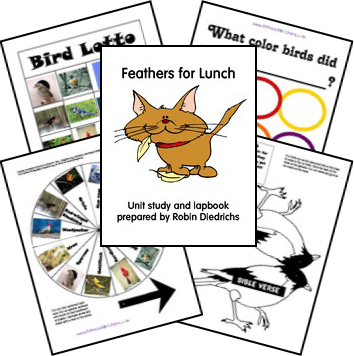
Feathers for Lunch
| Author/Illustrator: Lois
Ehlert ISBN: 0152009868 Unit and Lapbook by Robin Diedrichs |
Lapbook Templates
Library List
The Robins in Your Backyard by Nancy Carol Willis
Roger Tory Peterson’s ABC of Birds by Linda Westervelt
If You Were a Bird by S. J. Calder
Beaks by Sneed Collard
Birds by Gallimard Jeunesse, Claude Delafosse, and Rene Mettler
The Egg by Gallimard Jeunesse and Pascale de Bourgoing
Cats by Gallimard Jeunesse
Objectives
Enjoyment of bird poems and songs
Identification and matching colors – red, yellow, green, blue, purple, orange, brown, gray, black and pink
Introduce and explore the concept of camouflage
Use tally marks to represent an object
Learn facts about common neighborhood birds
Explore bird body parts and compare to human body parts
Discuss and learn about cats
Sort cat foods according to two criteria – wild and store bought
Investigate rhyming words
Discover the care of God for birds and humans
Explore the letters B and C
Lessons
Music/Poetry:
Read and enjoy
the poems and songs. Repeated readings will help your child learn the poems
and songs and will promote phonemic awareness.
Colors:
Talk about the different colors in Feathers for Lunch represented by the
birds and plants. Use the
“What Color is the Plant?" Flap Book to match the plants to their color.
You can also discuss the concept of camouflage in relation to birds. Talk about how the male birds tend to be more colorful than the female bird – for example, the male cardinal is a brilliant red and the female cardinal is tan. Birds use camouflage to hide from their enemies by blending in with their environment. Have your child try to camouflage the birds in the “Camouflage the Birds" Game by placing the birds on similar colors in your living room. Then you or another child can pretend to be the cat and try to find the “hidden” birds. Then reverse rolls and play the game again.
Math
Choose a location – neighborhood, local park, zoo,
backyard – and take a walk to hunt for birds. Use the
Bird Colors Page. Fill in the blank with the location – in your
neighborhood, at Doling Park, at the zoo, in your backyard. Teach your child how
to make a tally mark each time they see a particular color bird in the
corresponding colored circle. For example, when a cardinal is seen, put a tally
mark in the red circle. When you get home, you could use colored objects
(blocks, cubes, tiles, …) to make a hands-on graph comparing the amount of each
colored bird that they saw. Then you could compare the different amounts by
asking questions like, “Which color of birds did we see the most?”, “Which color
did we see the least?”, and “Were there any amounts of colors that were the
same?”. The level of questions will depend on your child.
Science
Discuss the different birds represented in the book
Feathers for Lunch – Northern Cardinal, Northern Oriole, Red-winged
Blackbird, Blue Jay, American Robin, Mourning Dove, Ruby-throated Hummingbird,
American Goldfinch, House Sparrow, House Wren, Northern Flicker, and Red-headed
Woodpecker. The back of the book tells about the different characteristics of
these birds – size, food, home, and area. It also challenges you to look for
these birds in your neighborhood. Make
“__________’s Bird Guidebook” as a guide to use when looking for the birds
in your neighborhood. Write your child’s name in the blank or have your child
write it. The directions for making the flag book are included with the
component. You can listen to the different sounds of the birds at
this website.
As a follow up to making the guidebook and looking for the birds from Feathers for Lunch, play the “Bird Lotto" Game. Give each child a lotto card. The children take turns spinning the spinner and covering the corresponding bird on their lotto card with a marker (pennies, torn up paper, …). The winner is the first person to get four in a row – either straight or diagonally.
Sing “Head, Shoulders, Knees, and Toes” with your child. Have your child identify his different body parts. Tell him/her that birds have different body parts just like people do. Some of their parts have the same names as ours but some parts are different. Introduce the following bird part terms – wing, crown, beak, leg, feathers, foot, and tail. Introduce the story of Billie Bird in the “Body Parts of a Bird” lapbook component. Read the story several times and perform the movements that correspond. Use the minit book to match the body part terms to the proper place on the bird using magnetic tape.
In Feathers for Lunch a cat is on the prowl for a bird to catch for lunch. Have a discussion about cats with your child. What does he know about cats? Does he have a cat or has he had any experiences with cats? Talk about what the cat was doing in the story. Make the Cats Layer Book to learn additional facts about cats. You could also read about cats and look at different types of cats on the internet. Discuss the concept of predator/prey. Talk about the type of food a cat would hunt and relate that to the predator/prey concept. Complete Prey Slider.
Compare and contrast the difference between cats and birds using the “Who’s Who” lapbook component. Instead of “teaching” the difference between mammals and birds, present your child with the tabs from the lapbook component and allow them to tell you which describe a bird and which describe a cat. Use this activity to provide a beginning discussion of the differences between mammals and birds.
Sorting: Discuss the part of Feathers for Lunch that says about the cat, “He’s looking for lunch, something new, a spicy treat for today’s menu. His food in a can is tame and mild, so he’s gone out for something wild”. Brainstorm a list of food that cats eat with your child. Discuss which foods are bought at a store and which foods a cat can catch in the wild. Complete the “What foods do cats eat?" Shutterfold
Language Arts
Rhyming Words – Talk to your child about words that sound the same at the end –
book/look, sit/hit, … Tell him that these words are rhyming words and there are
some rhyming words in Feathers for Lunch. Read the book Feathers for
Lunch having your child listen for words that sound the same at the end.
Depending on your child, some at this early stage may be able to recognize the
pairs and with other children they will need them pointed out. Make this an
enjoyable experience and have fun saying the words together! You can also make
the Rhyming Eggs for
your lapbook.
Alphabet – This lapbook would be an opportune time to add B and C pages to an Alphabet Notebook. (You can begin your discussions with B is for Bird and C is for Cat.)
Bible Verse:
Discuss the scripture verse Matthew 6:26 – “Behold the fowls of the air: for they sow not, neither do they reap, nor gather into barns; yet your Heavenly Father feedeth them. Are ye not much better than they?” Complete Bible Verse component.
Talk about how important we are to God and how He will care for us even better than He cares for the birds. This is not intended for memory work unless so desired.
Art
Feather art – Give your child feathers – one per paint color. Allow him to paint the picture as desired using the feathers.
Make bird binoculars using two toilet paper rolls painted and stapled together. Attach string to wear around their necks. Wear during your bird watching expeditions.
Decorate a bird pattern – first coloring the pattern and then by gluing colored feathers on it.
Websites