Google
 
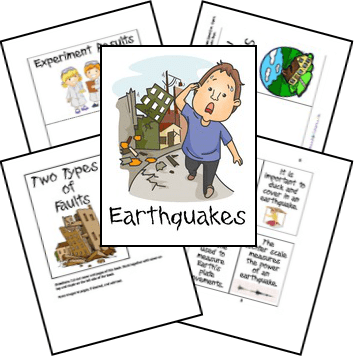
Free Earthquakes Unit & Lapbook

Earthquakes Unit and Lapbook
Unit and lapbook templates prepared by Holly Dong


Lapbook Templates

Cover Page
 
Creative Writing Pocket
 
Experiment Results File Folder
 
Types of Faults Tab Book
 
Predictions Clipboards
 
Earthquake Scales Comparison
 
Ten Major Earthquakes Simple Fold
 
Be Prepared Shape Book
 
An Earthquake in the Bible KJV
 
Disasters After Earthquakes Wheel
 
New Words Flap Books
 
An Earthquake in the Bible NIV
 
Ring of Fire Simple Fold
 
New Words Flap (Blank)
 
Images and Clip-art (includes faults for Fault Tab Book)
 
Types of Waves Layer Book    


Library List
 

Earthquakes by Trudi Strain Trueit 
This book is jam packed with information, but probably too much information for the elementary student to completely absorb. I believe it is best presented by the parent picking out the best portions and either reading it aloud or allowing the child to read it. The glossary in the back is a great resource.
 

Earthquakes by Seymour Simon
A less dense version of the above book, this would be more easily accessible by children. Parents should be aware that there are several photographs of destroyed houses, streets, and cars in the book.
 

DK Eyewitness Books Volcano & Earthquake  by Susanna van Rose
With lots of pictures, this book gives in depth information on measuring earthquakes and the mechanics of earthquakes.
 

...If you lived at the time of the great San Francisco Earthquake by Ellen Levine
This gives an in depth look at what life was like directly before, during, but mostly after the 1906 earthquake in San Francisco, CA.
 

Earthquakes: Let’s Read and Find Out by Franklyn M. Branley
Part of a great series, and easy for the newer reader to tackle on their own, includes the causes and effects of earthquakes, preparations, and a list of 10 most deadly (up to it’s publication in 2005) earthquakes.
 

Jump into Science: Earthquakes by Ellen J. Prager
A crow gives kids a bird’s eye view of the earth to explain earthquakes. There’s even an experiment where kid’s can make their own earthquake.
 

Earthquake in the Early Morning Mary Pope Osborne
If you have a Magic Tree House fan, then, of course, there is a Magic Tree House book on earthquakes. This covers the earthquake of 1906 in San Francisco, and if it is read in conjunction with
...If you lived at the time of the great San Francisco Earthquake , then your child can compare and contrast fact and fiction.
 

Kingfisher Knowledge Hurricanes, Tsunamis, and other Natural Disasters by Andrew Langley
This gives a brief overview of earthquakes, but goes more in depth about the results tsunamis. Most of the images are from the 2004 tsunami; parents should be aware, like the earthquake book, of the reality of the destruction depicted in the book.


Lessons and Research


Vocabulary
 

After-shocks: small tremors that occur after a large earthquake. They can happen for days, weeks, months, or even years after an earthquake.
 

Boundary: the edge or border
 

Crust: the outermost layer of the earth
 

Earthquake: the movement on the surface of the earth resulting from underground movement between two plates
 

Epicenter: the place on the crust directly above the focus of the earthquake
 

Friction: the force felt when one object rubs against another
 

Fault: A crack in the crust where two plates meet
 

Focus: the place an earthquake begins inside the Earth
 

Liquefaction: when the shaking from an earthquake causes, usually sandy, ground to behave more like a liquid, causing houses or other objects on it to sink
 

Logarithmic Scale: a graph scale where the divisions are some power of 10
 

Magnitude: the measurement of the size of the earthquake
 

Modified Mercalli Intensity Scale: a measurement scale for earthquakes based on people’s observations of how the earthquake felt
 

P waves: the primary (first) waves from an earthquake
 

Richter scale: a measurement scale for earthquakes based on the size of the waves it produces
 

S waves: the secondary waves from an earthquake
 

Sand Boils: when water pushes up through a bed of sand
 

Seismic wave: aka shock wave, an invisible wave that travels through rock during an earthquake, moving it
 

Seismologist: a person who studies earthquakes
 

Seismograph: an instrument that produces a record of the strength of an earthquake
 

Surface waves: waves that move on the surface of the Earth during an earthquake
 

Tectonic plates: the divided parts of the Earth’s crust
 

Tremor: a small earthquake
 

Tsunami: a sea wave caused by the movement of the sea floor during an earthquake or volcano.


Earthquakes occur when the ground unexpectedly moves beneath your feet. Earthquakes take place at areas of the Earth known as faults.


Types of Faults

There are two types of faults: 1) a strike slip fault and  2) a normal fault, also called a dip-slip.


1). At a strike slip fault, the rocks on one side of the fault try to slip by the rocks on the other side of the fault. Friction builds up. Then, like a rubber band releasing, the rocks move and there is a release of energy, which we call an earthquake. An example of this kind of fault is the San Andreas fault in California.


2). At a normal fault, the rocks on one side try to slip up and over the other set of rocks. The Sierra Nevada Mountains are an example of dip-slip faults.


Since every earthquake begins underground at a fault, earthquakes usually happen where two plates come together, at the boundary. Eighty percent of the world’s earthquakes occur along the “Ring of Fire” (known as that because it is also an area high in volcanic activity), border by the Pacific Ocean, stretching from South America, up through North America, to Asia and Japan, then south to the Philippines, New Guinea, and New Zealand.


The place an earthquake begins is called a focus, and the place above ground over the focus is known as the epicenter. The energy released when the rocks moved is released in the form of invisible waves.


Types of Waves

There are three types of waves:  P waves, S waves, and Surface Waves.

1.  P waves, or primary waves: The first waves to reach the surface and also the fastest moving at 4 miles per second. They push and pull the rock as they move through it, making a the initial jolt that people sometimes report feeling.


2.  S waves, or secondary waves, move slower than P waves, at 2 miles per second and move the rock up and down and back and forth.


P and S waves move through the entire Earth, so they, combined, are also known as body waves.


3.  Surface waves travel only on the surface of the Earth. They are made by the P and S waves hitting the surface of the Earth. The make a rolling sensation, sort of like waves in the water. Often, they cause the most damage, because they can last the longest  and they hit areas that have already been weakened by the other waves.


Measuring Earthquakes


There are two scales used to measure earthquakes: the Modified Mercalli Intensity Scale and the Richter Scale.


Modified Mercalli Intensity Scale

This is less widely reported because it is considered descriptive and relative. It is measured by having survivors of an earthquake fill out a form reporting how the earthquake felt to them.

I The earthquake is not felt by people but instruments recorded it.

II People resting noticed the earthquake, especially on higher floors. Suspended objects may swing.

III People inside feel a vibration, like a truck passing by. Hanging objects swing. People may not realize there was an earthquake.

IV Feels like a heavy truck hit a building. Dishes rattle, wooden walls shake, standing cars rock.

V Felt outside. Liquid in glasses splashes out; small objects are knocked over. Doors open and shut.

VI  Everyone feels it, many people go outside, many are scared. People may walk unsteadily (sea legs). Dishes and windows break, Pictures fall off the wall.

VII Hard to stay standing, furniture breaks, bricks fall, waves on ponds.

VIII Hard to drive. Walls, chimneys, monuments fall. Tree branches break. Changes in flow of wells and springs. Cracks in wet ground.

IX Panic, in people and animals. Major damage to foundations and frames of buildings. Underground pipes break.

X Most brick and frame buildings destroyed. Some well built wooden buildings destroyed. Large landslides. Water thrown out of rivers and canals.

XI Train tracks greatly damaged. Underground pipes out of service. Highways and roads useless. Ground has large cracks. Many large landslides and rocks falls.

XII Nearly all built structures above and below ground destroyed. Objects thrown into the air. River courses moved.


The more commonly reported scale is the Richter scale. The Richter scale is measured using a seismograph to measure the magnitude, or size, of the waves of the earthquake. The Richter scale is a logarithmic scale, which means that each time you go up one number, the magnitude increases ten time.  The Richter scale has no upper or lower limit, however, for most earthquakes, here are roughly what the Richter numbers translate to:


Less than 2— not felt

2-2.9 generally not felt but recorded

3-3.9 often felt but usually no damage

4-4.9 noticeable shaking of indoor things, rattling, usually no major damage

5-5.9 can cause major damage to poorly constructed buildings. At the most, minor damage to well constructed buildings.

6-6.9 can be destructive to areas 100 mi across in populated areas

7-7.9 can cause serious damage over larger areas

8-8.9 can cause serious damage in areas several hundred miles across

9-9.9 devastating in area thousands of miles across

10+ never seen


Measuring Earthquakes

Current seismometers (instruments that record earthquakes) have a recording device, the seismograph, and a record of the earthquake, the seismogram. Many times they are in remote locations, to be away from the vibrations of  shaking of cars, trucks, or airplanes. The data is recorded onto magnetic tapes.


Disaster on top of Disaster


Many times earthquakes can trigger other disasters. Some of the problems that can occur as the result of an earthquake are: tsunamis, fires, landslides, mudslides and avalanches, and liquefaction and sand boils.


Tsunamis

A tsunami, which means “harbor wave” in Japanese, occurs when an earthquake under the ocean makes a wave or series of waves that can travel for up to thousands of miles. In the ocean, the crest of the wave is not very high, perhaps only three feet, but it moves very quickly, at speeds up to 500 mph. When the wave reaches the coast, it slows down, the water towards shore draws back and the tsunami gets taller. Most are 50 feet, although they can reach a height of 100 ft. or more.


Fires

Fires are a danger after large earthquakes because of the following reasons: water mains have often broken, cities are left without water supplies, chimneys frequently fall during earthquakes, power lines can fall, and gas lines also frequently burst.


Landslides, Mudslides and Avalanches

The shaking of the ground can loosen any unstable soil or snow causing landslides, mudslides, or avalanches compounding the difficulties already faced by those dealing with the aftermath of an earthquake.


Liquefaction and Sand Boils

When some soils, particularly those with lots of sand grains in them, are shaken by an earthquake, they become like quicksand. Or, sometimes, the sand and mud form little “volcanoes” where the sand appears to boil water, becoming what is known as “sand boils.” When buildings, cars, streets, any structures are built on this kind of soil, damage can occur.


Earthquake Prediction


Only one earthquake has been successfully predicted. On Feb. 4, 1975, scientists in China used a variety of factors: foreshocks, ground tilt, changes in the groundwater, and changes in animal

behavior to successfully predict an earthquake in Haicheng and evacuate 1 million people. The next year, however, they failed to predict an 8.0 magnitude earthquake in Tangshan.


With no way to predict the next earthquake, the best thing to do is to prepare. 


Earthquake Preparation


If you live in an earthquake zone, one of the most important things you can do is prepare in advance. Some basic things you can do to prepare are:
 

Know how to shut off the gas, water, and electricity in your home.
 

Have heavy furniture, glass objects, mirrors, pictures, the water heater, and all breakables appropriately fastened.
 

Keep a fire extinguisher handy and make sure it is not expired.
 

Find safe zones in your house, away from windows, under tables, etc.  where you can duck and cover.  Door jams are not safe zones (even though they used to be recommended).  Fingers can get crushed when doors swing and people rarely remember to close them in an emergency. 
 

Make an earthquake kit with enough food and water for one week (water should be 1 gallon per person per day). Don’t forget a manual can opener, flashlights, a portable radio, pet food, extra prescriptions, glasses, and batteries. Keep sturdy shoes by your bed. Update your kit every year.
 

Never go outside during an earthquake. If one hits while you are outside, move out into the open, away from buildings, lights, and wires. Stay away from cliffs, hills, and rivers. If you are near an ocean or other large body of water, get to higher ground.
 

www.fema.org  and www.redcross.org  have specific tips on what to put into and earthquake kit as well as other tips on how to prepare for an earthquake.


Major Earthquakes in History


Information on this can be found in Earthquakes by Franklyn M. Branley (the 10 deadliest earthquakes). The information can also be found in an online search as the ten strongest earthquake by magnitude. Since this information is always changing, the parent will need to find the most up to date information (rather than it being posted in this unit).


Experiments and Activities


1: Liquefaction can be simulated very easily. Most of us have done it without even realizing it at the beach by tapping our foot in the sand until it turns “jelly-like.” Use a rectangular or square container that you don’t mind getting dirty (or go to the beach) for this project. Add sand and water and start tapping on it with a piece of wood or a brick. For a true effect, add some toy cars, houses and people. Watch what happens and take pictures. Have your child write an explanation and add the pictures to your lapbook.


2. Highway Seisomograph
Have your child hold a paper and pen at arm’s length as you drive down a bumpy road. It will work best if they can attach the paper to the backseat or if you have an adult do the in the front seat and have the paper on the dashboard (so that they are not holding the paper). As you are driving, their hand will move, marking the paper, the way a seismograph moves in an earthquake.  Source


3. Waves
P waves and S waves can be demonstrated using a slinky. Since surface waves move on the surface and not through the earth (or in this case, the slinky), it’s a lot had to demonstrate. For the P waves, have a person at each end of the slinky and have them move the slinky up and down quickly. For the S waves, have a person at each end of the slinky and have them move the slinky from side to side. Take pictures or have your child describe the experiment.


4. Make your own earthquake using the instructions found in the book, Jump into Science: Earthquakes .


Earthquakes and the Bible


There is a  miraculous earthquake which occurs in the bible at the rising of Jesus from his grave.. Read Matthew 28 1-6.