Affiliate Disclaimer
We sometimes use affiliate links in our content. This won’t cost you anything, but it helps us to keep the site running. Thanks for your support.
Chipmunks are the cutest! They hurry and scurry and gather and eat. A lot. Learn all about these fun rodents with our Chipmunks Lapbook.
Thanks to Marie Simms and Tara Mitchell for creating this Chipmunks Lapbook for Homeschool Share.
Chipmunks Lapbook Information
Here are some sample lessons from the Chipmunks Lapbook:
Chipmunks Species
Chipmunks are a type of ground squirrel. All chipmunks have stripes on their faces. They weigh less than other ground squirrels. Size and weight differ by type. Their fur is in shades of red, brown, gray with some black and white.
Eastern Chipmunk: The Eastern Chipmunk is found in the eastern half of the United States in wooded areas. They live in large underground burrow systems.
Cliff Chipmunk: The Cliff Chipmunk is found in the mountains and canyons in Oregon, Wyoming, Idaho, Nevada, Utah, Colorado, Arizona, and New Mexico. They can be seen in the Grand Canyon and Zion National Parks. These chipmunks will burrow underground or make nests in the cracks of a cliff face.
Townsend’s Chipmunk: The Townsend’s Chipmunk can be found in Washington, Oregon, Northern California, and along the Pacific Ocean. They prefer to burrow or live in yellow pine, redwood, hemlock, or fir trees.
Least Chipmunk: The Least Chipmunk can be found in more places than any other western chipmunk. They can be found in the sagebrush desert and mountains from North Dakota to New Mexico to Arizona, California and up to Washington. They can also be found in pine forests in Michigan, Wisconsin, and Minnesota.
Chipmunk Hibernation
Chipmunks hibernate in winter, but they wake up every few days to eat food they have stored. They sleep mainly underground in burrows.
Chipmunk Diets
Each type of chipmunk has certain preferences, but in general they eat seeds, nuts, and berries. Some types eat cactus fruit, bird eggs, flowers, ants, millipedes, and grasshoppers.
You can grab a copy of the entire Chipmunks Lapbook in an easy-to-print file at the end of this post.
Chipmunks Lapbook Printables
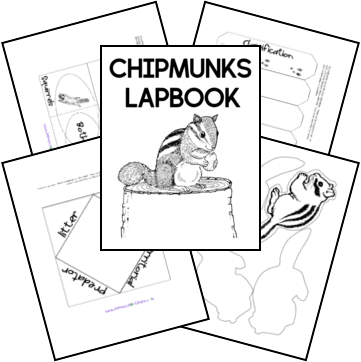
The following mini-books are included in the Chipmunks Lapbook:
- New Words Envelope Fold
- Squirrels vs. Chipmunks Venn Diagram
- Types of Chipmunks Side by Side Book
- Chipmunk Book Log Fan
- Predators Shutterflap Book
- Chipmunk Life Cycle Simple Fold
- My Heart vs. Chipmunk’s Heart Flap Book
- Where Do Chipmunks Live Matchbook
- Chipmunk Diet Shape Book
- How Do Chipmunks Communicate Simple Fold
- Chipmunk Classification Fan
- Chipmunk Shape Book (use as desired)
How to Get Started with Your Chipmunks Lapbook
Follow these simple instructions to get started with the Chipmunks Lapbook.
- If you want, go to your local library and check out books about chipmunks, squirrels, and other rodents.
- Print the Chipmunks Lapbook.
- Choose and prepare the mini-books you want to use with your student.
- Enjoy a week of reading and learning all about chipmunks.
Download Your Chipmunks Lapbook
Simply click on the image below to access your free Chipmunks Lapbook.
Explore Our Other Rodent Animal Lapbooks
Are you looking for more animal lapbooks? Try some of these: