| about us |
what's new
|
unit studies
|
unit study helps |
hss resources
|
fiar resources | indexes | lapbooking |

| about us |
what's new
|
unit studies |
hss resources
|
fiar resources | indexes | unit study helps | contact us |

Books Used
My Dear Noel: The Story of a
Letter from Beatrix Potter by Jane
Johnson
The Great Big Treasury
of Beatrix Potter or the following
stories
The Tale of Benjamin Bunny
by Beatrix Potter
The Tale of
the Flopsy Bunnies by
Beatrix Potter
The Story of a
Fierce Bad Rabbit by
Beatrix Potter
The Tailor of
Gloucester by Beatrix
Potter
The Tale of
Two Bad Mice by Beatrix
Potter
The Tale of
Mrs. Tittlemouse by Beatrix
Potter
The Pie and The Patty-Pan By Beatrix Potter
The Story of Miss Moppet
by Beatrix Potter
The Tale of Tom Kitten
by Beatrix Potter
The Roly-Poly Pudding
by Beatrix Potter Or
Mr. Samuel Whiskers
Ginger and Pickles
by Beatrix Potter
Chapter Book Read Aloud Suggestions
The Wind in the Willows by Kenneth Grahame
The Secret Garden by Frances Hodgson Burnett
Library List
The Country Artist: A Story about Beatrix Potter by David Collins
Nothing Is Impossible
the Story of Beatrix Potter by Dorothy Aldis
Miss Potter by Richard
Maltby Jr.
Tops and Bottoms by
Janet Stevens
The Milk Makers
by Gail Gibbons
The Tale of
Mr. Tod by Beatrix Potter
The Tale of
Mr. Jeremy Fisher by Beatrix Potter
The Tale of Mrs.
Tiggy-Winkle by Beatrix Potter
The Tale of Jemima
Puddle-Duck by Beatrix Potter
The Tale of Pigling
Bland by Beatrix Potter
Beatrix by Jeanette Winter
Videos
Miss Potter
Complete Beatrix Potter Collection
Website
Peter Rabbit
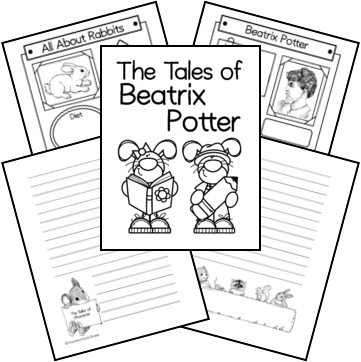
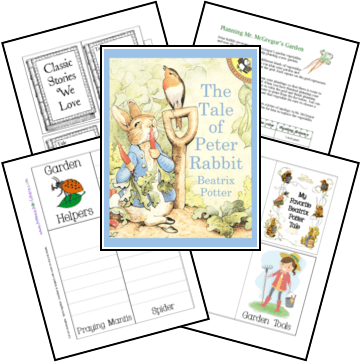
NOTEBOOKING PAGES
Notebook Covers
Geography Notebooking Pages
Animal
Stationary (for story writing)
Character Study Page (study as many
different characters as you want)
Notebooking pages for RABBITS section
Primary Lines
HWOT Lines
Ruled Lines
Notebooking Pages for MICE section
Primary Lines
HWOT Lines
Ruled Lines
Notebooking Pages for CATS section
Primary Lines
HWOT Lines
Ruled Lines
Note about vocabulary pages:
The vocabulary pages in the Primary and HWOT options have space to the left
for your student to cut and paste the appropriate clip-art (found at the end
of the file) and a space under the word for the teacher to write the
definition. Only one story per segment has vocabulary pages.
The vocabulary pages in the Ruled option have a space for the student to
write the word and its meaning (or a sentence using the word) and a box to
draw a picture that correlates with the word. Every story has
vocabulary pages, but it may overwhelm your student if you have her complete
all of them.
My Dear Noel: The Story of a Letter from Beatrix Potter by Jane Johnson
Background Information
Beatrix Potter did not begin
writing her stories to publish them. Her “stories” were first letters. She
would write stories for the Moore children when they were sick or for their
birthdays. Annie Moore, the mother of Noel, was Beatrix’s last governess.
Annie had taught her German. The letter that Beatrix wrote Noel while he was
sick would later become The Tale of Peter Rabbit. In 1901 when Miss
Potter first tried to get The Tale of Peter Rabbit published she was
turned down so she published it herself. Later, in 1902 Frederick Warne &
Company, Inc did publish it. The Tale of Peter Rabbit was the first of
Beatrix Potters stories to be published.
Who is Beatrix Potter?
Read a biography of Potter and
explain what a biography is. A biography is a true book written about someone’s
life. What is an autobiography? An autobiography is a story written by the
author about himself. The story may relate facts about the person himself, or
it may relate an event in the person’s past or present. Which type of biography
do you think is more accurate – one written by someone else or one written by
the person themselves?
Suggested biography books:
For the younger student: The
Country Artist: A Story about Beatrix Potter by David Collins
For the older student:
Nothing is Impossible: The story of Beatrix Potter by Dorothy Aldis
Another book you might want to
consider is Miss Potter. This book is a historical fiction not a
biography. There is also a movie called Miss Potter.
Autobiography Writing
Have your student write his own autobiography. Using a clustering
form, have you student write facts about himself. His name should be in
the middle, and his life facts extend out from the circle. Once he has brainstormed, begin a rough draft. If your
student is too young to do so much handwriting, let him dictate his
autobiography. The finished product should have a
photo added.
Beatrix Potter Timeline
As you read and learn about Miss Potter keep a
timeline of events in her life that you think were important or interesting. I
will list a few below.
Born: July 28, 1866
1872 Beatrix ‘s brother is born
Geography: Scotland and
England
Beatrix was born in London to a
family who believed children were to be seen and not heard. She was born in
1866, which was known as the Victorian age-- Queen Victoria was on the throne
and reigned from 1837 to 1901. Beatrix spent most of her time in
her nursery alone. She had a nurse care for her until her brother was born at
the age of 6. At that time she had a governess. Once her brother was old
enough he was sent to school and Beatrix was left alone in her room. Her only
companions were animals, which she kept in her room. The first of her animal
friends were mice.
Once her brother was born they
started spending the summers in Scotland. Beatrix loved her time in Scotland.
This is where she added to her love of nature-- plants.
Geography Notebooking Pages includes:
Page for England (mark England on the map)
Page for Scotland (mark Scotland on the map)
United Kingdom map (to label) and flag
The British Isles map to label
Art: Details
On page 1 and 2 based on the
pictures how do you think the children feel about Miss Potter coming for a
visit?
Page 3 is a picture of Miss Potter in her nursery/room. She is using a microscope. She used a microscope to study objects like leaves and butterflies to make her drawings more detailed and true to life. Notice her pets that are in her room.
On page 4 and 5 compare the difference between the two families eating breakfast. What can you learn about Miss Potter from this picture? It was not until Beatrix was in her teens that she was allowed to eat with her parents. Before that she ate alone in her room.
On page 8 and 9 notice the form of transportation during this time period
Continue looking at the pictures to see what more you can learn about Potter and the Moore family.
Language Arts: Letter
Writing
Since many of Potter’s
stories started as letters, discuss the different parts of a friendly letter.
There are five parts to a friendly letter. Make a note card with one part
labeled on each card. The parts include: the address to whom the letter is written,
date, greeting, body, and closing. Write a sample letter (on a
whiteboard/chalk board or posterboard) and let your student use the notecards to
label the parts.
Science: Microscope
A microscope is an instrument for viewing objects that
are too small to be seen by the naked eye. Show your student a
picture of a microscope and label the parts. You can find a picture at
Enchanted Learning. Each
part is also described. If you can get your hands on a microscope that your
student look at slides. Our museum has one with prepared slides that people can
use.
Health: Rheumatic Fever
In this book Noel is
sick in bed with rheumatic fever. It is an inflammatory disease which may
develop after strep throat or scarlet fever. (In 1887 Beatrix develops a serious
case of Rheumatic fever which affects her heart.)
Note: No study of Potter would be complete without reading The Tale of Peter Rabbit. Using the FIAR curriculum Vol II, do the study on this book.
The Tale of
Benjamin Bunny by Beatrix
Potter ~ published in 1904
The Story of a
Fierce Bad Rabbit by
Beatrix Potter ~ published in 1906
The Tale of
the Flopsy Bunnies by
Beatrix Potter ~ published in
1909
Optional Reading:
The Tale of
Mr. Tod by Beatrix Potter
Language Arts
Background Information
In the story The Tale of Benjamin Bunny, Benjamin is the cousin of Peter.
Together the two of them get into a jam and are finally rescued by Old Mr.
Benjamin Bunny – Benjamin’s father. Although, The Tale of Flopsy Bunnies was not
the next rabbit story that was published, it continues with Benjamin and Peter.
In this story Peter and Benjamin are all grown up and Benjamin has married
Peter’s sister, Flopsy. During this tale, the children of Benjamin must be
rescued.
Vocabulary for
The Tale of Benjamin Bunny
Bank:
the slope immediately
bordering a stream course along which the water normally runs
Gig:
two-wheeled one-horse
carriage
Widow:
a women whose husband has passed away
Scarecrow:
an object, usually a figure of a person in old clothes, set up to
frighten crows or other birds away from crops
Perplexed:
Puzzled
Vocabulary for
The Tale of Flopsy Bunnies
Soporific:
Causing or tending to cause sleep
Improvident:
Neglecting to provide for future needs
Rubbish:
worthless; unwanted material that is not needed and is thrown out
Profusely:
Spending or giving freely
and in large amount; usually to excess
Doleful:
sorrowful, showing grief
Vocabulary for
The Story of a Fierce Bad Rabbit
Fierce:
untamed, cruel, hostile
Savage:
rude, cruel, untamed, fierce
Comic Strip
Originally, The
Story of a Fierce Bad Rabbit was first published in a single strip of card which
opened up to tell the story. ~ Have your student create a comic strip with this
story or an accordion type fold using this story as their copywork. They
should sketch pictures for their comic strip or accordion book.
Adverbs (~ ly
words )
An adverb is a
word that tells about a verb. Some adverbs tell the how about the verb.
Adverbs that tell how something happens usually end in –ly. The following words
tell how something happens. They end in –ly: sufficiently, delightfully,
suddenly
Using the story
The Tale of the Flopsy Bunnies make a list of all the adverbs you see that end
in ly.
Have your student
write a paragraph or sentences about a rabbit using ly words.
Optional
Reading
Mr. McGregor was
not the only one Benjamin Bunny and his family had to worry about. Read The
Tale of Mr. Tod to find out who else Benjamin has to rescue his bunnies
from.
Science
Zoology: Rabbit
The first pet
rabbit that Beatrix had was named Benjamin Bouncer. He became the model for
many of her rabbit drawings. The second rabbit she owned was Peter Piper, which
was a Belgian buck rabbit.
Rabbits are furry-coated and short-tailed mammals. They have long ears and long back legs for running and jumping. Rabbits are herbivores with long front teeth for gnawing. Some make burrows or tunnels in the ground. The exception to this is the North America’s cottontail, which builds its simple nest on the surface, usually in grass or brush, and rarely lives, in social groups. Rabbits are smaller and have shorter ears than their hare relatives. A hare’s ears have black markings. A hare also has long, strong back legs. Unlike rabbits, their young are born with their eyes open and they live above ground. The skulls of the rabbit and hares are also different.
Scientific name: Oryctolagus cuniculus
Size: There are more than 60 different types of domestic rabbits. The small
breeds are two to six pounds; medium breeds are six to nine pounds; large breeds
are nine to 11 pounds; and giant breeds weigh more than 11 pounds
Lifespan: Seven to ten years
|
Kingdom |
Animalia |
An animal |
|
Phylum |
Chordata |
With a spinal chord |
|
Class |
Mammalia |
That breast-feeds its children. |
|
Order |
Lagomorpha |
A rabbit, hare or pika. |
|
Family |
Leporidae |
A rabbit or hare. |
|
Genus |
Oryctolagus |
|
|
Species |
cuniculus |
|
Zoology:Fox
Foxes are also
referred to as wild dogs. When used in literature, they are usually portrayed as
sly and cunning. (You may want to discuss how foxes are portrayed in
Aesop's Fables if your student is familiar with any of those stories.) An average life span for a wild
red fox is 7 years. They have red or brown fur. Their long bushy tail often
has a white tip and the backs of their ears are black. Parts of their legs are
black, too. They are usually found in woodland areas or wide-open country
land.
Red foxes are opportunist feeders and eat insects, earthworms, fruit, berries, wild birds, small mammals and scraps left by humans.
|
Kingdom |
Animalia |
|
Phylum |
Chordata |
|
Class |
Mammalia |
|
Order |
Carnivora |
|
Family |
Canidae |
|
Genus |
Vulpes |
|
Species |
|
Zoology:Badger
North American
badgers are carnivores and they will eat animals such as squirrel, rats, gophers
and mice. They have a
flat body with short legs and a triangular face with a long, pointed, tipped-up
nose. It has long brown or black fur with white stripes on its cheeks and one
stripe running from its nose to the back of its head. It has small ears on the
side of its head and long, sharp front claws. They live in open areas like
plains and prairies, farmland and the edges of woods.
|
Kingdom |
Animalia |
|
Phylum |
Chordata |
|
Class |
Mammalia |
|
Order |
Carnivora |
|
Family |
mustelidae |
|
Genus |
Taxidea |
|
Species |
|
Botany: Gardening
A gardener is
a person who plants seeds, bulbs, and roots and then manages
them. Discuss the first garden
with your student. (The Garden of Eden) How
is it different then the gardens we have now? Discuss man's curse with your
student
and why we must work so hard in our gardens
now.
When we eat food from the garden, what part of the plant are we eating? Have your student make a list of the following categories and list vegetables (see prepared notebooking pages), which fall under each category.Consider reading Tops and Bottoms by Janet Stevens.
|
Bulbs |
Flower Buds |
Fruits |
Leaves |
Roots |
Seeds |
Stems |
Onions |
Broccoli |
Tomatoes |
Lettuce |
Carrots |
Peas |
Celery |
|
Garlic |
Cauliflower |
Peppers |
Parsley |
Sweet Potatoes |
Kidney beans |
Asparagus |
|
|
|
Cucumbers |
Basil |
Turnips |
Lima beans |
|
|
|
|
Pumpkins |
Cabbage |
Beets |
Corn |
|
|
|
|
|
Spinach |
|
|
|
The following vegetables were mentioned in our stories: Lettuce, onions, carrots and cabbages
Carrots: Carrots contain vitamin A and other vitamins. Carrots grow down into the earth. The flowers from the tops of the carrots use to be used as decorations with flowers. Plant the top of a carrot in a flowerpot. This is what farmers do to grow seeds to plant more carrots. The flower part that will grow from this will contain the seeds of a carrot.
Lettuce and Cabbages: We usually eat lettuce raw and cabbage cooked. The leaves of a head of lettuce are usually pretty loose compare the leaves of a cabbage. They are usually packed tightly. Do some leaf rubbings.
Onions: A bulb
is a mass of leaves that overlap each other tightly. Begin peeling the leaves
back and see how they overlap. Cut another onion in half and examine the
onion. Notice how the leaves make a circle and they protect the bud. Make
prints with the onion using paint.
Add-in-- Bible verse for Copywork
"And God said, “Behold, I have given you every herb bearing seed
which is upon the face of all the earth." Genesis 1:29
Math
Time
In The Tale of Benjamin
Bunny, Benjamin and Peter hid under the basket for five hours. Review or
teach your student to tell time. (Time to the hour, to the minute, what is
half pass, quarter after, quarter till?)
MICE
The Tailor of
Gloucester by Beatrix
Potter ~ published in 1903 Background
information: Originally The
Tale of Two Bad Mice was written as a “letter” to Winifred Warne, who was a
niece of Norman Warne. Norman was her editor which later became the man she was
going to marry. They never got the chance to marry because he died the summer
before. Language Arts Vocabulary for
The Tale of Two Bad Mice Vocabulary for
The Tale of Mrs. Tittlemouse Fairy Tales Most fairy
tales have an oral tradition, and they usually take place a long time ago.
Special Words In the time of … Good Character Mice Evil Character Simpkin the cat Royalty and/ or
castle Times of swords Magic Mice make the
clothes Problem Man gets sick needs
to get clothes done Solution Man helps mice;
mice help man More Language Arts Discussion and Activities Compare and Contrast Creative Writing (writing a story from a picture) Social Studies Service Traditions
Science
Zoology: Mice
House mice can have as many as 104 babies per year. The babies are born
blind with no hair. Their eyes and ears are sealed. The eyes open at about
14 days of age. They are usually weaned by three weeks of age. A mouse
begins to breed between the age of 5 weeks and two months.
They can climb well and jump from high places. They can also swim.
They do not see well and they are colorblind. Their sense of smell, taste,
touch, and hearing are excellent.
House mice are omnivorous which means they eat both plants and animals.
Lifespan: 2 to 6 years Kingdom Animalia An animal Phylum Chordata With a spinal
chord Class Mammalia That
breast-feeds its children. Order Rodentia
Small gnawing animals: porcupines; rats; mice; squirrels; marmots;
beavers; gophers; voles; hamsters; guinea pigs; agoutis Family Muridae
Genus Mus Species Musculus
Zoology: Bullfrogs
Kingdom Animalia Phylum Chordata Class Amphibia Order Anura
Genus
Rana
catesbeiana
Discuss the
lifecycle of a frog
Math
Introduce/Discuss
The Pie and The Patty-Pan By Beatrix Potter ~ published in 1905 Optional Reading: Vocabulary for
The Pie and The Patty-Pan Vocabulary for
The Story of Miss Moppet Vocabulary for The Tale of Tom
Kitten Vocabulary for The Roly-Poly
Pudding Vocabulary for Ginger and
Pickles Writing an Invitation
Recipe
for “Mouse” pot pie Nursery Rhyme Connection Recurring Characters Interjections!
Strong Interjection
Mild
Interjection
Oh!
Mother
Yes, it
is infested with rats.
Oh!
Mother, Mother
Oh,
Mother, Mother!
Nonsense!
No, said
Samuel Whiskers Creative Writing
(writing a story from a picture) Science Zoology: Cats Cats are
mammals and usually weigh between 5 and 16 pounds. They have loose skin
especially around the neck. This is called scruff is useful for the mom cat when picking up her kitten. A cat’s ear can move
independently of its body and each other. Therefore one ear can point one way
and another ear another way. Or their body can be turned one way and their ears
another. The direction of their ears helps tell what kind of mood they are in.
We they are mad their ears will lay back. When they are playing, their ears will
turn back. The cats have something in common with camels and
giraffes and that is the way they walk. They move both legs on one side and
then both legs on the other side. However, most mammals move legs on alternate
sides of their body in sequence. Cats also have
retractable claws. Cats have heightened
senses to make them better hunters, and they have superior night vision. A house cat
would (of course) live in a house, but you may catch them sunning. They like to be
warn and will sleep in a sunny spot. Indoor cats usually live 14 to 20 years.
Kingdom
Animalia Phylum Chordata Subphylum Vertebrata Class Mammalia Order Carnivora Family Felidae Genus Felis Species Felis domesticus Zoology: Hedgehog The scientific name for a
hedgehog is Erinaceus albiventris. They are small
spiny-coated animals, which can have about 6,000 spines, depending on age. They
vary in color from brown to almost black. They have pointed heads and large
eyes. An African Hedgehog weighs about 1lb when it is fully grown. In the wild
they live from 3 to 4 years, but hedgehogs as pets can live for 10 years.
Hedgehogs cannot see very well, but have good
ears and a great sense of smell. It uses its long snout to find food and sense
dangers. It has a very strong sense of smell and can smell two miles under
ground. They are nocturnal and make their nest under matted grass
or in leaf piles, rocky places or holes in the ground. They are capable of
hibernating depending on their living conditions. If it gets below 60 degrees
they will hibernate. In the wild you will find them in wooded, cultivated land,
desert, and tropical rain forests. If you are going to keep it as a pet they
will need wood chips, water, and a food bowl in their man made habitat.
Hedgehogs are
insectivores. In the wild it eats worms, insects, slugs, snails, and
occasionally, small vertebrates, fruit, birds, and snakes. As a pet you can
feed it dry cat food. Its greatest
predator is the Eagle Owl. Kingdom
Animalia Phylum Chordata Class Mammalia Order
Insectivora Family
Erinaceidae Genus Species
Erinaceus albiventris
The Tale of
Two Bad Mice by Beatrix
Potter ~ published in 1904
The Tale of
Mrs. Tittlemouse by Beatrix
Potter ~ published in 1910Optional Reading
The Tale of Mr. Jeremy Fisher by Beatrix Potter
Originally The
Tailor of Gloucester was written as a “letter” to Freda, another of the
Moore children, because she had been ill and liked fairy tales. This story is
based on a true event. Of course mice did not finish the coat but an assistant
did, and it was just to help out. The event did not really take place on
Christmas Eve.
Vocabulary for
The Tailor of Gloucester
Periwigs:
wigs
Paduasoy:
a slightly corded,
strong, rich, silk fabric
Taffeta:
a medium-weight or
light-weight fabric of acetate, nylon, rayon, or silk, usually smooth, crisp,
and lustrous, plain-woven, and with a fine crosswise rib effect
Pompadour: any
fabric, as cotton or silk, having a design of small pink, blue, and sometimes
gold flowers or bouquets on a white background
Groat:
a silver coin of England, equal to four pennies, issued from 1279 to 1662
Pipkin:
A small earthenware or metal cooking pot
Ill:
unwell; sick
Spectacles:
eyeglasses
Wainscot:
wood, esp. oak and usually in the form of paneling, for lining interior walls;
wood covering the lower portion of a wall.
Alack:
used as an exclamation of sorrow, regret, or dismay
Throstles: A machine
formerly used for spinning fibers such as cotton or wool
Perambulator:
A baby carriage
Frugal:
prudently saving or sparing; not wasteful
Naughty: disobedient; mischievous
Larder:
a room or place where
food is kept; pantry
Tidy:
clearly organized and systematic
Cross:
an opposition; thwarting; frustration
Peevish:
cross, querulous, or fretful, as from vexation or discontent
Intrusion: An
inappropriate or unwelcome addition
Fender:
a low metal guard before an open fireplace, to keep back falling coals
Ponderously: awkward
or unwieldy
Moss:
any tiny, leafy-stemmed, flowerless plant of the class Musci, reproducing by
spores and growing in tufts, sods, or mats on moist ground, tree trunks, rocks,
etc
What elements classify a genre as a Fairy Tale?
Using The Tailor of Gloucester
fill in a chart (one was included in the Notebooking Pages) and answer the
following questions.
Who’s side of the story or
point of view is this story told from?
Do a character sketch of
the mice.
Do a character sketch of
the cat.
What happens to the mice?
What happens to the cat?
In The Tale of
Mrs. Tittlemouse by Beatrix Potter there is a character which is a frog. He
is an unwanted guest and his name is Mr. Jackson. Potter writes another story
which has a main character that is a frog. The title of that story is The
Tale of Mr. Jeremy Fisher. Read that tale and compare Mr. Jackson and
Jeremy Fisher.
Refer to the notebooking
page (in the mice section) for the picture to use as the prompt for the story. Discuss with your
student the events happening in the picture, possible setting, and the
characters. Have your student think of some of these questions. Who is in the
picture? What happened before the picture? Why are they doing what they are
doing? What are they thinking, feeling or talking about? What happens after?
etc…Help your student make an outline. It should include a topic sentence,
several details to support the topic, and a clincher or closing sentence.
In
The Tailor of Gloucester the mice do something for the man. In The Tale
of Two Bad Mice the Hunca Munca early every morning – before anybody got up
– she came to clean the dolls house. Involve you student in a service project.
Does someone need a meal? Visit a nursing home.
Both The Tailor of
Gloucester and The Tale of Two Bad Mice are set around the time of Christmas. In
one of the books I read about Beatrix, it said they did not celebrate
Christmas until it was time to introduce Beatrix to the world. At that time
they started having Christmas parties. What are your families traditions for
Christmas? Why do you do the things you do?
The scientific name for a common house mouse
is Mus musculus.
They are
mammals and are mainly nocturnal. They have bulging eyes in a small head
and large rounded ears. Their bodies are brownish gray and their bottom are
white to gray or yellow. The tail is usually the same length as the body.
They live in secluded parts of a building or cracks in the ground. An
indoor nest may be concealed in a hole, in the woodwork, or hidden in some
sort of shelter. The nests are made of shredded materials. Some of the
items may be cloth, rags, paper, or any soft material.
The scientific name for a bullfrog
is Rana catesbeiana.
They are amphibian and begin their life as a
tadpole. The bullfrog is usually green or brown and has large eyes. The
ones that live in the southern US are usually spotted. The head and body
are flat and broad. It is the largest frog in North America and can grow
larger then 6 inches. The adult will eat any animal that can be
swallowed. (Snakes, bids, fish, crawfish, and other frogs)
They have teeth in the roof of their mouths. They can jump around 3-6 feet
in distance. They tend to live in the vegetation near
large slow moving bodies of freshwater. The average life span is 4 to 5
years.
Family
Ranidae
Measurements
When sewing you need to be able to measure
the material. Give your student a 12-inch ruler and a yardstick. Have
her measure various things around the house. Which would you use to measure the couch?
(Yardstick) How about your book? (Ruler)
12 inches = 1 Foot
3 feet = 1 yard (show how 3 rulers would equal one yard stick.
CATS
The Tale of Tom Kitten
by Beatrix Potter ~ published in 1907
The Roly-Poly Pudding
by Beatrix Potter ~ published in 1908 Or
Mr. Samuel Whiskers
Ginger and Pickles
by Beatrix Potter ~ published in 1909
The Tale of Mrs.
Tiggy-Winkle by Beatrix Potter
The Tale of Jemima
Puddle-Duck by Beatrix Potter
The Tale of Pigling
Bland by Beatrix Potter
Language Arts
Punctually:
strictly observant of an
appointed or regular time; not late; prompt.
Postman:
a postal employee who
carries and delivers mail; mail carrier
Larder:
a room or place where
food is kept; pantry
Coal:
a black or dark-brown
combustible mineral substance consisting of carbonized vegetable matter, used as
a fuel.
Hearth:
the floor of a fireplace,
usually of stone, brick, etc., often extending a short distance into a room.
Well:
a hole drilled or bored
into the earth to obtain water, petroleum, natural gas, brine, or sulfur.
Gossip:
idle talk or rumor, especially about the personal or private affairs of others; light,
familiar talk or writing
Hob:
a projection or shelf at
the back or side of a fireplace, used for keeping food warm.
Anxiously:
full of mental distress
or uneasiness because of fear of danger or misfortune; greatly worried
Patty-pan:
A pan for baking patties
Perplexed:
bewildered; puzzled
Smithy:
a workplace where metal
is worked by heating and hammering
Conspicuous:
Attracting attention, as
by being unusual or remarkable; noticeable
Ill:
unwell; sick
Bellpull:
a handle or cord that is pulled to ring a doorbell or a servant's bell etc
Jig:
a rapid, lively, springy, irregular dance
Naughty:
disobedient; mischievous
Pinafores:
A sleeveless garment
similar to an apron, worn especially by small girls as a dress or an overdress
Tuckers:
A piece of linen or frill
of lace formerly worn by women around the neck and shoulders
Frocks:
A woman's dress
Rockery:
a heap of rocks in a
garden with earth between them in which small plants are grown
Affronted:
Insulted
Dignity:
The quality or state of
being worthy of esteem or respect
Anxious:
greatly worried
Mischief:
Behavior that causes discomfiture or annoyance in another; An inclination or
tendency to play pranks or cause embarrassment
Queer:
strange or odd
Fright:
scared
Haymow:
hay stored in a barn
Flue:
a passage or duct for smoke in a chimney
Convenient:
at hand; easily accessible
Patronized:
to give (a store, restaurant, hotel, etc.) one's regular patronage; trade with;
support or sponsor
Till:
a drawer, box, or the like, as in a shop or bank, in which money is kept.
Credit:
time allowed for payment for goods or services obtained on trust:
In The Pie and The Patty-Pan, Ribby invited Duchess to a party.
They were going to have mouse pie and tea. An invitation has five parts.
It should include who is being invited, what will occur, when it
will occur, where it will occur, and from whom the invitation is being sent.
Have a party and make mouse pie and tea. Create an invitation.
Bag or can of
Veg-all mixed vegetables
2 boneless
chicken “mouse” breasts
1 can cream of
mushroom soup
1 can cream of
celery soup
2 frozen pie
shells
1 box Pillsbury
flat pie shells
Salt and Pepper
to taste
Boil chicken 15 to 20minutes. Chop the chicken. Mix
chicken, vegetables, mushroom soup, and celery soup all together. Spread into
the two pie shells. Place flat shells on top. Pinch edges. Cut slits into the
top of the shells. Bake at 400 degrees for about 50 minutes.
The Tale of Tom Kitten reminds me of the nursery
rhyme The Three Little Kittens. Share this nursery rhyme with your
student
and compare the two. You could also use it for copywork.
Three
Little Kittens
In The Tale of Tom Kitten Jemima Puddle-duck
and her family take the clothes from the three kittens. Read more about Jemima
Puddle-duck in The Tale of Jemima Puddle-Duck.
Ginger and Pickles has a customer who patronizes
their store that is a hedgehog whose name is Mrs. Tiggy-Winkle. Read
more about her in The Tale of Mrs. Tiggy-Winkle.
The Roly-Poly Pudding has some examples of
interjections. An interjection is a word or phrase that expresses strong
feeling. If you have the DVD or video of Schoolhouse rock watch the one on
interjections. Examples: Oh my! Yes! Hurrah! Ouch! Oh!
Exclamation points are generally used after
interjections. When you punctuate with an exclamation point, you need to
capitalize the first letter of the next word. For mild interjections, a comma
may be used following the interjections. Go through the story and find some interjections. Are
they strong or mild interjections? (You may want to look through some of the
other stories as well.)
Refer to the notebooking
page (in the mice section) for the picture to use as the prompt for the story. Discuss with your
student the events happening in the picture, possible setting, and the
characters. Have your student think of some of these questions. Who is in the
picture? What happened before the picture? Why are they doing what they are
doing? What are they thinking, feeling or talking about? What happens after?
etc…Help your student make an outline. It should include a topic sentence,
several details to support the topic, and a clincher or closing sentence.
Felis
domesticus
is the scientific name
for a house cat. Of course a house cat eats cat food but what else will they
eat? Cats are carnivore and will eat chicken, tuna, fish, etc. However, do not
give them milk. They cannot digest it like human’s do, and it gives them
diarrhea.
Beatrix did have a pet hedgehog and she wrote about him in
a letter to Winifred Warne. The name of her hedgehog was Mrs. Tiggy-Winkle.