| about us |
what's new
|
unit studies
|
unit study helps |
hss resources
|
fiar resources | indexes | lapbooking |
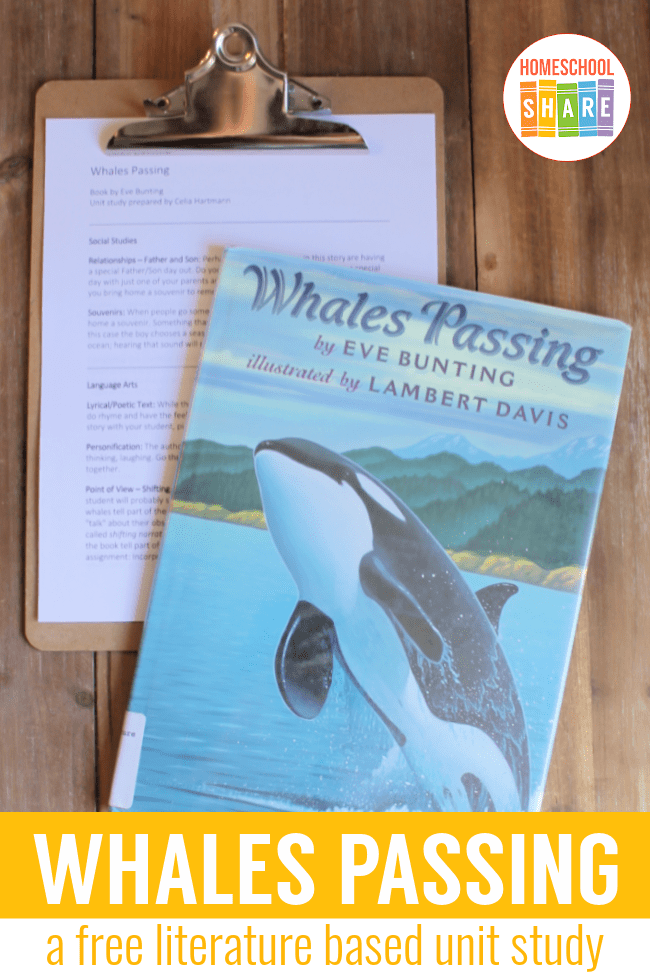
Whales Passing
|
Unit written by: Celia H.
Author: Eve Bunting
Illustrator: Lambert Davis
Summary: A boy and his father observes a pod of
orca whales....and the whales observe the boy.
ISBN: 0-590-60358-2
|
Social Studies
Geography: The story’s location is not revealed. I would place on Whidbey Island, Washington, in honor of a friend who lives there who can sit on her deck and watch the whales go by. You may wish to choose Alaska or even just one of the oceans. Make a story disk (an orca whale and a boy with a red shirt and sky blue shorts?), find the location you are using on a map/globe, and place the disk. If desired, have the student color a map/flag for your location. You could also allow this story to be a springboard for studying the four different oceans (Indian, Artic, Atlantic, Pacific). Learn about different whales and which ocean(s) they are found.
Relationships – Father and Son: Perhaps the father and son in this story are having a special Father/Son day out. Do you remember a time when you spent a special day with just one of your parents and with no siblings? What made it special? Did you bring home a souvenir to remember the day? (See next section.)
Souvenirs: When people go someplace special, like a vacation, it is tradition to take home a souvenir. Something that will remind the person of where they were. In this case the boy choose a seashell that would allow him to hear the sound of the ocean....hearing that sound will remind him of seeing the whales.
Language Arts
Lyrical/Poetic Text: While the story does not follow a rhyming scheme, several lines do rhyme and have the feel of reading poetry or of singing a song. Go through the story with your student, picking out examples together.
Personification: The author choose to give human qualities to the orcas....talking, thinking, laughing. Go through the story with your student, picking out examples together.
Point of View – Shifting Narrative: Ask your student who is telling the story. He/She will probably say the boy in the story. Praise him if he also says that the whales tell part of the story. If he/she doesn’t remember that the whales also "talk" about their observations of the boy, remind him. This shift in viewpoints is called shifting narrative, a fancy name that really just means different characters in the book tell part of the story from their viewpoint. Possible writing/narration assignment: Incorporate a shifting narrative in a story.
Vocabulary:
pod a group of whales that live and hunt and migrate together
surface to come up to the top of the water
spout the burst of spray from the blowhole of a whale
blubber the thick layer of fat between the skin and the muscle layers of whales
frolic to romp about playfully
Art
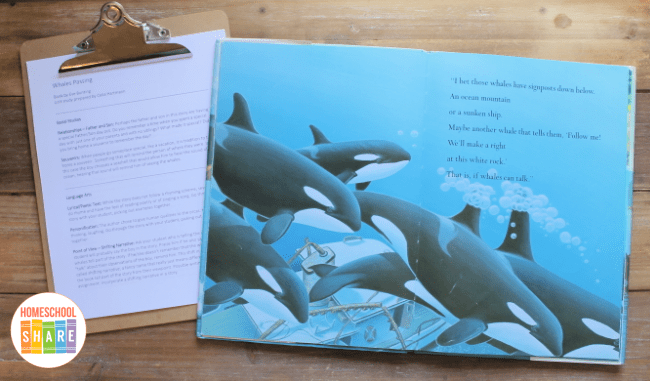
Cut-away View: Notice on the "surface, spout, and dive" pages that the view is half in and half out of the water...as a glass wall where in front of you and you were standing a little below the surface of the water. Compare with the "car-ee, car-ee" page...notice you cannot see the bodies of the orcas below the water’s surface.
Zooming In: Look at the title page of the book. Notice how it looks like you’re looking down on the scene from a low-flying airplane? Turn the page and it’s like you’re standing behind the father and son. Turn the page and it’s as if you are right beside them. Illustrator Lambert Davis drew very similar scenes three times....each time zooming in closer and closer to the father and son in the scene. (Praise your student if he/she recognizes that the artist does the reverse at the end of the story: the last two illustrations zoom out from the whales as they leave.)
Math
Count by Fives: On the pages where you can see all five of the whales, count by fives. I came up with 55 (including title page, but not including the cover pages since it is one of the pictures in the story). If you would like, use 11 nickels as a visual aid when you count to demonstrate the value of 5 (11 times).
Science
Orca Whales: Read the note at the back about Orcas, gleaning
facts to tell your child. A child should know that Orcas are often
called Killer Whales and that they are not really whales, but dolphins
(which are part of the whale family). They tend to travel in pods, which
are like families. A child should have a basic understanding of what a
blowhole and blubber is, and that orcas communicate by making sounds
under the water. Color an orca whale. For further exploration, research
and discuss the two types of whales: toothed (Odontoceti) and baleen (Mysticeti).
Orca Whale
Report Form with writing cues
Killer
Whale (Orca) Report Form (blank)
Migration: Why do orcas migrate? Where do they go and why? The colder parts of the oceans have more food in them, but newly-born calves of whales don’t have enough blubber to keep them warm. So, whales migrate to warmer areas to have their babies and then return to the colder waters to feed and build up their blubber. For further exploration, research and discuss what other animals migrate and why they migrate.
Echolocation: How do most mammals find their food? By using their eyes or nose. These organs are not very helpful in the water...sometimes the water is too dark or cloudy and you really can’t smell underwater. Orca whales use what is called echolocation to find food. Using their nose, they make sounds that move through the water. These sound waves will then "bounce off" of other animals and return to the orca, letting the orca visualize the object. Further exploration: research and discuss what other animals use echolocation.
Resources for teacher to glean info/find activities for student:
http://library.thinkquest.org/3926/main.html
http://library.thinkquest.org/3926/coloring.html
http://www.acsonline.org/factpack/KillerWhale.htm
http://www.adfg.state.ak.us/pubs/notebook/marine/orca.php
http://www.omplace.com/omsites/discover/ORCA/orcag.html
Whales and Dolphins by Petra Deimer (note: minimal Evolution)
Baby Whales Drink Milk (Let’s Read and Find Out Science, Level 1) by Barbara Juster Ebensen (and illus. by Lambert Davis!)
Whales by Gail Gibbons
p. 85 - 89 Evan-Moor Giant Science Resource Book
p. 104-105 DK Big Book of Knowledge
Observation:
Bible / Character Development
Genesis 1:28b God gave man "dominion over the fish of the sea, over the birds of the air, and over every living thing that moves on the earth." It is our responsibility to care for our earth and the creatures in it by being good stewards.
Jonah
Just for Fun
Seashell: Put a large seashell to the ear and listen....what do you hear? Is it really the ocean? No, it’s the amplification of the sound of your blood as it goes through your veins.
Field Trip: Visit an aquarium or SeaWorld. Bring home a souvenir!
Adopt-A-Whale: Google for "orca adoption" and choose one to adopt. May want to do this well in advance of rowing, so you and your child can go over the packet and see the orca you adopted.
Music: Find a recording of whales "talking" and listen.
Movie Tie-ins: Free Willy and Veggie Tales’ Jonah
Orca Whale Spot the Difference Print-outPossible bunny trails to explore:
Ship-wrecks
Icebergs
Pelicans
Are you a mom with daughters? (I am!) Try the mom/daughter’s morning out book: Swimming with Dolphins by Lambert Davis!
Materials and information on this website belong to the
original composers. It may be used for your own personal and school use.
Material may not be used for resale.
© 2005-07 HSS