Google
 
Whales Animal Study & Lapbook

Whales Animal Study & Lapbook
Created by Kristina Johnson


Lapbook Templates

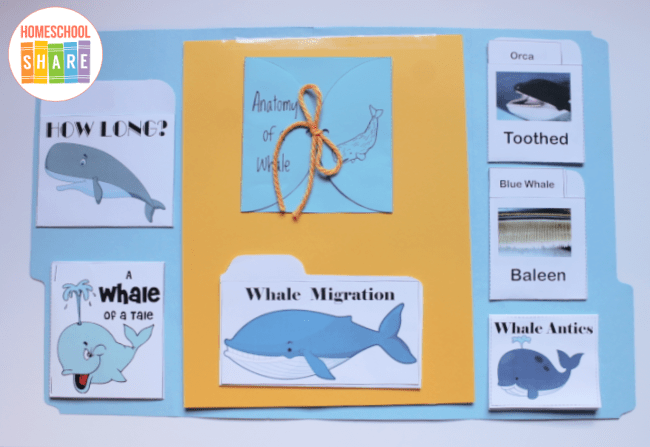
Cover Page
 
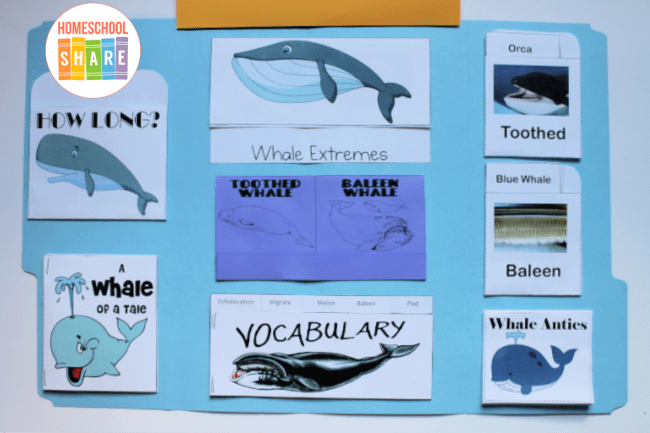
How Long? Pocket
 
Whale Booklist
 
Whale Antics T-book
 
Anatomy Shuttertied
 
Compare & Contrast Matchbook
 
Whale of a Tale Booklet
 
Lessons from Jonah Accordion
 
Whale Extremes
 
Vocabulary Tab
 
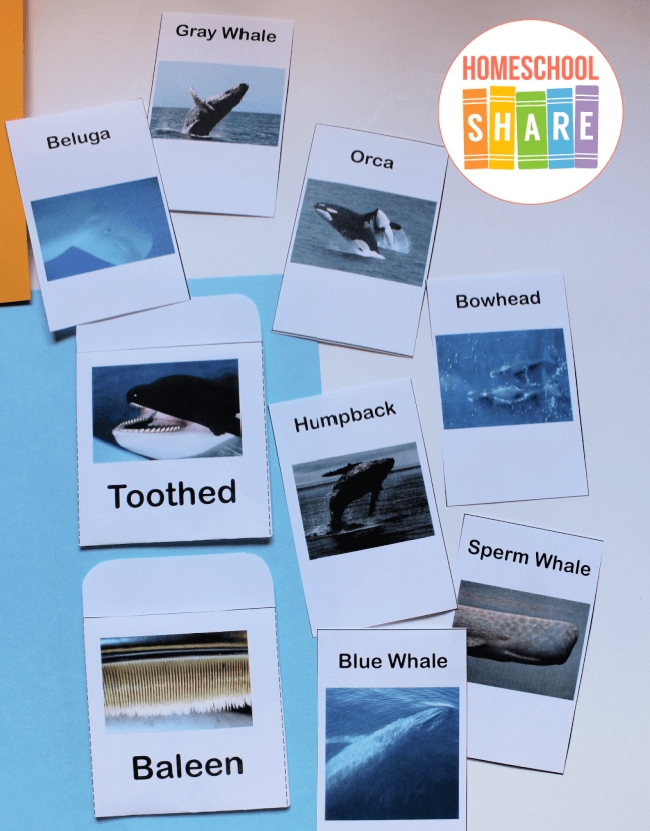
Whale Cards & Pocket
 
All About Blubber
 
Classification Petal Book Migration Map  

Research

Introduction
Whales are not fish. They are mammals.  Like all mammals, they are born live, breathe air, have hair, have a 4 chambered heart, are warm blooded, and have mammary glands for nursing their young. 

There are two types of whales, toothed (odonteceti) and baleen (mysticeti).  Dolphins and porpoises are part of the whale Cetacea class. 

Toothed Whales
Toothed whales are carnivores and the top predator in the ocean.  The male is slightly larger than the female.  They have teeth and eat marine animals and seabirds.  Some also eat other kinds of whales. Sperm, orca (killer) and beluga whales are all toothed whales.   

Like a bat, toothed whales use echolocation to navigate the waters.  It sends out a series of clicks (train) that bounces off an object and returns to the whale.  The train is passed through the melon (fat-filled organ in the head), bounces off an object and then echoes it back to the whale.  The whale then receives the “echo” in the fatty part of it’s lower jaw.  It then travels through the bone to the ear and brain.

Baleen Whales
Baleen whales are the largest species of whale and include the humpback, gray and bowhead whales.  The female is larger than the male.  They are carnivores and seasonal feeders.

This kind of whale has a structure in the upper jaw known as baleen that is similar to a sieve.  It is made of long, fringed blades of keratin (the same material that makes up our fingernails and hair).  Each blade overlaps the other and resembles thick, plastic hair.  They use this to filter plankton (such as krill and other small fish) from the water.  Before the use of plastic, whale baleen was used to make corset stays and combs.

Classification

Toothed whales:

Kingdom: Animalia
Phylum: Chordata
Subphylum: Vertebrata
Class: Mammalia
Order: Cetacea
Suborder: Odonteceti

Baleen whales:

Kingdom: Animalia
Phylum: Chordata
Subphylum: Vertebrata
Class: Mammalia
Order: Cetacea
Suborder: Mysticeti

There are 76 cetacean species.  For a complete list and further classification, please visit this website.

Anatomy
Baleen whales are larger than toothed whales.

All whales have:

Some Baleen whales have deep throat grooves that are used for filtering food.  These extend from the throat to the flippers.  The blue whale and humpback whale have these grooves. 

Reproduction
Whales usually breed in warm, tropical waters.  The new born whale is called a calf.  A female will have one calf every 1-3 years.  The gestational time varies from 9-18 months.  Within seconds of birth, the mother whale helps the calf, using her flippers, to swim to the surface for its first breath.  The newborn calf is 25 feet long and weights 6-8 tons. A calf drinks 50 gallons of milk from it’s mother each day.  A calf is cared for by it’s mother for at least a year.

Swimming
Whales swim by moving their fluke up and down (rather than left to right as a fish).

Whales also often do the following:


Migration
Many whales, especially baleen whales, migrate each year.  They travel in groups from cold water where they feed to warmer waters where they breed.

Sperm Whale
The largest toothed whale is the sperm whale at 50-60 feet.  It has the largest brain (20 pounds) of any animal.  The sperm whale gets its name from the valuable oil (wax) that it produces in the spermaceti organ in it’s head.  Sperm whales live in pods and have a strong “family” bond.  They protect their young, sick and injured.   They have a large box shaped head that is 1/3 of its total length.  Their skin is knobby and prune-like.  They are grey in color.  They can be found in the deep, off shore waters of most oceans and the Mediterranean Sea.  The famed Moby Dick was a sperm whale.

Orca
The Orca, a toothed whale, needs to eat hundreds of pounds of food each day.  They are skilled hunters and hunt in pods to attack prey.  They can swim over 30 mph in bursts in order to catch their prey.  This killer whale belongs to the family of dolphins.  They are between 27-33 feet long and are the largest member of the dolphin family.  They are black with white patches.  Like the sperm whale, orcas live in close-knit pods; caring for their young and sick.  They can be found in all of the world’s oceans and most of the seas.

Beluga
The Beluga, “white one”, is a white, small, toothed whale.  They are smaller than most toothed whales and larger than most dolphins.  They grow to about 15 feet and weigh 3300 pounds.  They have a small, blunt head and well defined neck.  Their life expectancy is 50 years.  They are very sociable and live in pods that number in the thousands.  They tend to move from pod to pod.  The relationship between mother and calf is strong.  Calves often nurse for as long as 2 years and even when fully grown, will often return to the same summer grounds as their mother.  They live in the Arctic and sub-arctic waters along the coasts of Alaska, Canada, Greenland and Russia.  They migrate to their summer grounds in spring and mothers usually return to the same site each year.  As their homes become clogged with ice in the fall, some will migrate in the direction of the ice-pack, staying close to it’s edge for the winter months.  Some will stay and find pickets of air trapped under the ice.  Their highly adapted echolocation capabilities help them to sense open water.  Belugas were the first whale species to be brought into captivity and are one of the few whale species still kept at aquariums across North America. 

Blue Whale
The Blue whale is the largest baleen whale.  They are live close to the surface of the ocean and are found in all of the world’s oceans. They can get as long as 110 feet, but most are between 80-90 feet.  (This is approximately the same distance from home to 1st base in professional baseball.   50 people could stand on it’s tongue and it’s heart is the same size as a Volkswagen bug.) Blue whales are also the loudest animal on earth, reaching 188 decibels.  Blue whales live near the surface in all oceans of the world. They have a life expectancy of 35-40 years. 

The Humpback
The Humpback, a baleen whale, “sings” by making a series of noises such as squeaks, shrieks, moans and grunts.  Their song can last upwards of 30 minutes.  They are white, gray, black or mottled in color.  They have a patch of white on the underside of their fluke that is unique to each whale (like our fingerprint).  They have the largest flippers of any whale.  They live in pods and cooperate in hunting, but do not form tight knit pods as blue whales do.  There is a strong bond between mother and calf though.  They are 52 feet long and weigh 30-40 tons.  They live at the surface of the ocean, both in the open ocean and the shallow waters of the coastline. 

Humpbacks use a method of hunting called bubble-net feeing.  The members of the pod form a circle, then blow a wall of bubbles as they swim to the surface in a spiral path.  The wall of bubbles traps krill, plankton and small fish, forcing them to move to the surface of the water. 

To hear a humpback song, visit this website.

The Gray Whale
The Gray whale, a baleen whale, migrates from the Arctic Ocean northwest of Alaska to the Pacific Ocean off the coast of Baja, Mexico.  They stay close to the coast and travel 12, 500 miles (round trip) each year.  During their migration, they swim day and night, not sleeping.  They are gray in color with blotchy white spots and average 45-50 feet.  They live in small pods of 3-16 whales.  Killer whales, sharks and humans are their predators.

The Bowhead
The Bowhead whale is usually black with a white spot on the lower snout. They grow to be about 50-60 feet.  It has the longest baleen, 350 pairs of black plates with silver bristles hanging from the jaw.  The baleen plates are 4.5 m long and 36 cm wide.  They are skimmers, swimming slowly with their mouth open, constantly eating.  They live only in the Arctic at the surface of the ocean. 

Bible Application
Take time to read the book of Jonah.   Discuss the miraculous nature of Jonah’s survival in the belly of the big fish.  

Library List
Humphrey the Lost Whale: A True Story, Wendy Tokuda and Richard Hall

Whalewhatch, June Brehens

The Life Cycle of a Whale, Paula Z. Hogan

Whales, Gail Gibbons

Symphony of Whales, Steve Shuch

Amazing Whales (An I Can Read Book), Sarah L. Thomson

Baby Whales Drink Milk

Whales the Gentle Giants, Joyce Milton

Winter Whale, Joanne Ryder

I Can Read About Whales and Dolphins, JJ Anderson

Baby Whale Rescue the True Story of JJ, Caroline Arnold and Richard Hewett


Materials and information on this website belong to the original composers. It may be used for your own personal and school use. 

Material may not be used for resale © 2005-07 HSS