Meeting Trees Free Unit Study
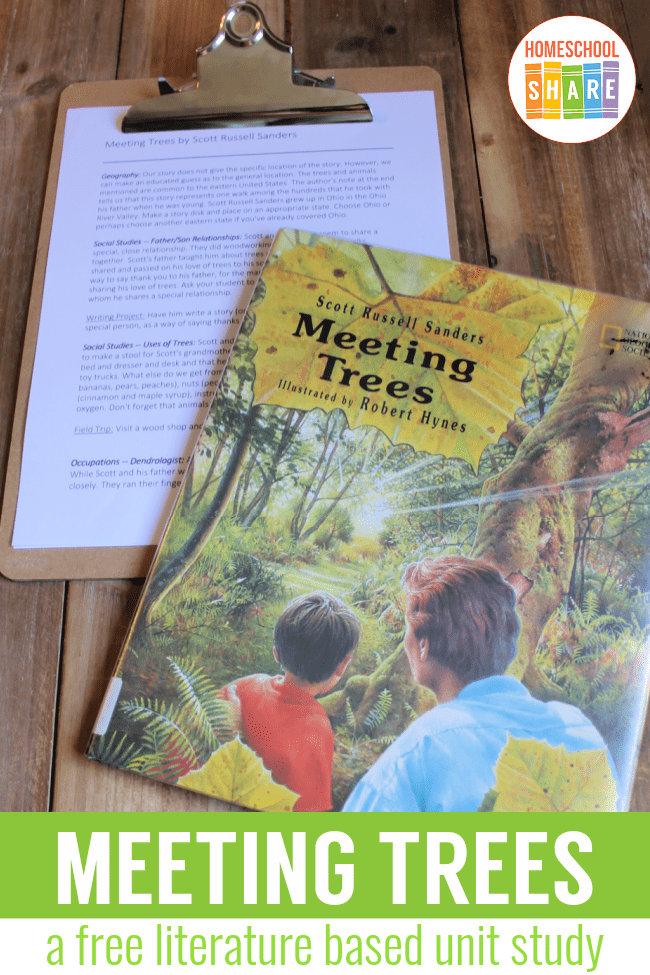
Meeting Trees
|
|
Author: Scott Russell Sanders
Illustrator: Robert Hynes
ISBN: 0792241401
Summary: As a boy and his father walk in the woods near their home, they share
what they know about the bark, leaves, and fruit of the different species they
see. |
A literature-based unit study by: Celia
L. Hartmann and Ami Brainerd
This unit would also be good to do during the week your state celebrates Arbor
Day.
Find out when your
state celebrates Arbor Day

A Homeschool Share Family Meeting a Tree!
Geography: Our story
does not give the specific location of the story. However, we can make an
educated guess as to the general location. The trees and animals mentioned are
common to the eastern United States. The author's note at the end tells us
that this story represents one walk among the hundreds that he took with his
father when he was young. Scott Russell Sanders grew up in Ohio in the Ohio
River Valley. Make a story disk and place on an appropriate state. Choose Ohio
or perhaps choose another eastern state if you've already covered Ohio.
Social Studies -- Father/Son
Relationships: Scott and his father seem to share a special, close
relationship. They did woodworking together and took walks together. Scott's
father taught him about trees and played games with him. He shared and passed
on his love of trees to his son. The author wrote this story as a way to say
thank you to his father, for the many walks they took together and for sharing
his love of trees. Ask your student to tell you about a person in his life
with whom he shares a special relationship.
Writing Project: Have him
write a story (or narrate for you to write) to give to that special person, as a
way of saying thanks for that person's time and love.
Social Studies
-- Uses of Trees: Scott and his father used a board from a walnut
tree to make a stool for Scott's grandmother. Scott mentioned that his father
made his bed and dresser and desk and that he also made his tree house and some
wooden toy trucks. What else do we get from trees? We get paper, fruit
(apples, cherries, bananas, pears, peaches), nuts (pecans, walnuts, almonds),
spices and flavorings (cinnamon and maple syrup), instruments (guitars, violins,
woodwinds), shade, oxygen. Don't forget that animals get homes!
Field Trip: Visit a wood shop
and a lumber company.
Use this website to guess which things come from wood:
http://www.freenetwork.org/kids/comes_from_trees.html
Occupations -- Dendrologist:
A scientist who studies trees is called a
dendrologist. While Scott and his father were not actual dendrologists,
they did study trees very closely. They ran their fingers over the bark,
traced the outline of the leaves, studied the nuts and fruits of the trees,
etc. By doing so, Scott and his father learned a great deal about trees. They
knew trees the same way they knew friends--"by
their character, their shapes and habits, by where and how they lived. All of
that knowledge added up to love." (From the author's note at the end.)
Tell your student he is going to be a Junior Dendrologist this week! Upon
completion of this unit study, you might wish to print out a
certificate for your Junior Dendrologist
(you will need the free
Adobe Reader to open this
file).
Language Arts -- Similes:
This story has many examples of
similes (use
like or
as or seems to describe.) Go
over several with your student. Point out how the similes can help him remember
which tree is which! Have him make up his own similes.
smooth gray bark
like the skin of a hippo
leaves shaped like tulips
patchy as an old quilt
willow leaves are like feathers
leaves of redbuds are like valentine
hearts
sassafras has leaves like mittens
sweetgum leaves look like zigzag
stars
leaves of white oaks curve up and down like
roller coasters
maple seeds come spinning down like
propellers
elm seeds skitter down like confetti
buckeye seeds turn shiny and brown like
the eyes of a deer
leaflets all lined up on their twigs like
cross-ties on a railroad track
Prepared Simile -
Crossword Puzzle
Language Arts -- Word
Choice: Mr. Sanders uses words like "birds
twittering, squirrels chattering, and wind whooshing" .... "minnows
flickering." Remember too the similes the author choose. The author's
choice of words really helps us visualize the scenes. Stories would be very
boring if we did not use strong words. Think about which sounds better: the
words the Mr. Sanders used or "birds singing, squirrels making noise, and wind
blowing." Which word choices help you visualize it? Help your child understand
that there are different ways of saying the same thing, and that some ways are
better, stronger, more precise.
Activity: Have your student
make better word choices for word walk.
Perhaps: meander, glide, saunter, amble. Now have him try the word
big or
said. Now have him use more precise words for the following sentence: The
small fish swam in the water. There are many possibilities,
but perhaps something like: The tiny fish
darted through the muddy creek. Have your student try other words or
other sentences, until he understands that using stronger words helps a reader
visualize better.
Similar activity: http://www.edina.k12.mn.us/concord/teacherlinks/sixtraits/wordactivity.htm
Writing Activity: Have your
student brainstorm to come up with some really good, strong word choices and
then have him use one or two in a sentence.
Websites:
List of some interesting words: http://www.edina.k12.mn.us/concord/teacherlinks/sixtraits/interestingwords.htm
Language Arts -- Poetry
Tie-in: Alfred
Joyce Kilmer (better known as Joyce Kilmer) was
an American poet who lived 100 years ago. Before he was killed in World War I,
he wrote a very famous poem entitled Trees.
Have your student write or memorize and then recite the poem.
Trees
- I think that I shall never see
- A poem lovely as a tree.
- A tree whose hungry mouth is prest
- Against the sweet earth's flowing
breast;
- A tree that looks at God all day,
- And lifts her leafy arms to pray;
- A tree that may in summer wear
- A nest of robins in her hair;
- Upon whose bosom snow has lain;
- Who intimately lives with rain.
- Poems are made by fools like me,
- But only God can make a tree.
With an older student, you may wish to discuss
anthropomorphism. Anthropomorphism is when a writer applies either
animal or human qualities to an inanimate object. In the case of the poem
Trees, Joyce Kilmer gave human qualities
to the tree. The tree has a mouth and hair, looks up at God, raises it's leafy
arms to pray, etc. Have your student write something using anthropomorphism.
(e.g. The craggy-faced mountain with the snow white hair looked down upon the
others.)
Art -- Nature Journal:
Give your student a sketchbook (or make one by three-hole punching copy paper
and putting a pretty cover on it and tying yarn through the holes). Let your
child draw different trees, leaves, fruit, and animals he sees. Let him study a
leaf, a twig, and a pinecone up close and draw it.
Art -- Bark & Leaf Rubbings:
Remove the paper from a couple of crayons (maybe brown for the bark and green
or fall colors for the leaves). Gather several sheets of plain white paper
(printer/copy paper works great). Have your student hold the paper onto a tree
and gently rub the crayon (lengthwise) over the left side of the paper. An
impression of the bark will come through. Next take a leaf from the same tree
and lay it under the right side of the same sheet of paper and do a leaf rubbing
in the same manner. Write the name of the tree on the paper with it's rubbings.
When possible, have the student include the similes used in the story. Repeat
with several trees....each on a separate sheet of paper. Punch the papers, make
a pretty cover, and tie yarn to hold it together to make a pretty tree book.
Math -- Circles,
Circumference, Diameter, and Pi
:
Gather supplies: paper, yarn, a drinking glass or similar object for a small
circle, a small butter bowl or similar object for a medium circle, and a large
butter tub or similar object for a large circle.
Ask your student to name the shape of a tree's trunk (circle). Tell your
student that today we're going to learn something very special about circles.
Draw a circle on the board. The circumference
of a circle is a measurement of the outside edge of the circle. If your student
has already learned about perimeter, tell him that circumference is like
perimeter, only we have a curved object and not a straight one. If we draw a
straight line across the middle of the circle, that is called the
diameter of a circle. Measuring the
diameter is easy because we can just use our ruler. But how are we going to
measure the circumference? Discuss ideas. Praise him if he comes up with the
idea laying a string/yarn around the circle.
Have your student carefully trace an upturned glass on a piece of paper. Help
him draw a line straight across the middle of the circle. Take a piece of yarn
and lay it around the edge (the circumference) of the drawn circle. Carefully
cut it to the correct size. Now take the cut yarn and lay it out flat. Have
your student measure it
on
this prepared worksheet. Now take another
piece of yarn and place it over the middle line (the diameter). Cut it
carefully and have your student measure and record that information.
Now have him take his diameter string and use it to measure the circumference
string he laid out. Have him note on his worksheet that it took a little more
than 3 diameter string lengths.
Now repeat the process two more times using the two butter bowls (medium and
large). Your student should have recorded on the worksheet that for each
circle, it took a little more than 3 diameter lengths to equal the
circumference.
Help him understand that no matter what size the circle is, that when you use
that circle's diameter, it will always take a little more than three diameters
to equal the circumference. Didn't God make circles special! How cool! When
man discovered this nifty little trick, he gave it funny name.....pi,
which is said just like the dessert we eat (pie). Write the pi symbol on the
board
and explain
that we use that symbol to represent a little more than 3.
Have him answer the question on the worksheet. (Answer: It always took the
same number of diameters to make the circumference, a little more than 3.) Have
him draw the
symbol
at the bottom and label it as pi.
With an older student (one who has been introduced to decimals already) you may
wish to explain that pi is a a number that, when carried out to 5 digits, stands
for 3.14159. Also discuss how the numbers after the decimal place NEVER
repeat!!! (That makes it an irrational number.)
Pi Day.org
claims that pi had been carried out (with the help of computers) to the 51
billionth place and it still does not
repeat!!! Wow! (More circumference and diameter math practice for the older
student can be found
at this site.)
Math go-along book: Sir
Cumference and the Dragon of Pi by Cindy Neuschwander (Highly
recommended!)
Websites concerning pi
:
Note: If you are doing this unit during
the time period that includes March 14th (3/14, 3-14, or 3.14), you may wish to
wish your student
Happy Pi Day and serve
him a little more than three rings (circles) of
pineapples for
breakfast, snack, or dessert!!! Could also serve any kind of
pie (if you make a
two-crusted pie, take out a bit of the crust dough and form it into the shape of
pi and place on the top crust before you bake it).
Health / Safety: Before
going out into the woods, be sure you and your child know how to identify
Poison Ivy, Poison Oak, and Poison Sumac. Poison Ivy generally has 3 leaves
and grows more in Eastern States. Its new growth is often tinged red and its
leaves turn red in fall. Poison Oak also has 3 leaves (which resemble an Oak
tree's leaves). It grows more in Western States. Poison Sumac has 7 to 13
leaves, each having a red vein. It likes to grow in swampy, wet areas. Another
plant,
Jewelweed, often grows
near Poison Ivy and the juices of it will help sooth your skin if you do get
Poison Ivy. So if you get into Poison Ivy, look around for
Jewelweed, open the
stems, and rub some of the juices on. Indians used it not only for Poison Ivy,
but also mosquito bites. It is also known as Touch-Me-Not. (You may wish to
pick several stems and place them in a freezer bag for later use.)
Also be sure your student knows not to put
Pokeweed berries in their
mouth!
From the FDA website:
Identification Please
Unfortunately,
poison ivy, oak and sumac don't grow with little picture ID badges around their
stems, so you have to know what to look for. The famous rule "leaves of three,
let it be" is good to follow, except that some of the plants don't always play
by the rules and have leaves in groups of five to nine. To avoid these plants
and their itchy consequences, here's what to look for.
Poison
Ivy
- grows around lakes and streams in the
Midwest and the East
- woody, ropelike vine, a trailing
shrub on the ground, or a free-standing shrub
- normally three leaflets (groups of
leaves all on the same small stem coming off the larger main stem), but may
vary from groups of three to nine
- leaves are green in the summer and
red in the fall
- yellow or green flowers and white
berries
Poison
Oak
- eastern (from New Jersey to Texas)
grows as a low shrub; western (along the Pacific coast) grows to 6-foot-tall
clumps or vines up to 30 feet long
- oak-like leaves, usually in clusters
of three
- clusters of yellow berries
Poison
Sumac
- grows in boggy areas, especially in
the Southeast
- rangy shrub up to 15 feet tall
- seven to 13 smooth-edged leaflets
- glossy pale yellow or cream-colored
berries
Learn the Poison Ivy Poem:
Leaves of three? Let it be! (Spring/Summer/Fall)
Berries white? Take flight! (Fall..note: Poison Ivy, Poison Oak,
&Poison Sumac all have whitish berries.)
A hairy rope? Don't be a dope! (Winter)
Links to pictures that will help you identify Poison Ivy,
Poison Oak, and Poison Sumac.
Another link to pictures and a quiz to test yourself.
Two myths about these plants......I've touched
it before and didn't break out, so I'm immune to it and It's
dead, so it's OK to touch. Neither statement is true. You can develop
an allergy to anything at anytime in your life. And the poison in these plants
can last up to 5 years, even if the plant itself is dead.
Science -- Woodland Animals:
Several are mentioned in the story. Here is a list:
Swallowtail Butterfly
Owls
Bats
Mice
Robin
Squirrels
Crayfish
Minnows
Argiope spider--black & yellow (We call them garden spiders
--see pictures!)
Deer
Luna Moth
Caterpillar (Note: two
different links, one to the moth and one to the caterpillar)
Cedar Waxwing (not mentioned in story but shown on page with the squirrel and
deer)
Have your student choose a couple animals that he is less familiar with to
research, draw/color, and learn more about.
Classification & Writing Activity: Have
your student classify and then write out the list of the animals mentioned in
the story in his best handwriting. Or, if you are keeping an index card file
for animal classification (as recommended in Five in a Row), add any animals not
currently on file. Use the cards to classify the animals from the story in
various ways.
Science -- Trees:
Several are mentioned in the story. Here is a list:
Walnut
Dogwood
Beech
Yellow Poplar
Shagbark Hickory
White Birch
Sycamore
Wild Cherry |
Willow
Redbud
Sassafras
Red Pine
White Pine
Sweetgum
White Oak
Maple |
Elm
Mulberry
Holly
Buckeye
Persimmon
Black Walnut
Northern Red Oak
Southern Red Oak |
Writing Activity: Make an
alphabetized list of those mentioned in the story. Or have the child use this
form to note where these trees would fall within a dictionary. Prepared
Worksheets--
Beginner;
Advanced.
Classification & Writing Activity:
Discuss with your student that just like animals, trees can also classified.
They are either an evergreen or a
broadleaf. Most evergreen trees--the
ones whose seeds are inside cones--are also known as
conifers. Evergreens do not have leaves
that drop each fall. Instead they usually have thin needles. Broadleaf trees
have flatter, wider leaves. And they usually have leaves that drop in the fall
and new ones that grow in the Spring. Trees that drop their leaves in the fall
are known as deciduous trees.
With an older student, you may wish to discuss
exogenous
and endogenous
tree classification.
Parts of a Tree:
The upper part of the tree is called the
crown or the
canopy.
The trunk is the main support for
the tree.
The branches (or
limbs) come out of the trunk.
The roots are usually underground
and are how the tree gets its food and water.
The bark is the outer protective
part of the trunk.
The inner bark (or
phloem) carries the food to the
other parts of the tree.
The cambian is a single layer of
living cells between the inner bark and the sapwood. The cambian makes the
inner bark and the sapwood.
The sapwood is between the cambian
and the heartwood. Each year, the cambian makes a new layer of sapwood and
this is what makes the rings that we count to get the age of a tree. The
sapwood carries water and some nutrients to the tree.
The innermost part of a tree is called the
heartwood. It is the core of tree. It is old, dead sapwood and it
is very strong.
Worksheet to label the parts of a tree
Interactive tree to learn more about the parts of a tree:
Crossword puzzle
Identification Activity: Discuss
with your child about how we identify trees. We use the bark of the tree, the
shapes of the leaves, the fruit they give, etc. to help us figure out the kind
of tree we are looking at. Go for a walk in the woods and "meet trees." Study
the bark. Look at the leaves. Is there any fruit? Use these to help you
identify the tree. Take along the storybook or a field guide. Or come back
and use one of these websites to help you identify.
If you can, go out into the woods several times, until you can play the same
game that Scott and his father played (asking your student to find a particular
tree by describing something about it.) Remember to use some of the similes
from the story! Do this during different seasons as well.
One thing I like to do is collect a nice specimen of various kinds of leaves.
Snip off any stems. Take these somewhere to be laminated. This is especially
nice if you can use the thicker laminating plastic. Cut around the shape of the
leaf, but leave a decent edge so as not to have any open air pockets. Then use
a Sharpie and write the name of each tree on each leaf. They can then be used
like flash cards to help your child learn to identify by leaves. My laminated
leaves are two years old now and still holding up well!
Field Trip: Go to a Nature
Center or an Arboretum and have a guide tell you about the different trees and
how to identify them.
Websites:
Bible
There are
many trees mentioned in the Bible. Choose one or two to discuss with your
child.
The Tree
of the Knowledge of Good and Evil: Read Chapters 2 and 3 of Genesis.
This tree was in the middle of the Garden of Eden, from which it was
forbidden of Adam and Eve to eat.
The Tree of Life: Mentioned in
Genesis 2:9 and Rev. 22. The fruit of this tree gives everlasting life.
Cedars of Lebanon: Mentioned over
70 times in the Bible.
Tree of Jesse: The family tree of
Jesus. (If you do a Jesse Tree for Advent, discuss it now.)
"The Tree" another name for The
Cross of Calvary. (Acts 13:29, 1 Peter 2:24)
Have your older student research one of these Biblical trees further and write
about he has learned.
Memory verse:
Psalm 1: 1-3
Blessed is the man
that walketh not in the counsel of the ungodly,
nor standeth in the way of sinners,
nor sitteth in the seat of the scornful.
But his delight is in the law of the LORD;
and in his law doth he meditate day and night.
And he shall be like a tree planted by the rivers of water,
that bringeth forth his fruit in his season;
his leaf also shall not wither;
and whatsoever he doeth shall prosper.
Singing Hills and Mountains and
Clapping Trees?!?: Did you know that the Bible mentions a time when the
trees will clap and the hills and mountains will sing!?! Read Isaiah 55:12.
For ye shall go out with joy,
and be led forth with peace:
the mountains and the hills shall break forth
before you into singing,
and all the trees of the field shall clap their hands.
Songs to Sing:
Tree of Life by Fannie
Crosby or
Trees of the Field (You
Shall Go Out With Joy) based on Isaiah
55:12 by Rubin & Dauerman
Other Ideas and More Resources
Craft -- Make a Twig Frame:
See samples/instructions at:
http://www.enchantedlearning.com/crafts/frames/twig/index.shtml
http://www.ci.tacoma.wa.us/envirokids/Projects/twig_frame.htm
http://fun.familyeducation.com/childrens-art-activities/crafts/35191.html
Leaf Paintings: You can
choose to put leaves down on a paper and the splatter paint over and around it,
so that when you carefully take the leaves off you have an outline of the leaf
in white (or whatever color your paper is). Or you can put the paint directly
on the leaf and place it on the paper and when you carefully take the leaf off,
you have an colored leaf shape. When my youngest was in preschool, they painted
the leaves and placed them on a white t-shirt and then splatter painted around
them. When that was dry, they used a Sharpie and wrote the names of each tree
on their leaves. They also did the back of the t-shirt. This could a be fun
end-of-unit activity...and a great souvenir for your unit!

Edible Forest Plants: Discuss
edible forest plants and use some in cooking. Enjoy some sassafras tea or make
a hickory nut cake. Here's a link to some edible plants and recipes: http://www.ohiodnr.com/parks/explore/brochures/wildedibles.htm
Plant a tree seedling! Arbor
Day is the last Friday of April, but you can plant one anytime except winter
(though the best time is Spring and Fall)
Arbor Day Crafts at
Enchanted Learning
In the Hands of a Child Plants Pack
Join the National Arbor Day Foundation!
State Trees: Each state has
it's own special tree. Have your student make a list of states he likes and
look up and write down what each state's tree is.
Websites:
Play some on-line Games
Dictionary Skills
Fun activities, songs, and games
More Ideas from the Arbor Day
Foundation
More crafts
More Tree Math: Have your older
student research to learn how a tree's age can be determined without cutting it
down and counting the rings (hint: use the tree's diameter.) Also have him
research to learn how the height of a tree can be found without climbing the
tree and sending a tape measure down to the ground (hint: shadows or yardsticks
or hypsometer).
Library Lists
Go Along Books for this week:
Tell Me, Tree: All About Trees for
Kids by Gail Gibbons
Have You Seen Trees? by Joanne
Oppenheim
Old Elm Speaks: Tree Poems by
Kristine O'Connell George
Trees by Harry Behn
I Have a Tree by Lillie D. Chaffin
A Tree is Growing by Arthur Dorros
Sky Tree by Thomas Locker
Trees by Jonathan Pine
A Tree is Nice by Janice May Udry (Caldecott Award)
Be a Friend to Trees by Patricia Lauber (Let's Read
and Find Out Science)
When
God Made the Tree by Virginia Kroll
Reference books you may wish to have on hand for
this week:
National Geographic Field Guide to the
Trees of North America by Keith Rushforth and Charles Hollis
Trees: North American Trees Identified by
Leaf, Bark, and Seed (Fandex Guide) by Steven M. L. Aronson
Crinkleroot's Guide to Knowing the Trees
by Jim Arnosky
Forest Explorer: A Life-Size Field Guide
by Nic Bishop
WoodsWalk: Peepers, Porcupines, &
Exploding Puffballs: What You'll See, Hear, & Smell when exploring the Woods.
by Henry W. Art and Michael W. Robbins
In the Woods: Exploring, Discovering,
Observing, Playing, Crafts (See, Make and Do Series) by Pamela Hickman
(pp. 14-17 go well with this story.)
Handbook of Nature-Study by Anna
Comstock
A Walker's Companion by Elizabeth
Ferber, et al. (This is an excellent guide for amateur naturalists that help
you know what to look for. Great for any season and
any location!)
The Easy Tree Guide: Common Native and
Cultivated Trees of the United States and Canada by Keith Rushforth
For additional tree activities, try these books:
Talking to Fireflies, Shrinking the Moon:
Nature Activities for All Ages by Edward Duensing (this book is more
for the parents, the author "reminds us that something always watches you when
you walk in the woods--you just need to know where, and how, to look.")
The Kids Nature Book: 365 Indoor/Outdoor
Activities and Experiences (a Williamson Kids Can book) by Susan Milord.
(One nature-related activity for each day of the year! Most involve no or very
little cost.)
Miscellaneous
If you have time (at least one
month prior to rowing this book), go to
http://order.iplifeoftheforest.com/
and order the Classroom Kit (use the extra booklets for a co-op rowing of
Meeting Trees or to give to friends).
It is a very nice kit! Celia highly recommends it. Or you can
download them at (But I imagine this would take a lot of ink!)
Parents: You may also wish to learn more about tree identification. Try
a four day e-course that arrives in your inbox
Opening and Closing Pinecones contributed by Jen Unsell
pinecone
oven preheated to 250 degrees
Bucket of cold water
Place the pinecone in the bucket of cold water. Check your pinecone in an hour. Has it made any changes? Record what you observe on a sheet.
Place the pinecone in an oven that has been preheated to 250. Check your pinecone in an hour. Has it made any changes?
Record what you observe. If you find a seed deep inside your pinecone, why not plant it and grow a tree inside?
Materials and information on this website belong to the
original composers. It may be used for your own personal and school use.
Material may not be used for resale.
© 2005-07 HSS