| about us |
what's new
|
unit studies
|
unit study helps |
hss resources
|
fiar resources | indexes | lapbooking |

Books Used
Leaf Man by Lois Ehlert
Red Leaf, Yellow Leaf by Lois Ehlert
Fun With Nature by Mel Boring (or another tree/leaf guide)
Library List
We're Going on a Leaf Hunt
When Autumn Comes by Robert Maas
Why Do Leaves Change Color? by Betsy Maestro
Autumn Leaves by Ken Robbins
Look What I Did With A Leaf by Morteza E. Sohi
SCIENCE
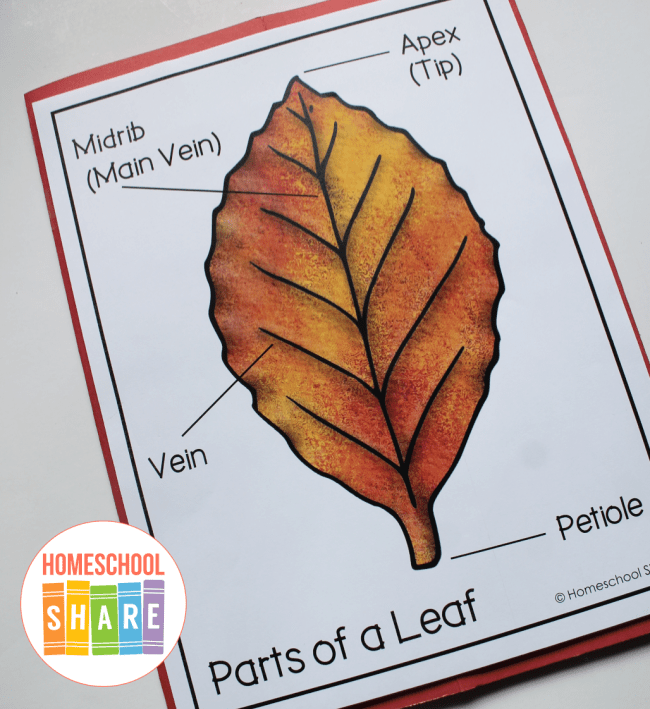
Leaf Diagram
Bring a few leaves in from outside. Have your student draw a
picture of the leaf (you may need to help add the details) attached to a stem.
Label the leaf with the following terms:
petiole - a leaf stalk; it attaches the
leaf to the plant
leaf apex - the outer end (tip) of a leaf; the end that is opposite the petiole.
midrib - the central rib of a leaf - it is usually in the center and continuous
with the petiole.
vein - one of the many vascular structures on a leaf. Veins provide supports for
the leaf and transport both water and food through the leaf.
lamina- the actual leaf (blade)
stem - (also called the axis) the main support of the plant.
stipule - the small, paired appendages (sometimes leaf-life) that are found at
the base of the petiole of leaves of many flowering plants.
Prepared Labeled Diagram (does not
include stem or stipule)
Smaller Version-- unlabeled
(to include in your lapbook)
Leaf Identification/Collection
Go outside with Fun
With Nature in hand and see how many different trees you can identify (use
their leaves to identify them). You may want to keep your leaves and make
a collection (include common names as well as scientific names). If
you don't want to store leaves, you can make a leaf rubbing of each leaf and
then add the names for the leaf; another idea would be to take photos of your
leaves and paste them into your book after you print your pictures.
Learn the names of different
types of leaves-- Play this Leaf
Concentration Game
Leaf Margins
The shape of the edge or margin of a leaf is another way it can be
identified. Margin is the term used to describe the edge of the
leaf; there are three basic kinds of leaf margins:
entire - having a smooth edge with neither teeth nor lobes.
lobed - divided into rounded or pointed sections and the incisions (cuts) go
less than halfway to the midrib.
toothed - having small, pointy teeth that point toward the tip of the leaf.
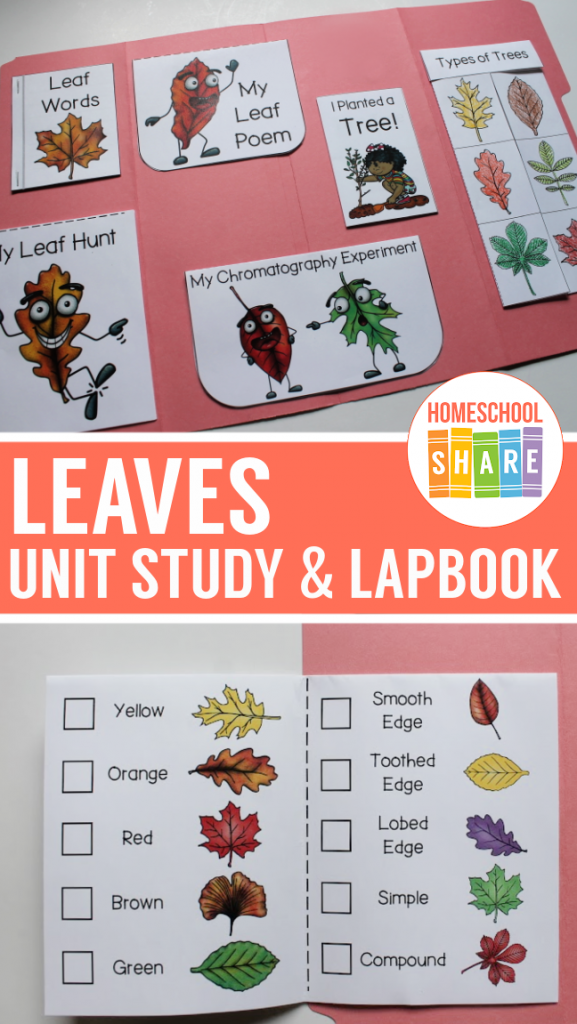
Leaf Margin Tri-fold book for your lapbook
Your older student may wan to learn more about other margin sub-classifications.
Check out this website for more information
Note: it seems that there are many different classifications for leaf
margins. Websites that I've used for this research are edu sites, but they
aren't consistent with one another. I think the important thing for your
younger student to learn from this lesson is that leaves can be classified into
margins (not that they memorize every type of margin there is); for your older
student to use observation and classification skills.
Why Leaves Change Color
First, explain to your student that there are two types of trees. The
first type is evergreen; they have green needles all winter long. The
second type is deciduous which "change" their leaf colors in preparation for
winter. It appears that leaves are changing colors, but really they
aren't!
Each leaf has millions of tiny packages of chlorophyll, xanthophyll, and
carotene. Chlorophyll is green; xanthophyll is yellow; carotene is orange.
In the summer time, the green chlorophyll packages are busy catching sunlight
and using energy, they change water from the ground and carbon dioxide (a gas in
the air that they need to survive) into glucose (sugar). This
process is called photosynthesis and provides the tree with food (the
glucose/sugar).
During the summer, the green chlorophyll packages continue to produce food for
the tree. They are able to do this since they are able to get the water
they need to do their job. The water goes up the tree's roots, on up the
trunk, and enters little tubes in the leaf's stem. Because these
green packages are able to get water and keep busy, the green color dominates
the other colors.
In the fall, the weather gets colder signaling to the tree that it is time to
prepare for winter. A thin layer (of cells) grows over the tubes in the
leaves and closes them up for winter-- they are no longer able to get water--
and that means they stop producing the food for the tree. The green
chlorophyll starts to disappear and the true color of the leaf-- the yellow and
orange, are able to be seen.
Red and purple leaves have a different explanation. Some trees have sap.
The sap in the trees uses the same tubes to travel through the tree that water
uses. When the thin layer of cells grows over the water tubes, the sap is
trapped. When it gets trapped in a leaf, it may cause the sap to turn red
or purple, so the leaf turns that color as well.
Experiment-- Using chromatography, your student will be able to see the
colors always present in a leaf
Supplies Needed
Variety of fall leaves
Fresh Spinach or Beet Leaves
Porcelain or Stoneware coffee mugs
Smooth, round rocks
Spoons
Fingernail Polish Remover (acetone)
Scissors
Coffee Filter
Q-tip
Clear Plastic Cup
Tape
Ruler
Pencil
Chromatography is a process scientists use to separate materials that are
different.
Procedure:
1. After the science lesson, ask your student if the color is on the outside of
the leaf or on the inside (the inside).
2. In order to see the color, ask your student to break up the leaves and use
the stone to grind the leaves into smaller pieces (use the mug for this).
3. Add a spoonful of acetone (polish remover) to the mug. Keep squishing
the leaf until the liquid has gained some color from the spinach.
4. Let the mix sit for 1-2 minutes. While you are waiting, cut a coffee
filter into a rectangle (about 2" by 8"). Let your student use the
q-tip to pick up a drop of the colored liquid from the leaf grinding and place
one drop one inch from the end of the filter rectangle.
5. Let the drop dry.
6. Then, use the q-tip again to add a few more (2-3) drops to the same
spot. Let each drop dry before adding the next drop.
7. Put 1/4 cup of the alcohol in the clear plastic cup.
8. Carefully put the end of the filter paper strip-- the end with the
drops on it-- into the cup, but DO NOT let the colored drop touch
the alcohol.
9. Put paperclips on the filter to secure strips to the side of the cup.
The alcohol will travel up the filter paper, separating the different colors in
the leaf (this takes about an hour or longer, so you will want to move on to
another subject while waiting).
10. When the color has stopped moving, remove the paper from the alcohol,
let it dry, and observe the different colors that were in the leaves.
Lifecycle of a Maple Tree (this goes with Red Leaf, Yellow Leaf)
Go on a nature walk (note: take a measuring tape along with you). Try to
find a maple seed, a maple seedling, a maple sapling, a pole, and a mature tree.
If your student is young, take a camera and photograph each stage that you can
find. When you develop the pictures, make a minit book on the lifecycle of
the maple tree. If your student is old enough to draw in a nature journal
(and you don't want to do the photography option), allow him to draw pictures of
the maple tree in each stage.
As
you measure trees together, explain to your student what diameter and
circumference are. The diameter is the distance across the center of a circle.
The circumference is the distance around the circle.
Seed
Seedling: the above-ground part of the embryo that sprouts from the seed
Sapling: After the seedling reaches 3 feet (1 m), and until it
reaches 3 inches (7 cm) in stem diameter
Pole: Trees from 3-12 inches in diameter (7–30 cm)
Mature tree: over 1 foot in diameter (over 30 cm), reproductive years
begin
Leaf and Tree Vocabulary
After you read Red Leaf, Yellow Leaf, read through the information
provided by Ehlert on the final four pages. As you read, you may want to
make a list of new words with your student. Take time to write
definitions, too. Review these frequently throughout this unit.
Prepared Vocabulary Pocket (with blank
cards)
Suggested Word List:
chlorophyll
photosynthesis
pigments
sap
buds
roots
bark
wrapping
staking
dormant
What other words have you encountered this week that are new words? Add
them to your list as well.
vein
evergreen
deciduous
Plant a Tree! (this goes with Red Leaf, Yellow Leaf)
Field trip time! Visit a nursery. Observe the different trees.
Let your student choose a tree to buy, take home, and plant. (Lois Ehlert
gives good information about planting trees, but be sure and ask the workers at
the nursery lots of questions, too!). You may want to let your
student measure it each year and record it's growth in the same spot.
Social Studies
Cardinal Directions
(this goes with Leaf Man only)
The wind blows
the leaf man in every direction - north, south, east, and west. These directions
are called cardinal points. Have your child look for the compass rose on a map
and locate the cardinal points. An easy way to remember the points is to look at
the letters going clockwise and remember this ditty: Never Eat Shredded Wheat.
Activity:
Draw a simple compass rose (N, S, E, W) in the middle of a poster board or
large piece of paper. Then add the details from the story. If your
student isn't writing yet on his own, you could write the words for him.
next to east
write -- "past the chickens"
draw-- chickens
next to south
write-- "following butterflies"
draw-- butterflies
next to north
write-- "above leaves that look like him"
draw-- leaves
next to west
write-- "above the orchards"
draw-- fruit trees
Art
Mock Illustrations
Go on a leaf hunt. Make color copies of your leaves with a photo
copier or scanner/printer. Cut them out and use them to make animals and
leaf men like Lois Ehlert did in her story. What other unusual media
can your student use to make a picture? Sometimes artists use things other
than traditional paint, crayon, colored pencils, etc. Let your
student use unusual media to create a picture (fabric, buttons, yarn,
wallpaper, foil, twine, or ?)
Four Seasons Sugar Maple Tree (Science Connection) (this goes with
Red Leaf, Yellow Leaf)
You need four pieces of paper for this project; you could also use a piece of
poster board if you want to display it in your classroom.
Look at the pages in the book where the speaker tells you about his tree through
the seasons. Discuss. Tell your student that she is going to draw a
tree and illustrate what it would look like in each season. Note:
I tried to give some suggestions for each tree, but don't let me stifle your (or
your student's) creativity! If you think of something you want to do
instead, feel free!
Winter: Bare branches. Paint the branches with a water-glue mixture
(to create an icy look). If you want to add some "snow" try white
glitter (sprinkle on before the glue/water paint dries. Let your student
add other things as desired (maybe treats for the birds or some birds or ?).
Spring: Make tiny leaf buds on the branches. You can use pinched
green tissue paper or dip a q-tip into green tempera (or green ink) and let your
student make the buds with the q-tip. Add some maple tree flowers, too
(see the illustration in the book); you may want to let your student cut yellow
fun foam or yellow construction paper to make these.
Summer: Add lots of broad, green leaves to make a full crown; you can tear green
tissue paper (or construction paper) to illustrate the leaves or you could stamp
them on if you have a leaf stamp and green ink (you could also use a piece of
sponge and sponge them on). Cut maple seeds from construction
paper and add to the tree.
Fall: Add red and yellow leaves to your tree (see suggestions for summer); if
you can find a very small maple leaf, you may want to make rubbings and cut them
out to use for your tree's leaves.
Here is a variation of this idea:

Photo submitted by Candace Crabtree
Craft Ideas
Leaf Prints
Make leaf prints by painting leaves and pressing them on
paper.
Placemats
Press and dry various leaves, and then
make a pretty fall placemat by mounting the leaves between two sheets of clear
contact paper.
Math
Symmetry
Discuss symmetry. Draw half of a leaf. Fold it and place it
against a window so you can see the lines through the blank side. Then
trace the lines and open it to reveal a complete leaf. Find lines of
symmetry in other things in your house.
Counting and Classifying Leaves
Go outside and gather some leaves. Bring them in and count how many you
gathered. Then, sort the leaves into different groups (by color or by
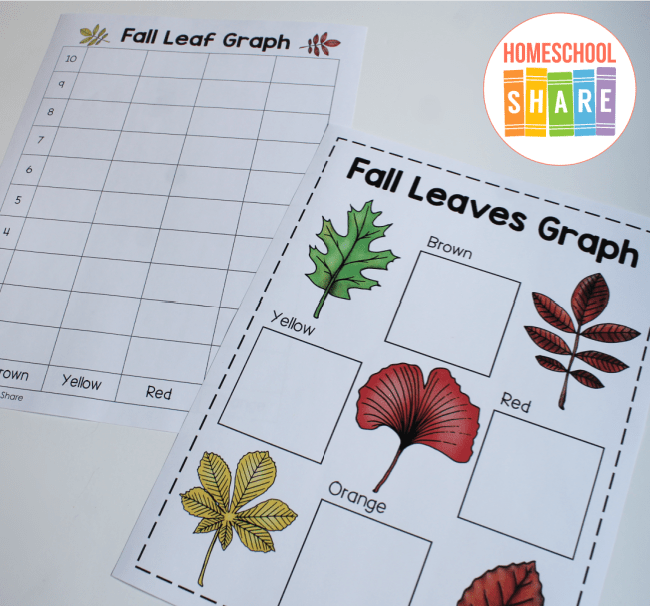
size). Then, make a graph and graph how many leaves of each color you
found. Your older student can find the ratio (how many red leaves are
there for every yellow leaf?).
Leaf Math for your
younger student from tinsnips.org
My Leaf Counting Book
from bry-back manor
Language Arts
Singular/Plural (leaf, leaves)
Does your student know the difference between singular and plural? Some
words in the English language are easy to figure out:
| SINGULAR | PLURAL |
| bear | bears |
| doll | dolls |
| rock | rocks |
| apple | apples |
The word leaf, on the other hand, is a little bit tricky. It's what we call irregular. Some nouns that end in -f or -fe are changed to -ves in the plural. The plural of leaf is leaves. Here are some other irregular plurals (that end in f or fe and are changed to ves):
| SINGULAR | PLURAL |
| calf | calves |
| half | halves |
| hoof | hooves |
| knife | knives |
| life | lives |
| self | selves |
| shelf | shelves |
| thief | thieves |
| wife | wives |
| wolf | wolves |
| loaf | loaves |
Language Arts: Creative Writing
Let your student write a story similar to one of the books you've been
reading.
If you choose Leaf Man, let your student write about a leaf man.
You may want to use Lois Ehlert's refrain-- "no one knows where a leaf man
blows..."
If you choose Red Leaf, Yellow Leaf,
let your student narrate or
write a story he creates about one of the trees where you live.
Seasons Poem: Autumn
There are many different ways to tackle this creative writing assignment.
You know your student best, choose the option you think she would enjoy!
Metaphor Poem
If you've introduced the poetic elements of metaphor and simile to your
student through various other unit studies you've used, then encourage your
student to try to write a metaphor poem. Have your student choose an
object in nature (something found in fall-- acorn, squirrel, tree, leaf,
pumpkin, etc.) and compare it to something else (usually a person or pet is the
easiest). Then, help him to find the connections between the two and
extend the metaphor into an actual poem.
Concrete Poem
Another option would be to try some concrete poetry. You get to play
with the lines and make the poem take shape. If your student writes about
leaves or trees, encourage him to stagger
the
words to resemble falling leaves.
Or, he could
even make his poem in the shape of a tree. It's up to him! He's the
poet!
Acrostic Poem
Choose a fall word (leaf, tree, autumn, etc.) and use the first letter in
each word to start that line of the poem.
Haiku
This type of poetry is usually nature centered. If your student has
written a haiku before, encourage her to write a fall-themed haiku poem (or
maybe even two!). Haiku usually combine three different phrases (in English we
usually write a haiku in three lines); the first line is five syllables, the
second is seven syllables, and the final line is five syllables.
If your student really enjoys writing poetry, you may suggest writing one of
each type of poem and making a Fall Poem minit book for your notebook or
lapbook.
Just for Fun
Lois Ehlert gives instructions for how to make a bird treat. Make some
together and hang them on your trees.
String of
Leaves Craft/Decoration
My
Leaf Color Book (for your younger student)
Leaf
Shape Book (excellent!)
Blank Leaf
Pattern (make your own shape book; pattern from www.abcteach.com)
Resources
Links
Fall Foliage Links (view fall
trees from all over the United States)
Materials and information on this website belong to the original composers. It may be used for your own personal and school use.
Material may not be used for resale. © 2005-07 HSS