| about us |
what's new
|
unit studies
|
unit study helps |
hss resources
|
fiar resources | indexes | lapbooking |
Groundhogs
Research & Lessons submitted by Cate Proudfoot
Lapbook Templates by Ami
Research & Lessons
Classification
Kingdom Animalia
Phylum Chordala
Sub-phylum Vertebrata
Class Mammalia (mammals)
Order Rodentia (rodents)
Family Sciuridae (ground squirrels)
Genus Marmota (marmots)
Species M. monax (Latin word for solitary)
Vocabulary
predator - animal that hunts other animals for food
herbivore - plant eating
burrow - hole or tunnel dug into the ground
asocial - not social
guard hair - long, course hairs in a mammal's coat that form the topcoat and protect the undercoat from the elements
diurnal - active during the day
incisors - front
teeth (humans have 8 - 4 in the upper jaw and 4 in the lower, rodents have 4 -
2 upper 2 lower)
mammal- any of a class of warm-blooded vertebrates that include human beings and
all other animals that nourish their young with milk produced by mammary glands;
mammals also have hair
Habitat
Groundhogs are found in the woodlands and fields of the United States, Canada and as far west as parts of Alaska.
The destruction of forest has actually increased the groundhog population in recent years.
Names
Groundhogs have several names. They are also know as woodchucks, land beavers, whistle pigs and marmots.
Whistle pig comes from the loud shrill whistle they make to warn each other of danger.
Woodchuck is derived from the Native American words "wojak" (Algonquian) and "wuchak" (Cree). Settlers pronounced these words as "woodchuck".
Groundhog Characteristics
Groundhogs are mammals. They are diurnal.
They can grow from 17 to 25 inches long and weigh 5 to 14 pounds. When conditions are just right, that can change to 32 inches long and 30 pounds.
Their feet are black with four toes on the front and five toes on the back. Short legs cause them to waddle when they walk.
Two coats of fur help keep them warm and dry. A dense, woolly undercoat and longer guard hairs. These guard hairs are banded with alternating dark and light colors of yellowish gray to reddish brown, giving this mammal a frosted or grizzled appearance.
Dark colored tails are fanned out and fluffy like their relative, the squirrel. Although, not as large in relation to body size (1/4 of their total body length).
Ears are small, low and rounded atop a black colored head with small black eyes.
Diet
Groundhogs are herbivores.
Diet primarily consist of wild grasses, dandelion greens, clover and agricultural crops like alfalfa. They love to feast on backyard gardens.
Family
relationship
Groundhogs are the only member of their genus that are asocial.
They generally live alone, only coming together to breed and raise cubs.
Babies are called kits or cubs. In early spring, females give birth to a litter of four to nine cubs. By summer, cubs move out to start burrows of their own.
Rodents
Groundhogs are
one of the largest members of the rodent family, the largest group of mammals.
There are more than 1,700 different kinds of rodents! Beavers are the
largest North American rodent, weighing in at 30 to 70 pounds. Capybaras are the
largest rodent in the world (found in South America), weighing up to 140 pounds.
The pygmy jerobas is the smallest member of the family with a two inch body and
four inch tail.
Rodent Characteristics
~ all rodents have two large upper teeth (incisors) which are ever-growing
(note: rodents are the only mammal with this characteristic)
~rodents must wear down their incisors by rubbing them together and by chewing
on tough foods; if a rodent doesn't do this, the top incisors will curve back
and pierce the rodent's skull
~many rodents have stretchy cheek pouches that can hold food; they gather food,
put it in the pouches, and take it back to their nest for storage
~use whiskers to feel their way around in the dark
~have an excellent sense of smell
~use front paws like hands
~most have sharp claws for digging or climbing trees
Rodents are grouped into three main categories: squirrel-jawed rodents,
mouse-jawed rodents, and porcupine-jawed rodents.
Squirrel-jawed include beavers, muskrats, squirrels, springhares, pocket
gophers, groundhogs, scaly-tailed squirrels, pocket mice, and kangaroo rats.
Mouse-jawed rodents include rats, mice, voles, gerbils, jerboas, hamsters,
lemmings, dormice, jumping mice, brich mice, and North African mole-rats.
Porcupine-jawed rodents include porcupines, cavies, capybaras, gundis,
South-American mole-rats, domestic guinea pigs, chinchillas, agoutis, and
nutrias.
Groundhogs, like other rodents, can climb trees and swim.
Burrows
Groundhogs live in homes they dig in the ground, called burrows.
Groundhogs are well equipped to dig. Their front claws are curved to scrape away soil, flat heads help to push dirt aside and strong back feet are used to kick dirt behind. Those powerful incisors come in handy to gnaw through any roots that are in the way.
The tunnels they construct have several rooms and at least two entrances. Tunnels can reach lengths of 40 feet and depths of 6 feet. Rooms are used to sleep, store food, raise babies and even as a toilet.
Other mammals, including rabbits, opossums, skunks, foxes and raccoons use vacant burrows. Even snakes will move in to abandoned burrows.
Predators
Animals that hunt groundhogs include: bears, foxes, wolves, bobcats, coyotes, and birds of prey. Humans are also groundhog hunters.
Snakes can easily access burrows and prey on young groundhogs.
To avoid predators, groundhogs stay close to one of the many entrances to their burrow; this allows them to make a quick escape down a tunnel. If necessary, they can run (gallop) up to 10 miles per hour.
Hibernation
Starting in late summer groundhogs start bulking up for winter, getting so fat they can hardly walk.
In late September or October, groundhogs stop eating and close off the burrows with dirt. They curl into a ball and sleep, living off stored body fat.
Breathing slows form 25 breaths per minute to 1 to 4 breaths per minute. Heartbeat rates slow from 100 beats per minute to only 4. Body temperature drops form 98 degrees Fahrenheit to around 40 degrees. That's about the temperature of your refrigerator.
Sleeping for up to six months, these mammals only awake to have a snack or use the toilet portion of the burrow.
Other animals, such as rabbits, use the tunnel exits for winter nest while the groundhogs sleep below.
Farmers
Farmers have a reputation for disliking groundhogs.
Livestock and farmers have been injured stepping on burrow entrances that may go two feet straight down. The tunnels also collapse under the weight of machinery causing damage to farm equipment.
Burrowing under barns and buildings wreck the foundations.
Groundhogs make a mess of the fields and eat the crops (profits).
There is one thing groundhogs do that is beneficial to farmers. All that digging exposes nutrient rich subsoil and turns it into topsoil. Approximately, 700 pounds of dirt is moved when building a single burrow.
It is estimated that 16 million tons of soil is turned over every year in the state of New York alone.
Tongue
Twister
How much wood could a woodchuck chuck, if a woodchuck could chuck would?
Tongue twisters are phrases that are difficult to articulate, many use alliteration (repetition of a sound) and rhyme. English tongue twisters are used to help foreign students improve their accents and by speech therapist to improve various speech difficulties.
Groundhog Day
They may not be
the fastest, cutest or most loved animal, but groundhogs are the only animal
with their own holiday!
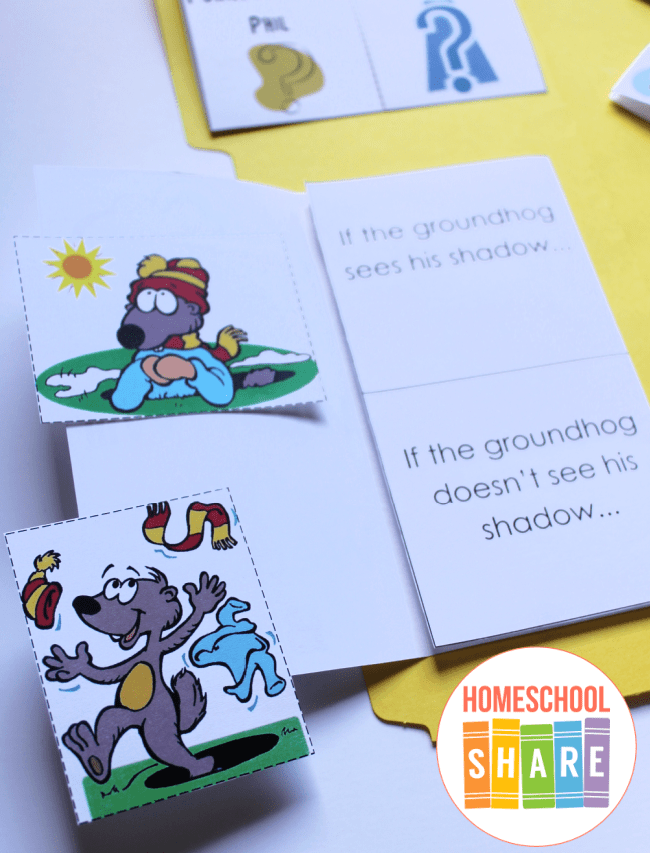
Groundhog Day is February 2nd. Tradition holds that if the groundhog sees his
shadow, there will be six more weeks of bad weather, and if he doesn't, that
spring will be here soon. Of course, the groundhog
doesn't really decide the weather! How did this holiday get started?
In the 1700s German settlers brought the tradition known as Candlemas Day with
them. It was the custom on this day for clergy members to bless candles
and distribute them (one for each window in every house) among the people for
light in the midst of a dark winter. On this day in Germany, the
people also watched
a badger to check for a
shadow. If the sun came out on Candlemas Day
(which was also February 2), it meant six more weeks of wintry weather because
the badger would have a shadow. When the Germans came to America,
the badger was replaced with the groundhog.
(For more lessons on weather lore, see Homeschool Share's
The Big Snow Unit.)
Old English saying:
If Candlemas be fair and bright,
Winter has another fight.
If Candlemas brings clouds and rain,
Winter will not come again.
The most famous groundhog is Punxsutawney Phil. The town of Punxsutawney, Pennsylvania holds a celebration in his honor each year (February 2nd). Thousands of people gather to watch Phil look for his shadow.
See the emergence of Phil live on February 2nd at www.groundhog.org
Book List
Groundhog Day
by Gail Gibbons
The Big Snow by Berta and Elmer Hader (HSS title)
A Garden for a Groundhog by Lorna Balian
How Groundhog's Garden Grew by Lynne Cherry
Gregory's Shadow by Don Freeman
More Information and activities
Groundhog Day at Enchanted Learning craft ideas, printable books and worksheets
Just for fun ~ Jokes
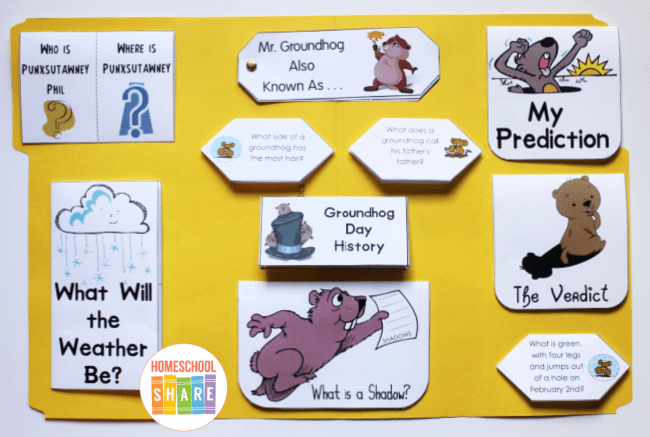
What is green, with four legs and jumps out of a hole on February 2nd?
Answer - A Ground Frog!
What happened when the groundhog met the dogcatcher?
Answer - He became a pound hog
What does a groundhog call his father's father?
Answer - Grandhog
What side of a groundhog has the most hair?
Answer - The outside!