Google
 
Crawdad Creek

Crawdad Creek

Author: Scott Russell Sanders
Illustrator: Robert Hynes
Summary: Two children find fossils, salamanders, dragonflies, frogs, deer tracks, and many other "treasures" when they visit the creek near their home.
ISBN: 0-7922-7097-5
 

Literature Based Unit Study written by Celia Hartmann

Note-This book reads "millions of years..."  You have a few options if you are a stout creationist.  When you read you can read change the word to "hundreds" (probably to a younger child), or you can take the opportunity to discuss why you believe the book is wrong (probably with your older child).  Even though it has the millions of years reference, please don't miss this book!  It is a JEWEL!


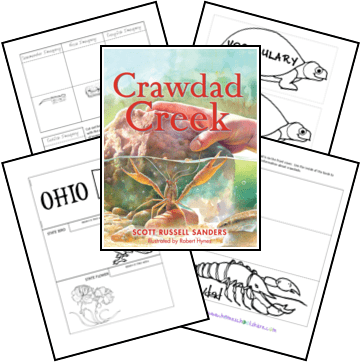
Lapbook

Animal Classification Cards
There is room at the bottom of each card for  your student to write a fact.  Your advanced student can write complete classification information on the back of each card.  Use these with the Animal Classification Pocket Book.  Store them in the book and pull them out (along with the classification tags) and review the different groups of animals (vertebrates/invertebrates as well as mollusks, mammals, reptiles, amphibians, arthropods, crustaceans, etc.!)   
*The crawdad picture is copyrighted by
www.utahfishinginfo.com.  Used with permission.

Vocabulary Shape Book
You can cut around the rectangles if you don't want to make it into a shape book.

Treasure Chest Book for Bible Verse

Figures of Speech Book (three matchbooks inside)

Crawdad Tri-fold Book

Ohio Tab Book

Siblings Simple Book
You have four different books to choose from; make sure you look through the file and only print the one page that you need. 
Ideas:  write sibling & the definition; let your student write the names of her siblings as well as something she loves about each one; write a verse that reminds your student how she is to treat her brothers and sisters such as Ephesians 4:32

Imagery Mini-Matchbooks

Animal Tracks Pocket
*Fold up any of the printable sheets your student completes and store in this pocket; there are lots of web links mentioned in the unit study. 

Another idea would be to use a mini file folder and let your student record some information about a Native American tribe that lived in Ohio.  (Write the name of the tribe on the tab.)

Cover Pages
Cut out and then cut in half to fit on the front shutters of your lapbook.
Possible Cover Page (black and white)
Possible Cover Page (full color photo) *photo contributed by Celia


Social Studies

Geography: At the end of the book, a note from the author states that the creek in this story was based on one that ran through the woods behind his house in Ohio. Make a story disk for Crawdad Creek (a crayfish in water), find Ohio on a map or globe, and place the disk on Ohio. Color a flag and/or outline map of Ohio.

Ohio State Flag

Ohio State Map

Ohio State Bird: Cardinal

Ohio State Flower: Scarlet Carnation

Ohio Bird/Flower Coloring Page
 

Relationships - Brother and Sister:  If you student has a sibling, discuss sibling relationships.  How did the brother and the sister exhibit that they loved one another?  (helping each other find things, they didn't fight, they didn't use ugly words with one another, they were like a team!)  Does your student realize that God specifically chose to give him the siblings he has?  The author's note gives a bit of description of the relationship Scott Russell Sanders has with his own sister and that his sister once saved his life!  Read the note with your student.

History – Native American Tribes of Ohio

The Adena Indians lived in central and southern Ohio from about 800 BC to about the birth of Jesus.  They are famous for the mounds they built over top of their graves.  These mounds range in size from 2-3 feet in height to structures nearly 70 feet tall and 300 feet in diameter.

The Hopewell Indians lived in southern Ohio from about 100 BC - 500 AD.  The Hopewell  Indians were also "mound builders" like the Adena.  They created complex earthworks enclosing hundreds of acres of land.  Some of the earthworks were geometric in shape--circles, squares, octagons, etc.  The largest of these sites, the Newark Earthworks on the Licking River near central Ohio, covers four square miles.  They also built created rings of earth on top of high hills.
 
No one knows why the Mound Builders left Ohio, they just seem to have disappeared.

More information: 
http://www.ohiohistorycentral.org/entry.php?rec=1287&PHPSESSID=6bac9dd9cd6f448c2dd78f30c445d0c5
http://www.oplin.org/point/people/erwdpeop.html
http://www.oplin.org/point/people/mdwdpeop.html

It was many, many years before other Native Americans came to Ohio:  the Fort Ancient tribe was here briefly.  Then, by 1700, several tribes had moved to Ohio after being pushed out of their lands by the Europeans.  The main tribes were the Delaware (Lenape), Wyandot, Miami, Ottawa, Shawnee, and Mingo (Seneca).

The Delaware tribe was part of the Algonquin Nation and originally lived along the Delaware River in New Jersey and southern New York state.  They settled in the lower Muskingum River area in eastern Ohio.  They were also known as the Lenape Indians.  More info:  http://www.pbs4549.org/onestate/delaware.htm
http://www.ohiohistorycentral.org/entry.php?rec=606

The Wyandot (also spelled as Wyandotte or Wendat) tribe was part of the Iroquois Nation and originally from Canada.    They were a very small tribe that lived near the Sandusky River and the upper Muskingum River area in north central Ohio.   They were also known as the Huron Indians.   More info:  http://www.pbs4549.org/onestate/wyandott.htm
http://www.ohiohistorycentral.org/entry.php?rec=608

The Miami (also known as Maumee) tribe was part of the Algonquian nation and originally from the Lake Michigan area.  They settled near the Miami River in southwestern Ohio.  More info:  http://www.pbs4549.org/onestate/miami.htm
http://www.ohiohistorycentral.org/entry.php?rec=606

The Ottawa tribe was also part of the Algonquian nation and was originally from Canda.  They settled along the Maumee River and the Cuyahoga River in northern Ohio.  More info:
http://www.pbs4549.org/onestate/ottawa.htm
http://www.ohiohistorycentral.org/entry.php?rec=614

The Shawnee tribe was part of the Algonquian nation.  They are believed to be descendants of the Fort Ancient people and lived in southern Ohio.  There were the most fierce of all the Ohio tribes.  More info:
http://www.pbs4549.org/onestate/shawnee.htm
http://www.ohiohistorycentral.org/entry.php?rec=631

The Mingo were probably part of the Iroquois nation and had originally lived in New York.  They lived in northeastern Ohio along the Tuscarawras River.  They were a small tribe and were also known as the Seneca.   More information:
http://www.pbs4549.org/onestate/mingo.htm
http://www.ohiohistorycentral.org/entry.php?rec=608

Early Ohio was covered with forests, which were filled with animals.  It was good hunting grounds.  They hunted buffalo, deer, elk and more.  They trapped smaller animals.  They fished along the banks of rivers.  In general, the hunting grounds were shared by all the tribes and they lived in peace before the first white men settled in Ohio.

Each tribe dressed differently and had their own rules and customs and languages.  They lived in wigwams or longhouses.  Wigwams were formed from poles or saplings with layers of bark on top.  They were usually circular in shape, but could also be oblong.  Longhouses were similar but much longer.  Some tribes used cattail mats to cover the poles.

Because each tribe spoke a different language, they would use sign language to speak to other tribes.  They had no alphabet, so they were unable to write their language.  Instead they used pictographs.

Art project idea:   Make a salt dough map of Ohio.  Draw in the rivers.  Make "flags" on toothpicks and label each flag with river names and tribes mentioned in the Native American Tribes of Ohio lesson. Place in their appropriate places.  Bake or allow the map to dry. 

Here are a couple of maps you can use to locate the rivers.  (If you don't want to do the salt dough map, you could just print out one of these maps and have the student label the map where the various tribes lived.)

http://www.gibbs-smith.com/textbooks/downloads/statemaps/OH/rivers.gif
http://nationalatlas.gov/printable/images/pdf/rivers/pagehyd_oh3.pdf  (Need Adobe to view.)

(Sources for this lesson:  In addition to the PBS and Ohio Central sites listed above,  Let's Discover Ohio [1998 edition] by Janine Montgomery and Kathy Akers was also used.)


Language Arts

Point of View-First Person: First Person uses words like "I" and "me" and "we" and "us."

Personification: Personification gives human traits to a non-human object. "The creek talks all the time....It whispers....it murmurs....shouts."  What other examples can your student find in the story?  Encourage your student to use personification in his own writing.

Simile: Compares two things using the words "like," "as," "seems."

                    "When the air is like an oven"

                    "like green bowls laid out to dry"

                    "Like a flag in the breeze"

                    "Like a hand brushing over silky cloth"

Descriptive Words/Imagery: the author’s careful choice of words allows the reader to better imagine or see the story.  Point these phrases out to your student and explain that descriptive words give readers pictures in their minds.  Encourage your student to use imagery in his own writing.

                    "curvy outlines"

                    "feathery shapes"

                    "slinky tunnels"

                    "salamander all rosy and quick"

                    "crayfish all jerky and pale"

                    "whiskery catfish"

Vocabulary:
                        murmur-a low, indistinct, continuous sound

                        rustle-to move with soft fluttering or crackling sounds

                        muggy-warm and extremely humid

                        burble-a gurgling or bubbling sound, as of running water

                        nabbed-to grab; snatch

                        darted-to move suddenly and rapidly

                        loafed-to pass time at leisure (in your own way, in your own time)

                        swoop-to move in a sudden sweep

                        gobble-to eat quickly

                        waver-to move freely back and forth

(note that many of these are descriptive verbs!)

Prepared Vocabulary Crossword Puzzle

Writing Assignment: An older child might enjoy writing or a younger child might enjoy narrating for you to write a story about "those long-ago people" who once "stood here listening to water burble over rocks." Did the Native Americans who once lived near this same creek hear it "talk?" What treasures might a young Native American child (or siblings) have found long ago near this same creek?  An older child should try to work in examples of personification and similes and use descriptive words as discussed this week.


Art

Medium: It looks like illustrator Robert Hynes used watercolors, however he used acrylics but in a watercolor technique.  You may want to let your student experiment with acrylics this week. 

Viewpoint: This is the position from which the subject of the picture is viewed. Illustrator Robert Hynes varies his viewpoints in the illustrations, often creating one from an unexpected position. Notice the viewpoint when the children are panning for gold (above, looking down). Notice the cut-away view of the salamander and the crayfish and of the frog and catfish. Notice the low to the ground views......it’s as if the artist drew some of his pictures while lying on the ground! Have child choose an interesting viewpoint and draw a picture.


Math

Counting: Count all the animals in the book (I came up with 24 in the story, 4 on the front cover, and 2 on the back cover...the front and back covers may not be the same, depends on which cover art your book has.)

Science

Fossils: Discuss the process by which a fossil is created and how scientists use them to learn about the past.

Arrowheads: Often what people call or think are arrowheads are really spearheads. Arrowheads are much smaller, about the size of the end of your finger (so as to fit on the end of an arrow without weighing it down). If the arrowhead that Michael found in the story were indeed as long as Elizabeth’s whole thumb, then it was more likely a spearhead.

Flora and Fauna: The books shows many examples of plant and animal life in and around a creek. Use field guides to look up what you don’t know. Explain that a crawdad is a another name for a crayfish. Have child classify all the animals found in the book. Website for Ohio Animals

Animal Tracks: go through Jim Arnosky’s Crinkleroot’s Guide to Animal Tracking. Print out these matching games:

http://nativeamericanrhymes.com/northeast/game1.htm
http://nativeamericanrhymes.com/northeast/game2.htm
http://nativeamericanrhymes.com/northeast/game3.htm

More Animal Track Print-outs!

Matching Animal Tracks 1

Matching Animal Tracks 2

Matching Animal Tracks 3


Simple Animal Tracks Sheet from Kizclub

Naturalist: A naturalist (someone who loves nature) must have patience (the children sitting still waiting to see animals) and keen observation and listening skills.   If you have a younger child, you may want to revisit Play With Me (from Before Five in a Row). 


Bible

Discuss the word treasure with your child.  What does it mean?  Did the characters in the story find real treasure? 
Discuss Matthew 6:19a-21 (Do not lay up for yourselves treasures on earth....)

Young Earth / Old Earth theories: Because the story talks about "millions of years ago," perhaps this is the time to discuss the Young Earth and Old Earth theories and your beliefs.

Feeling blessed even though no treasure (gold) was found.


Field Trip

Find a nearby creek and look for crawdads and other wildlife, explore the flowers, pan for gold, find your own "treasures," cast animal tracks for souvenirs. Take an animal and plant field guide along to look-up anything you don’t know.


Resources and Rabbit Trails

Crayfish Coloring page: 

http://www.pca.state.mn.us/artwork/kids/color-december-crayfish.gif
http://www.enchantedlearning.com/subjects/invertebrates/crustacean/Crayfishprintout.shtml
 
Dragonfly coloring page:
http://www.enchantedlearning.com/subjects/insects/dragonfly/Dragonflyprintout.shtml
Older kids might "enjoy" a bit of crayfish dissection....
http://www.biologycorner.com/worksheets/crayfishinternal.htm
 
Here are some other links about crayfish:
http://www.shrewsbury-ma.gov/schools/Central/Curriculum/ELEMENTARY/SCIENCE/crayfish.htm
http://www.thirteen.org/edonline/nttidb/lessons/id/crfshidw.html
 
Possible video go-along if one could just find it!  Tape Nature Watch: Crayfish from your local PBS station's ITV.  I checked my local PBS and it's not on their schedule.

p. 218 -221 Evan Moor's Giant Science Resource Book  (Sort cards into "rocks" or "fossils" and match objects with their fossils)

Other Avenue to Explore
California Gold Rush: This story could be used to start a discussion of the California Gold Rush.

Dry Bones and Other Fossils by Gary E. and Mary M. Parker. Great book on fossils from a Creationist standpoint. Well-explained (a conversation between child/dad). Plan on reading a chapter a day or something though....it's 80 pages, 6 chapters.