| about us |
what's new
|
unit studies
|
unit study helps |
hss resources
|
fiar resources | indexes | lapbooking |
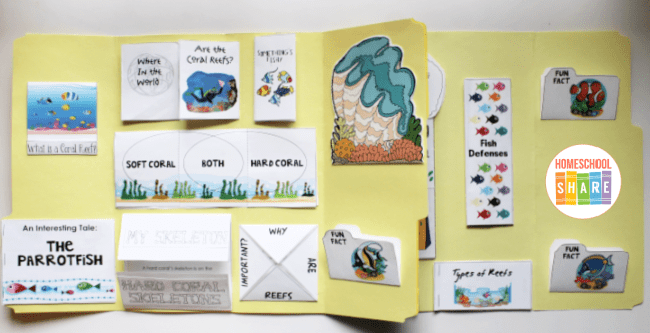
Coral Reef Animal Study & Lapbook
Unit and Templates by Michelle Wiesbrock
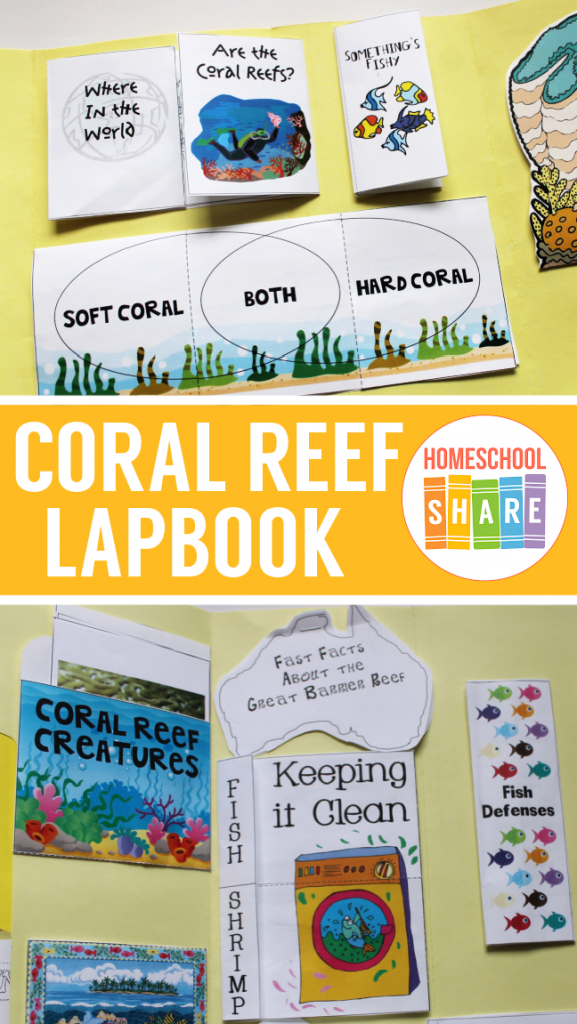
Lapbook Templates
Research & Lessons
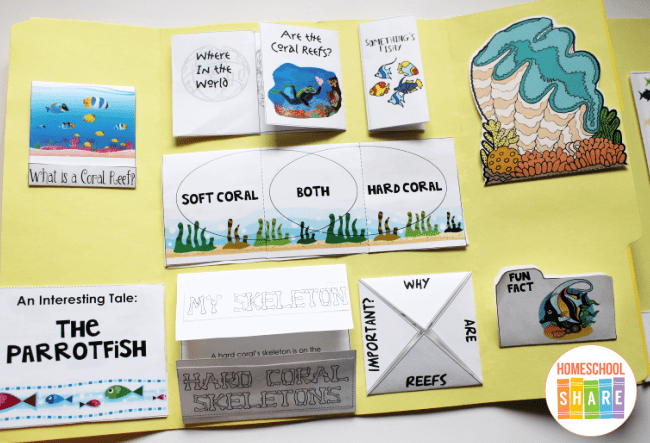
What is a Coral Reef?
Coral reefs are large underwater structures made up of millions of tiny
animals called coral polyps. Coral polyps look like plants but are in fact
simple animals. They have a soft tube like body with a mouth surrounded by long
tentacles. The tentacles grab its food.
Coral reefs grow in warm tropical seas where the temperature of the water stays
above 65 degrees F. Most reefs lie near the equator in shallow waters (usually
100 feet deep or less). Coral reefs are sometimes called the “rainforest of the
sea” because of the enormous diversity of plants and animals.
Find the locations of coral reefs around the world by doing a quick Google or
Yahoo search. Or check out these maps:
http://www.reefrelief.org/coralreef/maps/map.html
http://www.oceanservice.noaa.gov/education/kits/corals/media/supp_coral05a.html
http://www.nasa.gov/images/content/68211main_landsat_coralreef_m.jpg
Hard Coral vs. Soft Corals
Hard corals are so named because they have a stony bases and/or hard outer
skeletons. Hard corals live on the seafloor and on slopes. They feed only at
night and are bright and colorful during feeding. Hard corals are reef building
corals. See information below in How a Reef is Formed.
Soft corals do not have stony bases or outer skeletons; they are soft. They grow
on overhangs and cliffs and feed during the day. They are very bright and
colorful.
How a Reef is Formed
When the hard coral polyps die, their skeletons are left behind. New polyps
attach to the skeletons and when these new polyps die, their skeletons add
another layer. So a reef is built over a long period of time and consists of
layers and layers of coral polyp skeletons.
Speaking of Skeletons
Your
skeleton is on the inside of your body; your body made your bones by using
minerals from the foods you eat.
A hard coral’s skeleton is on the outside of its body. It is made by using
chemicals it takes in from the seawater.
Our Reefs are Disappearing
Sadly, our coral reefs have been disappearing. It has been estimated that we
have lost 20% of the coral reefs in the world in the last 20 years. Several
factors are contributing to the loss. Unfortunately, much of the blame is put on
humans.
1) Over fishing by humans. When too many of a particular species are removed
from a reef, it can upset the balance of the food web at the reef and can cause
parts of the reef to eventually die out.
2) Water Pollution. Chemical runoff from pesticides and fertilizers eventually
make it to the oceans. Many chemicals are poisonous to the creatures who live in
the oceans and on the reefs.
3) Global warming. Global warming has increased the temperature of the water in
the oceans and increased the level of water in the ocean. These factors make it
harder for the creatures in the reef to flourish as before.
4) Boat Anchors. Anchors thrown from boats by careless captains break up the
reef bit by bit.
5) Souvenirs. Coral reefs are fascinating places for divers and snorkelers to
visit. It is a huge industry and brings in many millions of dollars to countries
near reefs. However, many tourists touch the reef or try to break off pieces for
souvenirs.
Why are Coral Reefs Important to Us?
Besides being one of the most beautiful and fascinating places on Earth,
coral reefs are important to humans for many reasons.
1) Protection. Many reefs provide barriers to the coast against incoming waves.
Without the reefs, shorelines would erode more quickly.
2) Medicines. Many drugs and medicines have been developed from substances
collected from coral reefs. If the reefs disappear, we will lose a very
important medical resource.
3) Food. The coral reef teems with life. The reef provides food to many people
all over the world. Of course we have to be careful never to overfish or take
too many of a single species from the reef.
4) Tourism dollars. Countries located near coral reefs depend upon money
generated from tourists who come to visit the reef. Without those tourists, many
local people would lose their jobs.
Can your child think of other reasons?
Types of Reefs
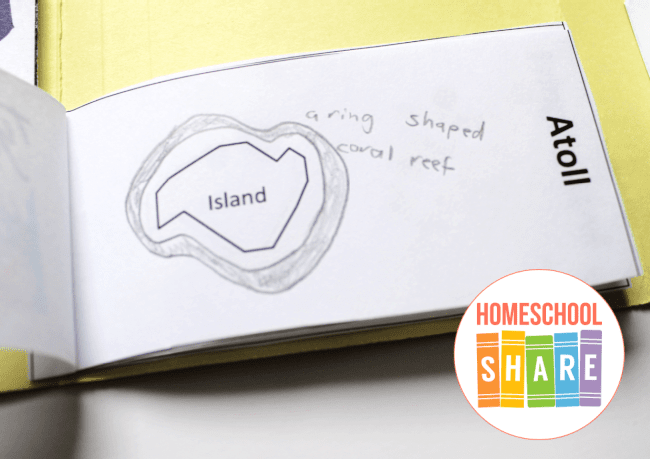
Atolls are circular reefs with a lagoon in the center. They are usually far
from the coastline.
Fringing Reefs are found close to the shore of islands and coastlines. The water
between the reef and the shore is shallow.
Barrier Reefs lie farther away from shore. The water between the reef and the
shore is deeper (up to 100 feet) and forms a lagoon
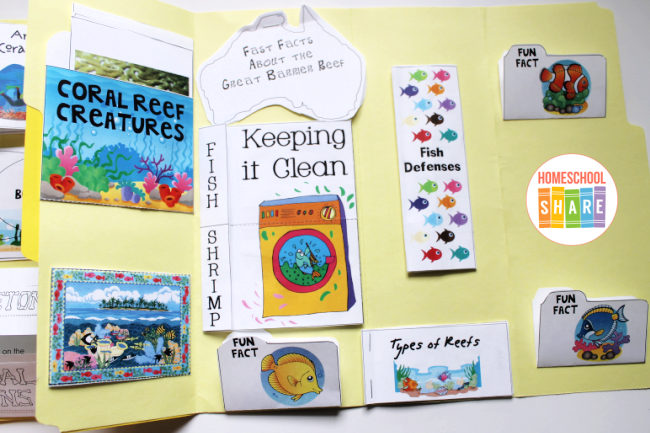
Great Barrier Reef
The Great Barrier Reef is the largest and perhaps the most famous reef in
the world. It is located in the Coral Sea off the northeastern coast of
Australia and is home to about 340 kinds of coral and more than 2,200 species of
fish. The Great Barrier Reef is more than 1,200 miles long but it is not
actually one reef. It is actually many, many (about 3,000) smaller reefs located
close together.
What Makes a Fish a Fish?
Fish are important creatures that live on the coral reef. But not all
creatures that live on the reef are fish. So how do we know which creatures are
fish?
If you asked 30 children “What is a fish?” You would probably get 30 completely
different answers. We all have different ideas of what a fish is? However, most
fish do share some common characteristics.
A fish is a vertebrate which means it has a backbone and an internal skeleton.
Most fish live underwater and breathe with gills. Most fish have scales and they
swim using fins. Most fish lay jellylike eggs.
Fish Defenses
There are many different ways that fish protect themselves from predators on
the reef. Here are just a few.
Black Spots
Some fish have black spots toward the backs of their bodies. Predators mistake
it for their eyes and attack the wrong end of the fish allowing the fish to
escape.
Black Stripes
Some fish have black stripes covering their eyes leaving predators wondering
which end to attack.
Poisonous Stingers
Some fish have poisonous stingers to protect themselves from predators.
Camouflage
Some fish have special features which allow them to blend very well in their
environments.
Schools
Some fish travel in groups, called schools, for protection. Large schools of
moving fish often confuse their predators.
Appearing Larger
Some fish are able to “inflate” themselves which makes them appear larger and
possibly too large for a predator to eat.
Food Chain
There are 3 levels to every food chain.
The first or bottom level consists of plants. Plants are called primary
producers. They make their own food through by using energy from the sun.
The second level is made up of herbivores or animals that eat plants. Herbivores
are called primary consumers because they are the first group to consume food,
or eat the primary producers or plants.
The third or top level consists of carnivores or animals that eat other animals.
Carnivores are called secondary consumers because they are the second group in
the food chain to eat food. Carnivores may also be tertiary consumers if they
have eaten another carnivore and are therefore the third group in the food chain
to eat food.
You can think of the food chain like an energy pyramid. On the bottom are plants
that receive energy from the sun. This bottom level of the pyramid is wide to
represent the many plants that are necessary to make food energy for the
herbivores. The next level is the herbivores. The level is not as wide as the
bottom level and shows that there are fewer herbivores than there are plants
because each herbivore has to eat many many plants in order to have the energy
it needs to survive. The third or top level is narrowest and represents
carnivores. There are fewer carnivores than herbivores because carnivores must
consume many herbivores in order to have enough energy to survive.
So a food chain involves plants, herbivores, and carnivores. But most plants and
animals belong to more than one food chain. When two different food chains
connect a food web is formed.
Animals of the Coral Reef
Parrotfish
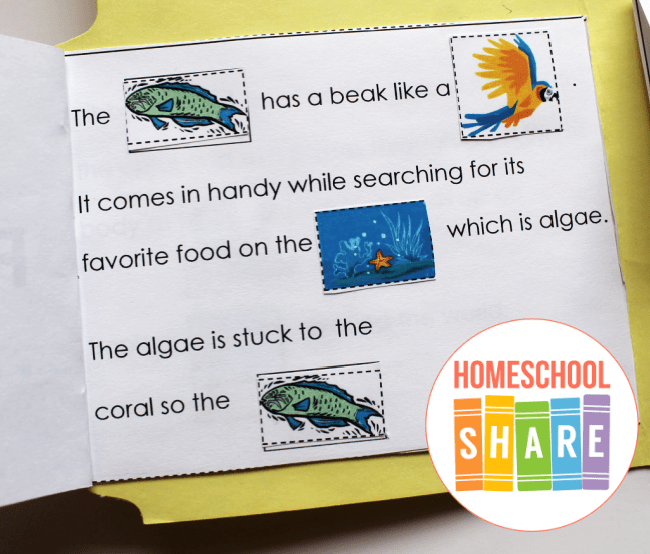
Parrotfish are very brightly colored and have beaklike mouths made of
“teeth” that are fused together. They are sometimes called the “cows of the sea”
because they are grazers. In search of small plants called algae, parrotfish
will eat the coral reef. The reef is digested and passes out of the parrotfish
as sand. One parrotfish can create as much as 1,100 pounds of sand each year
that ends up on tropical beaches around the world. (That's enough sand to
fill 75 1-gallon pails!)
Some parrotfish create a mucous blanket to surround and protect themselves at
night. The mucous blanket keeps predators from picking up their smell.
Anemones and Anemone Fish
Sea anemones are animals that live on the reef. They have stinging tentacles
that keep most predators away. Because anemone fish, such as clown fish, have a
protective coating of slime on their bodies, they can live among the anemone’s
tentacles. In return for providing a safe home for them, the anemone fish clean
up the anemone by eating parasites and scraps. Anemone fish also are very
territorial so they drive away anemone predator fish. Anemone fish rarely stray
from their homes and even lay their eggs at the base of the anemone.
Giant Clams
Most clams are only a few inches long, but the giant clam really is a giant
measuring up to 4.8 feet long and weighing over 500 pounds!
You can find a giant clam, the largest mollusk on Earth, in the warm waters of
the South Pacific and Indian oceans. Once a giant clam fastens itself to a
spot on a coral reef, it will sit there for the rest of its life which may be
100 years. Giant clams look alike, but no two giant clams have the
same coloring! Isn't that amazing!?
In order to eat and live, giant clams are dependent on algae that live in their
tissues, and algae are dependent on the giant clams. The clams consume the
sugars and proteins produced by the algae. In exchange, the clams offer the
algae a safe home and access to sunlight which the algae need for
photosynthesis. Clams also survive by consuming plankton; they use a
siphon to draw in water to filter and eat passing plankton.
Despite popular myth, giant clams do not eat people.
Keeping it Clean
Some animals in the reef help others to stay clean!
The cleaner wrasse is known as the reef’s vacuum cleaner because sucks
parasites, dead skin and bits of food from the fins, gills, teeth and skin of
reef predators. This process keeps the wrasse fish fed and the
larger fish clean! In order to let the fish know it's ready for
work, the wrasse will wiggle and jiggle. When the fish see the dance, they
line up for cleaning.
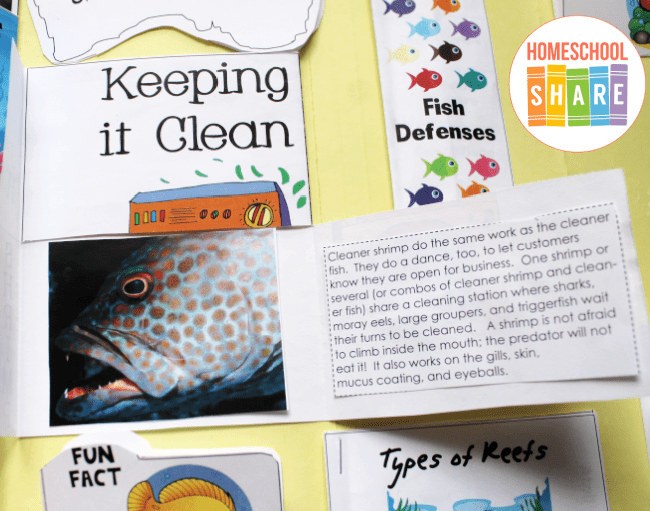
Cleaner shrimp do
the same work as the cleaner fish. They do a dance, too, to let customers know
they are open for business. One shrimp or several (or combos of cleaner shrimp
and cleaner fish) share a cleaning station where sharks, moray eels, large
groupers, and triggerfish wait their turns to be cleaned. A shrimp is not
afraid to climb inside the mouth; the predator will not eat it! It also works
on the gills, skin,
mucus coating, and eyeballs.
Other info and Activities
Virtual Diving in the Great Barrier Reef
Animal I Spy Game from Monterey Bay Aquarium
Coloring Pages of Coral Reef Fish
Make a Fish
Print
Look at Different Types of
Coral
Coral Reefs at Enchanted Learning
Movies:
IMAX Coral Reef Adventure
Disney’s Finding Nemo, of course!
Library List
Colorful Captivating Coral Reefs by Dorothy Hinshaw Patent
DK 24 Hours Coral Reef by Caroline Bingham
Coral Reef Food Chains by Bobbie Kalman
Eyewitness Books Fish by Steven Parker
One Less Fish by Kim Michelle Toft and Allan Sheather
One Small Square Coral Reef by Donald M. Silver
A Coral Reef Tale: Old Shell, New Shell by Helen Ward
Over in the Ocean: In a Coral Reef by Marianne Berkes
Easy Chapter Book:
Magic School Bus: The Fishy Field Trip by Martin Schwabacher
Materials and information on this website belong to the original composers. It may be used for your own personal and school use.
Material may not be used for resale. © 2005-07 HSS