Affiliate Disclaimer
We sometimes use affiliate links in our content. This won’t cost you anything, but it helps us to keep the site running. Thanks for your support.
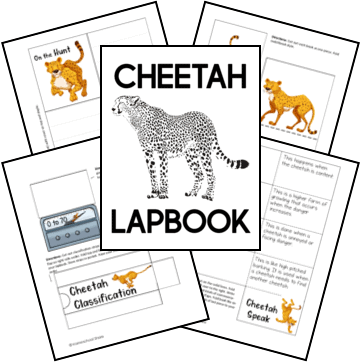
Learn all about the cheetah’s diet, anatomy, behavior, hunting practices, family life, and more with our Cheetah Lapbook.
Thanks to Debbie Palmer for writing the research lessons for this Cheetah Lapbook.
Cheetah Lapbook Information
Here are some sample lessons from the Cheetah Lapbook:
Cheetah Characteristics
The cheetah’s chest is deep and it has a narrow waist. Its fur is tan with black spots. Black tear marks run from the corner of its eyes down the sides of its nose. This aids in keeping sunlight out of its eyes. It has only semi-retractable claws which help it gain traction as it runs. The cheetah also has enlarged heart and lungs that aid in circulating oxygen through its system quickly while it is running.
Cheetah Behavior (Locomotion and Vocalization)
Cheetahs are unique among cats in that they have incredible speed, but lack the ability to climb. They can reach speeds of 70 miles per hour in shorts bursts (1,500 ft.). They have the ability to accelerate from 0 to 70 miles per hour in three seconds which is faster than most high speed cars.
Unlike most big cats, cheetahs purr when they inhale. Most big cats purr when they exhale. Cheetahs are unable to roar, but have several types of vocalizations. Here is a list of them.
Chirping- This is like high pitched barking. It is used when a cheetah needs to find another cheetah.
Growling- This is done when a cheetah is annoyed or facing danger.
Yowling- This is a higher form of growling that occurs when the danger increases.
Purring- This happens when the cheetah is content.
Cheetah Diet/Hunting
Cheetah staples include gazelles, wildebeest calves, impalas, Thomson’s Gazelle, Grant’s gazelle, springbok, young zebras, hares, guinea fowl.
Cheetahs are diurnal hunters, meaning they hunt during the day. Since they hunt by sight instead of smell, they need some light. They tend to hunt in the early morning or evening. Cheetahs average a success rate of 50% with each chase. Cheetahs kill by biting the throat of their prey.
You can grab a copy of the entire Cheetah Lapbook in an easy-to-print file at the end of this post.
Cheetah Lapbook Printables
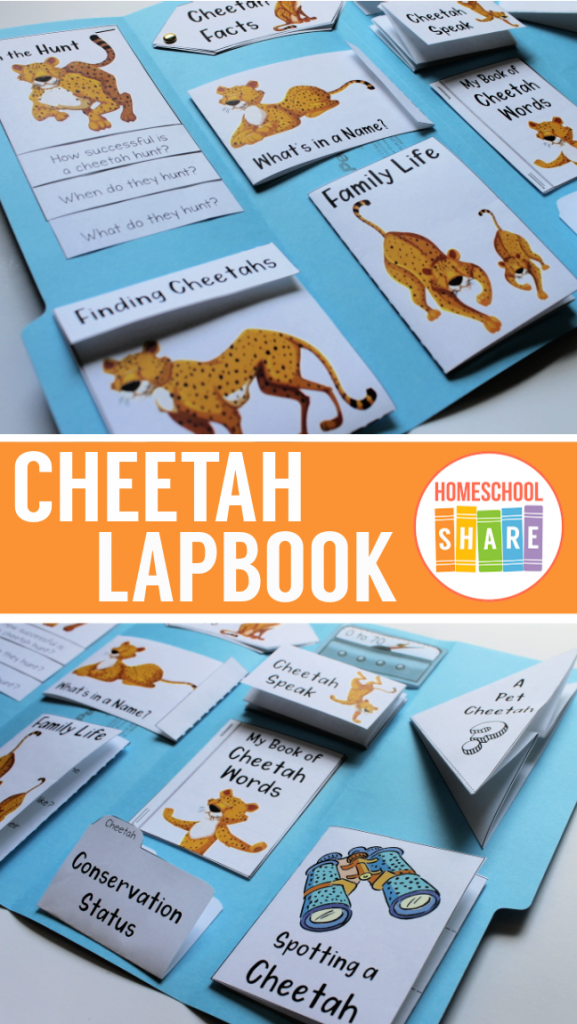
The file includes the lessons, research, and mini-books for your Cheetah Lapbook. These mini-books are included:
- What’s in a Name? Matchbook
- Finding Cheetahs Matchbook
- Conservation Status File Folder
- My Book of Cheetah Words
- Spotting a Cheetah Flap Book
- On the Hunt Layer Book
- A Pet Cheetah? Compressed Triangle
- Cheetah Facts Fan Book
- Family Life Tri-fold Book
- 0 to 70 Speedometer Shape Book
- Cheetah Classification Strips & Pocket
- Cheetah Speak Accordion Flap
- The King Cheetah Pop-up Book
- Cheetah Coloring Image
Cheetah Lapbook Sample
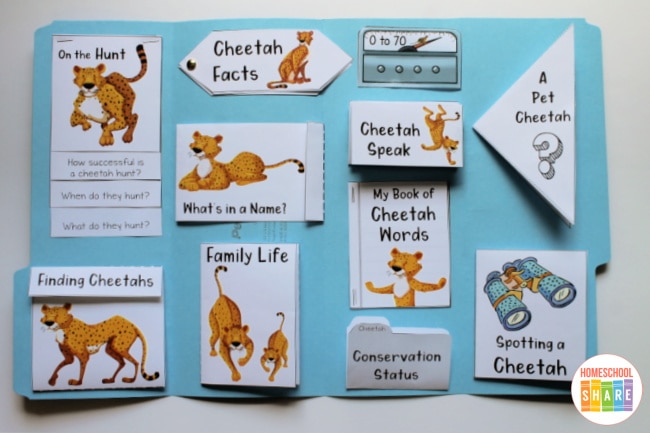
Here is a sample of the Cheetah Lapbook. Note: It doesn’t include every mini-book. Please pick and choose the mini-books that will work best for your student.
How to Get Started with Your Cheetah Lapbook
Follow these simple instructions to get started with the Cheetah Lapbook.
- If you want, go to your local library and check out books about cheetahs. You may want to grab some books about other big cats, too.
- Print the Cheetah Lapbook.
- Choose and prepare the mini-books you want to use with your student.
- Enjoy a week of reading and learning all about one of the world’s fastest animals.
Download Your Cheetah Lapbook
Simply click on the image below to access your free Cheetah Lapbook.
Learn More About Big Cats
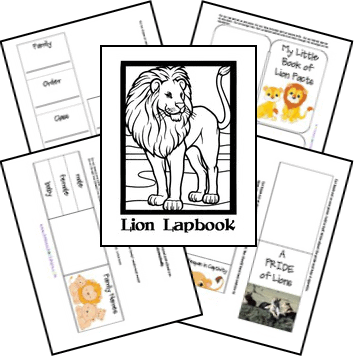
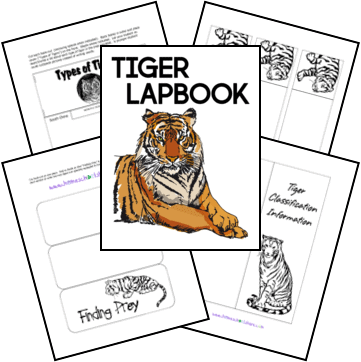
If your student wants to learn more about big cats, try one of these animal lapbooks.