| about us |
what's new
|
unit studies
|
unit study helps |
fiar resources
|
indexes | lapbooking |
|
Author/Illustrator:
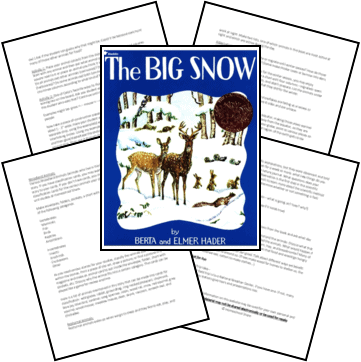
Berta and Elmer Hader ISBN: 0-689-71260-X Award: Caldecott Medal Winner Summary: Despite their elaborate preparations for the winter, the animals and birds are delighted by a surprise banquet after a big snow. |
Unit Study Prepared by Martha Posten Lesson Extensions by Ami and Celia
Rural vs. Urban:
Discuss the difference between rural and urban. What about this book makes us
think it is rural? Do you live in a rural or urban area? What would a day of big
snow look like in an urban area? A great tale to contrast the two is
The Country Mouse and The City Mouse.
(Any version will do)
Holidays: Groundhog Day
The Big Snow refers to Groundhog Day-- "The ground hog didn't
wake up until the second day in February. He pushed up through the snow
and looked about. The sun was shining brightly and there on the snow the
ground hog saw his shadow. 'Oh-oh, I know what that means,' he said.
'There will be six more weeks of winter.' And he hurried back to his den
to sleep until spring. "
Groundhog Day is February 2nd. Tradition holds that if the groundhog sees his
shadow, there will be six more weeks of bad weather, and if he doesn't, that
spring will be here soon. Of course, the groundhog
doesn't really decide the weather! How did this holiday get started?
In the 1700's German settlers brought the tradition known as Candlemas Day with
them. It was the custom on this day for clergy members to bless candles
and distribute them (one for each window in every house) among the people for
light in the midst of a dark winter. If the sun came out on Candlemas Day
(which was also February 2), it meant six more weeks of wintry weather.
According to the Old English saying:
If Candlemas be fair and bright,
WInter has another flight.
If Candlemas brings clouds and rain,
Winter will not come again.
According to the Scottish saying:
If Candlemas Day is bright and clear,
There'll be two winters in the year.
According to the German saying:
For as the sun shines on Candlemas Day
So far will the snow swirl until May.
For as the snow blows on Candlemas Day,
So far will the sun shine before May.
According to the American saying:
If the sun shines on Groundhog Day;
Half the fuel and half the hay.
Mr. Groundhog Project Pack from Hands of a Child
Groundhog Day History
Color a Groundhog
Picture
Groundhog Day
Books to Read
TONS of Great
Groundhog Day Stuff at Enchanted Learning
Fun Websites
http://www.groundhog.org/celebrate/
http://www.geocities.com/Heartland/Valley/8004/colorgroundhog2.html -- a
printable maze
http://www.groundhog.org/hogtivities/wordsearch.gif -- a word search
Culture: Weather Lore
Weather lore is sprinkled throughout this story. If you've
already discussed the Groundhog Day lesson with your student, you may wish to
build on that by discussing other weather lore.
The book mentions, "A rainbow around the moon meant more snow. MUCH MORE."
This is the same concept as Groundhog's Day. Is it true or just for fun?
(here is a picture --
http://www.astropix.com/HTML/SHOW_DIG/009.HTM )
Here are a few more weather sayings. Discuss the meanings of these sayings
with your student and why some of them can be considered accurate (not just
based in superstition). Observe some of the sayings over the
next several weeks and keep a record of the saying and the weather in the
notebook.....which sayings were accurate? Has God given us clues to know
what the weather may be like? (of course), but Who ultimately determines the
weather and always knows what is going to happen? (only One-- our sovereign God)
The moon and the weather may change
together,
But a change of the moon, will not change the weather.
A ring around the sun or moon, means rain or snow coming soon.
When grass is dry at morning light
Look for rain before the night.
Dew on the grass, rain won't come to pass.
When the night goes to bed with a fever, it will awake with a wet head.
When stars shine clear and bright,
We will have a very cold night.
Three days rain will empty any sky.
The sharper the blast, the sooner 'tis past.
If bees stay at home, rain will soon
come,
If they flay away, fine will be the day.
When clouds look like black smoke a wise man will put on his cloak.
When the chairs squeak, it's of rain they speak.
Catchy drawer and sticky door,
Coming rain will pour and pour.
When the sun shines while raining,
it will rain the same time again tomorrow.
When the wind blows from the west, fish
bite best.
When it blows from the east, fish bite least.
When the wind is in the east, 'tis
neither good for man nor beast.
Language Arts
Personification:
Personification is the giving of human qualities to things, animals, or other
concepts that are not human. In this book, the animals are portrayed as having
conversations in a very neighborly way. The next time your
student writes a story, you may want to encourage him to personify an animal or
object for the main character.
Alphabetical Order/List-Making:
List the animals in alphabetical order. For a smaller list, list only the
names of birds in alphabetical order. See Science: Woodland Animals
Lesson for complete list.
Onomatopoeia:
Onomatopoeia (owna-mat-uh-pee-uh) - using words that creates the sound of the
object as you say them. (See FIAR Vol. 1) This happens often in this book from
the first words of "Honk-honk-honk."
Have child point out other examples from the book and give some of their own
examples.
Capitalization:
This story provides an opportunity to remind your student that the seasons of
the year are NOT capitalized in writing. Months of the year are and so are
days of the weeks, but seasons are not.
Comparison and Detail:
Some of the pictures are in watercolor and some are black and white sketches.
Notice the color pictures catch the eye more, but the black and white pictures
are much more detailed. Compare the pages with the child. Ask them to point out
details. The most obvious are the two scenes where it first starts to snow. The
first is in black and white with each unique snowflake drawn; the second is in
color with white dots. Discuss which one illustrations your child
prefers and why.
Have your child draw a picture in pencil, encourage details. Now have your child
paint a picture, as close to being the same as the pencil drawing as they can.
Make sure to let them know that both pictures are great, but have different
qualities that make them beautiful.
Facial Expressions:
Compare the pages where "there were
hill-dwellers who came out to hunt" to the pages where "the
snow stopped falling on the evening of the second day." Look at the
expressions on the raccoons, the round circle of a mouth in an expression of
awe.
Tell your student to show you his "mad" face....his "happy" face...his
"surprised!" face...(other ideas include sad, excited, bored, etc.). Have
him look in the mirror...what does his mouth look like? His eyes?
With your younger student, make paper plate masks with different facial
expressions to illustrate different moods. With your older student, let
him draw some faces that include different emotions.
Caldecott Medal Winner:
Discuss the art work with your student. If your student is familiar
with other books that have received the Caldecott Award (Make Way for
Ducklings, Time of Wonder,
Once a Mouse, etc.), discuss why he thinks the
art work in this book won the award. If your student isn't familiar
with the award, explain that it is a prize given to one picture book each year
that has exceptional art work-- "the most distinguished American picture book
for children."
If your student is interested, check out some other Caldecott Medal winning
books from the library.
Caldecott Medal List
Story Problems:
Addition & Subtraction:
Add all the animals, or all the birds, or all the mammals on each page or in the
book. Then subtract. Example: All the animals in the book, minus the animals in
one scene or minus the number of birds. There are several possible math problems
along this pattern. Encourage the child to make their own word problems, if they
are of an age to do so.
We liked the idea that it was the same flock of geese viewed in each scene as
they passed over different areas. How many birds were in the flock? The first
page shows 11, then 9 in the next scene. How many of the flock are missing? (2)
Then the third scene shows 14! How many more birds did we find in the
flock? (3)
Tally Marks & Counting
by Five:
Use tally marks to add up how many black/white pages and how many color pages
there are. Then count by five to get the total of each and the total number of
pages in the book.
Note: Gather pictures of the animals in this book (either by cut outs of magazines, printed off, or stickers) to make this a hands-on lesson.
Food Chain (herbivores,
omnivores, carnivores):
What is the one animal that doesn't enter conversation with another animal? (The
owl.) Ask if the student can guess why that might be. Could it be because
owls hunt many of those other animals for food?
Activity 1: Place your animal cutouts from the story onto different colored squares. Start with any animal and then put what animal you think would hunt it in the square next to it or place an animal you think it would hunt in the square before it. Do all animals eat other animals (carnivores)? Do all animals eat plants (herbivores)? Do some animals eat both (omnivores)? Now, try putting the animals into three columns according to what kind of food they eat!
Activity 2: One of Celia's favorite ways to illustrate the food chain is this. Write the word grass on the board. Ask you student who eats grass and write that down. Ask the student who eats that? Continue until the student can't think of any more.
Examples might be: grass <--- mouse <----snake <---owl or grass <----cow <----people
Now take a piece of construction paper and cut it long ways into several strips about 1 - 2" wide. Have your student write each part of the chain , each on a separate strip, using the example(s) written on the board and assemble into interlinking circles. Using my example above, he would write grass on the first strip and then glue/staple/tape the ends to make a circle (a link) Write cow on the second strip. Then put it through the first link and glue/staple/tape its ends. Then write people on the third strip. Then put it through the second link and glue/staple/tape its ends. You now have a chain.....a food chain!

Woodland Animals:
Various Woodland Animals (animals who live in the forest) are characters
of this story. If you have classification cards, you may want to add the
following animals to your cards. If you don't have cards, you may want to
start some animal classification cards for the various animals your student
encounters through the FIAR and Homeschool Share curriculum.
Make envelopes, folders, pockets, a chart with pockets, or index card file for
each of the following categories
Vertebrates:
Mammals
Fish
Birds
Reptiles
Amphibians
Invertebrates
Insects
Arachnids
Crustaceans
Other
As you read various stories for your studies, classify the animals you read
about within the stories. Print a piece of clip-art, draw a picture, or
find a picture in a magazine and make an animal card to put inside the envelope,
folder, chart with pockets, etc. Discuss why the animal fits into a
certain category. The cards can be played like a game for review
anytime.
Here is a list of animals mentioned in this story that can be made into cards
for classification (click links for more information on the animal or a report
form).
wild geese
report form
rabbits
groundhog
chipmunk report
form
blue jay
blue bird
cardinal
song sparrow
robin
wood rat
ring-necked pheasant
crow
red squirrel
grey squirrel
wood mouse
meadow mouse
deer
skunk report form
raccoon report form
screech owl (the link is for a snowy owl because I couldn't find a screech
owl)
chickadee
Nocturnal Animals:
Nocturnal animals wake up when we go to sleep and they like to eat, play, and
work at night. Make two lists, one of which animals in the book are most active
at night and which are active during the day.
Daytime/Nighttime
Animals Activity Sheet from Kizclub
Nocturnal
Animal Information at Enchanted Learning
Hibernation and Migration:
Why don't all the animals hibernate or migrate until winter passes? How do those
animals cope with the cold season? (Some make thicker coats or burrow into dens
for warmth.)
Hibernating
Animals Information and Print-outs at Enchanted Learning
Migrating
Animals Information and Print-outs at Enchanted Learning
Since the animals did different things for the winter season, you may enjoy
charting this with your student. Make a chart with four columns--
"migrated--went South" "hibernated"
"gathered seeds/nuts" "didn't prepare"
List the animals under the appropriate column according to what they did for the
winter.
Snow:
You may want to use the page where the snowflakes are falling as a review
or introduction lesson on how snowflakes have 6 sides and are unique.
Polar Caps and the Equator:
Explain that the sun is more direct along the equator, making those areas
warmer than others. The polar caps are the farthest away from the equator,
so they are very cold. Show your student the equator on your globe;
point to various places on the globe and ask your student if she thinks that
region of the earth gets snow (sometimes, a lot, or always).
"The days grew shorter and shorter" -- the sun's relationship to the equator
also explains this phenomena. You can use a flashlight (representing the
sun) and a globe (the earth) to illustrate. The earth's axis' rotation
causes the sun to shine for different amounts of time throughout the course of a
year.
Seasons:
Discuss the four seasons. Get four pieces of paper. Write the name
of each season at the top of one of the pieces. Then, using these prepared
Season Sorting Cards (or
cut your own pictures from magazines/newspaper, etc.), ask your student to
sort them by placing cards on the appropriate season (you could even glue them
down to make a collage rather than just a sorting activity-- it depends on
whether or not you will want to do this again).
For a variation of this idea, have your student go through books on the shelf
and put them in piles according to what season appears on the cover
illustration.
Observation (and the Scientific Method):
The animals in the story are very observant about the world around them. People
have not always known scientific explanations, but they were observant and told
others. Try observing the weather for a week or more, what new things do you
notice? Record your findings in a nature journal. What questions
does your observation(s) lead you to ask? Observation is the first
step in the scientific method. Your older student may wish to learn more
about the scientific method and how it works to help people determine whether or
not something is fact.
Basics of the scientific method:
1. Observation (and ask questions)
2. Hypotheses (try to answer a question-- what is going on? how? why?)
3. Prediction (the formed hypothesis)
4. Experiment (test the hypothesis to see if it holds true)
Bible/Character
Occupations: Meteorologist / Weather Forecaster