| about us |
what's new
|
unit studies
|
unit study helps |
hss resources
|
fiar resources | indexes | lapbooking |
The Ox-Cart Man
|
Literature Based Unit Study written
by: Suzanne
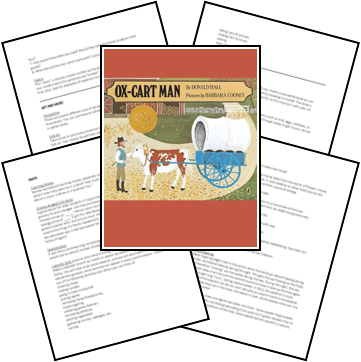
Mazer Stewart Author: Donald Hall Illustrator: Barbara Cooney Summary: Describes the day-to-day life of an early nineteenth-century New England family throughout the changing seasons ISBN: 0140504419 |
LAPBOOK
BIBLE
Memory Verse(s)
Proverbs 12:11
"He who tills his land will have plenty of bread, But he who pursues worthless
things lacks sense"
Proverbs 14:23
"In all labor there is profit, But mere talk leads only to poverty."
Lapbook Component:
Hardwork Bible
Matchbook
Bible Study: Biblical Families
One a day - Adam and Eve, Abraham and Sarah,
Hannah and Elkanah, Jacob and all his wives and children, and finally Joseph,
Mary and Jesus. Read a story about each family, and then perhaps find a
similarity or difference between that family and yours. You could also read a story and then
find a character trait or object lesson from that family that can be applied to
your own.
Bible Study: Seasons
Ecclesiastes 3: 1-8 - studying each "season" or "time" and its
contrast. Have children recall certain "times" in their own lives.
Lapbook Component:
Everything a
Season Book &
Clipart
SOCIAL STUDIES
Geography
This story takes place in New Hampshire. Find NH on a map or atlas; place a
storydisk there.
Color or ID its flag. Look for info from a book or on the internet. Record NH in
your notebook or passport. For older children, you could even do a state
report - listing important facts and data.
State Bird
and State Flower Coloring Page
Lapbook Components:
Where is
New Hampshire Shutterfold
New
Hampshire Report Form & Pocket
New Hampshire
Tab Book
History: Time Period
This story is set in the early 1800's.
-Have a "then and now" differences discussion; if you notebook or lapbook make a
chart of the differences
-Conduct a then and now interview with an older relative.
-Mark the
book on your timeline or Book of Centuries.
Lapbook Component:
Then & Now Shutterfold
Other Topics for Exploration
There are several historical "trades" that could be explored -
blacksmithing (the source of the kettle,) harness making, candle making, spinning
and weaving, etc. (We made a simple cardboard loom and wove with yarn.) The
girls also did some research into samplers and needlework. Another area to
explore, especially of interest to my girls, is hearth cooking. (We even found a
recipe book in our library that included many recipes for foods we eat now, with
directions to make them over a hearth.)
If your student would like to try a sampler, but you don't have the supplies,
let him mimic this
pattern by using graph paper and markers.
Allow your older student to choose some colonial trades to research--
blacksmith, cooper, tailor, whitesmith, hatter, miller, wheelwright,
silversmith, tanner, cobbler, housewright, pewterer, towncrier, clockmaker,
cabinetmaker, barber, etc.
LANGUAGE ARTS
Creative Writing: Adding Details
You can get creative with this story. Give each character a name, and then
take turns telling another story about your particular family member. These can
be in the form of a journal or diary entry, telling a little bit about
themselves and their day. (Youngest dc dictate theirs, older ones write them
out.)
Lapbook Component:
My Story Pocket
Comprehension & Discussion Questions
1. How did the family survive (how were they able to buy/produce what they
needed to live)?
2. Each person in the family contributed to the goods produced. Make a
chart of who made what.
3. List the steps in the production of the mittens.
4. Why did the family's jobs change with the seasons? Can your
student think of any jobs like that today?
5. Where did the Ox-Cart man go to buy/sell goods?
6. The Ox-Cart man's family was able to produce much of what they needed,
however, they couldn't make everything; what items did the Ox-Cart man have to
buy?
7. How would these items be used? Would they help the family produce
more goods?
8. What else did the man come home with? (coins in his pockets)
Lapbook Components:
Who Made What
Graph Simple Fold
Produced or
Purchased Pocket Book
Poetry
This "story" is actually a poem written by Donald Hall. Point
out the use of line to your student (why the sentences are "broken" off and
don't run as one continual line). Also, look for examples of repetition
throughout the story.
ART AND MUSIC
Perspective
There are several different uses of perspective and viewpoint in the story's
illustrations. You can use these to either introduce or reinforce this topic if
studied in earlier books.
Folk Art
Take a look at some early American folk art, and then contrast it to
modern-day folk art. Your library should have some sources for this.
Colonial Art
This book is also a good springboard for a discussion into formal colonial
art and artists. (One thing we learned is that during colonial times, painters
charged by the amount of the body they had to portray in their portraits. A head
was cheaper than a full body, sitting down less than standing up, etc. This is
the source of the phrase, "cost an arm and a leg.")
Early American Songs
Learn some early American songs, like "Yankee Doodle" or "In and Out the
Needle." The "Wee Sing Games and Fun" cassette has a nice selection. Also, this
website
has a LOT of colonial music in midi form to listen to,
download and learn, as most songs have lyrics, and some sheet music, provided.
You may also find this
website
useful.
Craft Projects
-Tying in with the history lesson, try your hand at simple samplers. There
are several books and websites that show examples of historical samplers.
-If you have a child responsible enough, you could let him or her try their
hand at whittling. If not with real wood and knife, soap carving as described in
the Daniel's Duck (FIAR Volume III) lessons would work in their place.
MATH
Counting Money
Review and expand counting money, especially coins. "How many ____ make
a dollar? How many pennies in a dime? How much do 2 nickels and 3 dimes make?
Which is more, 2 dimes or 2 quarters? etc."
Your younger student may enjoy these --
Coin Puzzles
Grocery Budget (Life Skills)
A good lesson for older dc is to give them several different grocery fliers,
a grocery list and a budget. Can they purchase enough for dinner? Which store
has the best prices on _____? Which store has the most expensive ____? Find the
average price of ____. (I got this idea because the father/farmer only had so
much goods to barter with, and only so much money to spend. He had to somehow
acquire the things his family needed with, hopefully, some left over. This
modern day equivalent was a real eye-opener for my dc as to just what it takes
to feed a family of 8!)
Multiplication
If you have a child learning multiplication tables, ask them to find out
how much it would cost to serve X number of people a certain item or items for
practice.
Calendar Skills (science and critical thinking, too)
Make a calendar (month by month or season by season) for the Ox-Cart Man's
family. You will have to do some research, and you will also have to make
some educational guesses; some activities will appear in every month/season.
Include any of the following activities plus others you can think of--
shearing sheep
making candles
going to town to buy/sell
picking apples
retrieving honey/honeycombs
maple sugaring
collecting goose feathers
harvesting potatoes
planting vegetables
gathering turnips, cabbages, etc.
carving
taking care of animals
making flax into linen
sewing
spun yarn
knitted mittens
Lapbook Component:
Four Seasons Circle and
Cone Pocket
Cone
Pocket Instructions
SCIENCE
Wool Production
There are several FIAR lessons, such as A New Coat
for Anna (Volume II) that cover this as well. A really nice go-along book for this
lesson is Charlie Needs a Cloak by Tomie de Paola. If you want to
touch this topic lightly, simply list the steps mentioned in Ox-Cart Man.
Charlie Needs a Cloak Activity Card
Lapbook Component:
Sheep to Cloak Graduated Book
(originally made for Charlie Needs a Cloak Unit)
Farmer's Market
If you have one, go for a field trip visit. If not,
there's a wonderful book by Lois Ehlert, titled Market Day, that shows a
family traveling to market. The book is illustrated with folk art from around
the world, so this may tie in with your art lessons, as well.
Farm to Table
Pick one or two of your everyday produce items (such as
milk, eggs, potatoes, or even honey) and research the process it goes through today to get to
your dinner table.
From the Farm Activity
Sheet
Go-along books:
Milk: From Cow to Carton by Aliki
The Milk Makers by Gail Gibbons
Farm animals
This book is a wonderful way to introduce your student to the
different animals that make up the farm. OR you could do a more in-depth study
of just one or two.
You could also have your student list the animals that lived on this farm and
what products each one "gave" to the farmer's family.
Gardening
"In May they planted potatoes, turnips, and cabbages"
Choose some vegetables to plant in your garden this year. If it's planting
time, plant outdoors. If the season is right for starting seeds inside,
then do that. Chart the growth of your plants in a nature journal (or on a
separate chart for your notebook or lapbook). You may even want to compare
the different seeds, growth rates, etc. of each plant (if you choose more than
one).
Bees/Honey
"While bees woke up, starting to make new honey"
Honeybee Report Sheet
Honeybee Print-out Enchanted Learning
Honey is a sweet fluid produced by honey bees from the nectar of flowers. Honey
is put away by bees as a food source. In cold weather or when food sources are
scarce, bees use their stored honey as their source of energy.
Here is the process of how honey is made (from
www.timekids.com )
A field bee carries nectar in its mouth.
The field bee gives the mouthful of nectar to a house bee at the hive.
The house bees put the nectar inside the hive's six-sided honeycomb cells.
The nectar is mostly water.
After the nectar is inside the cells, it must dry.
The bees fan the cells with their wings.
The bees cover the cells of the honeycomb with wax.
The nectar dries for a few days.
When the nectar thickens, it turns into honey.
Further topics to explore: lifecycle of the honeybee, beekeeping, how bees are
necessary in the apple-producing process
Go-along suggestion: The Honey Makers by Gail Gibbons
Maple Sugaring
(a big thanks to Colleen Yoder for the
following information! --this lesson was originally in
Letting Swift River Go)
Maple Sugaring begins late in the winter when the temps go above freezing
during the day, and below freezing during the night. This gets the sap
flowing up the trees (and therefore "running" out the spiles) during the
day. During the night, the sap goes back down the tree until the
warmth/sunshine draw it back up the tree again. We like to get long "runs",
lasting several weeks. In Ohio, the weather is more volatile and the
seasons can be cut short abruptly by a warm trend in the weather. When the
sap stays up in the trees, the season is over. As the leaves come out, the
sap becomes bitter.
Want to learn more about maple syrup? Try HSS's Maple Sugaring Unit Study & Lapbook
Additional Resources
Materials and information on this website belong to the
original composers. It may be used for your own personal and school use.
Material may not be used for resale.
© 2005-07 HSS