| about us |
what's new
|
unit studies
|
unit study helps |
hss resources
|
fiar resources | indexes | lapbooking |
Pirates Multi-book Theme Unit
Unit prepared by Ami Brainerd

BOOKS USED
Tough Boris by Mem Fox
Pirate Pete by Kim Kennedy
Roger, the Jolly Pirate by Brett Helquist
You may also want to add
Pirates in the Park to this study
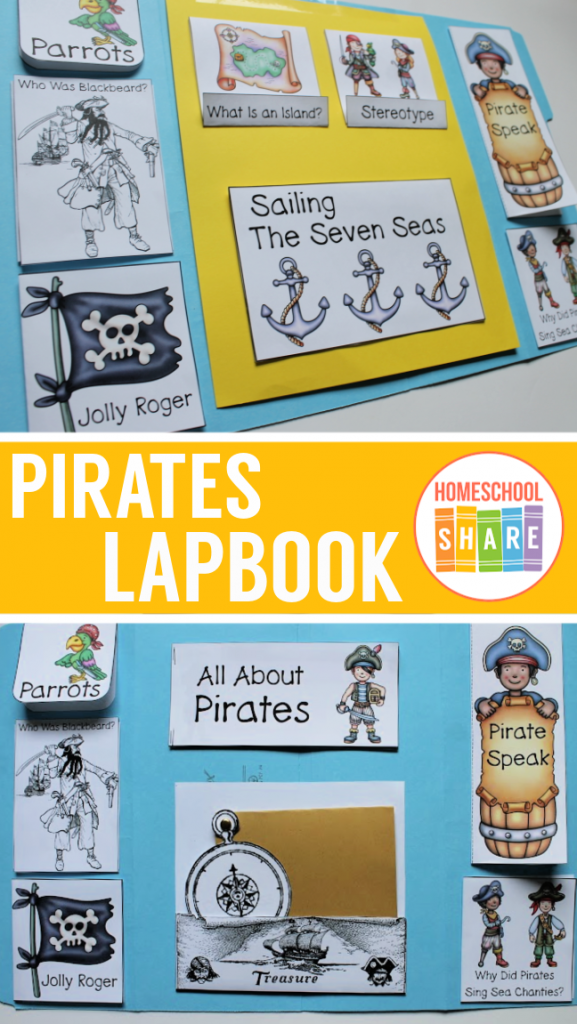
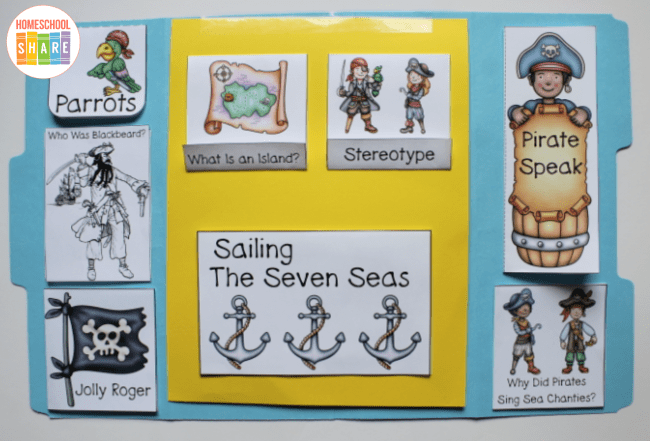
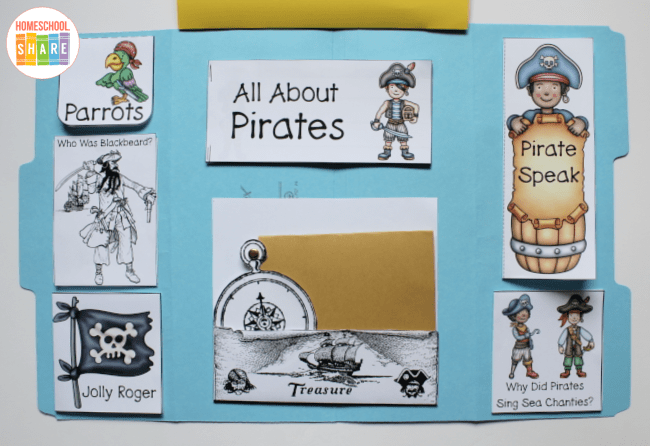
Lapbook Printables
Pirate Gear Prepared Page (glue page into your lapbook, if desired)
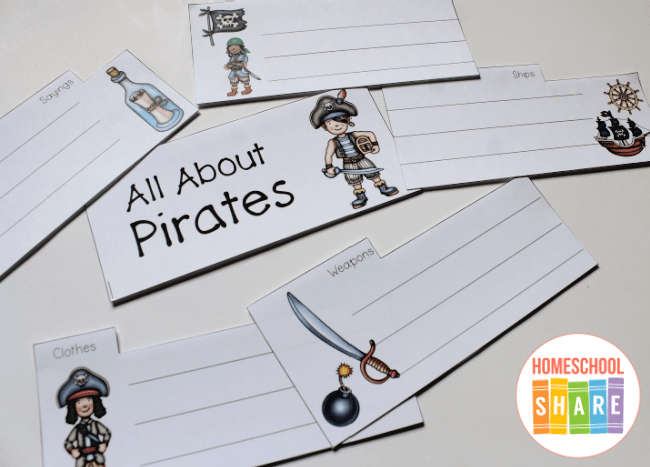
Pirate Tab Book
Parrot Book
Seven Seas
Minit book
Pirate Speak Dictionary
(blank)
Pirate Speak Dictionary (with words)
Treasure Map Pocket
Island Matchbook
Compass Rose
Minit Book
Jolly Roger Minit Book
Plot Wheel Book
Pull-tab Question ("Why did pirates
sing sea chanties?")
Blackbeard
Minit Book
Stereotype
Matchbook
RESOURCES
Library List
Little Badger, Terror of the Seven Seas by Eve Bunting
Pirates Robbers of the High Seas by Gail Gibbons
Do Pirates Take Baths? by Kathy Tucker
Classic Starts: Treasure Island by Robert Louis Stevenson
Pirate Pete's Giant Adventure by Kim Kennedy
The Everything Kids' Pirates Puzzle And Activity Book: Set Sail into a
Treasure-trove of Fun! by Beth L. Blair
Pirate Things to Make And Do (Usborne) by Rebecca Gilpin
How I Became A Pirate by Melinda Long
The World of the Pirate by Val Garwood
You may also want to check out nonfiction books about parrots, pirates, eyes (eyesight),
and dental hygiene
Videos
Muppet Treasure Island
Sunken Treasure -Reading Rainbow Video
Links
Patch the Pirate (download a radio
broadcast, coloring pages, and more)
Pirates at
Enchanted Learning
Pirate Printable
(use for your lapbook or for a coloring page)
Optional add-ons--items you can purchase from Homeschool E-store
Twenty Pirate Crafts (ages 5-10)
Pirates Learn N' Folder (3rd
grade - High School)
In the Hands of a Child Blackbeard Project Pack (3rd grade +)
See additional Resources and Ideas for older students at the end of this unit.
Also, be sure to check out Pirate Diary (a
Level C chapter book unit).
| PreSchool-Grade 2-Tough Boris is a treasure. This easy-to-read picture book features a repetitive, engaging text; a very popular subject; and an interesting subplot played out in the colorful illustrations. Boris von der Borch is a scruffy and fearless pirate who is nonetheless tender enough to cry when his pet parrot dies. While the brief text simply lists his attributes (and those of all other pirates), the energetic watercolors paint the larger picture. Boris and his crew dig up some buried loot and divide it (unevenly, of course), squabble over a prized violin, and enjoy the cabin boy's impromptu concert (after he's been caught stealing the instrument from Boris). As the story ends, the boy is taken ashore, mourning his exile from the ship but still clutching the precious violin. A compelling and entertaining tale of adventure. |
SOCIAL STUDIES ACTIVITIES
Introducing Pirates
(parts taken from Pirates in the Park)
The wide western hemisphere of our world was explored and settled by
adventure-filled people who were looking for something new. They came over
the deep blue sea and have used the sea ever since. Pirates used these
same seas to find adventure and wealth-- plundering and robbing other ships.
Learn more about pirates and who they really were. The book selections
I've chosen for this unit do stereotype pirates (find a lesson on stereotypes in
Roger the Jolly Pirate), but I wanted to choose books that were appropriate for
the younger set. Pirates were not nice guys, but that is not the
main focus of this unit.
Pirate Clothes-- Much of the clothes pirates wore were obtained
during attacks. The clothing worn was chosen for it’s comfort and durability,
and ease of moving around and fighting. Kerchiefs were worn around a pirate’s
head to keep out dirt and dust, and to catch sweat. Sashes, usually of red, were
pirate trademarks. And every once in a while, a pirate did wear an eye patch to
cover the damage done in some altercation.
Pirate Gear Prepared Page
Pirate Ships- Pirates used whatever ships they could steal, as long as
they were fast. They especially preferred small fast ships that were easy to
steer, so they could sneak up on their victims and get away fast. A picture of a
pirate ship with parts labeled
can be found by clicking here.
Lapbook Component::
Let your student begin compiling (or narrating) information about pirates
into this Pirate Tab Book. You
will continue to work on this throughout the unit.
Story Writing
Let your student write a story in the same fashion as Tough Boris.
Brainstorm a name for a pirate and a list of pirate adjectives (describing
words) together. Use the
provided template to create pages for your book. Cut the pages
out, let your student fill in the blanks with his words. Make a cover and
staple everything together. If your student wants to add illustrations,
you will have to add more pages. You could also glue the pages in a
prepared minit book.
Note: You can customize this book however you wish; your student doesn't
have to use all five "He was ________; all pirates are ________." He could
also leave the "so do I" at the end off. Let your student make some
decisions as the author.
Creative Writing: The Rest of the Story
The storyline of this book is simple; however, the pictures are
telling more. Let your student write or narrate the story based on what she sees in
the pictures.
Science:
Animal Study/Pets-- Parrot
Unlike pictures depict, pirates didn't have pet parrots permanently perched
on a shoulder; but, some did have parrots for pets.
Parrots can be found in most warm regions of the
world (the tropical regions of the southern hemisphere), including India, southeast Asia, Southern regions of North America, South
America, and west Africa. By far the greatest number of parrot species come from
Australasia, South America, and Central America. You may want to get out a
globe and show your student the equator; explain that the southern hemisphere is
the area below the equator-- where parrots are natives. Are parrots native
to your neck of the woods? Which hemisphere does your student live in?
Parrots are easy to recognize with their vertical stance and their short, strong bills.
God designed the top section of their beak to curve downward-- this is perfect
for crushing seeds and nuts; they also eat nectar, pollen, and sometimes even
animal prey. Parrots are
zygodactyl having two toes that point forward and two that point backward allowing them to grasp
objects with their feet and move with great ease in trees. Most parrots
have brightly colored feathers-- many have green feathers with bursts of red,
yellow, and blue.
Their bright
colors and social nature have made them popular pets.
Studies with captive birds have given us insight into which birds are the
smartest. While parrots have the distinction of being able to mimic
human speech, studies with the African Grey Parrot have shown that some are able
to associate words with their meanings and form simple sentences. Along with
crows, ravens, and jays (family Corvidae), parrots are considered the most
intelligent of birds.
Various breeds for your older student to research: Scarlet Macaw, Ground Parrot, Senegal Parrot,
Rainbow Lorikeet, Eclectus Parrot, Blue-frontfooted Parrot, Yellow-collared
Lovebird, Hyacinth Macaw, and Congo African Gray Parrot
Lapbook Component:
Parrot Book (Cut out book as one piece;
fold in half on center line. Let your young student simply cut
pictures of parrots out and paste them in the book; your student could also
narrate what he has learned about parrots. If desired, cut out lined
paper and paste inside book and let your student write parrot facts in the
book.
Parrot Coloring Pages
Science: Eyes and Patches
Lesson Prep:
Make an eyepatch (you need cardboard and elastic). If you don't want
to make the pirate patch, you can simply let your student close one eye for the
following activities. You will need a cup and a small object such as a
coin, too.
Many times pirates are depicted with an eye patch.
If you only had one eye, how would you see differently than you do with two
eyes?
Have your student put on his pirate patch (or close one of his eyes).
Place a cup on the table at one end and have your student sit at the other end
(you need to set it at least five feet away and tell him to look straight ahead for the activity). Get your small object
(a penny or dime works well); hold your arm out over the cup and ask your
student to tell you when to drop the object (so that it will fall in).
You may want to try coming from the right/left over the cup as well as starting
with the coin near you and holding your arm straight out. Is your student successful? Try a few times
(moving the cup to a slightly new position each time). After a few tries take the patch off
and play. Which way is easier?
It's hard to judge distance with one eye. God gave us two eyes so that
they can work as a team providing us something we call depth perception
the ability to perceive spatial relationships, especially distances between
objects, in three dimensions. Two eyes work together to send information
to the brain where the information is compared and helps us to know how far or
how close object are in relation to us and each other.
So, if you were on a ship on the high seas, and you ran into a band of pirates,
would you want them to be wearing patches? Why or why not?
Also, you may want to try this with multiple family members (siblings, etc.) to
see who has the best depth perception. Have fun!
JUST FOR FUN
Crafts and Fun
Treasure Chest
Craft from DLTK
Treasure
Chest Craft from Enchanted Learning
Be a Pirate!
Make a Sailing Hat and consider letting your child don some temporary
tattoos; you could even construct a cutlass from cardboard and tin foil.
| Ages 5-8. Gold puts the twinkle in Pirate Pete's eye, and where there's gold, he's a-goin'. After stealing a treasure map from the queen, Pete and his parrot set sail for Mermaid Island. Unfortunately, they are sidetracked by the possibilities of gold elsewhere. Nothing pans out until a baby dragon, hatched from the golden egg Pete steals from Dragon Island, sets the ship afire, causing it to sink conveniently near Mermaid Island. It's there Pete finally finds a treasure--only to be caught by the angry queen, who seizes the booty and leaves Pete and his parrot marooned. Lucky for Pete and Parrot, she forgets to take the rowboat, which Pete points toward the sunset, "where the ocean glistened like a thousand coins of gold." The appealing, richly colored, cartoon like paintings have a robust, sculpted look, derived from Kennedy's use of clay models that allowed him to visualize the characters and their movements. Particularly inventive is the first view of each stop along the journey, which is presented in a circular illustration set against a black background, as if seen through a telescope. |
Geography: The Seven Seas
Pirates sailed the seven seas. The Seven Seas are the North and South Atlantic,
the North and South Pacific, the Indian, the Arctic, and the Antarctic oceans.
Using your globe or world map, label the seven seas. (If pirates sailed
the seven seas, was there any water they didn't sail in?)
Lapbook Component:
Seven Seas
Minit book -- Cut out the cover (first page). Cut out the
book (second page) as one piece; fold in the center. Glue cover on the
front. Have your student write the numbers on the map (will be on the
inside) corresponding to each ocean.
Seven Seas Notebooking Page
-- Label the world map
Geography Landform-- Island
An island is a piece of land surrounded by water. Look at the
map/globe together. Can your student find various islands? Does he
recognize any from previous studies?
Lapbook Component: Island Matchbook
Let your student
draw an island inside and/or write the definition.
Geography: Compass
A compass is a device for determining directions by means of a magnetic
needle pointing to the magnetic north. People use compasses to know which way to go.
Teach (or review) cardinal directions with your student (north, east, south,
west). If this is review for your student, be sure to include north east,
south east, north west, south west to your discussion. If you have the
opportunity and energy, create a treasure hunt around your house and yard that
requires the student to use a compass to find his way.
Lapbook Component: Compass Rose
Minit Book
Your older student may enjoy making his own compass (see lesson in
Pedro's
Journal)
Directions on board the ship
Starboard = right
Port = left
Stern = back
Bow = front
To help your student learn the directions on board, play this game (created by
Wende and Celia)
Directions: Print out game board and two copies of the
cards on card stock. Cut out cards,
shuffle, and place face down in front of
players. Players put pawns on Start. A "dead ahead" card must be drawn
to move out of start. Players take turns drawing cards and moving in
direction specified.
Aft= Stern
Dead Ahead = Bow
Remember, Port is left from the FRONT of the ship. So, you may want to
turn your game board so that the word STERN (back of the ship) is further away
than the BOW (front). A helpful hint
for your student to remember which way is left is that PORT has four letters
and so does the word LEFT.
The first player to get to a Treasure space wins.
Pirates attack any player who lands on a space
already occupied and chase that player back to start.
If a player is in the last block for starboard and draws another
starboard card (or in the last block on the port side and draws another
port card), he is becalmed and has to wait until the winds blow him aft,
ahead, or the opposite direction.
Mapping Skills: Make a Treasure Map!
Although treasure maps have become strongly associated with pirates,
there are very few documented cases of pirates actually burying treasure, and no
documented cases of a historical pirate treasure map. The pirate most
responsible for the legends of buried pirate treasure was Captain Kidd (you may
want to help your interested student learn more about Captain Kidd), and Sir
Francis Drake buried Spanish gold and silver after raiding the mule train. So,
the buried treasure part is true (although not common for every pirate as one
would think), but the maps are most likely a complete work of fiction (and they
do, indeed, appear in many fiction works about pirates such as Treasure
Island by Stevenson). Explain to your student that pirates probably did not
have treasure maps, but that a few did bury treasure. This activity is included
in the unit just for fun (and for learning some geography skills).
Read more about hidden treasure on the last page of Gail Gibbons'
Pirates Robbers of the High Seas.
Before you start this project, brainstorm with your student about possible names
for islands, destinations, obstacles, etc. on your map. Write down your ideas.
Supplies
White Paper
Cookie Sheet or 9x13 pan (something with sides)
Blow dryer
Coffee or Tea (for staining)
Oil (optional)
Cinnamon (optional)
Lemon Juice (optional)
Paint Brush (optional)
Black marker (permanent and thin tip)
Directions:
Take a sheet of white paper and crumple it into a ball. When you open it up,
it should be really wrinkled. Rip off the edges so it looks torn and old.
Place it on a cookie pan (with sides) or a 9x13 pan if it will fit. Pour
coffee or tea over it and let it soak for about five minutes. Pour the liquid
that the paper did not absorb into the sink. If you'd like, you can sprinkle
some cinnamon on the edges to give them an even older look. Use your blow dryer
to dry the paper (don't try to pick it up or it will tear, just leave the paper
on the cookie sheet).
If you'd like for your map to look like parchment paper try this-- after it's
dry, you can brush a thin layer of oil on the paper (then let it dry again).
Now, draw out the map. Don't forget to add a compass rose (N, S, E, W). Using
the black permanent marker, draw destinations (such as islands) and obstacles
(such as dragons, mermaids, mountains, etc., and place to side-track a pirate
(like the islands did in Pirate Pete). Draw dashed lines (- - - -) from
destination to destination. Let your student draw an X or-- try this option:
use "invisible ink" (lemon juice) for the X (paint it on with a small brush).
After it is completely dry, you can hold it over a candle or hot light bulb (be
careful!) and the invisible inked X will turn visible and BROWN!
Lapbook Component:
You can store your map in your lapbook. Use this
Treasure Map Pocket for
storage. Pocket instructions: cut out as one piece. Fold
long rectangle up behind the front ("treasure") and fold the flaps
behind the rectangle. Glue the flaps down.
Language Arts: Pirate Speak
This book is full of pirate phrases
Teach your student some of the simple/most common phrases as you see fit.
| Ahoy! | hello |
| Avast! | stop and pay attention; it can also be used in a sense of surprise (in place of Wow! or Whoa!) |
| Aye! | I agree |
| Beauty | a lovely woman |
| Buccaneer | a sea rover of the 17th century. Buccaneers sailed the Caribbean and attacked Spanish ships. |
| Cutlass | popular sword among pirates |
| Corsair | a pirate of the Mediterranean Sea |
| Davy Jones' Locker | the bottom of the sea |
| Disembark | to leave the ship |
| Embark | to enter the ship in order to go on a journey |
| Foul | bad |
| Gold Road | this was a road that went across Panama. Built by the Spaniards, it was used to transport gold |
| Jolly Roger | a pirate flag |
| Keelhaul | punishment |
| Lubber | land lover; someone who doesn't want to go to sea |
| Matey | friend |
| Ne’er-do-well | a scoundrel or rascal |
| Pieces of eight | Spanish silver coins that could actually be broken into eight pieces, or bits.Two of these bits were a quarter of the coin, and that’s where we get the expression “two bits” for a quarter of a dollar, as in the cheer, “Two bits, four bits, six bits a dollar. |
| Plunder | treasure taken from others |
| Rigging | ropes that hold the sails in place |
| Weigh anchor | prepare to leave |
Lapbook Component
Pirate Speak Dictionary
(blank)
Pirate Speak Dictionary (with words)
Directions: Print the file of your choice. Cut out book as one piece
(along the solid outer lines). Fold in half along the center dotted line
(text should be on the outside). Open and fold outer dotted lines in to
middle dotted line. Open and cut along the short solid lines between words
to form flaps. Refold so that your finished product is one long rectangle.
When you open it, your student should be able to manipulate each flap to see
the word and definition.
Be sure to add your student's favorite pirate sayings to his tab book (that
you started in Tough Boris)
Grammar
Correct Pirate Pete's use of the English language-- if ye dare! Arrr!
Alliteration
This book is full of examples of alliteration from the main character's name
(Pirate Pete) to the description
of sweet eaters on candy island-- licorice-licking,
taffy-tugging, chocolate-chomping.
Review alliteration with your student. If your student is writing a
pirate adventure (see lesson below), encourage her to use alliteration in
the title or in the text of her story.
Creative Writing: Island Adventure
If your student were sailing the seven seas, what islands would he
like to stop off at? Let your student think up some fun (and maybe
even scary) names for islands. Next, let him write a pirate-y adventure as
he sails from island to island.
Questions to ask him to help him write his story
What are you looking for? What island would you start at? Why?
Why would you leave that island? Where would you go next? Why?
How would you get there? What's there? What danger is found?
etc.
Health: Dental Hygiene
On candy island, Pirate Pete hopes to find gold fillings in rotten teeth.
What does he find instead? Why? You may want to use this as an
opportunity to discuss good dental hygiene with your student.
Math: Counting Paces
Have fun with this exercise. For counting practice, tell your student
to walk ten paces. Then call out another number of paces for him to
walk. For a student who is just learning addition, tell him to walk
eight paces and five more. Ask, "how many paces are you going to walk
total?" You can make all kinds of fun math problems with this
kinesthetic activity. You can even reverse roles and let your student
tell you how many paces to walk.
Extra Activity
Make a
spy-glass telescope
Roger the Jolly Pirate
History:
Jolly Roger + Design Your Own Pirate Flag
Although this fun book is more fiction than fact, the "Jolly Roger"
really is the name now given to any pirate flag. The most famous Jolly Roger
today is the Skull and Crossbones. Pirates would use this flag as a
symbol of terror-- trying to induce their victims to surrender without a
fight. Let your student design his own Jolly Roger (pirate flag).
If you want to include it in your lapbook, you need to print the template
first, so you will know how large (or should I say small) the flag needs to
be.
Lapbook Component:
Cut and paste your student's Jolly Roger into this prepared
minit book.
Note: I recommend that the teacher prepares this book for the student.
The folding has to be exact or the skull won't look right.
Cut out as one piece. The two diagonals are going to be the FRONT of
your book. Fold them in. Let your student cut and paste his
Jolly Roger into the inside of the book.
Be sure to add some information (A pirate flag is called a Jolly Roger) to
your student's tab book (that you started in Tough Boris)
Famous Pirates: Blackbeard
At the beginning of the book, there are some famous pirates listed.
You may want to teach your student a little bit about some famous pirates.
Here is some information about Blackbeard:
Blackbeard
Of course, his real name wasn't Blackbeard, it was Edward Teach.
Blackbeard was British born. As a young seaman, he had served on a
British privateer (a privately owned ship hired by the government during war
time) that was based in Jamaica. As a privateer, he was trained to
attack enemy ships; they were also allowed to plunder the ships and keep the
stolen goods. This trained Teach in the ways of plundering and
fighting, making him a perfect pirate candidate. After the war
was over (and he was out of a privateer job), he joined a fierce group of
Caribbean pirates. He is known for being a mean pirate who (along
with his crew) terrorized sailors on the Atlantic Ocean and Caribbean Sea
from 1716 through 1718.
Source and
More Information
Lapbook Component: Blackbeard
Minit Book
Cut out the book (at the top of the page) as one piece. Fold in half.
Cut out the other two pieces. Use the Blackboard piece as the front
cover (your student can color it first, if desired). The other piece
should be cut into strips for your student to paste in the appropriate
spaces. If handwriting isn't a chore, then let your student write in
his own answers.
Pirate Weapons
Generally, pirates possessed whatever weapons they had stolen from
victim ships, and usually had very well stocked arsenals. They had short
weapons, such as a flintlock pistol, cutlass, and dagger, for fighting on
board in close quarters. For attacking at a distance they used cannons,
catapults, muskets, grenades, and stinkpots. Look through Roger the
Jolly Pirate with your student and discuss the weapons you see.
Lap book Component: Record a list of weapons in the Pirate Tab book
you started at the beginning of this unit.
Language Arts: Pirate Speak
What pirate phrases can your student find in this story?
Review the words you learned when you studied Pirate Pete.
Music: Sea Chantries
Teach your students some songs from the sea! Sea chantries
were sung by crews to help them pass time as they completed tasks (pulling up
the main sail or anchor, etc.). The sea shanty usually had a rhythmical
quality to help the crew keep in time with their task. Sing one of
the following sea chantries (or look up some on your own). (Don't forget to
sing the one found in the back of the story-- Roger, the Jolly Pirate.)
Lapbook Component:
Pull-tab Question ("Why did pirates
sing sea chanties?")
|
A Children's Pirate Shanty by Mark "Cap'n Slappy" Summers Chorus I'm a pirate! That I be! I sail me ship upon the sea! I stay up late - till half past three! And that's a peg below me knee! Yo Ho, my friends I have a tale of treasure, plunder, sea and sail my story's bigger than a whale it gets so deep, ye'll have to bail. Sing Chorus I like to fish, I like to fight I like to stay up half the night When I say "starboard" ye go right! Me ma, she says, "Ye look a fright!" Sing Chorus I've got no hand but that's me hook! I pillage stuff but I'm no crook. Me booty's in this chest I took. They'll write about me in a book! Sing Chorus And that's all there is to this song. I hope it hasn't been too long. A pirate's life might just be wrong So grow up nice and big and strong! Sing Chorus
|
Sailing, Sailing Listen to a sample of the music for this song Y'heave ho! My lads, the wind blows free, A pleasant gale is on our lee, And soon across the ocean clear Our gallant bark shall bravely steer. But ere we part from freedom's shore tonight, A song we'll sing for home and beauty bright. Chorus: Then here's to the sailor, And here's to the soldier, too, Hearts will beat for him Upon the waters blue. Sailing, sailing, Over the bounding main, For many a stormy wind shall blow Ere Jack comes home again, Sailing, sailing, Over the bounding main, For many a stormy wind shall blow Ere Jack comes home again! The sailor's life is bold and free, His home is on the rolling sea, And never heart more true or brave Than he who launches on the wave. Afar he speeds in distant climes to roam, With jovial song he rides the sparkling foam. (Chorus) The tide is flowing with the gale, Y'heave ho! My lads, set every sail! The harbor bar we soon shall clear, Farewell once more to home so dear; For when the tempest rages wide and far, That home shall be the sailor's guiding star. (Chorus) |
If you prefer some "tamer" sea songs, try one of these:
My Bonnie Lies Over the Ocean
Row, Row, Row Your Boat
Links
International Shanty
and Sea song Association
Shanties and Sea songs
Songs of the Sea
More Shanties and
Sea songs
Creative Writing: Write Your Own Sea Chanty!
After you have some fun learning
and singing together, try writing your own.
Language Arts: Plot
After you've read this story twice, discuss the idea of plot with your
student. There are four basic parts to the plot of a story:
Conflict- The problem is what we call the conflict. What is the
conflict in this story?
Rising Action- The events created by the problem. How the
characters) try to solve the problem. What is the rising action in
this story?
Climax- The most exciting moment of the story! What is the climax?
Resolution (or Denouement)- The final solution to the problem; the way the
story ends. How does this story end? What is resolved?
Lapbook Component:
After you complete the discussion part of the lesson, use this wheel book to
review and record your student's answers for each part of the plot (you may
want to complete this the day after you do the lesson).
Plot Wheel Book
Language Arts: Stereotypes
After reading the three books in this unit, discuss
stereotypes with your student. A stereotype is an idea that many
people have about a thing or a group and that may often be untrue or only
partly true. Discuss this concept with your student. Do ALL
pirates have peg legs? Parrots for pets? Eye patches?
Treasure maps? Discuss other stereotypes of pirates you have noticed
as you've completed this study. Why is it a bad idea to stereotype a
group of people? Would your student like to be stereotyped? (ALL
boys are hyper and like sports...or ALL girls are prissy and fussy and would
never want to learn about pirates, etc.)
Lapbook Component: Stereotype
Matchbook
Let your student write the definition of stereotype in his book. He
may also want to include a list of stereotypical pirate traits.
SCIENCE ACTIVITIES
Nautical Vocabulary
starboard- the right side of a ship if you are looking forward
larboard- the left side of the ship if you are looking forward
windward- moving or placed toward the direction from which the wind is
blowing
leeward- located away from the wind (down wind)
main- (the mainsail; the principle sail on the mainmast)
hold- the cargo area of a ship below the main deck
stem- front end of the ship
stern- back end of the ship
port- left side of the ship
Just for Fun
Bake a Pirate-themed Cake!
You can't possibly read this book and not want to bake a cake together
(of course, you may want to leave out the gun powder!)
In order to win over the other pirates, Roger decides to bake them a cake.
Maybe you'd like to bake a pirate cake! Hopefully, yours won't
explode!
Treasure
Chest Cake
Pirate Ship Cake
Make a treasure chest
Materials
Box with lid
Brown or black craft paper
Foil
Scissors
Glue or tape
Crayons or markers
Goodies for the inside
Cover a shoebox other small box that has a lid with brown (or black) craft
paper. If you don't have any craft paper, you can use a brown grocery
bag (if the box is small), but it may be harder to work with. Using
foil make hinges and a lock. Help your student fill the
box with treasure (you may want to pre-purchase some fun items from Oriental
Trading such as plastic jewelry or golden chocolate coins would probably be
a big hit!).
Milk Carton Pirate Ship (make sure to use fun foam instead of
construction paper so your pirate can play in the bathtub!)
Older Students along for the adventure?
Try adding some of these resources and lessons:
Library List
A Pirate's Life for Me: A Day Aboard a Pirate Ship by Julie Thompson
The Great Pirate Activity Book by Deri Robins
Pirates Past Noon (Magic Tree House #4) by Mary Pope Osborne
Treasure Island
Resources here at Homeschool Share--
Pirate Diary (a complete literature based unit
study on the book by Chris Platt)
Pirate
Notebooking Pages Set I
Pirate Notebooking Pages Set II
Other optional resources for purchase
Pirates Learn N' Folder (3rd
grade - High School)
In the Hands of a Child Blackbeard Project Pack (3rd grade +)
Social Studies: Research Famous Pirates
(make booklet for notebook/lapbook)
Sir Henry Morgan
Captain Kidd
Edward Teach (Blackbeard)
Anne Bonney
Mary Read
John Avery
Bartholomew Roberts
Captain Hook (fictional)
Social Studies: Research Privateers
A privateer was a pirate who by commission or letter of marque from the
government was authorized to seize or destroy a merchant vessel of another
nation. The privateer was used as a cheap means of weakening the enemy by
frequenting shipping routes (avoiding the costs related to the maintenance and
creation of a navy). In theory no Privateer with a letter of marque could
be charged with piracy, since it was recognized by international law. However,
it was not uncommon for privateers to be charged and prosecuted for piracy by
hostile nations. All occurrences of vessels captured by privateers had to be
brought before an Admiralty Court where they were tried to ensure that their
plunder was legal game."
Sir Francis Drake
William Dampier
William Kidd
http://www.piratesinfo.com/detail/detail.php?article_id=63
http://www.thepirateking.com/bios/index.htm
http://www.usmm.org/revolution.html
Poetry: Copywork or Memory work
Needles and Pins
by Shel Silverstein
Needles and pins,
Needles and pins,
Sew me a sail
To catch me the wind.
Sew me a sail
Strong as the gale,
Carpenter, bring out your
Hammers and nails.
Hammers and nails,
Hammers and nails,
Build me a boat
To go chasing the whales.
Chasing the whales,
Sailing the blue
Find me a captain
And sign me a crew.
Captain and crew,
Captain and crew,
Take me, oh take me
To anywhere new.
Materials and information on this website belong to the original composers. It may be used for your own personal and school use.
Material may not be used for resale. © 2005-07 HSS