| about us |
what's new
|
unit studies
|
unit study helps |
hss resources
|
fiar resources | indexes | lapbooking |
Masai and I
| Author: Virginia Kroll Illustrator: Nancy Carpenter ISBN: 0689804547 Summary: A young African-American student uses her imagination to compare her life with what it would be if she were a Masai. |
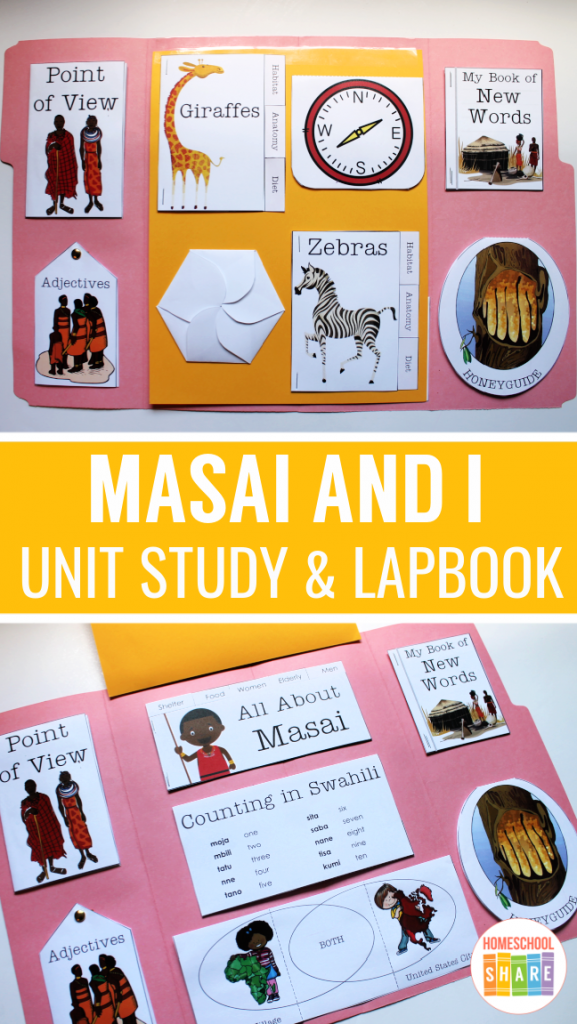
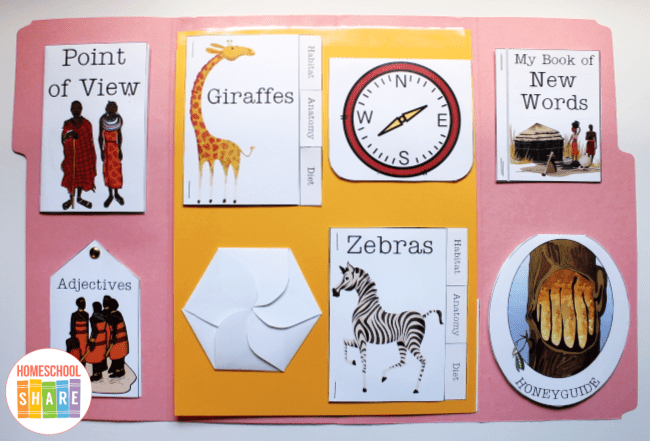
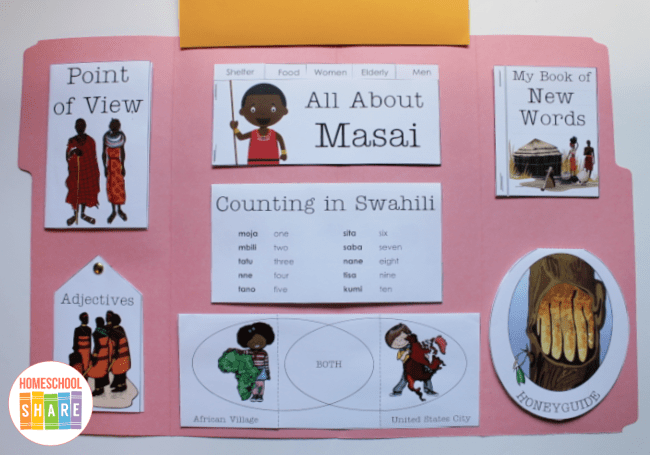
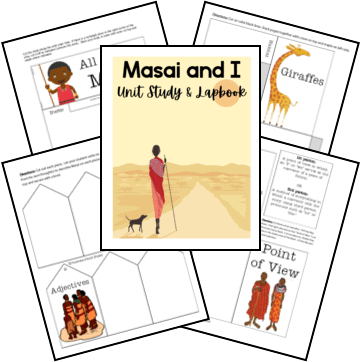
Lapbook Templates
Does your student want to
include more about African Animals in his lapbook?
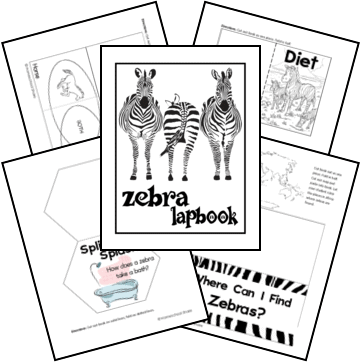
Try Homeschool Share's Zebra Lapbook
and Ostrich Lapbook
Social Studies:
History : African- Americans –
The
little girl from whose perspective the story is written feels a certain
kinship with the Masai people as she learns about their
culture in school knowing that her ancestors
were from Africa. Ask your child, “If you were to feel a tingle of
kinship with a group of people who would it be with?” This could lead to
a talk about where their ancestors are from.
Geography:
Africa is a continent that consists of over 50 different countries each with many different tribes having their own unique cultures (Swaziland is an exception – it being a small one-tribe one language group nation; however even within this country there are tribes from neighboring countries that have settled there). The northern third of the continent is home to the Sahara Desert – the largest and hottest desert in the world.
African Culture:
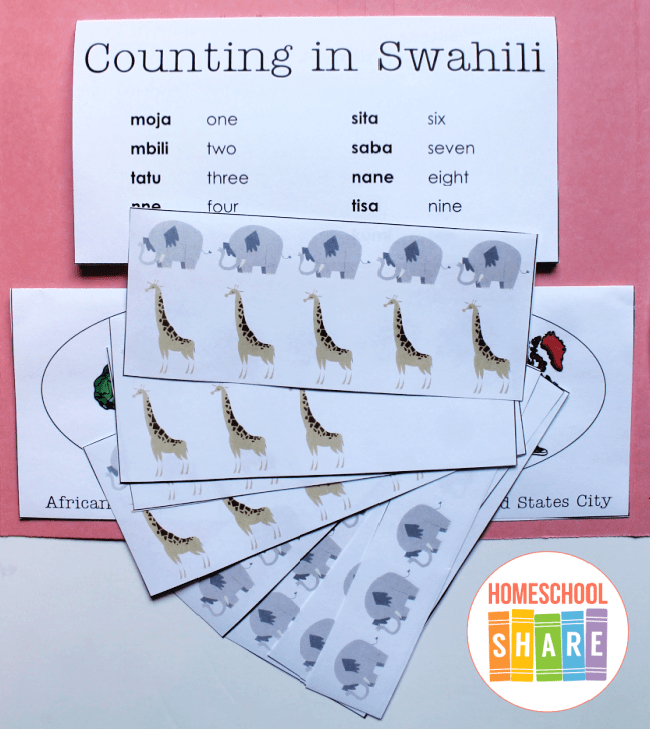
Contrast
the differences in village life in Africa compared to US city life, for
example:
1. Homes:
Mud and stick huts are clustered
together for extended family to live together in homesteads, cooking by
open fire, lack of
refrigeration, furniture ,
windows and beds (sleep on mats).
2. Mode of Transportation:
It would not be unusual in the
villages of Africa to walk a mile or several miles to get to water, get
to a store etc.
Note: You should, however, point out
that just as in the US rural and urban areas vary a lot, so there are
cities in Africa that are much
more modernized where people do live
in concrete style homes or apartments with furniture and beds and where
people get around
by cars and buses.
3. Tribal Life:
The Masai is just one tribe of 100's in Africa; each tribe has its own
language and unique culture; Notice in the book the distinctive
dress of the Masai people-including
loose cloth and large beaded necklaces and hoop earrings (even the men);
the Masai people
wear a lot of red clothing which stands for
“power” and are strong warriors** (note the
double page of the warriors with no text); notice
also the differences in girls' names
mentioned in the book.
Source
4. Resourcefulness:
Rural Africans generally live off the land growing their own food,
selling their extra, raising livestock for personal use and sale,
selling
handicrafts made from grass, wood,
clay etc.
Growing up in Africa, children learn to be resourceful at an early age;
Instead of going to the store to get sweets, children in rural
Africa will look to nature to find
something sweet such as honey from a beehive, sugar cane from the field
or fruit from a fruit tree
(guava, mango, etc).
(Note: this section is not directly related to the story but would be
fun to look at since the story is about children)
Many of the toys would be more simple
and made with available resources (tin cans, wire, sticks etc); see the
supplemental books
listed at the end to look more
closely at African toys. The Mancala game originated in Africa but has
been adapted and played
around the world; traditionally it would be
carved from wood and small stones would be used as the playing pieces.
To make your own
Mancala game from egg cartons and tuna cans
visit:
http://www.kidsdomain.com/craft/mancala.html
The game can
be played with marbles, small stones, shells, beans etc.
In spite of
all these differences, there are commonalities between the two cultures
that you can bring out: love of family, respect, participation in
household chores, self-care
Masai
Many different kinds of people live in Africa; they have different
ways of life, different customs, different languages, different foods
they eat. Masai (also spelled Maasai) is one tribe of people who
can be found in Kenya and Tanzania.
The Masai are a warrior tribe typically pictured wearing a red cloth and
holding a spear. They live in villages consisting of 8 to 15 huts which
the women are responsible for building. The frame is built of
branches and then a plaster mixture of twigs, grass, and cow dung is
applied to the frame. When the mixture dries, it is very strong
(comparable to our cement). It takes a woman about 7 months
to complete the task of building one hut.
Inside the hut, the only openings are the doorway and a small hole in
the roof or wall which allows the smoke from a fire to escape. They use
dried cow dung for fuel to keep the fire going to cook and keep them
warm during the rainy season. The only furnishings inside are beds of
woven branches cushioned with dry grasses and animal skins.
Women and girls are also expected to milk the cows and fetch water.
Their time is also filled with beadwork; they decorate animal hides with
beads in addition to making arm and leg bracelets. They also pick
gourds and clean them. Then the gourds are decorated with leather
and beads. They use the gourds to store milk, water, honey and cornmeal.
Masai do not kill animals for food but will eat them if they die
naturally.
In order for the village to be protected from wild elephants, lions, and
cheetahs, the men use thorny branches (comparable to our barbed wire) to
build fences. At night, Masai bring their domestic animals (cows,
goats, etc.) inside the fence so they will be protected as well.
The men's primary job is to care for the cattle which they believe God
has entrusted to them. Their wealth is measured by the number of cattle
they own. As young Masai boys reach the age of 15 they participate in
coming of age ceremonies which include many rites and rituals. Several
Masai warriors will live together in one hut until they have passed on
to manhood (5 to 7 years time). Then they will marry and bring their
wives and raise their families in the same hut. People of the same age
usually live in the same kraal. The elderly will all live together but
teach traditions and skills to the youth; they also lead celebrations
and ceremonies.
Language Arts –
Point of View-
Ask your child who is telling the story? This story is told in the 1st person by the African-American girl holding the African artifact in the first illustration; she uses her imagination to consider what it would be like to grow up in Africa.
Vocabulary -
kraal (pronounced crawl): an enclosure for domestic animals in Africa
kinship: relationship
tingle: to feel a pricking or thrilling sensation
cowhide : the hide (skin) of a cow or leather made from it
gourd: a hard-rinded inedible fruit the shell of which may be used for carrying water
sod: top layer of soil
slender: slim, thin
graceful: attractive; moving with ease
glide: to move smoothly and effortlessly
lope (along):
moving in an easy manner
Swahili
Vocabulary Cards made by Kimberly
Kaffenberger
Adjectives:
used to describe the Masai people - tall, proud; you can also add your
own:
e.g.
hard-working, strong
Science
Animal Kingdom-African animals:
Mentioned in the book – cattle, zebras,
ostriches, giraffes. Determine which animals are unique to Africa?
(zebras, giraffes, ostriches) Which are found in other parts of the
world as well as Africa? (cattle, fireflies, bees); the birds in the
“running and leaping” photo is a guinea fowl, also native to Africa.
This can lead to a discussion of animal habitats: Desserts, Plains,
Congo....
You may want to check-out the report forms and copywork pages on Homeschool Share's Animal Forms page as well as the Zebras Lapbook and the Ostriches Lapbook in the Animal Studies section.
Red Clay:
Much of
Africa is covered with red clay; As the story notes, this clay is
sometimes mixed with fat and used on the skin and in the hair; also used
for the walls and floors of huts, making pots etc.
Honey:
You may
choose to review honeybees and calming of bees. See if you child can
identify what was meant by “honey guide”
Fire: can lead to a discussion about creating fire by the friction of rubbing sticks together
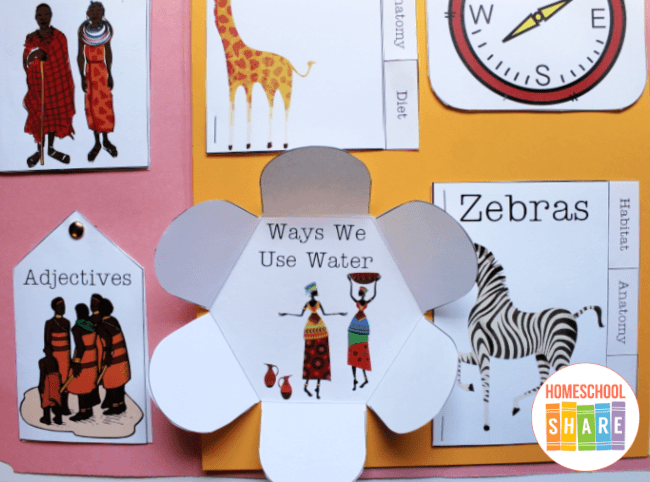
Health: Water Sources -
Water is essential to life; Discuss what
we need water for – drinking, cooking, washing ourselves, dishes,
clothing, feeding to livestock, irrigating crops; In parts of Africa and
especially at various times of drought water can be scarce; In rural
areas, running water is not common and water sources could include:
rivers, springs, catchment systems for rain water, bore holes (deep
hole, similar to a well, but smaller in diameter with water pipes to
carry the water out); Children learn from an early age to balance large
buckets or gourds of water on their heads. Get on your swimsuits and try
carrying buckets of water on your head, African style!
Math
Directions
North, South, East, West – locate these areas of Africa on the map and
note that several countries make up each area of this vast continent;
the Masai people are from East Africa ( mostly living on the border
between Tanzania and Kenya)
Distance – 3 miles = think of a landmark in your area that
is about 3 miles away in order to better visualize the distance; it
would take close to one hour to walk each way.
Art
Method:
A note from the artist at the start of the book (after title page) states her method as being “oil and color pencil on paper”. The first illustration in the classroom shows this method clearly and your child could attempt this art style.
Viewpoint-
In most cases, the illustrations spread across double pages, with one side illustrating life in the US city, contrasted on the opposite page with life in rural Africa. The artist does this in such a way that the illustrations are blended across the page. Enjoy each of the illustrations that accomplishes this unique style. For example, note especially the page where the girl opens her apartment door into what looks like the African homestead; the page where the girl is walking down the street to the store is drawn in such a way that the tree's shadow appears to be formed by the tree that the African children are searching for honey in. Likewise, in the page about the animals/pets it appears the little girl is looking at the elephant. On the page where the girl is preparing for her grandmother's celebration when she looks in the mirror she sees a reflection of the Masai girl.
Details:
Notice the
artifacts in the classroom ( Masai necklace, a gourd), Africa on the map
on the wall of the classroom, the differing shoes on the title page
which are mentioned in the text, as well as the way the letters of title
page are decorated in an African art style
Supplemental Books and Resources:
A
is for Africa by Ifeoma Onyefulu; this book
was written from a perspective and illustrations from Nigeria (West
Africa) but the author cites that the goal of the book is to represent
common African values of “warm family ties,
traditional famille life, and
hospitality”; it has some great photos
Galimoto by Karen
Lynn Williams
Add even more to
your Unit Study!
Africa Lapbook
from Hands of a Child
Materials and information on this website belong to the original composers. It may be used for your own personal and school use.
Material may not be used for resale. © 2005-07 HSS