| about us |
what's new
|
unit studies
|
unit study helps |
hss resources
|
fiar resources | indexes | lapbooking |
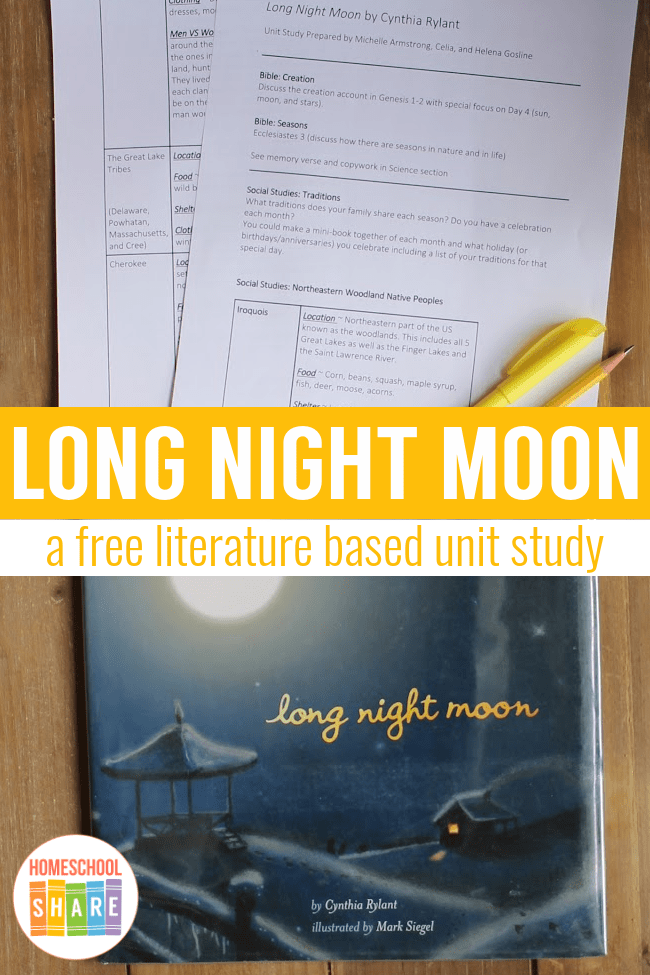
Long Night Moon
Author: Cynthia Rylant
Illustrator: Mark Siegel
ISBN: 0689854269
Summary: A lilting text with wispy pictures of how the moon changes
throughout the year. Poetic descriptions of the seasons and the
Native American names of each month’s moon are described.
Unit Study Prepared by Michelle Armstrong; Native American Lessons by Helena Gosline; additional lessons by Ami and Celia
Bible: Creation
Discuss the creation account in Genesis 1-2 with special focus on Day 4
(sun, moon, and stars).
Bible: Seasons
Ecclesiastes 3 (discuss how there
are seasons in nature and in life)
See memory verse and copywork in Science section
Social Studies: Traditions
What traditions does your family share each season? Do you have a
celebration each month?
You could make a mini-book together of each month and what holiday (or
birthdays/anniversaries) you celebrate including a list of your traditions for
that special day.
Social Studies: Northeastern Woodland Native Americans
Iroquois
(Known as the “Five Civilized Tribes”. These tribes included the Cayuga, Mohawk, Oneida, Onondaga, & Seneca.) |
Location ~ Northeastern part of the US known as the woodlands. This includes all 5 Great Lakes as well as the Finger Lakes and the Saint Lawrence River. Food ~ Corn, beans, squash, maple syrup, fish, deer, moose, acorns. Shelter ~ Long houses Clothing ~ Deerskin breechcloths, fringed dresses, moccasins Men VS Women
~ The women ran things around the home. The elder women were the ones in
charge. The men cleared the land, hunted, fished and fought in wars.
They lived in clans. The clan mother headed each clan and selected the
men that would be on the council. When they married the man would join
the women’s clan. |
|
The Great Lake Tribes
(Delaware, Powhatan, Massachuset, and Cree) |
Location ~ beside the Great Lakes Food ~ clams, oysters, lobsters, mussels, wild birds and game, nuts, greens, & berries Shelter ~ wigwams Clothing ~ wore little clothing except in winter – made from elk and deerskin. |
|
Cherokee |
Location ~ North Carolina, they tried to settle further North but the Iroquois would not let them. Food ~ Corn, squash, beans, deer, turtles, pumpkin, melons, sunflower Shelter ~
Winter – Round homes Clothing ~ Deerskin, moccasins, and rabbit fur decorated with porcupine quills. Men VS Women ~ They lived in a village. The village had two chiefs. The white chief (Peace) and the Red Chief (war). The white chief and the Village council made decisions for the village. During peace time the red chief just prepared for war. Women could be on the council if chosen. |
|
Ojibwa |
Location ~ Northern Great Lakes Region Food ~ Maple syrup, bread, rice, squash, pumpkins, potatoes, wild fruit, fish, corn, deer, beaver, muskrat, raccoon, elk Shelter ~ Wigwam - Round building with a round top Clothing ~ Deerskin leggings, shirts, and dresses. In winter used fur to make clothes. Moccasins Men VS Women ~ They lived in clans. When they got married they would live with the wife’s family for a year then move into their own wigwam. When a baby was born it belonged to its mother clan. |
|
Algonquin |
Location ~ Northeast in what is now New York, Pennsylvania, New Jersey, and Delaware. Food ~ corn, maple sugar, clams, oysters, lobsters, mussels, wild birds, moose, caribou, beaver, otter, nuts, greens, & berries Shelter ~ wigwams Clothing ~ wore little clothing except in winter – made from elk and deerskin. |
Using the table above, discuss and compare the different tribes. We did a three-tab fold and recorded our information or drew pictures and glued them inside of a shutter fold or portfolio fold. We compared the food, clothing, and shelter in our tab book.
Possible read aloud books:
Note: Helena has not read all of these books, so you may want to pre-read them.
Soft Rain by Cornelia Cornelissen
Indian Shoes by Cynthia Smith
Aunt Mary, Tell Me a Story by Mary Chiltosky
Seven Clans of the Cherokee Society by Reed
If You Lived With The Cherokees by Peter Roop
Trail of Tears by Joseph Bruchac (Step Into Reading)
The First Strawberries by Joseph Bruchac
Only the Names Remain by Alex BealerGuests by Michael Dorris
Houses of Bark by Bonnie Shemie.
The Star Maiden by Barbara Juster Esbensen
Grandfather Bear: A Story Told in Cree
The Path of the Quiet Elk: A Native American Alphabet Book
by Virginia A Stroud
How Turtle's Back was Cracked: A Traditional Cherokee Tale retold by Gayle Ross
The Story of the Milky Way: A Cherokee Tale by Joseph Bruchac
Language Arts: Vocabulary
Moon – a satellite that orbits a planet
Month – a set of days to measure time that follows closely the period of the moon’s revolution. Approximately 30 days or four weeks
Year – a set of months to measure time. There are twelve months in a year
Hope – to expect with confidence
Path – a worn area that leads from one place to another
Wait - to remain in place in readiness or
expectation of something
Language Arts: Introduction to Cursive Writing
Since the font of this book is in cursive, you may want to introduce your
younger student to cursive writing. You may be able to inspire your
older student to use her best cursive for one of the writing assignments this
week.
Language Arts: Discussion
Discuss what the
current season is, then discuss what "your breath" is like this season.
Discuss what it is
like when "clouds beat their drums". What does that mean?
This book makes the
seasons in a year seem like a visitor; waiting, then here, then leaving again.
Also seems to come & go each day. Discuss the "ebb&flow" or dynamics of this
book.
Discuss other aspects of Rylant's poetry.
Which moon described by Rylant is your favorite? Your student's favorite?
Why?
Language Arts: Creative Writing (name the moons!)
After you have read this story a few times and your student understands that
Native Americans gave the moons different names as we give months different
names, encourage your student to create her own names for each month's moon.
This is a simple writing assignment that will promote creative thinking. Your student may want to make a small booklet
to write each of her moon names along with an illustration of each moon.
Language Arts: Creative Writing Extension- Poetry Writing
If your student wants to delve further in to creative writing, encourage her
to write a poem (short descriptive phrases) for one, some, or all of her moon
names (from lesson above). Note that Rylant doesn't use fancy words
or a lot of words-- just simple words with power when put together. Again,
she may want to make a small booklet to write her moon name/moon poem along with
an illustration of that moon.
Science: The Moon and Moon Phases
Despite various legends and myths, the moon is not made of cheese or
anything soft; there also isn't any life on the moon! It's a big ball of
rock -- a dry, dusty place lacking air and water. The surface of the
moon is rocky with hills and huge holes (craters). These craters are
caused by rocks floating through space that crash into the moon.
As the moon moves around Earth, the Sun lights up different parts of the moon
making it seem like the moon changes shape. However, the moon's shape is
always the same.
New Moon-- This is when the Sun shines behind the Moon, we can't see the "light"
side
Crescent Moon-- This is when you can only see part of the Moon
Full Moon-- This is when the Sun lights up one entire side of the Moon
To demonstrate the concept of the Sun lighting up parts of the Moon, we've made
cookies. Using a circle cutter, cut your favorite sugar cookie dough
(Pillsbury Ready to bake, anyone?) and tell your student that the circle
represents the Moon. Bake the cookies. Now, frost the cookies to
demonstrate the three moon phases mentioned above. Discuss the following
with your student--
Does the moon change? (No...it's always the same shape)
Does the way the sun lights up the moon change? (Yes)
What are the three phases we learned (and point to each cookie that represents
that stage)? New Moon (no frosting), Crescent Moon (partly frosted in a
crescent shape), Full Moon (fully frosted-yum!).
You may also want to Introduce your student to
waxing and waning.
Phases of the Moon
Demonstration
Here is more information on the Moon from Enchanted Learning:
General Description of the Moon
Inside the Moon
Phases of the Moon
Go out every evening (that you are studying this book) and observe the moon.
If you have a telescope, look through it at the moon. You could also take
pictures of the moon. You may want to continue tracking and charting
what the moon looks like for an entire month.
Extend your Moon Study-- Hands of a Child Moon Project Pack
(Note: the seven stars
mentioned here is probably referring to a star cluster called Pleiades, or The
Seven Sisters.)
If you have a membership to Enchanted Learning, you may wish to print out the
Orion dot-to-dot activity page.
Constellation and Orion Pictures
If you place your mouse over the
picture and it hold it there a second, it will outline the constellations for
you so you can see them better!
http://www.astropix.com/HTML/SHOW_DIG/008.HTM
http://antwrp.gsfc.nasa.gov/apod/ap060720.html
http://www.astropix.com/HTML/SHOW_DIG/SHOW_DIG.HTM
http://www.astropix.com/HTML/SHOW_DIG/013.HTM
Science: Seasons
Go
through the book with your student noting the pictures are near the same tree--
sometimes right under, sometimes right beside, and sometimes beside it but
further away. Discuss how the tree changes through the seasons.
If you have an opportunity, take a picture of
one tree in your neighborhood or favorite park (or observe and enter in a nature
journal/notebook) then go back in the next month or season and take another picture of it.
Do this for each month/season through the rest of the year.
Applied Math: Calendar Skills
If your student doesn't know the months of the year, this would be a great time
to learn them!
Applied Math: Counting
This book has oodles
for your student to count. Find something different on each page to count: how
many stars or birds in the sky, how many footprints, how many
skunks/rabbits/lightning bugs, electric poles, etc.
Applied Math: Dozen
Introduce or review the concept of one dozen. There are twelve months in
our year, there are twelve full moons shown within the pages of our story (if
you only count the pages concerning the months and not the pages at the
beginning and the end with the mother and child close up in the gazebo). Twelve
of anything is also called a dozen.
Art: Mixed Medium
Illustrations are rendered in charcoal, pencil, and pastel on Arches paper
and digital color. Encourage your student to make a picture using mixed
mediums (include charcoal, pencil, and pastels if you have them on hand).
If your student is making a book with illustrations (see creative writing
lessons) encourage her to fashion her illustrations with these mediums.
If you don't have pastels on hand, you may want to substitute with chalk.
Your student may also enjoy drawing with pastels (or chalk) on different
materials and blending the colors together using fingers or a napkin or whatever
else you can think of to blend with (q-tips work nicely, too).
Art: Attention to Detail
The illustrations are described as "wonderfully atmospheric." The more
you study the illustrations, the more you see. What does your
student see if he really looks at the pictures? Some discoveries may
include the wolf in the clouds, hibernating bears, squirrels in the trees,
raccoons in the field, bunny rabbits, skunks, bugs going up the tree, birds,
etc.
Cumulative Activity (Math, Language Arts, Science, Art)
1. Brainstorm (pre-writing activity)
Discuss the four seasons with your child. Make a column or area on a piece
of paper (can be scrap since this is your pre-writing) for each season.
Write down words, phrases, etc. for each season. Also include the months
that are contained in each season.
2. Divide a poster board into fourths by drawing a large t (that looks like +).
You could discuss fractions after you draw the t (fourths). Discuss the
four seasons and have your student write the months of each season in he
corresponding quadrant. Write the name for each moon (as mentioned in the
book) beside the correct month.
3. Write the other phrases and words from your pre-writing in the appropriate
quadrant
4. Optional: have your student draw or paste pictures (cut-outs from
magazines work well) that correspond with each season in the correct quadrant.
Just For Fun: Listening to Music
Listen to Native American Music (check your local library for ideas)
Listen to Vivaldi's Four Seasons (Can your student determine which piece
of the music depicts which season? How does she know?)
Just for Fun: P.E.
Make up a dance for each season (you could do this as you listen to Vivaldi--
see above)
Walk like the animals in the pictures
Websites
Native American
Moon Names
Library List
Tasha Tudor’s Around the Year and
A Time to Keep: the Tasha Tudor Book of Holidays
Nightlight: a Book About the Moon, Dana Meachen Rau
The Moon Book by Gail Gibbons (may contain evolutionary content)
Sunshine Makes the Seasons by Franklyn Mansfield Branley
Earthwise’s Seasons by Jim Pipe
Nature
in the Neighborhood
by
Gordon Morrison
Materials and information on this website belong to the original composers. It may be used for your own personal and school use.
Material may not be used for resale.
© 2005-07 HSS