Affiliate Disclaimer
We sometimes use affiliate links in our content. This won’t cost you anything, but it helps us to keep the site running. Thanks for your support.
Enjoy a classic book and dive into fun avenues of learning with our The Little Island activities and printables.
Thanks to Shannon Cook for preparing this The Little Island unit study for Homeschool Share.
The Little Island Summary
Winner of the 1947 Caldecott Medal, this beautifully moving story centers around a little island in the midst of the wide ocean, and the curious kitten who comes to visit. As the seasons pass, the island and the creatures who call it home witness an ever-changing array of sights, smells, and sounds – proving that, no matter how small, we are all an important part of the world.
from The Little Island at amazon.com
This book by Margaret Wise Brown has stood the test of time. It is the rich base for a variety of lessons found in our The Little Island unit study and lapbook.
The Little Island Unit Study Lessons
Here are a few sample lessons from The Little Island unit study:
Language Arts Lessons
Describing Words
Margaret Wise Brown uses many descriptive words, or adjectives, to paint vivid pictures and engage four of the reader’s senses – sight, smell, hearing, and touch. See if your student can find some of these describing words and phrases as you read the story. Talk with your student about some of the words the author uses such as, “tickly – smelling pear tree” or the “howling, moaning, whistling wind.” Do these words make you think about how the wind sounds during a storm or how a pear tree might smell?
Ask your student to choose an object to describe. Have some items available for him from which he can choose. Some items from nature would be especially fitting for this story – perhaps a flower, a pinecone, or a leaf – things that will be easy for your student to describe with more than one of his senses. For the younger student you may need to guide him in describing his object with more than just his sense of sight. Let your student make a list of words that describe the object he has chosen.
Science Lessons
Islands
An island is a piece of land that is completely surrounded by water but is not large enough to be a continent. Check out a book about islands to look at together. Show your student how the islands are completely surrounded by water. You might also want to show them this on a map. Explain to your student that even though an island is surrounded by water, it is still part of our earth because it is attached down at the bottom of the ocean. This may be a hard concept to grasp. You might want to draw a simple sketch showing the side view of island and what it looks like beneath the water. Check out the book Islands by Philip Steele for more information and pictures.
There are many different kinds of islands. Some are flat with sandy beaches, some have rocky beaches, others (like the one in the story) have rocky cliffs and ledges, and others are mountainous. Islands are formed in different ways. Some, such as the British Isles, were part of large continents but became separated from the continents when sea levels rose and land was flooded. Some other islands like New Zealand were formed because they became separated from large continents when movements in the Earth’s plates caused the land to break off and drift away. Others, like the Hawaiian Islands, are the result of volcanoes erupting under the ocean. The deposits of molten rock and lava grow larger until eventually an island is formed. The world’s smallest island, Surtsey, in Iceland, was formed in this way over a period of days in 1963.
Since some islands are formed from volcanoes, make and erupt your own volcano. (Activity instructions are included in the unit study download.)
Animals and Migration
In the story many animals come to the island for different reasons. When animals travel to a different area at certain times of the year in order to survive, this is called migration.
Talk about the different animals that migrate to the island and their reasons for coming there. (The lobsters come there to molt, the seals come there to raise their young, and the kingfishers come there to build their nests.) See if your student can name any other animals that migrate to the little island. (butterflies, moths, etc.)
Social Studies Lessons
Geography: Determining Location
The author does not reveal to us the exact location of the little Island, but we do know that this island was visited by lobsters and seals and had rocky ledges and fir trees – just like the islands off the coast of Maine. Also, Margaret Wise Brown had a home on an island in the Gulf of Maine, so we would probably be safe to guess that this story is set in the coastal Northeast.
To access all of the lessons in this The Little Island unit study, grab an easy-to-print file at the end of this post.
The Little Island Lapbook Printables
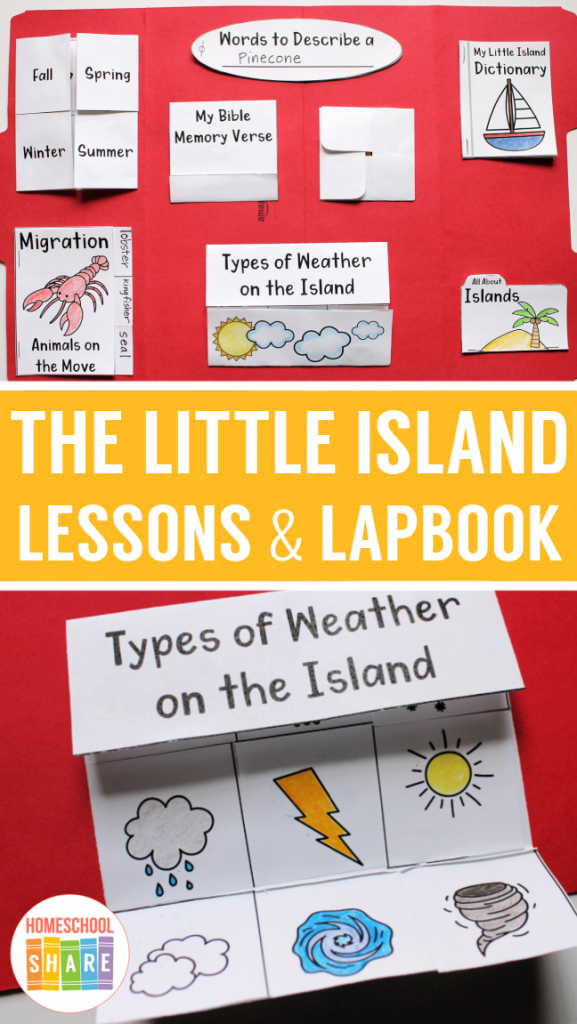
These printable activities are included in the download to help your student create a The Little Island lapbook.
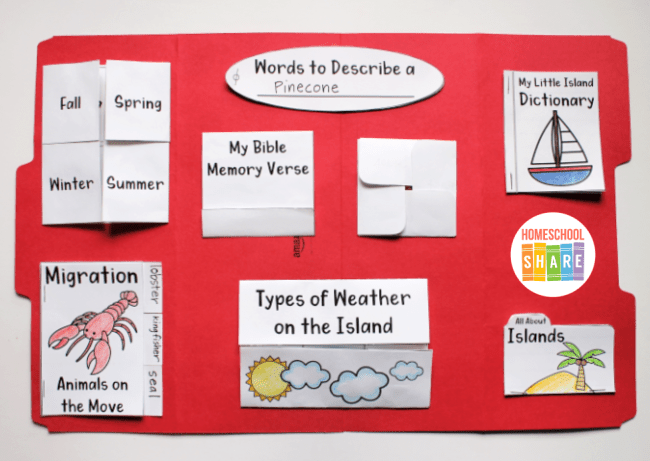
- Migration: Animals on the Move Tab Book
- My Little Island Dictionary
- Compass Petal Book
- Types of Weather on the Island Shutterfold Book
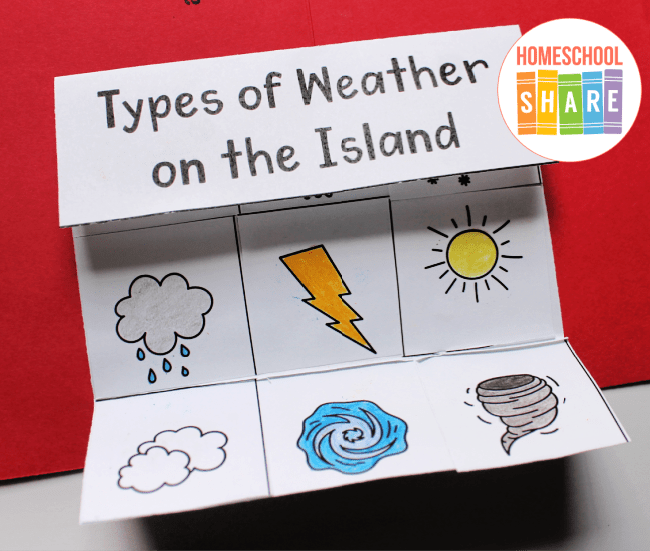
- Describing Words Fan
- All About Islands File Folder Shape Book
- Caldecott Medal Simple Fold Book
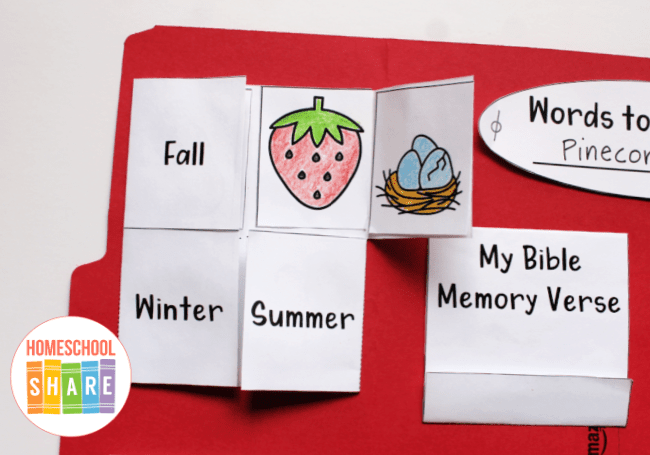
- My Bible Memory Verse Matchbook
- Seasons Shutterfold Book
How to Get Started with The Little Island Lessons and Printables
Follow these simple instructions to get started with the The Little Island unit study.
- Buy a copy of the book, The Little Island, or check it out from your local library.
- Print the The Little Island unit study.
- Choose the lessons you want to use with your student (a highlighter works great for this).
- Choose and prepare the lapbook printables you want to use with your student.
- Enjoy a week of engaging learning with your student.
Download Your Free The Little Island Study and Printables
Simply click on the image below to grab the free The Little Island unit study and lapbook.
Check Out These Related Unit Studies