| about us |
what's new
|
unit studies
|
unit study helps |
fiar resources
|
indexes | lapbooking |
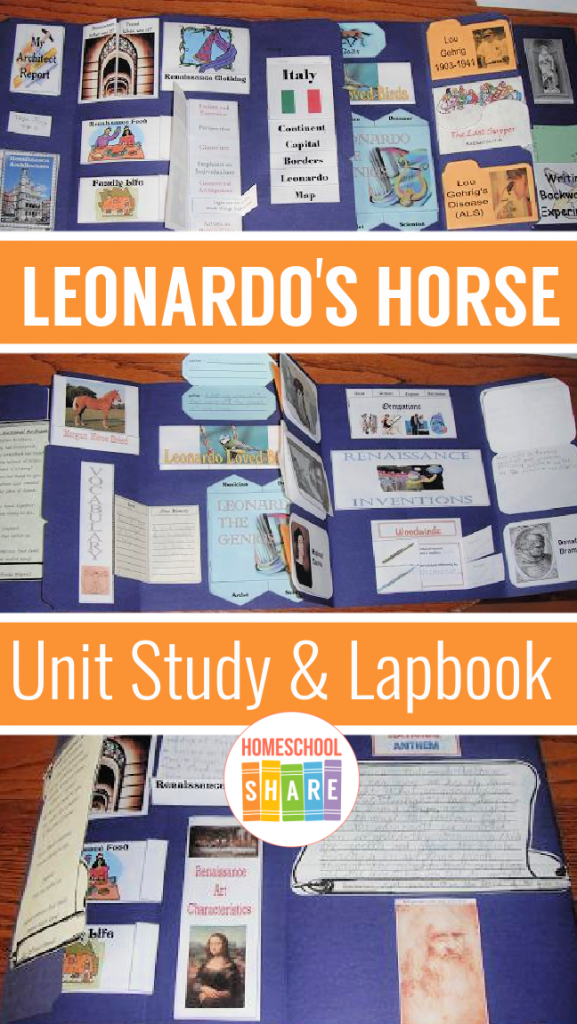
Leonardo's Horse
| Author: Jean Fritz Illustrated by Hudson Talbott Summary: Fritz's narrative opens as Leonardo da Vinci earns a commission from the duke of Milan to create a sculpture to honor the duke's father a bronze horse three times larger than life. Though this creative genius spent years on the project, he died without realizing his dream and, writes Fritz, "It was said that even on his deathbed, Leonardo wept for his horse." The author then fast-forwards to 1977: an American named Charles Dent vows to create the sculpture and make it a gift from the American people to the residents of Italy. How his goal was accomplished (alas, posthumously) makes for an intriguing tale that Fritz deftly relays. An inventive introduction to the Renaissance and one of its masters. ISBN: 0399235760 Unit prepared by Jodi Small Lapbook created by Cindi Fry |
Lapbook Templates
Social Studies
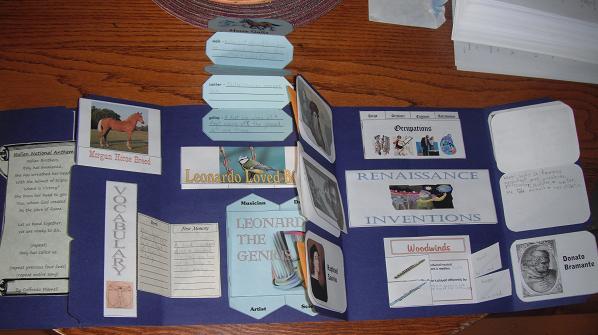
There are many occupations mentioned throughout this story. Discuss the ones that most interest your child. Complete Occupations Tab Book.
Artist - An artist is someone who uses his imagination to create something using a variety of materials. There are many types of artists including photographers, painters, cartoonists, illustrators, pottery, and jewelry. There are many others. Research your favorite type. What kind of experience might this person need? What famous artists in your researched area can you find? (See art lessons for information on a few other Renaissance era artists.)
Architect - An architect is another type of artist who plans and designs buildings, makes the blueprints for the building, and supervises the construction process.
Building architects have to think about their buildings before they can make the design. What kind of building will it be? An office building would need lots of rooms, while a train or bus station needs one large room. A library or school needs large rooms.
What is the function of the building? How can it be most efficient for everyone using the building? It would be unrealistic to put the men’s restroom and the women’s restroom on opposite parts of the building because it’s inconvenient for families and there would be more plumbing needed. At a train or bus station, the ticket area needs to be easily seen and easy to get to.
How can I make it safe? Are there enough fire escapes? Is the roof strong enough for heavy rains or snow?
Every architect has his or her own style, just as a painter would. Some architects like lots of curves while others use many straight lines to make their buildings look sleek and smooth.
Architects can use a pencil and paper along with a ruler and/or graph paper to make their designs. However, anymore, many use computer programs designed for architects. Many architects work as part of a team.
In order to become an architect, you need to enjoy design and art. You should have an eye for details and be able to work with a variety of other people. Even if you design alone, you will have to be in contact with the builders. Architects use math along with art in order to make their designs.
Other types of
architects:
Landscape architect – designs outside the building. Where would a pond go
for efficient drainage? What is the best use of trees for shade? How big
should the parking lot be?
Urban designer – plans the arrangement of a city – where the roads should go, their shapes, and where public areas should be.
Architects can design bridges, roads, dams, and canals. Civil engineers and these architects work together.
Other famous
architects to research:
Frank Lloyd Wright
Buckminster Fuller
Maya Lin (woman architect who designed the Vietnam Veterans Memorial in
Washington DC)
Architect
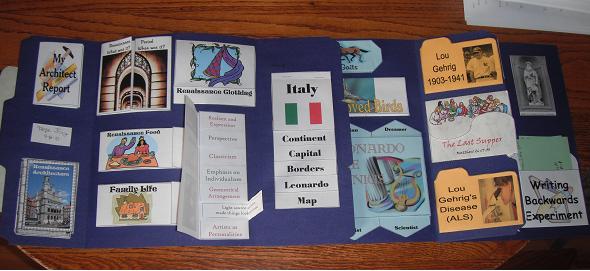
Report Hotdog Book*
Architect Book (no lines)
Engineer - An engineer develops new products. They use science and
mathematics in their profession. There are several different kinds of
engineers – industrial engineers, electrical engineers, agricultural
engineers and chemical engineers – to name a few. Research one of these
types. What kinds of things does this engineer do?
Astronomer - Astronomy is the study of space – stars, galaxies, planets. Research what an astronomer does. What kinds of things must an astronomer study in school?
Characteristics
of an Artist -
Why
would the people of Vinci, Italy not be surprised that Leonardo would become
an artist? The story says that he stopped to examine things and that he
carefully looked at the land to see the details. The illustrations show
Leonardo with drawing pads and brushes. Having an eye for detail is one
characteristic of an artist.
Characteristics
of a Genius -
A
genius is a smart person. Often a person considered to be a genius will not
only be smart, but he will also be “different.” Remember how the story said
that people noticed Leonardo was different? Do you remember how he was
different (dressed differently, wrote backwards, wouldn’t eat meat).
History-
Renaissance Period -
During the
Middle (Dark) Ages, people forgot things that had been known before. They
no longer read books or made new inventions. Leonardo lived at the time
when the Middle Ages had ended and people had begun to learn again. This
time period was called the Renaissance. The word Renaissance means
“rebirth”. During this time period, every way of thinking was challenged.
New ways of thinking were introduced. They became curious again and started
inventing things again. This “new thinking” was shown in the arts, poetry,
literature, and religion. The Renaissance period lasted from the 14th
to the 17th century.
Renaissance Period Shutterfold
Fashion -
Clothing during the Renaissance Period was a status symbol. The more
elaborate the decorations, the more expensive the clothing was. The wealthy
spent much of their money on their clothing. Silk, velvet and cotton were
expensive fabrics at that time.
Women began wearing hoops under their skirts. Men wore padding at their shoulders and hosiery on their legs. Men and women wore collars that stood up around their necks. Clothing was heavily embroidered and beaded.
In order to differentiate the wealthy from the common people, royalty established a law that commons only wear one color of clothing. To show their disapproval, commons began wearing two colors in layers and slashing their upper layer so the contrasting color would show through. This became a popular fashion during this time.
Before this
time, women wore high, pointy hats with all their hair covered. During the
Renaissance, head coverings became optional, depending on your age or the
weather. Berets, or short caps, were invented. Berets were decorated with
beads and had a drawstring so that it would fit any size head.
Complete
Renaissance Clothing Matchbook.
Family Life -
The Renaissance family consisted of the parents and children. Very few
people lived long enough to be grandparents. Women stayed home to care for
the children while men worked either in the fields or in merchant shops.
Boys were sent to private school when they were seven years old. At age 14,
they worked alongside their fathers to help with finances. Girls stayed
home with their mothers to learn how to run a household.
Food -
Eating was thought to be only for nourishment. During the Renaissance,
eating became thought as pleasurable. Food was prepared to be both pleasing
to the taste and pleasing to the eye. Garnishments were used. Roasts were
a popular main dish. Side dishes were introduced, mainly a variety of
pastries. Soups were rich and expensive to serve. They were made in
various colors and seasoned with sugar and spices.
Complete
Renaissance Food & Family Life Matchbooks
Architecture -
Architecture during this time changed from complex to symmetrical and
proportioned. Windows were symmetrically arranged, columns were used and
there were arches and domes. Buildings became very ornamental. Homes were
small with only one or two rooms. They had low ceilings and cooked over the
fireplace. It was not uncommon for families to share one bed.
Complete
Architecture
Book Shape.
New Inventions
During the Renaissance -
~Mechanical
clocks – Time began to be measured in 24 hour time periods. After the
invention of the pendulum by Galileo, clocks became more accurate.
~Eyeglasses – Only the wealthy or well educated wore eyeglasses.
~Microscopes/Telescopes –After the invention of the eyeglasses, lenses were
created to see close up and far away for scientific purposes.
~Printing press – Invented by Gutenberg, books could now be printed instead
of copied by hand as it had been done in the past. The Bible was the first
book to be mass-produced.
Complete
Inventions Side
by Side.
History- Famous Person: Lou Gehrig -
Lou Gehrig was born in New York in 1903. He played major league
baseball for the New York Yankees. He holds the record (in 2009) for the
most career grand slams at 23. During the 1939 season, Gehrig had loss of
strength and struggled playing baseball. He remained on the team as a team
captain. After going to Mayo Clinic, he was diagnosed with ALS (amyotrophic
lateral sclerosis), also known as Lou Gehrig’s disease.
Lou Gehrig’s disease is an attack of the central nervous system. It causes decreased strength leading to paralysis, difficulty swallowing and talking, and a short life expectancy, however, the person is fully aware of everything going on in their body. Lou died in 1941. There is no cure for Lou Gehrig’s disease. Lou Gehrig File Folders
History: Famous
Person: Leonardo Da Vinci -
Leonardo was
born April 15, 1452 in the village of Vinci in Italy. As a child, he
usually carried a notebook with him to make notes and sketches for his
inventions and art. Some of his notebooks survive.
Leonardo wrote that his first memory was of a bird called a kite and swooped down and brushed it’s tail on him as a baby. He claimed this was why he was so interested in birds. His entire life, he drew pictures of birds and tried to figure out how their wings worked.
Leonardo lived during the Renaissance period, beginning in the 1300s and lasting until about 1600. The Renaissance began in Italy and spread throughout Europe. During this time, the people became excited about science, art, music and books. They studied the architecture of ancient Greece and Rome and began to recreate buildings from that time.
Florence, Italy was the center of the Renaissance thinking. When Leonardo was a teenager, his family moved to Florence. In the center of Florence was the cathedral, Duomo, with its red dome that could be seen from a great distance. The marketplace was in the oldest part of town. It is said that Leonardo would buy caged birds from the market and set them free.
Leonardo’s father took his drawings to Verrocchio, a famous artist. Leonardo became Verrocchio’s apprentice. An apprentice’s job was to keep the artist’s workshop clean, mix paint and clean brushes. Leonardo began to work under Verrocchio when he was about 16 years old. Most artists used tempera paints, but Verrocchio showed Leonardo how to use oil paints. Oil paintings were richer in color, but took much longer to dry than tempera. Leonardo’s first painting was the angel in the background of Verrocchio’s painting The Baptism of Christ.
When Leonardo was 20 years old, he began his own reputation as an artist and joined a guild. A guild was a group of people who were of the same trade, like a group of artists. Each guild had its own rules and they set up workshops around the city.
Leonardo, the
Musician -
Leonardo played the lyre. He designed his own instrument, which had seven
strings and was played with a bow like a violin. It was made of silver and
was shaped like a horse’s head. He sang poems along with his music and it
was thought that he also wrote his own music.
Leonardo, the
Dreamer -
Leonardo drew
and wrote down many ideas for inventions, many of which were never built.
Some of the ideas he had were for flying machines, bridges, buildings,
contact lenses, diving suits, and life preservers. Another of his ideas was
of an armored car that looked similar to the tanks of today. It was never
built during his lifetime, but if it had been, it would’ve been too heavy to
operate.
He drew plans for a double-hulled boat, which is an idea that we use today. If the first layer of the boat were destroyed, the second layer would protect it from sinking. He also drew plans for submarines and weapons, including a cannon and crossbow. He invented a parachute that was proved recently to work.
In 1502, Leonardo was hired to design a bridge for Sultan Bayezid II of Turkey. The sultan decided to not have the bridge built, but after Leonardo died, a Norwegian builder used the design for a bridge in southern Norway.
Although Leonardo thought up many flying machine plans, he never flew. The ornithopter was one flying machine he invented. The pilot would lie on his stomach and use his feet to push pedals hooked to the bottoms of each wing. He also designed a two-man ornithopter, where each pilot controlled one wing. Leonardo even drew plans for a helicopter.
Leonardo, the
Scientist -
Leonardo was
observant about the things around him –rocks, water, storms, weather, the
moon and the human body. He studied human anatomy by attending lectures
where the teachers dissected bodies during class. He also got special
permission to dissect bodies on his own. He studied the muscles and tendons
and drew skeletons. He wanted to know how bodies move. He also studied
plants and trees, leaves, and flowers. He drew many pictures of plant life.
Leonardo, the
Artist -
Leonardo found
new ways to paint, new ways to show clothing and other details. He mastered
perspective and used light and dark to make things look natural. Leonardo
had an apprentice study under him who was nicknamed Salai, which means
“little devil”. Salai stole things from Leonardo that he hoped to sell.
Salai came to him when he was ten years old and when Leonardo died, he left
Salai a house and garden and some paintings.
Duke Sforza asked Leonardo to design a bronze horse to honor his father. Leonardo wanted to show the horse on his hind legs, but realized that it would not work. There would be too much weight on the hind legs. He had his apprentice work a clay model of a prancing horse. When the French invaded Milan, the clay horse was destroyed.
Leonardo was hired to do a painting of the last meal Jesus had with his disciples called The Last Supper. He and his apprentices painted on the wall with tempera and oils, but the wall was not sealed properly and the painting soon began to fade. Leonardo took three years to finish this painting.
The Mona Lisa is Leonardo most famous painting. It is believed that her husband hired him for this painting. Leonardo worked on it for three years, and his was still with him when he died. No one knows why he kept the painting. Leonardo invented the technique, sfumato, meaning “smoked”. This technique is the layering of colors to soften lines. This technique was used around her mouth to make it look as if she is smiling.
Leonardo was hired by the city of Florence to paint a battle scene, known as the Battle of Anghiari. He spent much time sketching battle scenes before he began the painting. When he began the painting, he used wax to bind the paint to the walls. When a storm made the walls wet, Leonardo used heating pots to try to dry out the wall, but the heating pots got too hot and melted the wax. The painting was ruined and Leonardo never restarted the painting.
Leonardo’s
Death -
As Leonardo got
older, he lost use of his right hand. King Francis I asked him to come to
France and let him live in a house near the palace. He died in 1519 of
“black death” or the bubonic plague. People with this disease got black
spots on their bodies before they died.
Leonardo left many notebooks behind that were in the possession of his assistant, Francesco Melzi. When Melzi died, many of his notebook pages were sold or stolen. Many people wanted to see pages from the genius’s notebook.
Leonardo Minit Books to Complete:
Leonardo the Genius Tab Book
Leonardo's Life Story Hotdog Book*
Language Arts
Vocabulary -
Landscape - a
large area of land
Flurry – a confusion or commotion
Midst – the middle point
Elaborate –complicated or detailed
Rival – Someone whom you are competing against
Taunt – To try to make someone angry or upset by teasing
Mourned – To be very sad for someone who has died
Envious – To wish that you could have something that another person has
Flare – To burn with a sudden, very bright light
Gesture – To move your head or hands in order to communicate a feeling or an
idea
Hoisted – To lift something heavy
Envisioned – to picture mentally a future event
Pedestal – A base for a statue
Vocabulary Flap
Biography -
A biography is
a true story about someone’s life. An autobiography is a story about your
own life. Leonardo’s Horse is a biography of Leonardo Da Vinci, however, it
includes more details after his death that is not biographical of Da Vinci’s
life. The author includes this information because it finishes the story of
the horse statue he was trying to create. Write a biography of someone in
your family, or an autobiography of your own life. Biographies include more
than just a list of details. They usually include personal stories or
events that happened in that person’s life.
Onomatopoeia -
The
sound an object makes put into words is called onomatopoeia. Ping, Ping,
Ping was the sound the arrows made against the horse. What other words can
you think of that describes a sound?
Dialog -
Quotations marks (“”) are used to show someone is speaking. In Leonardo’s
Horse, quotations marks were used to show what Leonardo wrote in his journal
and what Michelangelo said to Leonardo. When reading a story, we read
these words with more expression. Write a story using dialog. It could be
a true story of something that was said to you, or you can make it up.
Art
In order to make the statue, Leonardo made a clay model of the horse. A clay model is not meant to last, but to only be a practice for what the finished product would look like. Try to make your own model of a horse. You may need to study several pictures of horses to get the details just right.
Recipe for clay:
1/2-cup potato
starch or cornstarch
1-cup salt
1-cup boiling water
Boil the mixture until it is similar to a softball; then knead on waxed
paper. Wrap the clay in a wet cloth, and place in airtight container to keep
it moist.
Allow products to air-dry. Pieces may be painted after drying is complete.
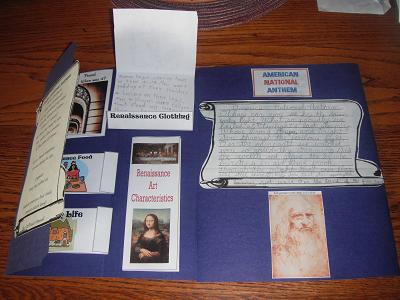
Renaissance Art Characteristic -
Renaissance art
has a look of its own. Here are some characteristics that will help you
spot an artwork from this time period. Complete the
Renaissance Art Flap as you study the characteristics of
Renaissance art.
Realism and Expression – Instead of flat, people began to look more
rounded and plump in art. Artists in their work presented happiness,
sadness, laughter and other feelings.
Perspective – Objects in artwork were shown as close or far away from the
viewer.
Classicism – or high quality in works of art. Balance and symmetry were
seen.
Emphasis on Individualism – People began to have personalities because of
expressions.
Geometrical Arrangements of Figures – Placement of objects within a piece of
work were many times in a triangle. This would draw the eye to the area of
the painting the artist felt was most important.
Light & Shadowing (softened edges) – Showing more shadows allowed the artist
to make things look more rounded. The source of light began to be seen in
paintings.
Artists as Personalities – Artists began to create themselves within a work
of art they were creating.
Famous Art
Works for Observation
-
Look at the painting of The Last Supper. This painting was done in
Milan in the 1490’s. It depicts Jesus’ last meal with his disciples before
he was crucified. Because he did not use the common fresco method, the
painting quickly deteriorated. Regardless, it’s one of the most commonly
reproduced works of art.
Look at the Mona Lisa. Leonardo painted this painting in 1506. It is also known as “la Gioconda” or the laughing one.
What do you notice that distinguishes these two famous paintings as Renaissance works of art?
Artist Study
Possibilities -
Choose another
Renaissance artist to study and compare his works with the works of
Leonardo.
Famous
Artists Simple Folds
Michelangelo - Michelangelo was born in 1475 Michelangelo di
Lodovico Buonarroti Simoni. He was an
Italian Renaissance
painter,
sculptor,
architect,
poet, and
engineer.
He is most famous for painting the ceiling in the Sistine Chapel.
Michelangelo was much younger than Leonardo and was short-tempered.
Michelangelo did not get along with Leonardo and is considered a rival of da
Vinci. A rival is a person competing for the same goal as another person.
Why do you think they were considered rivals?
Verrocchio
-
Andrea del
Verrocchio, born Andrea di Michele di Francesco de' Cioni was born in
Florence in 1435. One of his famous works is The Baptism of Christ.
Leonardo da Vinci assisted him on this painting. Study the painting. What
do you notice that makes this a Renaissance painting? Are there
similarities and differences in da Vinci’s works?
Raphael - Raphael was a young painter who was greatly
influenced by Leonardo and Michelangelo’s works. He was a quick learner and
very talented. He died at the young age of 37.
Alberti - Leon Battista Alberti was a famous architect, poet,
musician, philosopher, sculptor, and writer. He loved animals and was
athletic. Leonardo studied Alberti’s ideas and read his ideas about art and
painting.
Bramante - Donato Bramante was a painter, but his love was architecture. He shared many techniques with Leonardo.
Writing
Backwards -
Leonardo was
able to write backwards – starting on the right and moving left. You would
need a mirror to read what he wrote. Try to write backwards. Start on the
right side of your paper and write each letter backwards as you move left.
(It will be easiest to use manuscript instead of cursive. Once you get more
comfortable, you can try cursive.) Use a mirror to read what you have
written. Do all the letters look correct? Is it easy or hard to read?
Store your paper in the
Writing Backwards Pocket.
Casting
Experiment -
You will need
Plaster of Paris, some modeling clay and an object to cast (like a shell).
Flatten the modeling clay into a circle. Firmly press the shell (or other
object) into the clay to make a deep impression. Mix the Plaster of Paris
as directed. Pour the Plaster of Paris into the impression and let it
harden for a couple of hours. When the plaster is dry, carefully peel the
modeling clay off the cast. You can then paint your cast, if you like.
Music
Flutes
-
A
flute is a musical instrument that belongs to the woodwind group. Other
woodwinds are clarinets, oboes, and bassoons; however, these woodwinds
require a reed to play. The flute is reed less. The flute is played by
blowing air across a hole at the top of the instrument, much like blowing
across the top of a glass bottle. Try blowing across a bottle (like a Coke
bottle.) Is it easy for you? If so, you may be suited to play a flute.
There are
several references of flutes in the Bible. Psalm 5 is written to be sung
with flute accompaniment. Psalm 150 directs us to praise God with the sound
of the flute. Other references are:
1 Samuel 10:5, 1 Kings 1:40, Isaiah 5:12.
Woodwinds
Shutterflap
Italian
National Anthem -
When
Leonardo’s horse was unveiled in Milan, they played the Italian National
anthem. Goffredo Mameli wrote the anthem. It became the national anthem at
the end of World War II. The translation follows:
Italian
Brothers,
Italy has awakened,
She has wreathed her head
With the helmet of Scipio.
Where is Victory?
She bows her head to you,
You, whom God created
As the slave of Rome.
Let us band together,
We are ready to die,
(repeat)
Italy has called us.
(repeat previous four lines)
(repeat entire song)
If you would like to hear what the Italian National anthem sounds like go HERE.
The American National anthem is “The Star Spangled Banner”, a song about the American flag. Frances Scott Key wrote the words during the War of 1812 while he was a prisoner. The words were then put to music, an old bar tune. The lyrics are as follows:
O! say can you
see by the dawn's early light
What so proudly we hailed at the twilight's last gleaming.
Whose broad stripes and bright stars through the perilous fight,
O'er the ramparts we watched were so gallantly streaming.
And the rockets' red glare, the bombs bursting in air,
Gave proof through the night that our flag was still there.
O! say does that star-spangled banner yet wave
O'er the land of the free and the home of the brave?
There are other verses, but the first verse only is commonly used as the national anthem. If you would like to hear what the American National anthem sounds like go HERE.
Math
A ratio is a comparison of two objects. If you look at a matchbox car package, the ratio says 1:64. That means that the size of the toy car is 64 times smaller than the real version of that car.
Activity: Trace around an object such as a check box or Kleenex box. Something square or rectangular is easier. If you were drawing an object to scale it would be a 1:1 ratio, or both objects would be the same size. If you are going to draw it ½ the size of the original, the ratio would be 1:2. Measure each side of the original drawing. Divide each side’s length in ½ and redraw the object using those measurements.
For a challenge, measure a larger object (such as a desk or bed.) To scale the object down in a drawing, change the feet to inches. For example, if the bed is 6 feet long, draw it 6 inches long on your paper. (Your scale would be 1 foot = 1 inch.) Look at a map and look for the scale. See if you can convert the inches to miles on your map. How many miles are between 2 cities close to you?
Parallel lines are lines that are going the same direction and never cross. (Hint: Look at the L’s in the word Parallel. These are parallel lines. Look around you; do you see any parallel lines around you?
Science
Birds -
Leonardo loved birds. He couldn’t stand to see them in a cage. He studied
them to discover their secret of flying and dreamed of flying himself. How
does a bird fly?
Our bones are heavy and thick. Birds bones are hollow inside, but are very strong. This allows them to be light enough for their bodies to fly. Save a chicken bone and a bone from a pork chop or steak. Cut them each in ½. What do you see? A bird also has strong muscles at the breast giving them enough strength to use their wings to fly.
Go to a pet
store and look at the different kinds of birds that can be kept as pets. Or
look outside at your bird feeder and just watch the birds. Watch how they
take off, land and fly.
Leonardo Loved Birds Flap Book
Apples - a treat!
Barley - should be boiled or soaked for at least two hours before feeding as it swells when wet (prevents swelling in the horse's stomach)
Maize - this should be flaked and cooked to make it easier to digest
Oats - they are easily digested if crushed, rolled or cooked
Root vegetables - such as beetroot, carrots, parsnips, and turnips can be fed (but in small quantities)
Leonardo saw many statues of horses in an amble – or a walk, where both left legs were moving at the same time. He liked the horses he saw in a trot. The way horses move is called their gaits. Here is a list of horse gaits:
Walk – A slow
gait where 3 feet are on the ground while the other one is lifted and moving
forward.
Trot – A slow jog where the horse moves his feet in diagonal pairs.
Canter – Faster than an average trot
Gallop – A fast run where all 4 feet come off the ground at one time.
Horse Gaits
Accordion
There are many
types of horses, which your child may find interesting to research on his
own. Charles Dent went to the stables to study two champion Morgan horses.
The Morgan horse is a muscular horse commonly used for competition. They
were used in the cavalry during the Civil War.
Morgan Horse Breed Matchbook
Foundry
-
A
foundry is a factory that produces metal castings. The foundry melts scrap
metal in large, very hot furnaces. The foundry produces a mold that the
melted metal will be poured into. Once the metal is cooled, it is sanded to
achieve the desired finish.
Bible
Read the story of the Last Supper. While looking at the painting by Da Vinci, see if you can guess each disciple's name. You could also study the twelve disciples throughout the gospels. The Last Supper Interlock
LIBRARY LIST
Leonardo Da Vinci
by Diane
Stanley
Who Was Leonardo Da Vinci? By Roberta Edwards and True Kelley
Magic Tree House Research Guide #19 Leonardo da Vinci by Mary Pope
Osborne (this research for Leonardo in this unit is based on this book)
Amazing Leonardo da Vinci Inventions You Can Build Yourself by Maxine
Anderson
JUST FOR FUN
Field Trip
Ideas
Go
to an art museum and study the sculptures
Are you close
to one of these places?
Grand Rapids, Michigan – see the American horse!
Milan, Italy – See Leonardo’s horse!
Allentown, Pennsylvania – visit DaVinci Discovery Center