| about us |
what's new
|
unit studies
|
unit study helps |
hss resources
|
fiar resources | indexes | lapbooking |
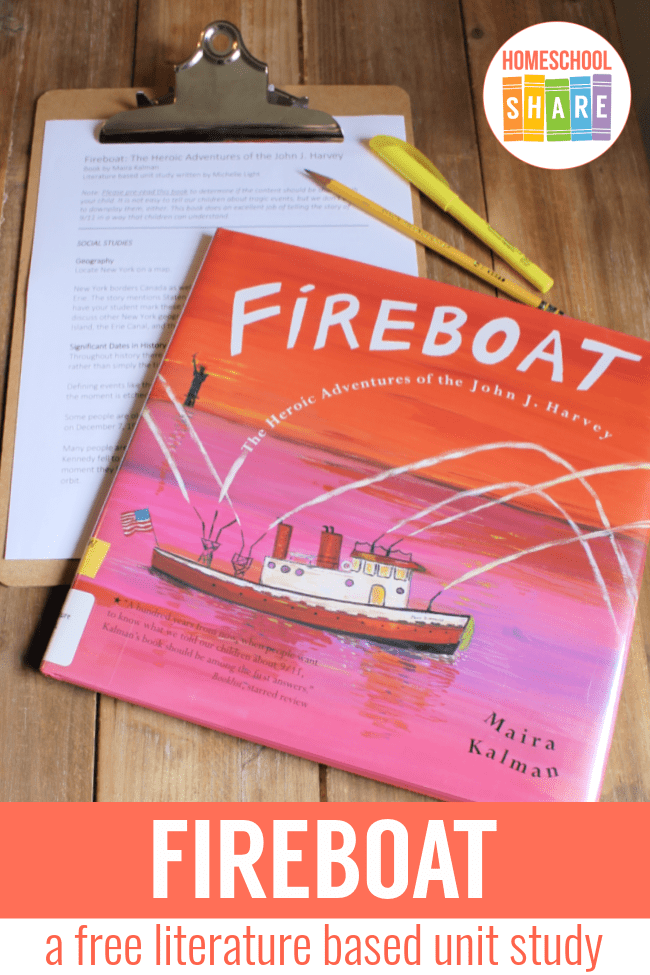
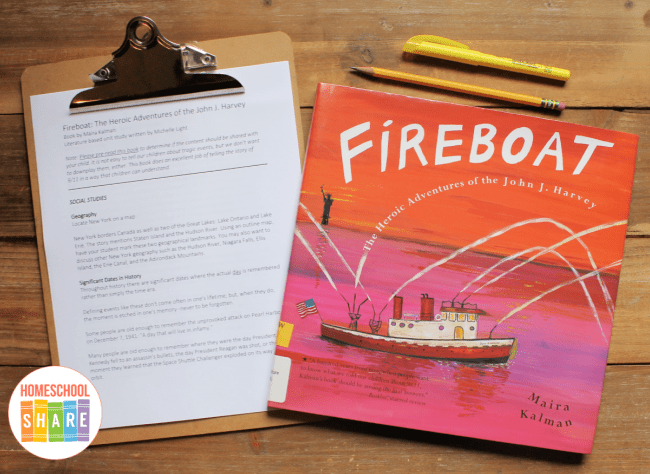
Fireboat ISBN:
0399239537
Summary:
A fireboat comes out of retirement to help it’s
city during the events of 911.
Author/Illustrator: Maira
Kalman
Unit Prepared by: Michelle
Light
Note: Please pre-read this book
to determine if the content should be shared with your child. It is not
easy to tell our children about tragic events, but we don't want to downplay
them, either. This book does an excellent job of telling the story of 911
in a way that children can understand ("many people were hurt--many lives were
lost") without the blood and gore.
SOCIAL STUDIES
Geography
Locate New York on a map.
(You can place a story disk there if you plan to make one.) New York borders Canada
as well as two of the Great Lakes-- Lake Ontario and Lake Erie.
The story mentions Staten Island and the Hudson River. Using an outline
map, have your student mark these two geographical landmarks. You may also
want to discuss other New York geography such as Niagara Falls, Ellis Island,
the Erie Canal, and the Adirondack Mountains.
Enchanted Learning Outline Map
Enchanted Learning Flag
Significant Dates in History
Throughout
history there are significant
dates. (Where the actual day is remembered rather than simply the time
era.)
Defining events like these don't come often in one's lifetime; but, when they do, the moment is etched in one's memory--never to be forgotten.
Some
people are old enough to remember the unprovoked attack on Pearl Harbor on
December 7, 1941 -- "A day that will live in infamy." (Franklin D. Roosevelt) Many people are old enough to remember where they were the day President
Kennedy fell to an assassin's bullets, the day President Reagan was shot, or the
moment they learned that the Space Shuttle Challenger exploded on its way to
orbit. We will forever remember the moment we saw two hijacked commercial airliners crash into the World Trade Center twin
towers in New York City. September 11, 2001, will go down as another day of
infamy. Discuss with your student what you were doing on this date.
Perhaps you have stories from your student's grandparents about some of the
other dates mentioned.
If your child was alive on 911, maybe he can recall where he was and what he was
doing (and even how he felt) when he heard the news.
History and Timeline of New York
Mandy different aspects of 1931 New York City history are mentioned at the
beginning of this story. Have your older student choose one (or more) of
these topics for an in-depth research project--
Babe Ruth
Snickers Candy Bars
The Empire State Building
The George Washington Bridge
Pendley Calling of Blarney
You could also make a timeline of NYC history with your student. The above
events are all mentioned as 1931 happenings. The book also gives a bit
more NYC history (ending with 911). If your student is interested, you can
continue this project by looking up other significant NYC events online or in an
encyclopedia (don't forget to add The Little Red Lighthouse if you are familiar
with that story).
Another idea would be to add your family history (dates of birth, death,
marriage, etc.) to the timeline.
Character Building: Willingness to Help
So many people jumped in on that dreadful day to see how they could help.
We need to be willing to help when the need arises! Try to teach your
children this week to be helpful. Try also to teach them to go the extra
mile by teaching them the phrase, "is there anything else I can do for you?"
Tell them to be alert and keep their eyes out for things that they can be
helping with-- to see what needs done and DO it (Is there trash on the ground at
the park that needs picked up? Does someone need help with something that
they dropped? Can I wipe up a spill? Can I take my brother's laundry
to the hamper?) Think of a creative way to reward happy
helpfulness this week.
LANGUAGE ARTS
Vocabulary:
Prepared
Crossword Puzzle
bustling- excited place with activity; noisy
elegantly- graceful yet simple
launched- to cause to move into water
brave- having or showing courage
merchandise- anything bought and sold for profit
celebration- to observe a day or event; to have a happy and
lively time
scrap- to discard; to get rid of
surprising- causing wonder; amazing or startling
urgent- requiring immediate attention
terrified- filled with fear
snoozing- to sleep lightly
scene- the place and surrounding of a certain event
ceremony- a formal act or occasion
audience- a group of people gathered together to hear and see a certain event
hero- a person of great courage especially one who had undergone great danger or difficulty
award- a prize usually given as a result of winning a contest
Choices Writers Can Make: Font
With your student, look at each page in the story paying special attention
to the way the font (text) is written. Look at the way the
author chose to write certain words-as to grab your attention--up, down, big,
small, capitalizing the whole word. Can you and your student
determine why the author made certain choices for certain pages/words/phrases?
In poetry, this is an especially common practice (something usually called
concrete poetry). Poets can manipulate the text to help give a visual
impact to the tones/themes of the poem. Encourage your writer to try
playing with font sizes and shapes in order to make what is being written more
meaningful.
Listmaking (Social Studies connection)
List all the people who helped when the 911 tragedy occurred (firefighters,
police officers, doctors, etc.). Take a few minutes and discuss each
occupation. How could the different people use their area of expertise to
help specifically?
Listmaking
List all the maintenance jobs that had to be completed in order to fix the
John J. Harvey.
Inventing Words
The author mentions the invention of "HOT-CHA"-- a new jazz word.
Since English is a living language (unlike Latin), new words and phrases are
frequently implemented into our speech. A language continues to evolve as
long as it is alive and even the rules of grammar, punctuation, and spelling can
change over time.
Discuss other words (especially slang) that take on new meanings with time
(cool, sweet, and do you remember when people used to say, "that's bad"-- and it
had a positive connotation! Funny!). You can also discuss
words (or phrases) that your family may have invented and that you use within
your own family culture (for instance, at my house we call ketchup DIP-IT).
Creative Writing: Newspaper Writing
Your older student may enjoy designing the front page of a newspaper to tell
about the events of 911. Have her study the front page your local
newspaper and then use a similar lay-out and design. If a front page
project is overwhelming, you may want to simply the assignment to just one
column.
ART
**Art lessons have not been written at
this time**
APPLIED MATH
Story Problems
1. There were 8 pipes on the Harvey that could shoot 16,000
gallons of water per minute. If all the pipes shoot the same amount, how
many gallons were being shot per pipe? (16,000 /8= )
2. How many total gallons could be shot in five minutes? (5x16,000)
in ten minutes? (10x16,000)
in one hour? (60x16,000)
3. The story mentions that people worked for 4 days and 4 nights.
How many hours of work total? (24x4=)
4. The John J. Harvey could go 20 miles per hour. How long
would it take it to go 60 miles? 10 miles?
SCIENCE
Different Types of Boats
(this lesson was originally written to go with the Curious George Unit)
There are many
different kinds of boats! Has your student ever
been in a boat? What kind of boat was it?
Different boats are used for different jobs-- large
barges are used to carry cargo, small kayaks are
used for sport and recreation. Other boats are used
for fishing and some boats even serve as houses.
Would your student like to live on a boat? Some
boats are used in specific areas of the world like
the Jamaican banana boat and the Chinese dragon
boat.
Use these
Prepared Boat Cards to introduce your
student to some of the many different boats that
have been used around the world throughout history.
Ways to use Prepared Boat Cards (you need Adobe
Acrobat Reader to open this file)
1. Classification (classify the boats with your
younger student by size making one pile for BIG
boats and another pile for little boats; classify
the boats with your older student -- boats used in
the present vs. boats used in the past.)
2. Have your student find all the boats that have
sails, all the boats that use oars (row boats), or
all the boats that can be used for recreation (fun).
3. Print two copies of the cards and play
concentration or memory. You may not want to use
all 24 pairs depending on the ages of your students.
4. Print two copies of the cards and play Go-Fish!
(Choose about 12-18 pairs depending on ages of your
students and how many people are playing.)
5. Let your older student choose a card out of a
bowl each day for "boat research of the day" and
have him write up a paragraph about that boat after
researching it in an encyclopedia or on-line.
6. Ask your student to put the cards in alphabetical
order.
Boat Lingo
There is a bit of boat vocabulary used in this book and your student may not
be familiar with the terms used.
pilot's cabin-
a small cabin on the deck of the ship that protects the steering wheel and the
crewman steering
propeller- A rotating device, with two or more blades, that acts as a screw in
propelling a vessel
hull- The main body of the boat, not including the deck, mast, or cabin.
If your student is interested in boats, let him create his own Boat Vocabulary
Book using this website
to copy terms/definitions. Have him copy one term/definition on each page
and possibly draw a simple illustration to go along with it.
Rivers
The Hudson River is mentioned in this book. See Five in a Row
Volume II (The Little Red Lighthouse and the Great Gray Bridge)
page 139 for an excellent lesson on rivers.
Animal Classification:
Barnacles
Barnacles had to be cleaned off the bottom of the boat. What are they?
A barnacle is an invertebrate-- a type of arthropod. There are
approximately 1,000 species of barnacles.
Barnacles go through two stages as larva. The first is called the nauplius--
spends about two weeks eating, molting, and floating wherever the wind and waves
will carry it. In the second stage, it doesn't feed and it becomes a
strong swimming cyprid larva eventually settling down in an safe and productive
environment such as rocks. This environment is sometimes a man-made
structure and the barnacles will eventually destroy the structure (especially
that of ships). The cyprid larva cements itself headfirst to
the surface and undergoes metamorphosis into a juvenile barnacle. Most
develop six hard armor plates to surround and protect their bodies. For
the rest of the barnacles life, it will stay on the structure using feathery
legs to capture food.
You can google "barnacles" and hit the images button to look at
pictures of these sea creatures.
Rabbit Trails
Discussion: Discuss the word useless with your student. If your
student has
previously rowed Mike Mulligan ask your
child, "Can you remember another story where something else is considered old and
useless?" (Mary Anne from Mike Mulligan). Was Mary Anne useless?
Was the John J. Harvey useless?
Go-Along Books
The Man Who Walked Between the Towers by Mordicai Gerstein
September Roses by Jeanette Winter
On That Day: A Book of Hope for Children by Andrea Patel
Hero Dogs: Courageous Canines in Action by Donna M. Jackson
Find an emblem of The World Trade Center (to
include in your lapbook or notebook) on
this page. Scroll down to
last image.
Materials and information on this website belong to the original composers. It may be used for your own personal and school use.
Material may not be used for resale.
© 2005-07 HSS