Affiliate Disclaimer
We sometimes use affiliate links in our content. This won’t cost you anything, but it helps us to keep the site running. Thanks for your support.
Thanks to Rachel Harris and Candance Crabtree for creating this Cinderella unit study for Homeschool Share.
Cinderella Unit Study Lessons
Here are a few sample lessons from the Cinderella unit study:
Science
Botany: Pumpkins
Cinderella’s godmother turned a pumpkin into an elegant coach for her to ride to the ball. Pumpkins are common as decorative jack-o-lanterns around Halloween and are served in pies and treats for Thanksgiving and Christmas, but do you know much about pumpkins? The pumpkin seed goes through many changes on its way to become a giant pumpkin. First, it begins its life as a seed. As all plants do, the seed requires lots of sunshine and water to grow, and before long that seed begins to sprout. The sprout eventually becomes a vine. With continual water and sunshine, the vine grows and eventually yellow flowers begin to bloom. As time passes, little green unripe pumpkins begin to grow on the vines. The pumpkins continue to grow larger and turn from green to orange in color by the fall.
Social Studies
Human Relationships: Acting Like a Princess
Common characteristics associated with being a princess include the following:
- Kind – Having a generous and compassionate nature; showing courtesy to someone
- Smart – Clever; Intelligent and showing mental alertness
- Caring – Showing concern for others
- Brave – Having or showing courage, especially when faced with danger, difficulty or pain
- Polite – Showing or possessing good manners and common courtesy; elegant
Language Arts
Literature: Various Versions of the Same Story
Read several different versions of Cinderella. Discuss how they are different and how they are similar. You may even want to make a Venn diagram or chart comparing/contrasting the different versions.
Which version is your student’s favorite? Why?
Some other versions include:
- Cendrillon: A Caribbean Cinderella by Robert D. San Souci
- Yeh-Shen: A Cinderella Story from China by Ai-Ling Louie
- The Irish Cinderlad by Shirley Climo
- Adelita by Tomie dePaola (set in Mexico)
- Cinderella by Marcia Brown
Math
Measuring
Whose foot will fit in the shoe? How do we determine the size of things? We measure!
Let your student use a ruler to measure his foot, your foot, dad’s foot, and even brother or sister’s foot! Chart results on a graph. Who has the longest foot? Who has the shortest? After he has charted the length of your feet, bring out some shoes. Have him measure the shoes to determine who each shoe belongs to.
To access all of the lessons in this Cinderella unit study, grab the easy-to-print file at the end of this post.
Cinderella Lapbook Printables
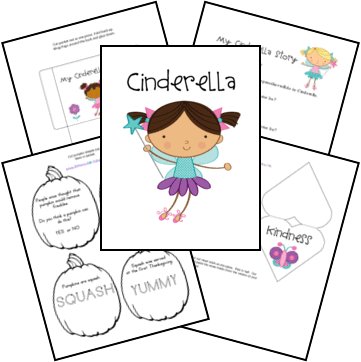
In addition to the lessons, this unit study also includes these printables:
- My Cinderella Story Pre-writing Page
- My Cinderella Story Pocket
- Kindness Heart Shape Book (to include Bible verses)
- A Princess Is . . . Petal Book
- Foot Measuring Chart
- Clock Printable
- Pumpkin Facts Pocket
- Pumpkin Shape Cards (with pumpkin facts)
- Lifecycle of a Pumpkin Hotdog Book
- Where in the World is France? Shutterfold Book
- Flag of France Simple Fold
- My Book of French Colors Mini-book
How to Get Started with the Cinderella Unit Study and Lapbook
Follow these simple instructions to get started with the Cinderella unit study and lapbook:
- Buy a copy of the book, Cinderella, or grab one from your local library.
- Print the Cinderella unit study.
- Choose the lessons you want to use with your student (a highlighter works great for this).
- Choose and prepare the lapbook activities you want to use with your student.
- Enjoy a week of fairy tale learning with your student.
Download Your Cinderella Unit Study and Lapbook
Simply click on the image below to get your free Cinderella unit study and lapbook.
More Fairy Tale and Folktale Resources
Are you looking for additional fairy tale and folktale resources for your student? We have them here!