Google
 
Free Cats Lapbook and Unit Study

Cats Unit and Lapbook
Lessons by Wende
Lapbook Templates by Wende and Ami


Library List

Picture & Nonfiction Books
Papa Piccolo by Carol Talley
Millions of Cats by Wanda Gag
Cats by Gail Gibbons
The Tale of Miss Moppet by Beatrix Potter
The Tale of Ginger and Pickles by Beatrix Potter
Usborne Beginners
Cats by Patrizia Donaera
Six Dinner Sid by Inga Moore
Mrs. Katz and Tush by Patricia Polacco
Cats (DK Pockets) by DK Publishing

Preschool
Cookie's Week by Cindy Ward (preschool)
If You Give a Cat a Cupcake by Laura Numeroff (preschool)
Have You Seen My Cat? by Eric Carle
Mr. Wishy-Washy by Joy Cowley

Young Readers
Fat Cat on a Mat by Jenny Tyler
Mr. Putter and Tabby Series by Cynthia Rylant
Henry and Mudge and the Happy Cat by Cynthia Ryland
The Fire Cat by Esther Averill


Chapter Books
Socks by Beverly Cleary
The Lighthouse Family Series by Cynthia Rylant
Pinky Pye by Elanor Estes
The Cat Who Went to Heaven by Elizabeth Jane Coatsworth (please preview, written from a Buddhist perspective)

Units About Cats At Homeschool Share

Christmas Day Kitten

The Valentine Cat

Comet's Nine Lives

The Cats in Krasinkski Square

Feathers for Lunch  (preschool)


Lapbook Components

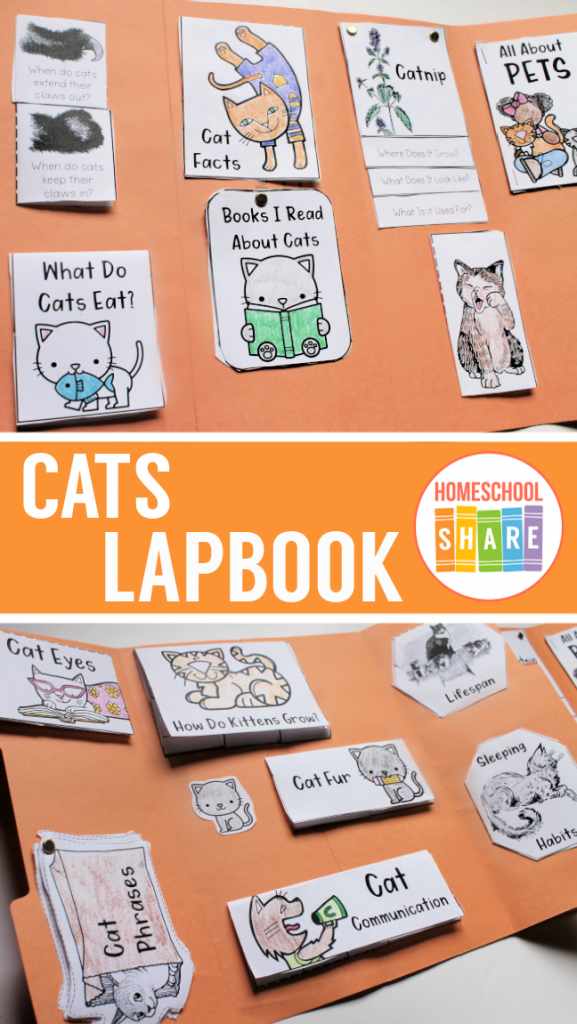
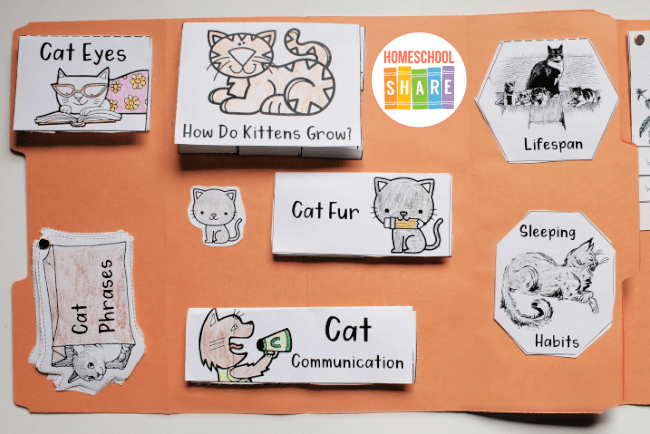
Note: Most of these lessons and components are from the HSS units listed above and have been adapted to provide a cat specific lapbook.


Cat Math Mini-Workbook
 

Cat Growth Matchbooks and Cover
 

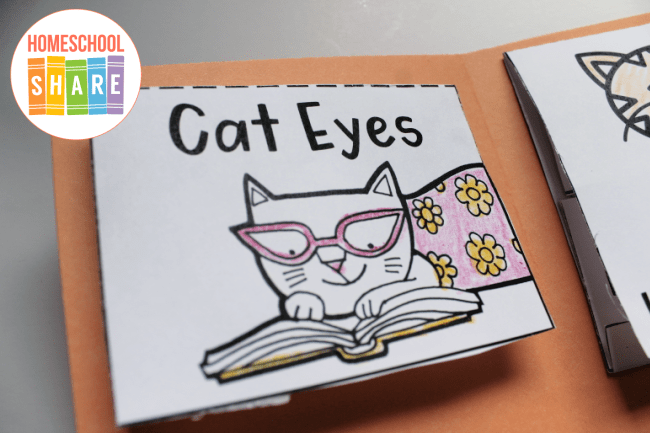
Cat Eyes
 

Pussy Cat, Pussy Cat Manuscript Copywork
 

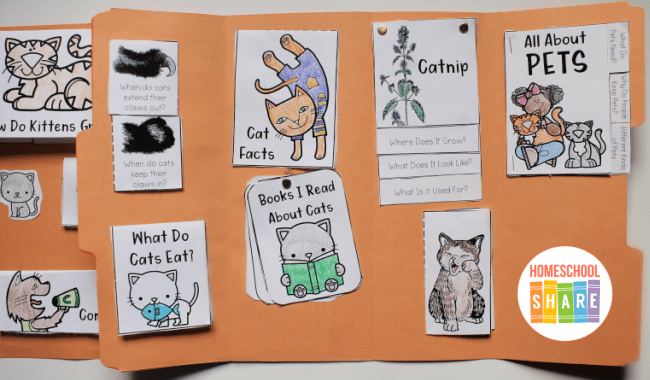
What Do Cats Eat? Simple Fold
 
Cat Claw Bi-Fold
 

Pussy Cat, Pussy Cat Cursive Copywork
 

Cat Fact Accordion Book
 
Cat Fur Tri Fold
 

Pet Care Layer Book
 

Cat Communication Flap Book
 
Catnip Graduated
 

Cat Classification Graduated Book
 

Cat Joke Mini Shape Folds
 
Book Log
 
Cover Page    


Extra
Books (use as desired, not for any specific lessons)

Shape Book
 
Simple Folds
 
Fan
 
Cat-ch Phrases
 
Oval Accordion
 

Domestic and Wild
 

Tri-fold or Accordion
 
Hotdog Book  (directions)
 
Cat Facts Tri-fold


Cat Math –

Use a cat’s body to figure out these word problems:

If there are 8 eyes, how many cats all together?

If there are 20 legs, how many cats all together?

If there are 6 tails, how many cats all together?

If there are 10 ears, how many cats all together?

If there are 53 tongues, how many cats all together?


Have your child make up his own word problems and solve them. Complete Cat Math Mini-Workbook.


Nursery Rhyme/Copy Work –

 
Pussy Cat, Pussy Cat

Where have you been?

I’ve been to London to visit the Queen.

Pussy Cat, Pussy Cat,

What did you there?

I frightened a mouse from under her chair.


Pussy Cat, Pussy Cat Manuscript Copywork Book

Pussy Cat, Pussy Cat Cursive Copywork Book


Pet Care –

Pets are kept for many reasons including companionship, security, rodent control, and to be helpers.  Pets are a big responsibility. They need water, food, shelter from the elements, and affection. They need to be protected from predators and diseases. Most need to be brushed and bathed, and cleaned up after. There are many different kinds of pets, such as cats, dogs, fish, birds, turtles, hamsters, etc. Does your child have any pets? Does he act responsibly for the care of them? As a side note, if you happen to be doing this lapbook during February, February is Responsible Pet Owner’s Month! For further information you may want to check this website. Have child complete Pet Care Tab Book.


Animal Classification –

All living things are grouped according to their varying characteristics. All living things are first separated into Kingdoms. Cats are members of the Animal Kingdom. The Kingdoms are then broken down into Phylum. Cats are Chordates, which means they have backbones. The Phylum then is broken down into groups called Classes. Cats are Mammals. Mammals share certain characteristics including being warm blooded, having fur coverings, live births and providing milk for their young. The Classes are further broken down into Orders, depending on what kind of eater the animal is. Cats are Carnivores, meaning they are meat eaters.  These Orders are then broken down into even smaller groups, called Families. All cats, including both domestic and wild, are in the Felidae family.  And the Families are then reduced down to Genus. Domestic cats are of the Genus Felis catus. The domestic cats are then broken up into over thirty different breeds.

Kingdom – Animal

Phylum – Chordates

Class – Mammal

Order – Carnivore

Family – Felidae

Genus – Felis catus


Complete Cat Classification Graduated Book if desired.


Also, as you learn more about cats this week, you may choose to complete Cat Fact Accordion Book, or complete individual books found throughout the lessons.


Cat Growth –

As with all mammals, cats are born by live birth. The mama cat will be pregnant for about two months, and will then give birth to a litter of kittens. They are born blind and instinctually know where to go to mama cat for milk. The first two weeks of their lives they mostly just sleep and eat. Usually around the fourteenth day of their lives, the kittens’ eyes will open and by the twentieth day they will try to walk around, dragging their hind legs. By the time they are a month old they will be able to walk, and will even play with each other a bit. They still depend on their mother for milk. By the sixth week, the kittens will learn to climb, eat out of a bowl, and will be very curious about their surroundings. The mother cat will wean the kittens (stop giving them milk) by the time they are two months old, when the kittens are ready to find new homes. Complete Cat Growth Matchbooks and Cover if desired.


Cat Diet–

Cats are carnivores, which means they are meat eaters. By God’s design, cats have a natural instinct and are equipped with especially designed claws to catch prey, and sharp pointy teeth to kill their meal. What kind of foods do cats eat? Other than store bought cat food, they eat most any small animal that they can catch, including mice, shellfish, fish, birds, moles, rabbits, etc.  When very hungry they will move from their regular diet to whatever is available, including sometimes-even insects. Sometimes you will even see cats eating grass, to obtain nutrients or fiber that their bodies instinctually know they need. Complete What Do Cats Eat? Simple Fold.


Cat Communication –

Cats communicate with people in various ways. When they are hungry they say, “meow”. When cats are scared, they will cry, hide, hiss, or scream. To show that they like you and that they are friendly, they will rub their fur up against your leg.  When a cat is happy it purrs. Does your child know what an arched back, or hair rising off a cat’s back mean? That he is angry! Complete Cat Communication Flap Book.


How Do Cats Purr? –

Has your child ever wondered how a cat purrs? A cat has little stretchable bands in its throat. When a cat is happy, relaxed, or satisfied, these bands in his throat vibrate. As the cat breathes, the air carries the sound of the vibrations to your ears. To demonstrate how a cat purrs, perform this experiment. Stretch a rubber band between your thumb and finger. Gently pluck the two strands between your fingers and watch them vibrate. If you gently blow throw them you will hear a purring sound.


Cat Eyes - 

Did your child know that cats are able to see in the dark? The reason they can see in the dark is also the same reason that their eyes seem to glow in the dark. A mirror-like tissue called tapetum lucidum is located behind the retina in the eye of a cat. When light hits it, it reflects light back into the retina. This helps the cat to see better at night, and also causes the appearance of glowing in the dark. Complete Cat Eyes Lapbook Component if desired.


Cat Claws and Paws –

Cats have four toes on each of their front paws, and one small toe further up its leg called a dewclaw. Cat claws are made of keratin, the same thing as your fingernails. When a cat wants to scratch, catch food, or protect him or herself, it will extend out its claws. Usually, though, a cat will keep its claws retracted into the pads and fur. Cats like to keep their claws sharpened and they do that by scratching at trees, furniture, or a scratching post. Has your child ever noticed how a cat walks? They swing their paws in front of each other, so they walk in a straight line. This is why cats can walk on narrow ledges or fences. Have your child try to walk like a cat, keeping one foot in front of the other. Complete Cat Claw Bi Fold.


Cat Fur –

A cat has fur that protects its skin and keeps its body warm. Cats rarely need baths because they are constantly cleaning themselves. They lick their fur with their rough tongues, and they lick their paws and use them like a washcloth. Cats continuously lose their fur, or shed. In wintertime they shed less to keep a warm coat on. Domestic cats will often swallow the hair that they lick, and these hairballs may gag or choke the cat. We can help prevent this from happening by brushing the cat regularly so the loose fur does not accumulate. Complete Cat Fur Tri Fold if desired. 


Catnip -
Catnip is a perennial herb in the mint family. Cats are very fond of it, and will often get playful and energetic when eating it. They will roll upon it, chew it and tear it to bits. Catnip grows wild across Europe and western Asia, and was introduced in North America. It likes dry soil and will flower from June to September. Catnip has a long history of being used as a domestic remedy too, with the leaves and flowers being used to treat infantile colic, anemia, chronic cough, and even toothaches. Maybe your child would like to draw a picture of catnip for his nature notebook, or complete Catnip Graduated Book for lapbook