Google
 
Butterfly Lapbook

Butterfly Lapbook


Research and Photos** by Molly Boulter
Lapbook Templates by Molly Boulter and Ami Brainerd


Lapbook Templates

Cover Page
 
Butterfly Copywork Primary/HWT/Regular
 
Butterfly Shape Blank Book
 
Butterflies Eat & Caterpillars Eat Shape Books
 
Copywork Pocket
 
Butterfly Shape Book HWT
 
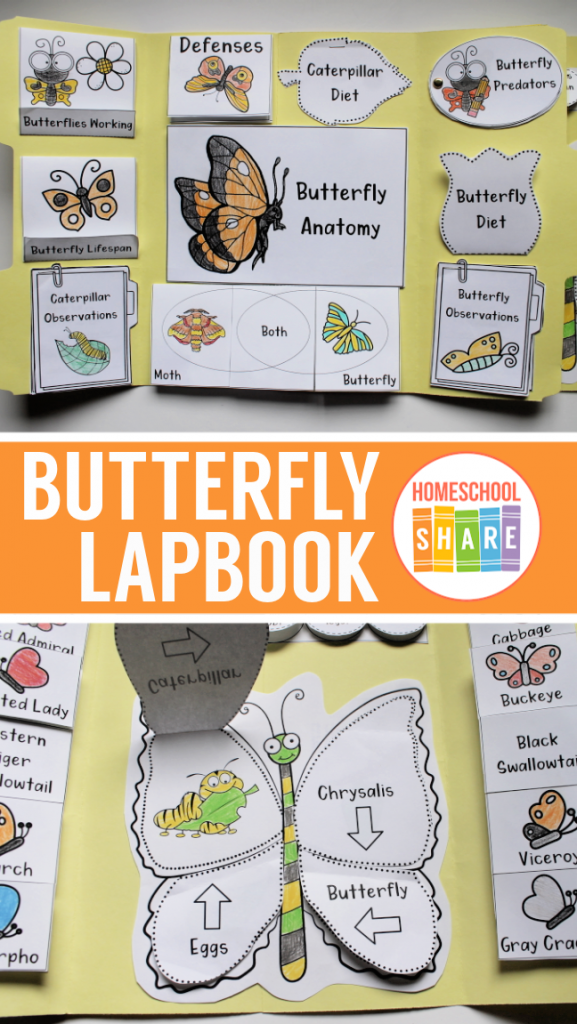
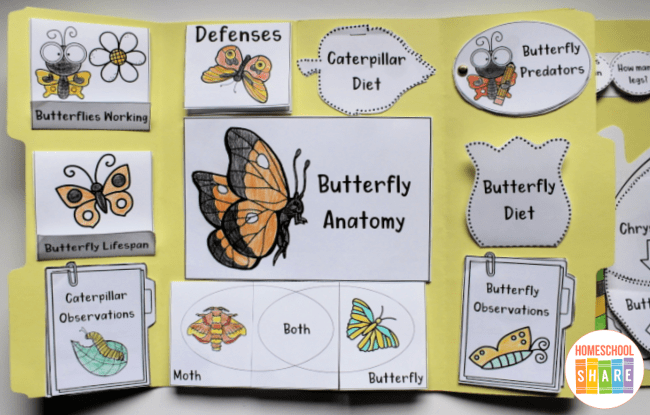
Butterfly Predators Flap Book
 
Butterfly vs. Moth Venn Diagram**
 
Butterfly Shape Book Primary
 
Butterfly Defenses T Book
 
Butterflies Working Matchbook (1 student)**
 
Butterfly Shape Book Regular Lines
 
Butterfly Lifespan Simple Fold (1 student)
 
Butterflies Working Matchbook (2 students)**
 
My Symmetrical Butterfly
 
Butterfly Lifespan Simple Fold (2 students)
 
Butterfly Diagram
 
Butterfly Observation Accordion (prompts)
 
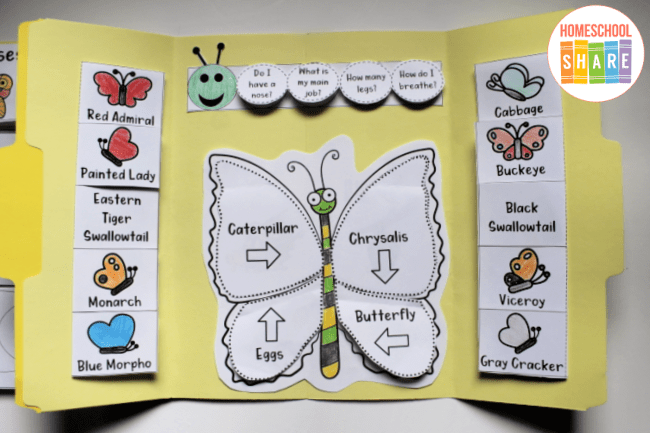
Butterfly Cards (United States)
 
Butterfly Math
 
Butterfly Observation Accordion (simple)
 
Butterfly Cards (Rainforest)**
 
Favorite Flowers Shape Book
 
 
Butterfly Cards Pocket Caterpillar Questions Flap  

Research

Caterpillar Diet
A mother butterfly will lay her eggs right on the kind of leaf they like to eat. Caterpillars eat leaves and grow quickly until they are big enough to become a butterfly.

More About Caterpillars
A newly hatched caterpiillar, a larva, is tiny.  Most can only crawl about 3 feet per minute, so they hide under leaves.  Caterpillars eat and eat and eat!  They spend about one month eating; they also molt (shed their skin) during this time. 

Caterpillars usually have 16 legs.  They don't have nose, and they breathe through holes in their backs; these holes are called spiracles.


Lapbook Component:
Caterpillar Questions Flap

Butterfly Diet
Butterflies like to eat nectar and rotting fruit. They use their long proboscis to sip the liquids like a straw.

Life Span
Adult butterflies can live from a few days up to a few weeks.

Lapbook Component:
Butterfly Lifespan Simple Fold (1 student)
Butterfly Lifespan Simple Fold (2 students)


Butterflies Working: Pollination
A butterfly is a hard worker. Her job is to spread pollen from flower to flower. When she lands to drink the nectar, pollen will stick to her legs and body, waiting to be carried to the next flower.

Lapbook Component:
Butterflies Working Matchbook (1 student)**
Butterflies Working Matchbook (2 students)**


Predators:
Butterflies and moths have lots of enemies. They are eaten by birds, spiders and insects.

Lapbook Component:
Butterfly Predators Flap Book

Defenses:
Butterflies have many defenses to protect against predators.

Warning Colors. Some butterflies taste bad and can make their predators sick if they are eaten. These butterlies are brightly colored to warn a predator of this bad taste.

Camouflage helps a butterfly to blend into it's surroundings. They might look like a leaf or the bark of a tree at first glance.

Some butterflies mimic, or copy, other animals. Eye spots are a common way to trick it's predator into thinking it is a bigger animal. Some butterflies mimic other butterflies that have bad taste by also having bright colors.

Lapbook Component:
Butterfly Defenses T Book

Lifecycle
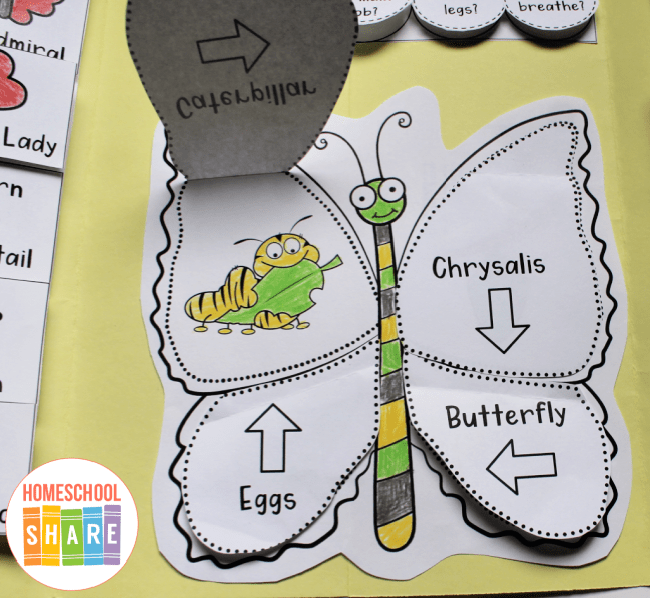
Butterflies lay tiny eggs about the size of a pinhead.  When it's time, the caterpillars (also known as larva) in the eggs eat their way out of the egg.  This begins their eating frenzy! After they eat the eggshell, they start eating green plants (such as the leaf the egg was on).   They eat and eat and eat until they are too big for their skin.  The skin splits down the back and the caterpillar crawls out with new skin.  This is called molting.  (thank goodness humans don't do this!).   Once the caterpillar has consumed enough, it will start to make a chrysalis.   The caterpillar (now known as a pupa) stays in the chrysalis for a long time (the chrysalis is also called the pupa).   The caterpillar starts to change inside its new home.   It takes a long time, but eventually the chrysalis will crack and a beautiful butterfly will emerge...and eventually it will lay some eggs.

Lifecycle Sequencing Cards
Lifecycle of a Butterfly Shape Book
Painted Lady Lifecycle Tab Book
Evan Moor Giant Science Resource Book pages 35


Anatomy
Look at pictures of butterflies and point out the various parts to your students. 

~Antenna - All insects have antenna. Butterflies have two antennae with clubs at the end.
~Compound Eye - A compound eye is made up of many different lenses. 
~Fore wings - The fore wings are the two upper wings
~Hind wings - The hind wings are the two lower wings.
~Proboscis - Butterflies sip nectar with a tube-like proboscis located on their head.
~Legs- Just like all insects, butterflies have six legs.
~You may also want to review the three body parts that all insects have:  head, thorax, and abdomen.

Lapbook Component: 
Butterfly Diagram

Butterflies Versus Moths
Butterflies and moths may look alike, but they are very different insects.

-most butterflies fly during the day while most moths will be out and about at night
-butterflies have knobs at the end of their feelers (on their antenna), but a moth's antenna end is feather like or plain
-most butterflies rest with their wings held up above their bodies while moths rest with wings spread out flat
-butterflies usually have bright wings and moths usually have dull colored wings
-most butterflies have slender bodies; most moths have fat abdomens
-butterflies are usually hairless; moths are furry
-butterflies form a chrysalis during the pupa stage of their lives; a moth's chrysalis is usually contained inside a cocoon
-insects, birds and spiders eat butterflies; bats eat moths

Lapbook Component:  Butterfly vs. Moth Venn Diagram


Butterfly Garden
Of course, butterflies love flowers!   If you wanted to plant a butterfly garden, what kind of flowers would you include?  Use this
Favorite Flowers Shape Book to learn more about the kinds of flowers that butterflies love.  

Butterfly Garden Information

Copywork Poems
Use these poems or something else for your student to practice his copywork this week.  Another option would be to let your student use the paper as stationary to write a butterfly story.

The Caterpillar
by Christina Rosetti

Brown and furry
Caterpillar in a hurry;
Take your walk
To the shady leaf or stalk.

May no toad spy you,
May the little birds pass by you;
Spin and die,
To live again a butterfly.

To a Butterfly
by William Wordsworth

I've watched you now a full half-hour;
Self-poised upon that yellow flower
And, little Butterfly! indeed
I know not if you sleep or feed.
How motionless!--not frozen seas
More motionless! and then
What joy awaits you, when the breeze
Hath found you out among the trees,
And calls you forth again!

Butterfly Copywork Primary/HWT/Regular
Copywork Pocket

Symmetry
Have you ever noticed the wings of a butterfly are exactly the same?  One wing is the mirror image of the other.   This means that butterflies are symmetrical.   Something is symmetrical  when you can draw a line (either real or by imagining the line) down the middle of it and it would look the same on both sides of the line.  Look at some photos of butterflies and point out the symmetry.  Can your student see it? 

Complete the My Symmetrical Butterfly project and paste it to the back of your lapbook, if desired.


Note:  The Butterfly Shaped Book has been included as an extra.  Use as desired, if desired.  :)
Butterfly Shape Blank Book
Butterfly Shape Book HWT

Butterfly Shape Book Primary
Butterfly Shape Book Regular Lines

Library List
The Usborne Complete First Book of Nature (pages 73-96)
Butterfly House
by Eve Bunting
Monarch Butterfly by Gail Gibbons
Where Butterflies Grow by Joanne Ryder
Are You a Butterfly? by Judy Allen
The Butterfly Alphabet by Kjell  B. Sandved
A Place for Butterflies by Melissa Stewart
Usborne Beginners Caterpillars and Butterflies by Stephanie Turnbull
Waiting for Wings by Lois Ehlert
From Caterpillar to Butterfly by Deborah Heiligman
The Very Hungry Caterpillar by Eric Carle


     Materials and information on this website belong to the original composers. It may be used for your own personal and school use. 

Material may not be used for resale© 2005-07 HSS