Google
 
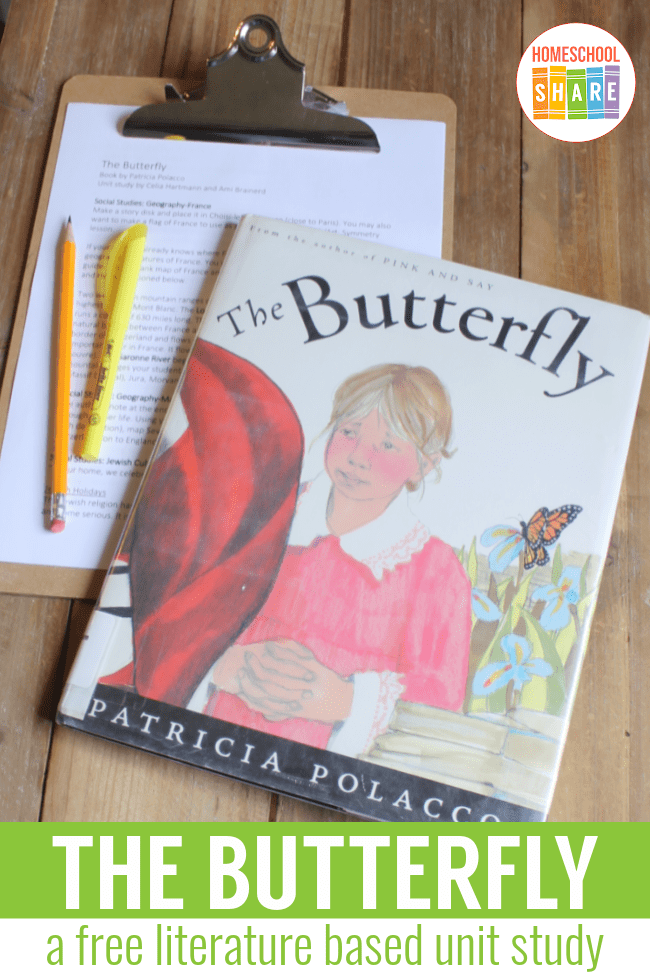
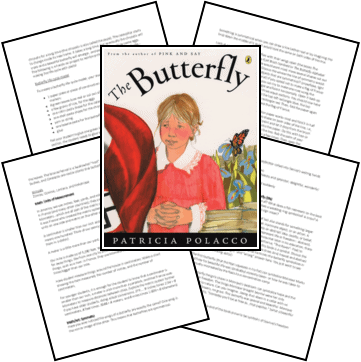
The Butterfly  Patricia Polacco

The Butterfly
 

Literature Based Unit Study written by: Ami Brainerd and Celia Hartmann
Author/Illustrator: Patricia Polacco
ISBN: 0399231706

Summary and help deciding if you should read this to your child
  

Social Studies: Geography-France
Make a story disk and place it in Choisi-le Roi, France (close to Paris).  You may also want to make a flag of France to use as a visual aid for the Math/Art: Symmetry lesson. 

Outline Map of France (EL members only)

If you've used Five in a Row Volumes I-III, you've been to France many times (Mirette, Madeline, Glorious Flight, How to Make an Apple Pie, The Giraffe That Walked to Paris, etc.).  Since your student may already know where France is, you may want to learn some of the geographical features of France.  You will need a detailed map of France to use as a guide.  Print a blank map of France and allow your student to mark the mountains and rivers mentioned below.

Two well-known mountain ranges of France are the Alps and the Pyrenees.  The highest peak is Mont Blanc.  The Loire River is the longest flowing river in France.  It runs a course of 630 miles long.   The Rhine River is a very busy waterway.  It is the natural border between France and Germany.  The Rhone River begins at the border of Switzerland and flows southwest.  The Seine River is perhaps the most important river in France.    It flows through Paris (bypassing the Eiffel Tower and the Louvre).   The Garonne River begins in the  at the border of France and Spain.   Other mountain ranges your student may want to put on his map include-- Auvergne (Massif Central), Jura, Morvan, Vosges, and Corsica. 

Social Studies: Geography-Map Skills (map Sevrine's travels)
The author's note at the end of the book mentions the places Sevrine went throughout her life.  Using your map and some yarn (and thumbtacks to stick at each destination), map Sevrine's route-- first she was hiding in France, then to Switzerland, on to England-- eventually relocating to Israel.  

Social Studies: Jewish Culture

"At our home, we celebrated Shabbat, the holidays...Passover, Hanukkah..."

Jewish Holidays
The Jewish religion has many holidays, some major and some minor, some fun and some serious.   It is highly recommended that the teacher get the book Celebrate! Stories of the Jewish Holidays by Gilda Berger.  Shabbat and the major holidays are explored in this book.  Each has a story retold from the Bible (or Apocrypha), a few paragraphs on "What We Celebrate" and "How We Celebrate," and crafts and recipes.  
 
Here is a small amount of background information on the ones Sevrine mentions:
 
Shabbat   (Shuh-bought)   
This is the Jewish Sabbath, the day of rest and it is held from Friday at sundown to Saturday at sundown.  All Jewish days begin at sundown.   To learn more about Shabbat, read Berger's Celebrate! or visit:  http://www.jews.net/shabbat.htm
 
Passover
Also known as Pesach (PAY-sock).   Pesach is celebrated in memory of The Exodus (when Moses led the Jews out slavery, out of Egypt).  It is known as Passover because God passed over the Jewish children when he slew the firstborn children of Egypt.   The family gathers together for a special meal called a Seder (Say-dur).  To learn more about Passover, read Berger's Celebrate! or visit:  http://www.jews.net/pesach.htm
 
Hanukah (Hahn-uh-kuh)
Also spelled Chanukah and is known as the Festival of Lights.   It is an eight-day festival held in remembrance of a miracle that took place a long time ago in Israel.  There was only enough oil to light the menorah for one day, but instead it lasted eight days.  To learn more about Hanukah, read Berger's Celebrate! or visit:  http://www.jews.net/hanukkah.htm
 
More Culture-- Star of David
The Magen (Mah-gun) David (or Star of David by which it is more commonly known) is a symbol of the Jewish people, much in the same way the cross or the ichthus (fish) is a symbol for Christians.   During WWII, the Magen David became a symbol of humiliation, shame, fear, and death, when the Nazis forced the Jews to wear the yellow star of David to identify the wearer as a Jew.   The Magen David has since become a source of pride and honor for the Jewish people.   The flag of Israel has a blue Magen David on a background of white. 

Social Studies: History-WWII and the Holocaust
How is WWII and the Holocaust portrayed in the book?  Discuss the following incidents with your student.  This won't give them a detail by detail account of what happened in concentration camps, etc., but it will give them a basic understanding of the events surrounding this time.  You may want to compare the following with knowledge your student already has (if this is not a new topic).
*Monique's mother wasn't sure how much longer she would be able to go to school
*Monsieur Marks' candy shop jars were mostly empty (sugar was scarce)
*People lived in fear of the Nazis-they had quiet conversations in their homes, they knew they were taking a risk by hiding Jews
*People had to watch friends and loved ones being mistreated (as the girls watched Monsieur Marks' be beaten by the Nazis)
*The Nazis hated the Jews (even French Jews)
*Jews had to leave their homes and possessions behind.  Many of them hid all over France.

Social Studies: Human Relationships-Friendship
 "The girl just sat there for the longest time, holding on tightly to Pinouff.  'I once had a cat just like this one,' she finally said."  When Sevrine left her home, she had to leave almost everything she had behind her including her cat.   Monique understood that this was very sad and very hard.  When it is time for the girls to part, the story says, "Monique took something from the pouch she'd been carrying.  It was Pinouff! 'Take her, Sevrine,' Monique whispered."   The story goes on to show that Sevrine, in turn, gave Monique her treasured possession-- a fine gold chain with a gold Star of David.  The author's note at the end of the story says, "Monique and Sevrine are friends to this day."  Ask your student what between Sevrine and Monique portrayed true friendship?  How can your student be a good friend to others?  In your discussion of what makes a good friend, you may want to talk about how to choose friends.  


Language Arts: Vocabulary
Prepared Vocabulary Crossword Puzzle

            bleak- providing no encouragement; depressing, gloomy
            radiant- filled with light; bright 
                       The moon was so radiant, it almost seemed festive.
            festive- merry; joyous
            privilege- a special advantage, immunity, permission, right, or benefit granted to or enjoyed by an individual
                           God know how much longer you will have the privilege of going to school with the war...
            confection- a sweet preparation, such as candy
                             ...as the beautifully wrapped confection rolled into Denise's waiting hands
            mysterious- being a mystery
                              somehow she seemed mysterious.
            glorious- characterized by great beauty and splendor; delightful, wonderful
                          it was a glorious butterfly  
            lurched- the act of moving forward suddenly
                         she cried as the train lurched away

Language Arts: Symbolism—the butterfly (life)
What symbols are your students aware of?  What does a fish represent on the back of someone's car? (Christianity)  What does a wedding ring symbolize?  A cross? A Star of David?  What does the thumbs up sign mean?

A symbol is something that stands for itself but also stands for something larger than itself.  It may be a person, an animal, an inanimate object, or an action.  A writer often uses a concrete object to express an abstract idea, quality, or belief.  (For instance, using a butterfly-concrete to represent life or freedom-- abstract).  Throughout the literature your student will encounter later in his education, there will be literary symbols (The Scarlet Letter-Hawthorne, "The Raven"- Poe) to discover.  In the same manner, the butterfly in this book is a symbol.  Discuss the term symbol with your student.   Discuss concrete (tree, bird, house) and abstract (love, hope, peace).   Ask your student what he thinks the butterfly symbolizes in the story.  (There isn't a "right" and "wrong" answer here.  You just want to see some critical thinking skills!)

The first butterfly (that the Nazi squeezes in his fist) can symbolize Monsieur Marks and how his beautiful life was (probably) violently taken- or how he was taken to be cruelly mistreated by the Nazis to a concentration camp.

The butterfly the girls share in Monique's bedroom can symbolize hope and the longing for freedom.  The things Monique brought Sevrine were her only connection to nature.  Can you imagine...being shut down in a cellar with no sunlight, no flowers, no grass.  This butterfly was special and beautiful.  Monique eventually claims, "Someday you'll be as free as...that papillon." (what a beautiful simile!) 

The butterflies at the end of the book prove to be symbolic of Sevrine's freedom and life (I live!).   She made it.   The beautiful life of Sevrine flew to safety and was free. 

Let your student create/draw a symbol for your family.  What does he choose?  Why? 

Language Arts: French
This book provides a great opportunity to introduce your student to words from the French language. 
French Language Activities at Enchanted Learning
           
            mon Dieu- my God
            sacre blue -- an expression like Holy Cow (oh my!)
            ma cherie- my darling or my sweetie
            monsieur- Mr.
            madame- Madam (Mrs.)
            valises- suitcases
            vite-quickly
            regarde-look
            papillon- butterfly
            Joli n’est-ce pas? Isn't it pretty?  (*I am not sure about this translation. If someone knows, please email me)
            maman-mom/mamma
           
            Judenschwein (this is German)-- the Nazi's spoke German  (it means Jewish swine)

Language Arts: Hebrew
In addition to French and German languages, the story also has Hebrew.  Sevrine's father prays in Hebrew, "Adonai yihieh etanu halailah."  (God will be with us tonight.)  Hebrew is a beautiful lyrical language.  We sometimes hear it in Christian songs....listen to the song El Shaddai (Amy Grant has a beautiful version) and pick out the Hebrew words.  You may also want to mention that the original manuscripts of the Old Testament are written in Hebrew.
 

Science: Butterflies
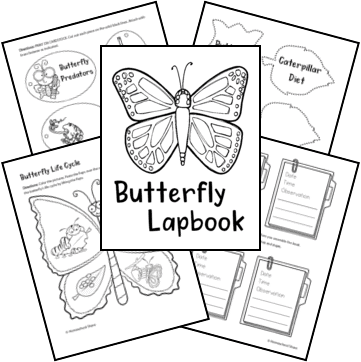
Butterflies lay tiny eggs about the size of a pinhead.  When it's time, the caterpillars (also known as larva) in the eggs eat their way out of the egg.  This begins their eating frenzy! After they eat the eggshell, they start eating green plants (such as the leaf the egg was on).   They eat and eat and eat until they are too big for their skin.  The skin splits down the back and the caterpillar crawls out with new skin.  This is called molting.  (thank goodness humans don't do this!).   Once the caterpillar has consumed enough, it will start to make a chrysalis.   The caterpillar stays in the chrysalis for a long time (the chrysalis is also called the pupa).   The caterpillar starts to change inside its new home.   It takes a long time, but eventually the chrysalis will crack and a beautiful butterfly will emerge...and eventually it will lay some eggs.   The following is a hands-on project to reinforce the four stages of butterfly life-- making the life cycle with pasta! 

Butterfly life cycle model--adapted from http://www.erpenbeck.boone.k12.ky.us

To create a butterfly life cycle model, your student will need:

          1 paper plate or piece of construction paper, divided into four sections
          markers
          4 green leaves (use real or cut out of construction paper)
          a few grains of rice, for the eggs
          one rotini pasta shape for the caterpillar (larva stage)
          one shell pasta shape for the chrysalis (pupa stage)
          yarn or string
          one bowtie pasta for the butterfly (adult)
          glue

Tell your student to glue one green leaf in each of the four sections.  For the first section, the student needs to glue a few grains of rice on the leaf.  In the second section, the student needs to glue one rotini pasta on the leaf.  In the third section, the student needs to glue one shell pasta hanging down from the leaf (you can glue a piece of yarn from the leaf to the shell to represent the hanging).  In the fourth section, the student needs to glue one bowtie pasta on the leaf.  The pasta may all be colored with markers, as the student wishes.  Each section needs to be labeled with the correct stage of the butterfly’s life cycle.

You may want to check-out the butterfly report forms and copywork pages on Homeschool Share's Animal Forms page. 

If you want to watch this awesome phenomena take place in your home, you can buy caterpillars from www.insectlore.com
 

More on this subject -- p. 116-117  DK Big Book of Knowledge
p. 34 and 35 Evan Moor's Giant Science Resource Book  (Label the parts of a butterfly and The Butterfly Life Cycle)

Science Links
www.allaboutbutterflies.com 
activities, crafts, coloring pages, etc. at Enchanted Learning)
http://www.thewildones.org/Animals/monarch.html
Life Cycle of the Monarch Butterfly (print each stage out and use as sequencing cards.  I would print out the monarch on the flower at the top of the page to use as the last stage.) 
Scholastic's Lesson Plans for The Life Cycle of the Butterfly
 
Does your young student like to play on the computer?  Try The Butterfly Life Cycle

Planting a Butterfly Garden
Research what plants that grow in your area attract butterflies and then plant a butterfly garden. 

Some you may want to include:
Perennials
Bee Balm, Butterfly bushes, Butterfly weeds, Bronze Fennel, and Coreopsis.  Butterfly weed is a Monarch host plant meaning that the Monarch will lay eggs on the leaves.  The bronze fennel is a Swallowtail "host" plant.  The Bee Balm, Butterfly bushes, and Coreopsis are nectar plants that butterflies can drink from.
Annuals
Zinnias, Cosmos, Lantana, Pentas, and Heliotrope

Butterfly Garden Information

Math: Units of measurement

In America, we use inches, feet, yards, and miles to measure length and distance.  In France (and many other countries), they use centimeters, meters, and kilometers...which are all part of the metric system.   (A bit of history trivia for you:  It was France who created the metric system.)   Find a ruler or yardstick with English units on one side and metric on the other and show your student. 
 
A centimeter is smaller than our inch and there are 100 of them in a meter.  ("cent" means one hundred....think of our penny which is one cent and there are 100 of them in a dollar).
 
A meter is a little more than our yard. 
 
Our mile is made up of 5,280 feet.  We use miles to measure the distance between far away things, like from one city to another or to measure the length of very long things, such as a river.   In France, they use kilometers which is over one and a half times bigger than our mile. 
 
Have student measure things around the house in centimeters.  Make a chart showing the item measured, the number of inches, and the number of centimeters. 
 
For younger students, it is enough for the student to know that a centimeter is smaller than our inch, a meter is a bit more than a yardstick, and that France uses kilometers to measure distances between cities.   Explore the metric system further if you have older students, doing actual conversions.   (FYI.... # inches times 2.54 = # centimeters,  # feet times .3048 = # meters,  and # miles times 1.609 = # kilometers)
 
Math/Art: Symmetry
Have you ever noticed the wings of a butterfly are exactly the same?  One wing is the mirror image of the other.   This means that butterflies are symmetrical.   Something is symmetrical  when you can draw a line (either real or by imagining the line) down the middle of it and it would look the same on both sides of the line.
 
Look at several pictures of butterflies with their wings open (the books The Butterfly Alphabet:  Photographs by  Kjell Bloch Sandved  or  The Butterfly Alphabet Book by Jerry Pallotta & Brian Cassie would work nice).   Have several shapes cut out of paper (heart, circle, square, etc.)  Discuss the where the line of symmetry would be.  Can your student think of other objects that are symmetrical?  (snowflake, light bulb, the flag of France, and much more!)  If you opted not to make a flag of France during your geography lesson, maybe you can try to make one now using the principle of symmetry.  Cut out a rectangle and fold it horizontally.  Open it back up.  Draw two vertical lines so that you have three equal sections.  You should now have 6 small rectangles. Let your student paint the top left rectangle blue, the top middle rectangle white, and the top right rectangle red.   Then, fold the paper again (horizontally) and open it up.  Voila!  You have the flag of France. 
 

Print out these worksheets if you'd like to do more with symmetry

 
Take a rectangular piece of paper (construction paper works nice) and fold it in half....either horizontally or vertically....it's the same shape on both sides of the line, i.e., it is symmetrical.  Now take a small amount of paint and let it drop from the brush onto (or close to) the line that you just folded into the paper.  Do this with two or three more colors.  Now re-fold the paper along the line.  Rub the palm of your hand from the line out toward the edges.  Do this a few times.  Then open the paper.  You now have a beautiful symmetrical painting.....does it remind you of anything?  Sometimes they look like animals, or people, or flowers, or even butterflies!  Do several of these using different colors.
 
You could also fold a piece of construction paper in half and cut out a butterfly shape.  Open it up and allow the student to dab different colors of paint on one side.  Fold the butterfly back up and smooth it down with the palm of the hand.   Open it up and you have a symmetrical butterfly.


Art: Patterns
Adapted from Story S-T-R-E-T-C-H-E-R-S for the Primary Grades
 
Notice that Patricia Polacco's illustrations contain many different patterns...in the clothing, on bed covers, tablecloths, rugs, etc.   Gather scraps of patterned cloth, like calico.  Let the child draw a picture that contains at least one swatch of fabric.  The fabric can be cut to match something in the picture and then glued down, or it can be glued down first and then a drawing made around it.

Extra Art Project

Decorate or Draw a Butterfly in memory of children who died in the Holocaust
 
The Butterfly has become the universal symbol of the Holocaust.  Provide a butterfly cut from construction paper for your artist to decorate, or let him draw one of his own.   Help your child remember that the wings should be the same on both sides (symmetrical) If desired, use coloring page #1, #2, or #3.  Take a picture of your artist with the butterfly and the book The Butterfly by Patricia Polacco.   Then hang it up for the rest of the time you are studying the Holocaust.   After your study is over, send it to the Houston Holocaust Museum....they are collecting 1.5 million butterflies to display in memory of the 1.5 million children who died in the Holocaust.  

Bible: Obedience
Sevrine was surely tired of being in the dark, damp cellar, but her parents had asked her to stay down there for a reason.   What was that reason?  Sevrine's disobedience seemed not to cause any harm at first, but eventually Monique and Sevrine were seen together by a neighbor man.  What was the result of her disobedience?  (her family had to run).  Disobedience can be costly!  God wants us to obey and He is serious about it.  Part of obeying God is obeying parents.  In I Samuel 15:22 he says, "...obedience is better than sacrifice..."     Your older student may want to research the context/story surrounding this verse and the importance of Old Testament sacrifice in order to fully understand the meaning of the words.

Bible Story: Rahab
You may want to include a Bible Study about Rahab hiding the spies.  You will find it in Joshua 2.


Other Discussion
Ghosts-- Monique thinks Sevrine is a ghost, but finds out that she is a real person.  What are ghosts? Are they real?  You may want to discuss this with your child.


Just for Fun

*
As true Europeans, the characters in this book drink tea.  Make time for tea with your child.
*Create some flower arrangements
*Nature Study with a focus on flower names
*Learn more about cats
*A candy shop is mentioned—teach your children how to make homemade candy!   As you make it remind your students that sugar was hard to come by in Europe during WWII.  And, if you go through all the trouble to make those delicious candies, you should let the kids set up "shop" and use their math skills buying and selling candy.
*Visit this web page -- http://www.patriciapolacco.com/books/butterfly/butterfly_navigations.html


More Web Sites
(for the teacher or teenagers) that you may find helpful in studying the Holocaust:
More info for teacher
 

Books for older readers (Parents be sure to pre-read)
 
The Hiding Place by Corrie Ten Boom
A Diary of Anne Frank by Anne Frank
Ten and Twenty by Claire Huchet Bishop
I Never Saw Another Butterfly edited by Hana Volavkova
The Devil's Arithmetic by Jane Yolen
Alicia:  My Story by Alicia Appleman-Jurman (Celia has had the pleasure of meeting her!)
Cage by Ruth Minsky Sender
Upstairs Room by Johanna  Reiss
Four Perfect Pebbles by Lila Perl
I Have Lived a Thousand Years by Livia Bitton-Jackson
The Number on My Grandfather's Arm and We Remember the Holocaust by David A. Adler
Night by Elie Weisel (Ami has had the pleasure of hearing him speak)  I only recommend this book for your mature young adult.
 

Picture Book Go-alongs
Don't Forget by Patricia Lakin (illus. by Ted Rand).  It's probably the most gentle book I know that mentions the Holocaust....you the parent are totally left to decide just what to discuss.  While out shopping for the ingredients for her mother's birthday cake, a young girl sees the numbers tattooed on the storekeepers' arms and thinks they don't talk about long ago.  That was when the Nazis gave them the blue numbers and put them in the concentration camp--just because they were Jews.  She says "I know how you got them.  And that they are your secret."  To which the storekeeper replies "The numbers should never be a secret...If no one knows about bad things, they can happen all over again.  Don't forget."     That is the extent of the mentioning of the Holocaust.  Perfect for Yom HaShoah, since that is what the day is about...never forgetting, so it can never happen again.
 
The Lily Cupboard:  A Story of the Holocaust  by Shulamith Levey Oppenheim.   A Charlotte Zolotow book.  Miriam's parents decide to send her to the country to hide with strangers during the Germany occupation of Holland.   The opening page states  "For five years the Dutch people endured German occupation.  Jews in particular were sent to concentration camps, where many died a hideous death.  But even in these dark times there were many heroes."  The rest of the book focuses on Miriam's adjustments to living with the strangers in the country (they have a young son and the two enjoy many things together) and tells of the first incidence she must hide.