Google
 
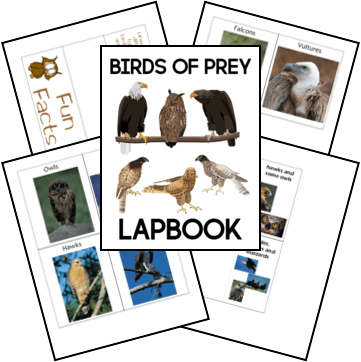
Free Birds of Prey Zoobook Lapbook

Birds of Prey

by Tina Franks


Cover Page
 
Picture Cards and Pocket Diet Simple Fold
Anatomy Tab
 
Wings Side by Side Thermals Pocketbook (older)**
Day vs. Night Hunters Matchbook
 
Flight Facts Shutterfold Skeleton Accordion
Catching Prey
 
Moms, Dads, and Babies Layer Book Predator and Prey Matchbooks
What are Birds of Prey? Matchbook
 
Vulture Simple Fold Endangered Envelope Book


**Your older student may want to draw a diagram based on the information in the Zoobook and include it in the pocketbook


Books used:

ZooBooks – Birds of Prey by John Bonnett Wexo

A First Look at Owls, Eagles, and Other Hunters of the Sky by Millicent E. Selsam & Joyce Hunt


Library List

Raptor!: A kid’s guide to birds of prey by Christyna M. & Rene Laubach & Charles W.G. Smith

Birds of Prey by Laura Evert

Amazing Birds of Prey (DK Eyewitness Juniors) by Jemima Parry-Jones


Research and Lessons

Day Hunters vs. Night Hunters

There are many different kinds of birds that are considered birds of prey (over 400!) but they can be grouped into several main types of birds.  The day hunters are mostly eagles, hawks, ospreys, falcons and vultures.  The night hunter category consists mainly of owls.


Important Birds of Prey Facts

According to ZooBooks, there are over 420 different kinds of birds of prey.  Most of them are eagles, hawks, falcons and vultures.  Owls are also birds of prey and there are close to 140 of those.

The smallest bird of prey is the Bornean falconet.  It weighs about an ounce and is less than 6” long.

The largest bird of prey is the Andean condor, which weighs around 30 pounds and has a wing span of over 10 feet.


Why are they called birds of prey?

These birds are named for their skills and ability to catch live prey.  That is what separates them from other hunting birds.


Predator and Prey

A predator is an animal that hunts others for food.  Prey is the animal being hunted.  Predators are an important part of nature.  Their job is to get rid of insects and nuisance animals and to weed out the animals that aren’t able to survive in nature on their own (survival of the fittest).  The predators that make up the birds of prey family do their jobs well and their prey does not suffer.


Flight Facts

All birds fly in two ways.  First, they flap their wings.  In order for them to be able to fly while carrying prey, birds of prey have very strong flight muscles. The primary flight muscles are attached to the bird’s breastbone.  These are the muscles that do most of the work when the bird hovers, takes off, maneuvers and lands.  Second, they glide.  Older children may wish to investigate a bird’s use of thermals in flight.  (This can be found on and around page 13 in the Birds of Prey Zoobook.)


Birds of Prey and Their Wings

Some birds of prey can fly very high.  Some can fly very fast, as fast as 80 miles per hour sometimes!  How a bird of prey uses its wings depends a lot on how they fly.  Falcons and other smaller birds of prey are very fast flyers and have thin wings that help them to fly fast.  Hawks and some owls fly often have to navigate in and around forests so they have short, stubby wings that give them some speed, but more lift.  Eagles, vultures and buzzards fly very high and glide for long periods of time.  (Gliding is flying without flapping the wings.)  Their wings are big and broad and provide them with a lot of lift to help them glide.


Skeleton Facts

To make them lighter and able to fly more easily, all birds have many hollow bones.  Even as light as they are, though, a bird of prey’s skeleton is very strong.


Which Bird of Prey Does Not Catch Its Food?

Vultures do not catch their food.  They search for animals that are already dead and then eat everything but the bones.  They are part of the clean-up crew in the animal world, removing dead and decaying animals that would otherwise take a long time to go away.


How Do They Catch Their Prey?

First, a bird of prey will swoop down and try to grab its prey with its sharp talons.  If the bird is successful and the prey is caught, the force of the impact and the sharp, piercing talons will usually kill the prey instantly (so the prey really doesn’t suffer).  However, 9 out of 10 attacks are not successful and the prey escapes.


Bird of Prey Bodies

Eyes – Birds of prey usually have large, bright eyes with 3 eyelids to protect their eyes: an upper eyelid, a lower eyelid and the “nictating membrane”.  Owls are most like humans, in that they move their upper eyelids down like we do.  Hawks close their eyes by moving their lower eyelids up… the exact
opposite of what we do.  Their 3rd eyelid is called a “nictating membrane” and it closes from side to side.  It is specifically designed to clean the bird’s eyes and keep it moist.

Vision – Overall, the vision of a bird of prey is 8 to 10 times better than that of a human being.  Eagles can see small animals clearly from several miles away.  Owls’ eyes are created to see at night, so their eyes are very sensitive.  They can see anywhere from 10 to 100 times better than us in the dark.

Beak – A bird’s beak is dependent on the kind of prey they hunt.  Birds with short beaks, like the American kestrel, eat insects and small animals.  Birds with long, curved beaks, like the Everglades kite, are likely to eat things like snails and other animals with shells that they have to pick at.  Beaks that are heavy and strong, like that of the bald eagle, are for tearing apart large pieces of meat (larger animals).

Talons – Talons, too, depend on the type of prey.  Birds with small talons usually hunt and eat rats, mice and other small animals.  The barn owl is one example of this.  Birds with large talons, like the harpy eagle, have talons as big as a bear’s claw and can even hunt and carry a small sheep!


What Do They Eat?

The main prey of birds of prey are rats, mice, insects, birds, snakes, fish and other vermin.  Sometimes they do go after larger animals such as rabbits and small farm animals.


Moms, Dads and Babies

Birds of prey are usually considered to be excellent parents and a large amount of their hunting is done to feed their offspring.  Not all birds of prey mate for life.  The amount of time they stay together depends on how many seasons they’ll have to spend raising their young.  Condors usually do mate for life, or a really long time at least.  Smaller birds only mate for a season or two.

Their eggs vary in all aspects: size, shape color and texture.  Most species lay somewhere between 1 and 4 eggs.  Certain owls can lay up to 12, provided there is enough food available.  Larger birds, though, rarely lay more than 2, probably because their young will require much more food.  Mom keeps the eggs warm until they hatch and, while she’s doing that, dad does the hunting for them both.

Nests can be found in many places; usually parents choose locations that can best protect their young.  Many owls build their nests in holes in trees, though some prefer holes in the ground (the burrowing owl) and the elf owl builds its nest in a giant cactus.  Other birds of prey more commonly build their nests high up in the trees.


Birds of Prey Picture Cards (answer key)

Owls – 1

Eagles – 2

Hawks – 3

Ospreys – 4

Falcons – 5

Vultures – 6


Birds of Prey are Endangered

Endangered means that an animal is in danger of dying out and becoming extinct, never to be seen again.

People kill birds of prey in many ways and for many reasons, and often indirectly.  Some people think it’s okay to shoot and trap them because they believe that these predators kill lots of farm animals.  Although they do sometimes take chickens or other small farm animals (like small sheep), it is very seldom.  In reality, birds of prey really help farmers by killing millions of pests and crop-destroyers every year.  Pesticides that are put down to kill off vermin are absorbed by prey and can build up in the birds’ systems and slowly but eventually kill them.  Commercial development, too, can disrupt hunting and nesting territories and either drive the birds away or starve them to death.