| about us |
what's new
|
unit studies
|
unit study helps |
fiar resources
|
indexes | lapbooking |
|
Authors: Natalie Kinsey-Warnock and Helen Kinsey Illustrator: Ted Rand ISBN: 9780525651031 Summary: A fictionalized retelling of the true story of three-year-old Sarah Whitcher, who became lost in the woods of New Hampshire (in 1783) and was protected by a bear until her rescue four days later.
Unit Prepared by: Rachel Poe |
Social Studies
History:
This story takes place in 1783, not many years after the Continental Congress adopted the Declaration of Independence in 1776. The setting of the story is in Warren, New Hampshire. The town library is named for its first settler, Joseph Patch, who built a cabin there in 1767. (Joseph Patch is one of the neighbors that helped search for Sarah Whitcher) New Hampshire was one of the 13 original colonies, being the ninth state to enter the Union, on July 21, 1781.
US Geography:
This story takes place in New Hampshire just two years after it joined the union. Have your child locate New Hampshire on a US map. You will find it in the northeastern part of the country, in what is known as the New England States. On the larger map of New Hampshire, have your child draw an icon (a small picture) that indicates where Warren, New Hampshire is. The icon should be one that will help them remember Sarah’s story. They might want to draw a stick figure girl, or a bear, or maybe a teardrop. Let them use their imagination.
New Hampshire is called “The Granite State” because over two hundred kinds of rocks and minerals, including granite, are found in the state’s White Mountains. The capital is Concord. The state flower is the purple lilac, and the state bird is the purple finch.
New Hampshire State Symbols Tab Book
New Hampshire Bird and Flower Minit Books
Where is New Hampshire Shutterfold
New Hampshire Symbols Coloring Page
Vocabulary:
Hollow- having an empty space inside
Scolded- to find fault noisily or angrily
Bounded- leapt forward or upward
Brambles- rough prickly shrubs or vines
Bolted- moved suddenly or quickly
Yoked- two animals connected together, usually at the neck, by a wooden bar or frame to make them work together to pull a load
Discouraged- lost confidence or courage in
Famished- extremely hungry
Venison- deer flesh
Descriptive Writing:
The author of this story used descriptive nouns and adjectives to give the reader a good mental image. Talk with your child about using descriptive nouns and adjectives. Using descriptive words can make stories (or even sentences in general) more interesting. A noun is a person, place, thing, idea, or event. An adjective is a word that describes a noun. Look at this sentence:
Brook trout swam in the deep green pools.
Notice how easily you can picture this in your mind, and how interesting it sounds. If we remove the descriptive words the sentence might read, “Fish swam in the water”. While this is a complete sentence, it generally would not make someone want to read on. Notice that even replacing the word fish with the type of fish adds more detail to the sentence. Here’s one for your child to try. Look at this sentence:
A bird sat in the tree.
Again, this is a complete sentence, but it does not give you a real picture of what is going on. How can you change the sentence to make it more interesting? Help your child (if they need it). You may offer suggestions to end up with something like this:
The blue jay perched herself in the morning sun, high on a thick branch in the old oak tree.
Find examples in the story of instances where the authors used descriptive words or phrases that made the sentences more interesting. Ask your child, “What was your favorite sentence in the story? Why?”
You can follow up with this by giving your child a few plain sentences to dress up. Try not to use this as handwriting practice because you want the focus to be on the sentences, not on letter formation, spacing, etc.
Handwriting Practice:
For handwriting practice, have your child neatly write out a Prayer of Thanksgiving. You could have them pretend they are Sarah’s father and write what they think he said in his prayer; you could have them write their favorite Prayer of Thanksgiving (table grace); or you could have them copy a verse or two out of the Bible that talk about giving thanks. (examples: Psalm 31:19, Psalm 100, 1 Chronicles 29:11-13)
Shadows:
The illustrator used shades of color intensity to make things look realistic. Also note how he added details like the reflection in the water, and shadows. Discuss briefly with your child what causes shadows. To have a shadow there must be a light source, an object blocking the light source, and a back drop of some sort. If it is a sunny day, you might wish to take your child outside to see different shadows that are cast near your house. See if the size of the object makes a difference in the size of the shadow. If you have the opportunity, you could let your child trace your shadow (or the car’s shadow, etc) on the driveway or patio with sidewalk chalk. Another option would be to simply bring a piece of paper and a pencil outside and place a small object on the paper, positioning to cast the “best” shadow, and allow your child to trace the shadow. Keep in mind that their hand will also cast a shadow, and that may confuse younger children on how they can trace the shadow correctly.
Of course all of the above can be accomplished in different ways indoors, using lamps or flashlights. You could really go wild and try several different methods for creating shadows and note how the shadows from the different light sources compare and contrast.
Watercolors:
The illustrator used watercolors in this book. Allow your child to illustrate their favorite scene from the book using watercolor paints. Ask them, “Is it day or night in your picture?” Point out any shadows in their painting (or where shadows might be).
Bears:
Black bears are large, mostly harmless mammals with powerful limbs, small heads, and small, rounded ears. Female black bears generally weigh between 125 and 150 pounds, and males are larger, usually weighing between 200 and 250 pounds. Black bears have several color phases; most black bears in the northeast are all black with a brown or tan muzzle. Black bears have five toes with claws on each foot. They walk on the soles of their feet, just like we do.
Black bears eat grasses, berries, fruits, roots, blossoms, insects, beechnuts, acorns, and hickory nuts, and sometimes small mammals, though they will eat larger livestock if they cannot find their “natural foods”. Black bear attacks on humans are uncommon, unless the bear cannot find other food.
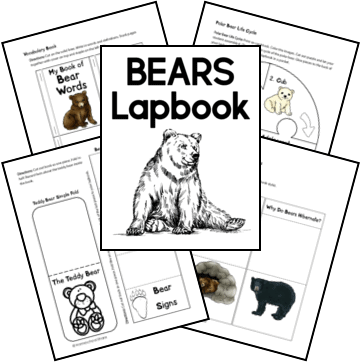
Bears Lapbook at Homeschool Share
Here is a link to a printable page on the American Black Bear at Enchanted Learning.
Bear Report Form Stained Glass
Bear Report Form with HWOT lines
Bear Report Form 2 with HWOT lines
Forest Safety:
Discuss with your child about forest safety in your area. Take a nature walk, if possible, and point out things they must definitely avoid touching (or eating) in the woods. It might be a good time to note that they need water to live more than they need food. If you have a forest/woods near your home, make sure your child knows their boundaries, and knows what to do if they become lost on one of their adventures.
Units of Time:
How many years have passed since this story took place? Have your child (or help your child) write a number sentence to show the answer. (2009-1783=226)
A century is a period of 100 years. How many centuries have passed since this story took place?
A decade is a period of 10 years. How many decades have passed since the story took place?
You might have an older child figure out how many months and/or days have passed since the story took place.
Measurement:
In the story, Ms Richardson was baking a bushel of beans to feed the searchers. How much is a bushel? A bushel is four pecks. How much is a peck? A peck is about eight quarts. Allow your child to write a number sentence to tell (approximately) how many quarts are in a bushel. 8+8+8+8=32 (or for older children, 8x4=32)
You can use this time to reinforce cups to pints to quarts to gallons if you desire.
If you have a container or pan that holds 32 quarts, show it to your child so they can get an idea of how much a bushel would be. If you have a bunch of dry beans you can use, you could let them use a measuring cup to measure beans into the container or pan. Marbles can be fun too, if you have them on hand.
Ten Commandments:
This story refers to at least two of the Ten Commandments. If your child already knows about the Ten Commandments, see if they can tell you which two are referred to.
The most obvious one will be “Remember the Sabbath Day, to keep it holy.” (No axes rang in the great pine woods because Sundays were a day of rest.
The other commandment referred to in the story is “Honor thy father and thy mother.” (Sarah meant to be a good girl…)
Open your Bible to Exodus chapter 20 and read the Ten Commandments with your child. Discuss them to make sure your child understands them.
You can use the following pages as a tool to help your child learn (or as a refresher) the Ten Commandments. You may want to use this activity in a workbox in the future!
Page 1 is will be the base- the “stone tablets”. Print on cardstock for longevity (you can even laminate if you’d like)
Page 2 can be used as an introduction to the commandments, or learning what they are.
Page 3 is for practicing/ learning the commandments in order.
Page 4 is the same as page 3, except it uses Roman numerals.
1.If you have an older child that is doing this unit with you, you might have them read Sarah Whitcher’s Story by Elizabeth Yates.
2.A fun story to go along with this unit is Moonbear’s Shadow by Frank Asch.
3.If your child likes songs you could sing “The Bear Went Over the Mountain” together. You could change the words a bit to go along with the story.
The black bear walked through the forest
To see what he could see
He saw little Sarah Whitcher
And what do you think he did?
He kept her safe and warm
Is what that black bear did.