Google
 
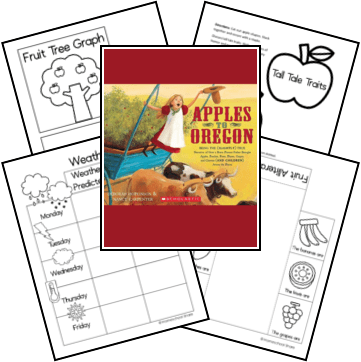
Apples to Oregon Free Unit Study

Apples to Oregon

Being the (Slightly) True Narrative of How a Brave Pioneer Father Brought Apples, Peaches, Pears, Plums, Grapes, and Cherries
(and Children) Across the Plains

Author: Deborah Hopkinson
Illustrator: Nancy Carpenter
ISBN: 0-6898476-9-6
Summary:  A pioneer father transports his beloved fruit trees and his family to Oregon by covered wagon in the mid-nineteenth century. Based loosely on the life of Henderson Luelling.

Literature Based Unit Study by Mary Machado

Lapbook/Notebook Resources
Notebook Page by Jayne Hatcher

Where is Oregon Shutterfold
 
My Tall Tale Page Primary
 
Apple Symmetry
 
Oregon Symbols Tab Book
 
My Tall Tale Page Regular
 
Wagon Diagram
 

Vocabulary Crossword Puzzle
 

Apple Half Math
 
Weather Phenomenons
 
Oregon Flag Notebook Page Primary
 
Book Report Primary
 
Henderson Luelling Page Primary
 
Oregon Flag Notebook Page Regular
 
Book Report Regular
 
Henderson Luelling Page Regular
 
Tall Tale Accordion (prompts)
 
Flag Symbolism Trifold
 
Frost- Personification
 
Tall Tale Accordion (blank) Wagon Shape Minit Book Fruit Alliterations

Social Studies: Geography- Oregon

The story follows the adventures of the family traveling on the Oregon Trail. Use this map along with the one on the inside cover of the book to trace the route of the family from Iowa to Oregon and locate the places mentioned by Delicious in the book (Courthouse Rock, Chimney Rock, Independence Rock, Platte River, Columbia River, Walla Walla, Washington).  After studying the maps compare them to a current United States map.  Were the states that they went through (Iowa, Nebraska, Wyoming, Idaho, Oregon) actually states at the time?  Were there any states west of the Mississippi River in 1847?  Which ones?

Oregon was the destination of the majority of travelers on the Oregon Trail.  They were drawn by promises of lush land, good soil, and moderate climate. Today fruit orchards remain an important part of Oregon’s economy.   In the book, the family settles at the end of the trail in the area near Portland, Oregon.  Find Oregon on the map and mark it with a story disk.   Oregon State Flower/Bird Coloring Page

Find out more about the state of Oregon and make a state report (or lapbook).   Add desired information from these sites to the state report.

                        http://www.50states.com/oregon.htm  
                       
Oregon Information
                        Report cover and other state information
                        Label Map
                        http://www.enchantedlearning.com/usa/statesbw/oregon.shtml  answer the questions listed.
                       
Oregon Flag 

Symbolism of the flag -

Specifically point out elements of the flag that connect it to the Apples to Oregon book:

1)     covered wagon – many settlers including Delicious’ family came to Oregon  in covered wagons

2)     plow and wheat (farming) – Delicious’ daddy chose to farm in the rich soil of Oregon, Oregon is known for it strong fruit production

3)     1859 – the year that Oregon became a state.  This book takes place in 1847.  How many years before Oregon became a state did Delicious’ family travel to Oregon?

Social Studies: History – Oregon Trail

In the mid-1800’s, thousands of pioneers (emigrants) traveled from the eastern part of the United States into the western frontier by covered wagon. Along these well-worn trails, groups of from 15 to 30 wagons were led by experienced scouts who knew the way. The covered wagons were nicknamed "prairie schooners" because from a distance they looked like ships bobbing on the "seas" of the Great Plains. Wagon trains usually began their journey in the month of May. In order to get through the mountains and to their destination before winter snows, scouts had to prod them on to cover about 15 miles a day. This pace allowed for a variety of crises, such as wagon damage and repairs, river crossings, and bad storms.

                    Interactive Oregon Trail Site
                    
What pioneers took on the trail

Pioneers had to decide what to take to get them through the long months of travel as supplies would be limited on the trail.  The pioneers often found that they had packed too much and would abandon unneeded items along the trail.

For discussion: Do you think it is unusual that the family in this story would take trees along?  Why would it be difficult to take plants?  Do you think it was a good idea?  Why or why not?  If you were a pioneer is there anything that you would really want to take with you on the wagon?  Can you find any other stories of pioneers who brought unusual items with them on the trails?

                    View a covered wagon (with parts labeled) here 
                    Build a covered wagon I
                    Build a covered wagon II
                    Purchase the game, Oregon Trail II
 --Students have an opportunity to play the part of pioneers on
                        the Oregon Trail – including purchasing supplies, trading, hunting, etc.  It’s a fun and
                        educational game.

Have older students along for the ride?
Try
In the Hands of a Child Pioneer’s Pack


Social Studies: Tall Tales and History

Throughout history people have told and written stories about their heroes. In America, tall tales were first told by settlers in the 1800’s who made their homes in the American wilderness/frontier.  Apples to Oregon is told in the form of a tall tale – it is based on a true story, but is exaggerated and has larger than life characters.  Some of the heroes and heroines in tall tales are not real, but sometimes they are real people like Davy Crockett or Johnny Appleseed.  The stories that were told about them grew bigger and became more exaggerated as time went on.  Many times tall tales are specific to an occupation of a geographic region. 

Common features of a tall tale:

1. A larger-than-life, or superhuman, main character with a specific job.
2. A problem that is solved in a funny way.
3. Exaggerated details that describe things as greater than they really are.

Additional books for studying American tall tales:

American Tall Tales – Mary Pope Osborne
Big Men, Big Country – Paul Robert Walker
Johnny Appleseed – Steven Kellogg
Paul Bunyan – Bill Balcziak

                    Read about America's most famous tall tale characters   (Also writing suggestions) 
                    More Tall Tales

Find out more about Henderson Luelling, the pioneer that this story is based on.  He brought over 700 fruit tree seedlings to Oregon in a covered wagon in 1847. Luelling is known as the Father of the Pacific Fruit Industry. Discuss together what parts of the story are based on fact.  Which parts are exaggerated in the tall tale story? See information in author’s notes and at this website                                                                                                                                                                                                                                                                                                                                                                                                                                                                                                                                                                                                                                                                                                                                                                                                                                                                                                                                                                                                                                                                                                                                                                                                                                                                                                                                                                                                                                                                                                                                                                                                                                                                                                                                                                                                                                                                                                                                                                                                                                                                                                                                                                                                                                                                                                                                                                                                                                                                                                                                                                                                                                                                                                                                                                                                                                                                                                                                                                                                                                                  


Language: Hyperbole

Hyperbole is a figure of speech that uses exaggeration or overstatement for emphasis or humor.  

Exaggeration means claiming something is greater than it really is. 
For example:
                        "I’m so hungry that I could eat a horse." 
                        "I can run faster than the speed of light."

Can your student remember some of the things that Delicious said that were exaggeration. 
                        “It (the Platte River) was wider than Texas.”
                        “I reckon that wind blew my left boot clear to the other side of the moon.”
                        “…our feet were redder than the poison apple the old witch gave to Snow White.”

Have your student pick one characteristic of something to write about, and exaggerate it as wildly as he can.  Example if using the world's spiciest food. What kind of food might that be? Maybe a hot pepper. What kinds of things would happen if you ate the world's hottest hot pepper? Would you breathe flames? Would your hair ignite? Would you drink a lot of water? Perhaps an entire lake? What else would happen?  

Language: Personification

Personification is a figure of speech in which a thing, quality, or idea is represented as a person, or has human characteristics.  In Apples to Oregon, Delicious talks about the varmint, Jack Frost as if he (frost) were a person.  People sometimes refer to a visit from Jack Frost when they mean that the ground has developed a layer of frost during the night.

List all the descriptions of Jack Frost from the book that make it sound like he is a person.

        He is described as

                                            “…sneaking around our campsite”

                                            “brushing the cottonwoods with his cold white tongue”

                                            “slinking across the meadow”

                                            “…hightailing it out of here”

From the way Delicious describes Jack Frost, what do you think he would look like?  Describe him.


Language: Vocabulary

Prepared Crossword Puzzle

            daring – courageous

            ornery – stubborn and mean-spirited

            crooning – singing or humming softly

            fluttered – to wave or flap lightly ad rapidly

            plummeting – dropping straight down, plunging

            tuckered – tired

            sagebrush – an aromatic shrub that is common in the western United States

            keeled – to drop or faint from shock or being really tired

            scrutinized – to examine or observe with great care

            numb – having no feeling as from too much cold

            swanky – extremely elegant, grand

            prospector – one who explores an area for natural deposits, such as gold

            bushel – a dry measure, containing four pecks, eight gallons, or thirty-two quarts


Math: Fractions

Take several apples or other larger fruit (peaches, pears) and cut each into pieces to illustrate fractions.  Cut first fruit in half (cut through stem to blossom end).  Show students that there are now two pieces – each one is ½ of the fruit.  Now cut those pieces into half again.  Show your student that there are now 4 pieces – each piece is ¼ of the fruit. Cut in half again for eighths.  Start with a new fruit and cut it initially into three equal pieces – show that each is 1/3 of the fruit.  Cut those pieces in half and show that the pieces are now 1/6 of the fruit.  Try some simple fraction addition or subtraction. Use more fruit if needed.

½ + ½  = 1

1/3 + 2/3 = 1

3/8 + 1/8 = 4/8 

4/8 is also equal to what?  - ½

Ask student to point out relationships he notices between different fractions. 

Books to use for illustrating fractions:
Apple Fractions – Jerry Pallotta
Apple Fractions – Donna Townsend

Math: Circumference
Using string, find the circumference of an apple

Math: Counting
Read Ten Apples Up on Top by Dr. Seuss

Math: Graphing
Look at this list of the fruit trees that Henderson Luelling brought with him to Oregon. http://www.ars-grin.gov/cor/cool/luelling.html 

Make a graph of comparing the different kinds of fruit tree he brought (apple, peach, pear, cherry).  Make a bar graph for each fruit type, then graph the number of different varieties he brought of each type of  fruit tree (18 apple, 8 pear, 3 peach, 6 cherry)  Which type of tree did he bring the most varieties of? The least?  How many more types of apple trees did he bring than cherry? 


Science: Weather
Delicious and her family encountered many different types of weather during their journey to Oregon.  Review the weather phenomenon that they experienced – drought, wind, rain, hail, frost.  With your student, each day this week keep a record of what kind of weather you have that day.  Compare it to the forecast in the newspaper or online?  Was the forecast correct? 

If interested study weather and find out more about the variety of weather phenomenon.

Weather (DK Eye Wonder)– Lorrie Mack

Eyewitness Weather – Brian Cosgrove

Wild About Weather – Ed Brotak

Weatherwatch – Valerie Wyatt

How the Weather Works – Michael Allaby

Janice Van Cleave’s Weather

                         Here is a useful weather site to check the weather in your local area
                       
 Try the Weather Maker interactive program in the “Investigate” section of  this weather site
                         
Conduct an experiment to demonstrate how frost is formed


Science: Growing Fruit Trees
Fruit trees grow from seeds.  The seeds are found inside of the fruit.  Take a look at the seeds in an apple.  How many seeds does it have?  What size are the seeds?  Compare the apples seeds to other fruit seeds from fruit mentioned in the book (peach, pear, plum, cherry).  How many seeds does a cherry have? A pear? A plum? A peach?  Which fruit has the biggest seed? The smallest?

The book Fruit – A First Discovery Book by Gallimard Jeunesse might be helpful.

The science of fruit growing is called pomology.  If you plant a seed from an apple an apple tree will grow, but you can’t be sure what kind of apples will grow on it.  So in most orchards farmers use a different method for growing apple trees.  It’s called grafting.  A farmer cuts a small branch or bud (called a scion) from a grown tree that produces the kind of apple he wants.  Then he puts the branch/bud into a small cut in the trunk or under a slit in the bark of another apple tree already rooted in the ground (called the rootstock). This is taped together or covered with wax to protect it. The rootstock and scion join together and grow to produce a tree that grows the kind of apples that farmer chose.

These books have good illustrations and explanation of the process of grafting.

Apples – Rhoda Nottridge

Apple Trees – Dorothy Hinshaw Patent 

Science: Density
One of the apple facts on the back of the book is that fresh apples float, because 25% of their volume is air.  Objects float if they are less dense than water.  Experiment with an apple by placing it in a bucket of water.  Does it float or sink?  Check other objects (cork, rubber band, key, quarter, rock, crumpled paper, ice cube, stick, nail, etc.).  Before putting them into the water, have your student make a guess whether each will float or sink.  Sort the items into a sink pile and a float pile.  Then test them to find out.


Art: Music

In the story Pa fiddled lullabies to the fruit trees.  Fiddle music was a common form of entertainment in the 1800’s and particularly with the travelers along the frontier trails.  In the evenings the pioneers would often listen to or dance along with the fiddle music played by one of the pioneers.  Find a collection of fiddle music at the library or music store to listen to.  Another option is to listen to audio clips at this Library of Congress site

Imagine you are a pioneer on the trail listening to the music.  How does the music make you feel?  After a hard day of traveling it was a nice diversion to have the music.


Craft: Apple Printing

(Note the Apples Facts on the back of the book “Cut an apple in half, across the core, and you’ll see a star)

Materials Needed: Apples (or other fruit-cherry, pear, etc.). paper towels , Styrofoam plate, construction paper, paint

Instructions: Cut the apple in half. Cut through the top and out the bottom to make a 'traditional' apple print, cut through the middle to make apple 'star' prints. Fold a paper towel into 4ths and lay it on the bottom of the Styrofoam plate.  Pour paint into the center of the paper towel to make it into a stamp pad. Dip the cut side of the apple into the paint.  Dab it around on the paper towel to wipe off excess paint, and then press it onto the paper.  You can also use other fruits to make prints.


Just for Fun Activities

Next time you go to the grocery store with your student point out all the different kinds of apples.  Buy a few different kinds, and when you get home, let your student try them.  Ask how each one tastes. Ask your student how each one is different.

There are hundreds of varieties of apples and other fruits.  Many have very interesting or colorful names.  Read some of the different names.  Here is a list of some of the varieties that Henderson Luelling brought to Oregon-- http://www.ars-grin.gov/cor/cool/luelling.html.  Check the list below for website resources with apple variety lists.  Have your student choose one they think is especially funny or interesting.  See if you can find out why it has that name.   

Field trip ideas

- Visit a local apple (or cherry, peach, pear) orchard or self-pick fruit farm.  http://www.applejournal.com/trail.htm  (a listing of orchards by state)  If you can’t visit an orchard find out about one in a book like Life on an Apple Orchard – Judy Wolfman

-Visit a local nursery (one that specializes in trees would be good) to see young plants/seedlings. Find out how the growers
grow, transport, transplant the young plants.   See if they can demonstrate grafting.  Or look for signs that a tree has been  grafted.

-If you live in a state along the Oregon Trail, visit a historic marker or site along the trail.

Recipe: Applesauce

1 quart Apples (peeled and sliced)

1 cup Water

1/2 cup Sugar

1 tsp. Lemon Juice

Cinnamon (optional)

Put all the ingredients in a sauce pan and cook until tender, about 20 minutes. Mash the mixture using a potato masher or an electric mixer until it is smooth.  Top with a little cinnamon if desired.

Or choose any other apple recipe to make some apple goodies.  Find a variety of recipes--  http://www.bestapples.com/recipes/index.asp


Additional Books of Interest


Pioneer Settlers/Oregon Trail
Sunsets of the West – Troy Johnson (actually about the California Trail, but excellent depiction of life for pioneers on the western trails)
Covered Wagons, Bumpy Trails – Verla Kay
Roughing it on the Oregon Trail – Diane Stanely

Conestoga Wagon - Richard Ammon
If You Traveled West in a Covered Wagon - Ellen Levine
A Frontier Fort on the Oregon Trail - Scott Steedman

Oregon
B is for Beaver: An Oregon Alphabet - Marie & Roland Smith
Oregon (From Sea to Shining Sea) - Dennis Fradin


Apples
The Seasons of Arnold’s Apple Tree – Gail Gibbons
Apples – Gail Gibbons
Starting Life: Tree – Claire Llewellyn, Simon Mendez
The Life and Times of the Apple – Charles Micucci
Bite Into an Apple – Lynn Brunelle

Additional Resources

Apple websites:

http://www.bestapples.com/varieties/index.html 
http://www.bestapples.com/
http://www.vermontapples.org/index.html 
http://www.urbanext.uiuc.edu/apples/intro.html
http://www.naturalhub.com/grow_fruit_cultivars_apple.htm#COX%27S%20ORANGE%20PIPPIN

Deborah Hopkinson's website:

http://www.deborahhopkinson.com/index.2ts?page=1010