| about us |
what's new
|
unit studies
|
unit study helps |
fiar resources
|
indexes | lapbooking |
The Apple and the
Arrow Unit & Lapbook
| Authors: Mary and Conrad
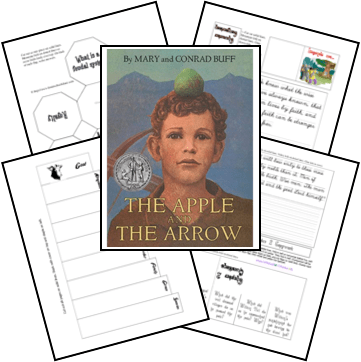
Buff ISBN: 0618128093 Summary: The year is 1291, and Walter is the twelve-year-old son of William Tell, the greatest bowman in the land of Uri. Walter lives happily in the remote heights of the Alpine Mountains, caring for his family"s goat herd and practicing his marksmanship in the hopes of making his father proud. But as the end of the year approaches, Walter"s peaceful life is shaken as his country enters a revolution, and Walter must carry a secret that could threaten the life of the father he loves so dearly. More than seven hundred years have passed since the day Walter stood in the marketplace balancing an apple on his head while the Austrian tyrant Gessler commanded Walter"s father, William Tell, to take aim at the apple with his great crossbow. The dramatic tale of William"s arrest and escape and the daring revolt of the Swiss against the Austrians has become a legend around the world. Unit and lapbook created by Wende |
General Lessons –
Medieval Occupations Tri Fold and mini-books
Chapter 1 –
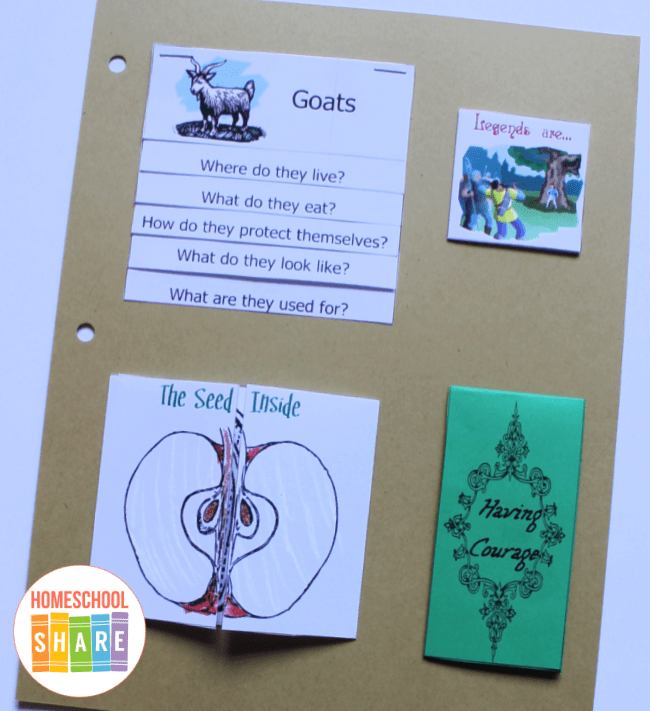
Goat Classification Graduated Book
Language Arts Components (includes comprehension questions and cursive copywork)
Chapter 2 –
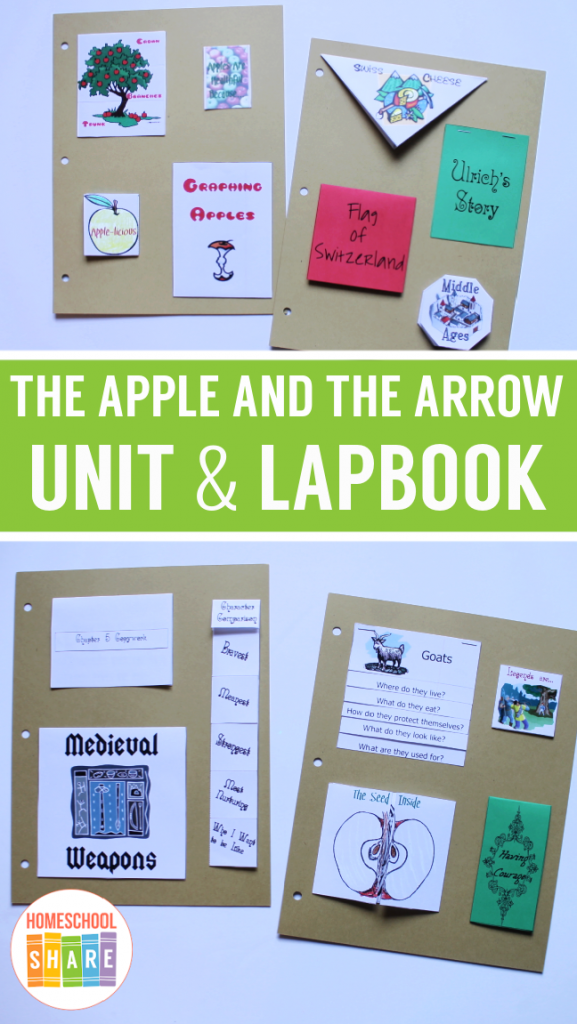
Apple Components (includes Apple Seed shutterfold, Tree Parts 3-Flap, Apple Product Accordion)
Language Arts Components (includes comprehension questions and cursive copywork)
Apple Fraction Cards and Pocket
Chapter 3 –
Language Arts Components (includes cursive copywork and narration mini-book)
Chapter 4 –
Language Arts Components (includes cursive copywork and narration mini-book)
Chapter 5 –
Language Arts Components (includes cursive copywork, Legends fold, and Character Flap Book)
Timeline Fan
Lap ~N~ Note Sample
Photos
![]() |
![]() |
![]() |
![]() |
![]() |
![]() |
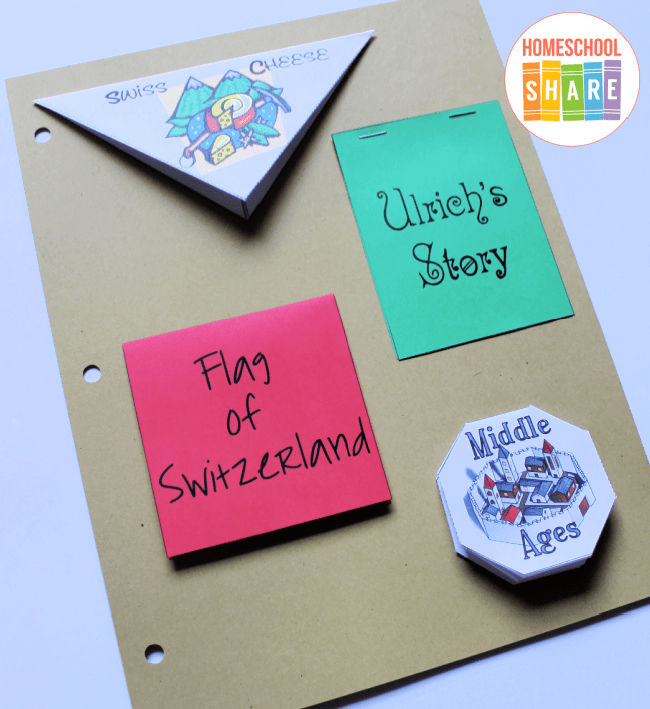
This story takes place in what is now Switzerland, during King Albert’s reign. The Middle Ages, also called medieval times, are the period of European history beginning at the downfall of Rome in 476AD and lasting until about 1500AD. During the middle ages, the form of government and society that was set up was called the feudal system. It was based on the ownership of land. While the king of a region owned all the land, he could give possession of tracts to those who worked for and pledged allegiance to him. People were separated into different classes during the middle ages. There was the nobility, or vassals, which was composed of people having hereditary title, rank and privileges. The nobility included those that worked directly for the king, mainly having the job of protecting the kingdom. Then there was the clergy, who were in charge of the spiritual needs of society. And then there were the peasantry, also called serfs, who worked for the nobles, cultivating the lands and performing the manual labor. Lastly, there were slaves. Many of the nobles owned slaves, who may have been prisoners captured in war, or people who actually sold themselves to the nobles in order to survive. The dream of the serf was to become a nobleman, and the dream of the nobleman was to become a knight. We will discuss more about the different roles people played, and the lifestyles they lived, throughout this unit. Complete Middle Ages Octagon Fold.
History - Medieval Occupations –
You will encounter a wide variety of occupations throughout this book. Some of them you will be familiar with, and others are now obsolete. Keep track of the various occupations, identifying the class of each, i.e.: ruling class, noble, clergy, or serf. Print out Medieval Occupations Tri-fold and mini books. Complete mini books and add to tri-fold as you learn about them in each chapter.
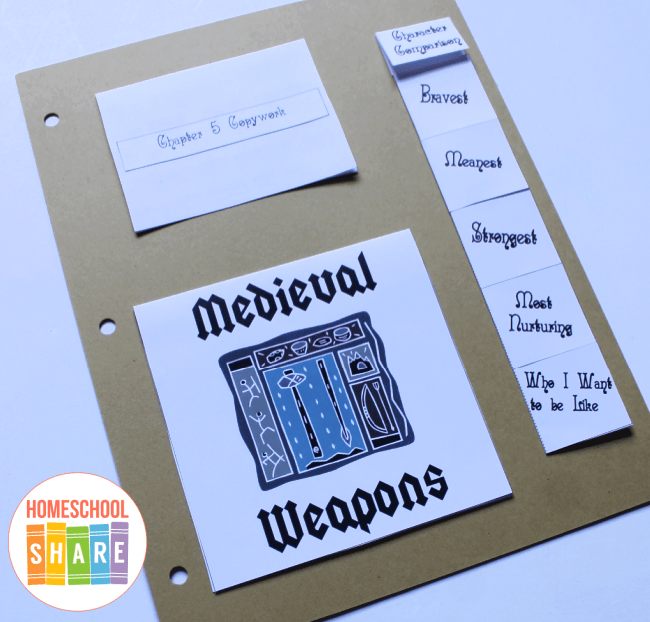
The Middle Ages was a very violent period in history and all men were expected to know how to use many weapons to protect and defend their land. There were different weapons for different kinds of attacks, and you will be introduced to many of them throughout this book. Print out Medieval Weapons Simple Fold. As you come upon the lessons in each chapter, complete and glue each of the compressed triangle folds inside of simple fold.
Vocabulary –
You will come across many unfamiliar words in this book. If you come across a word you don’t know, first try to figure out the meaning by the context of the sentence. For instance, if you don’t know what the word “Chamois” means, read the information given around the world. You can deduce by the information that is given that it is a kind of animal, and that the thickness of the hide is important. If you can’t figure out the meaning of a word, look it up in the dictionary. Print out Vocabulary Shields and complete them for all unknown words throughout the book. At end of unit, assemble shields into a fan with a brad and glue into lapbook.
An opera is a form of drama that includes a lot of music. There is an orchestral accompaniment, choruses, acting, and sometimes dance. The actors and actresses sing all their lines. In 1829, a man named Gioachino Rossini wrote an opera based on the legend of William Tell.
Gioachino Rossini was born in Italy on February 29, 1792. He learned about music from his parents at a very young age. His mother was an opera singer and his father played the horn and trumpet. Gioachino wrote his first opera in 1810 at the age of 18 and throughout his life wrote more than thirty such works. William Tell was his last opera. After retiring in Paris, Gioachino Rossini died on November 13, 1868 at the age of 76.
Probably the most famous part of Rossini’s opera is the William Tell Overture. An overture is the instrumental prelude, or introduction, to an opera. The William Tell Overture starts out with a soft trumpet call, moves into what sounds like horses coming, and then a fight ensues, as there is a struggle back and forth. The bow is then raised and the arrow flies! Can you tell what part of the story this overture represents? After listening to the piece a few times, act it out. What does the music make you want to do?
Listen to the William Tell Overture by Gioachino Rossini
If you complete the printables from the above site, you can store them in Overture Pocket.
Walter made a promise that he would not tell anybody about the meeting or the planned revolt. His mother trusted him enough to share this important information. How do you think Walter built up this trust? Walter must have proved himself to be honest, dependable, obedient, and careful with others’ things. If he said he was going to do something, he did it. When people trust you, they can depend on you because they know you won’t let them down. They will believe what you say, they will respect you, and they will allow you to do more on your own. How do you think Walter learned to be trustworthy? He probably learned trustworthiness from his parents’ examples. If you have younger siblings, they will be watching and learning from your example.
What does the Bible say about being trustworthy?
In Matthew 5:37 it says:
“But let your communication be Yea, yea; Nay, nay: for whatsoever is more than these cometh of evil.” When you say “yes” make sure you mean “yes”. When you say “no”, make sure you mean “no”.
In Romans 12:17 it says:
“Recompense to no man evil for evil. Provide things honest in the sight of all men.” We should live in a way that all men see us as being honest.
Complete Being Trustworthy Flap Book.
Medieval Occupations –
Refer to general lessons above. Complete mini-book for each occupation and paste in tri fold. Next to each one you’ll find a letter to identify the class. R=Ruling Class; N=Noble; C=Clergy; S=Serf;
King – (R) – The male ruler of a kingdom
Bowman – (N or S) – A person skilled at archery
Herdsman – (S) – A person who owns or tends to a herd of goats
Bailiffs – (N) – A person under the king given certain functions in a certain district, such as keeping the peace.
Knight – (N) – Knights worked for the lords of the land to defend and protect the property.
Soldier – (N) – a brave, skillful warrior that shows loyalty to the king.
Blacksmith – (S) – a person who works iron on an anvil and using a forge to make things such as tools, weapons, horseshoes, etc.
Crossbow – William Tell was an expert at the crossbow. A crossbow is a medieval weapon consisting of a bow fixed on a grooved stock on which arrows or stones are released. The crossbow has been used for hunting, protection, war, and sport throughout medieval Europe. The crossbow was easy to use and didn’t require a lot of strength to use. It consisted of a wooden stock, with a bow made of a strong strip of wood, steel, or other flexible material, crossing it at right angles. A bowstring was pulled back by a lever and held in a notch by a catch or trigger. The bolt was then laid in a groove on the top of the stock. An arrow is propelled as the bowstring is pulled back and released. It only shot 2 arrows a minute. The longbow was then developed, which required more training than the crossbow but was capable of releasing 10 – 12 arrows per minute. The introduction of gunpowder made bows and arrows obsolete for protection and warfare, but they are still used around the world for hunting and sport. Complete Crossbow Compressed Triangle and glue into Medieval Weapons Book.
Sword –The sword, also called a broadsword, was a weapon used by knights in the Middle Ages. It was a 30” to 45” sword with a two-sided blade that was used to cut, not stab. It weighed approximately 3 to 5 pounds and was used as a close contact weapon. This deadly weapon could cut off the limb or head of an opponent with one stroke! A knight had to spend quite some time training to use the broadsword, in a place called the Pell, where they could practice cutting, slicing, and thrusting without threat to an opponent. Complete Sword Compressed Triangle and glue into Medieval Weapons Book.
Rudolph the First was born in Limburg castle in 1218 and was elected German king and head of the Holy Roman Empire in 1273. He was a decent king, spending a great deal of time suppressing the robber knights and putting an end to their lawless practices. In 1282, Rudolph gave control of Austria, Styria, and Carniola to his son Albert (Albrecht). It is interesting to note, that to the best of the Tells’ knowledge, Rudolph I had died. News did not travel fast in those days, and all they knew was there was a new king, and probably heard stories of the death of Rudolph I. Rudolph the First, however, did not die until 1291, the year Switzerland became free. When Rudolph died, German electors refused to recognize Albert’s claims to the throne, but Pope Boniface VIII did recognize him as Holy Roman emperor. Albert was killed in 1308 by a nephew whose inheritance he had withheld. Complete Rudolph Accordion Flap Book.
Kingdom – Animal
Phylum – Chordata (having backbones)
Class – Mammal (live birth, warm blooded, fur, milk for young)
Order – Artiodactyla (even-toed, hoofed animals)
Sub-Order – Ruminant (cud chewing)
Family – Bovidae
Genus – Capra (goat)
Species – C. hircus (domestic goat)
Goats are ruminants, which means they have don’t have a single stomach like most mammals, but instead have a four compartment stomach and chew their cud. When they eat, the food passes down the esophagus to the rumen where it is broken down and formed into small balls of cud. As it desires, the goat will return the cud back to its mouth, where it will be chewed up some more to further break up the fibers. It will then reswallow the food, where it will go through the rumen, on to the reticulum, then to the omasum, and finally to the abomasums, the true stomach. In the abomasums, enzymes are secreted and normal digestion takes place.
Goats are grazers by nature, and when given the chance will browse on the tips of woody shrubs and trees, and pretty much any other plant matter. Their diets largely consist of grass and hay, alfalfa being a favorite.
Goats love to jump and climb and are well adapted for mountainous areas like the Alps. They can hold their balance and can even climb trees if they are on a slight angle. Goats are extremely curious and intelligent, and often get into mischief.
Complete Goat Fact Graduated Book and Goat Classification Graduated Book.
For a more in depth study of goats, please see the free unit and lapbook HERE
As you come across unfamiliar words, write them and their definitions on Vocabulary Shields.
Chamois – a mountain antelope of Europe, about two foot high at the shoulder and 45” long.
Granite – a hard, coarse-grained igneous rock composed principally of quartz, feldspar, and mica.
Vesper Bell – a bell that signals the late afternoon or evening church service.
Larder – a room or cupboard where food is stored.
Plotting – secretly planning for a questionable purpose
Pack Train – a group of animals such as horses or mules used to carry packs or burdens
Noble – pertaining to nobility, an upper class in European society.
Scheming – secret or underhanded plotting
Revolt – rebelling against authority
Tyrant – one who rules oppressively or cruelly
Canton – a district in Switzerland, similar to a state here in the United States.
Comprehension Questions –
1) What did Walter do that made him feel so happy and proud? (He hit the bulls-eye with his arrow)
2) What did the 33 men meeting at the Rootli agree to do? (To fight as one, and revolt against Gessler)
3) What promise did Walter make? (That he would tell no one of the meeting on the Rootli)
4) Why did William insist he had to go to Altdorf? (To find out what, if anything, Gessler knew about the revolt)
5) List the things Walter hoped to see in Altdorf. (Blacksmith, cider, fountain, children, bear, eagle, pack train, knight)
Complete comprehension question lapbook component.
“War means starvation and death, not only for soldiers, but for women and children too. War always means that.” Complete Cursive Copywork simple fold.
Figure of Speech –
“Gessler smells a rat. ” The author used the word rat as a metaphor for a cowardly or selfish person who betrays his own. To smell a rat means to suspect that something is wrong.
Characters –
In this chapter we meet Walter Tell, son of William Tell. What was Walter like? Did he have good, Godly characteristics, or was he corrupt and evil? Reflect on his physical and character traits. A physical trait tells what a person looks like, and a character trait tells what a person acts like. Start on Walter Tell Character Sketch and continue it as you learn more about him.
They lived in the thirteenth century. A century is 100 years. The first century was the years 1AD to 100 AD. During what years was the thirteenth century?
William Tell talked of bartering cheese for salt. Bartering is trading something of value that you don’t want or need for something of value that you do want or need. Because he was a goatherd, with lots of milk available, William could trade his excess cheese for salt. Do you ever barter anything? Bartering is a good way to get what you need without the use of money.
“Thirty-three men, eleven from each of the three cantons, met on the Rootli.” Review multiplication and division of 11. Figure out these word problems:
There were 7 cantons, with 11 men in each. How many men altogether?
There were a total of 110 men. If each canton had 11 men, how many cantons?
There were 11 cantons, with 11 men in each. How many men altogether?
There were a total of 132 men. If each canton had 11 men, how many cantons?
Chapter 2 – Faith
Faith and Belief –
Walter believed in his father’s skills as a bowman. He had faith in God, as he said, “Shoot, Father, shoot. I am not afraid. God is watching over us.” Faith trusts a person or thing without the need of proof. Faith is different than belief. We believe the sun will rise and set every day (because we have seen it happen). We have faith in God (even though we can not see Him). What does the Bible say about faith? Look up and read these verses:
Hebrews 11:1 – Now faith is the substance of things hoped for, the evidence of things not seen.
Romans 10:17 – So then faith cometh by hearing, and hearing by the word of God.
Matthew 17:20 – And Jesus said unto them, Because of your unbelief: for verily I say unto you, If ye have faith as a grain of mustard seeds, ye shall say unto this mountain, Remove hence to yonder place, and it shall remove, and nothing shall be impossible unto you.
1 Peter 1:7-9 – That the trial of your faith, being much more precious than of gold that perisheth, though it be tried with fire, might be found unto praise and honour and glory at the appearing of Jesus Christ:
Whom having not seen, ye love; in whom, though now ye see him not, yet believing, ye rejoice with joy unspeakable and full of glory:
Receiving the end of your faith, even the salvation of your souls.
So faith comes from hearing the word of God (through prayer and reading the scriptures) and not by seeing. And faith, once planted in the heart, grows naturally like a tiny mustard seed into a huge plant. Sometimes our faith may be tested, but true faith will continue to rejoice, honor, and praise in spite of the trials.
Both Walter’s belief and faith were tested. Even when Walter’s life was at stake, Walter believed his father would send the arrow true, because of the skill he has seen in him, but his true faith relied on God. Complete Faith and Belief Flap Book.
Medieval Occupations –
Refer to general lessons above. Complete mini-book for each occupation and paste in tri fold. Next to each one you’ll find a letter to identify the class. R=Ruling Class; N=Noble; C=Clergy; S=Serf;
Tanner – (S) – a person who converts hides or skins into leather
Monk – (C) – a member of the Church who has taken the religious vows of poverty, chastity, and obedience.
Maidservant – (S) - a female household servant. A maid is always female;
Governor – (N) – an official appointed by the king to manage or head a territory like a canton.
Dagger – A short, pointed, and edged weapon that was used for stabbing. It was used for close contact warfare. Complete Dagger Compressed Triangle component and glue into Medieval Weapons Book.
Spear - A weapon consisting of a pointed head on a long shaft that was used for stabbing. Complete Spear Compressed Triangle component and glue into Medieval Weapons Book.
Science
The Tell family often munched on apples and drank sweet apple cider. Apples are delicious, nutritious fruit that grow on apple trees, which start out as tiny seeds. If you cut open an apple, you will see the many seeds inside.
Each of these seeds is a little package of plant life. A seed coat protects the inside embryo, which is the baby plant. There is storage of food inside the seed around the embryo. Some seeds have a very hard coat, and it helps to soak the seed before planting. Explain to your child how not all seeds will grow though. They need air, plenty of water, and the right temperature and amount of light to begin to grow, or germinate.
As the seed germinates, the roots grow down into the ground to absorb water and nutrients that feed the tree. The roots are also what will hold the tree in place as it grows. Growing up from the seed is the sprout, which will turn into the trunk of the tree. The trunk helps the food travel from the roots up to the crown of the tree, which is where the branches and leaves are found. From the branches will grow tiny buds that will produce blossoms, some of which will produce fruit.
Apples contain vitamins A and C, as well as potassium. They contain very little fat or sodium. There are many varieties of apples, differing in taste, firmness, and skin color. Apples were introduced in America, most likely from Holland, when settlers brought seeds with them. Apples are used to make a wide variety of foods including juice, cider, vinegar, pies, etc. While sharing this book, try to get a few varieties of apples and have a taste test to see which your child prefers. Encourage your child to describe the color, shape, texture and taste.
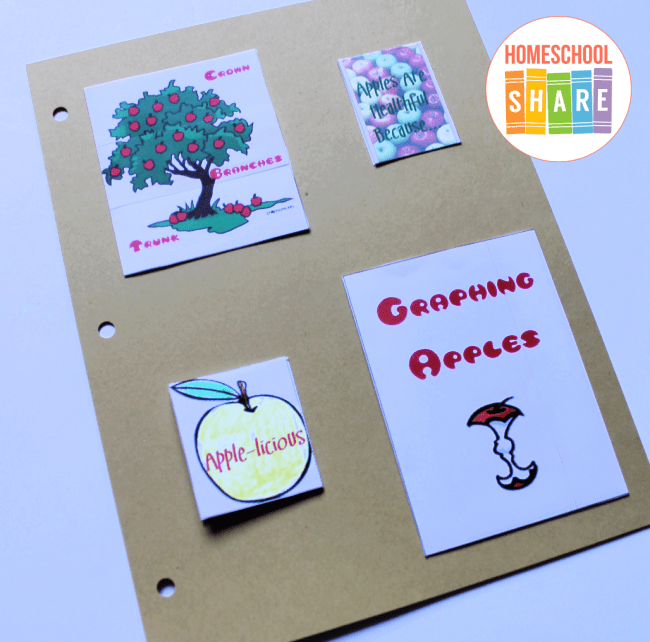
Complete Apple Lapbook Components.
As you come across unfamiliar words, write them and their definitions on Vocabulary Shields.
Hamlet – a group of houses forming a little village
Knave – a dishonest person; rascal;
Hearth – the fireside
Traitor – one who betrays a trust
Nobly – grand; stately
Dignity – the state of being excellent, worthy, or honorable
Dunce – a stupid or ignorant person
Ducal hat – the hat belonging to the duke, who is just under the prince in terms of nobility
Unheeding – not paying any attention to
Filbert – the nut of a hazel tree
Lout – awkward person; clown
Dross – waste matter; refuse;
Insolent – insulting; disrespectful
Wretch – a miserable or pitiable person
Comprehension Questions –
1) What changed William Tell’s happy mood? (He saw Gessler’s castle)
2) What did the well dressed villager do as he passed the pole? (Took off his cap and bent his knee to the pole)
3) What did William Tell do as he approached the pole? Why? (He did nothing because he was not going to bow to a silly hat)
4) What was William’s punishment for not bowing to the ducal hat? (He has to shoot the apple on his son’s head)
5) What would you have done when walking past the ducal hat? Why?
Complete comprehension question lapbook component.
Copywork –
“I will bow only to those more truly noble than I. Men of gentle birth. Wise men. The man of God and the good Lord himself.” Complete Cursive Copywork simple fold.
Characters –
In this chapter we get to know more about William Tell. What was William like? Did he have good, Godly characteristics, or was he corrupt and evil? Reflect on his physical and character traits. A physical trait tells what a person looks like, and a character trait tells what a person acts like. Start on William Tell Character Sketch and continue it as you learn more about him.
Math
Apple Fractions –
William Tell split the apple in two with his arrow. These two pieces are each ½ the apple. Cut up an apple into halves, quarters, and eighths. Figure out these words problems using your apple pieces:
If I ate 2/4 of the apple, how many eighths are left? (4)
If I ate 3/8 of the apple, how many eighths are left? (5)
½ of the apple equals how many quarters? (2) How many eighths? (4)
If I had three apples, all cut up into eighths, how many eighths would I have? (24)
Now make up your own word problems and ask a parent or sibling to figure them out. Or use Apple Fraction Cards and store in pocket.
Compassion –
When William went missing, many friends came by the Tells’. They came to help with chores, to bring food, and to comfort the family. They showed compassion. Compassion is the act of feeling someone else’s pain and also wanting to help eliminate the cause. The Bible speaks of having compassion in many verses.
Romans 12:15 - Rejoice with them that do rejoice, and weep with them that weep.
Galatians 6:2,10 - Bear ye one another's burdens, and so fulfill the law of Christ.
I Peter 3:8 - Finally, be ye all of one mind, having compassion one of another, love as brethren, [be] pitiful, be courteous.
When someone you know is hurting or is in need, do you show compassion? Complete Compassion Flap Book.
Medieval Occupations –
Refer to general lessons above. Complete mini-book for each occupation and paste in tri fold. Next to each one you’ll find a letter to identify the class. R=Ruling Class; N=Noble; C=Clergy; S=Serf;
Baker – a person who bakes breads and pastries and sells them to the public
Fisherman – a person that catches fish and sells them to the public. He would have spent a great deal of time out on the water.
Science
Cheese –
The Tell family could make lots of cheese with their goats’ milk. Cheese is made from the pressed curd of milk, and the flavors vary depending on what kind of milk, how it is prepared and how long it sits. Adding rennet, an enzyme found in a suckling calves stomach, to heating milk is basically all that is required to make cheese. As the enzyme and milk heat up, they separate the milk into a liquid portion, the whey, and a solid portion, the curd. The curd is cooked and reduced to a consistency that allows you to compress into balls or blocks of cheese. Changing the milk base can change the flavors of cheese. Fresh raw milk, low fat milk, and goat milk will all give the cheese different flavors. Adding seasonings, such as salt, herbs, onions, peppers, wines, or olives will also give cheeses their own unique taste. Other factors, including the pressing of the cheese, and the aging of the cheese, will determine such cheese characteristics as how hard or soft, or how moist or dry, or how strong or mild the cheese is. It may be fun for your child to learn to make his own cheese. A simple cottage cheese recipe is included with most rennet tablets (available at the grocery store). Make sure to have some Swiss cheese on hand to munch on while sharing this unit. Complete Cheese Envelope Book.
Language Arts
As you come across unfamiliar words, write them and their definitions on Vocabulary Shields.
Venison – the meat of a deer
Flagon – a large container with a handle and a spout, and often a hinged lid, used to serve liquids
Crone – a withered old woman
Peevishly –irritably, fretfully,
Hermit – somebody who lives in seclusion
1. Narrate the story Ulrich, the baker’s son, told about William in Mini Book.
“Every woman’s son will be coming here now with a new tale until at last we learn the true story. Each man adds a little to what he has heard, and the story grows like a snowball.” Complete Cursive Copywork simple fold.
Characters –
In this chapter we get to know more about Hedwig, Walter’s mother. What was Hedwig like? Did she have good, Godly characteristics, or was she corrupt and evil? Reflect on her physical and character traits. A physical trait tells what a person looks like, and a character trait tells what a person acts like. Start on Hedwig Tell Character Sketch and continue it as you learn more about her.
William showed great courage in risking his life to free himself and his country. What is courage? Courage is the quality of mind or spirit that enables one to face difficulty, danger, pain, etc., with firmness and without fear. Can you think of any courageous people in the Bible?
Read 1 Samuel 17:32 – 50. David showed great courage as he took down the Philistine. Where did David’s courage come from? David said, “The Lord that delivered me out of the paw of the lion, and out of the paw of the bear, he will deliver me out of the hand of this Philistine.” It was David’s faith in God that gave him courage. And David relied on his faith as he grew up and became King. He records some of his thoughts in the book of Psalms:
Psalm 28:7 – The LORD is my strength and my shield; my heart trusted in him, and I am helped: therefore my heart greatly rejoiceth; and with my song will I praise him.
Psalm 56:11 - In God have I put my trust: I will not be afraid what man can do unto me.
Here are some other verses that explain why someone of faith has every right to be courageous:
Isaiah 43:2 - Fear thou not; for I am with thee: be not dismayed; for I am thy God: I will strengthen thee; yea, I will help thee; yea, I will uphold thee with the right hand of my righteousness.
Romans 8:37-39 - Nay, in all these things we are more than conquerors through him that loved us. For I am persuaded, that neither death, nor life, nor angels, nor principalities, nor powers, nor things present, nor things to come, Nor height, nor depth, nor any other creature, shall be able to separate us from the love of God, which is in Christ Jesus our Lord.
2 Timothy 1:7 - For God hath not given us the spirit of fear; but of power, and of love, and of a sound mind.
Hebrews 13:5-6 - Let your conversation be without covetousness; and be content with such things as ye have: for he hath said, I will never leave thee, nor forsake thee. 6 So that we may boldly say, The Lord is my helper, and I will not fear what man shall do unto me. Complete Courage Flap Book.
Medieval Occupations –
Refer to general lessons above. Complete mini-book for each occupation and paste in tri fold. Next to each one you’ll find a letter to identify the class. R=Ruling Class; N=Noble; C=Clergy; S=Serf;
Duke – (N) – A duke is a nobleman having hereditary rank immediately below that of a prince and above that of a marquis, ruling over a duchy. (If you read FIAR title Duchess Bakes a Cake, the duke was the duchess’s husband)
Woodcutter – (S) - The woodcutter was a medieval profession that involved high risk and loneliness. He would live in the forest and live in temporary dwellings depending on where he was cutting down wood. His lord or overseer would give him other work to do depending on what needed done. Sometimes the woodcutter might have to build a bridge or other project, weed out and make clearings, collect and bundle wood, collect bark for the tanners, help in the sawmill or charcoaling wood for the castle. He was strong and brave and often thought of as being suspicious by the villagers. His job was dangerous. He could be hurt from falling trees, his tools, thieves, or wild animals in the forest. Just like any other job in the medieval city there were stages of wealth and success in the particular job. Not all woodcutters were peasants. Their wealth depended on the success of their crops. Some were woodcutters for the hierarchy, while some were independent woodcutters.
Language Arts
As you come across unfamiliar words, write them and their definitions on Vocabulary Shields.
Rascals – an unprincipled person of low birth or station
White-livered – having a pale and unhealthy look
Ague – a malaria fever accompanied by chills and sweating
Wrath – extreme or violent rage or fury
Waylay – to lie in ambush for and attack
Milksop - sissy
Comprehension Questions –
Copywork –
“Yes, Gessler is dead. He died as any man dies, poor or rich, great or lowly. Uri is free of him at last,” said Tell, looking into the smoldering fire. Complete Cursive Copywork mini-book.
Characters –
In this chapter we get to know more about Gessler, the governor. What was Gessler like? Did he have good, Godly characteristics, or was he corrupt and evil? Reflect on his physical and character traits. A physical trait tells what a person looks like, and a character trait tells what a person acts like. Start on Gessler Character Sketch and continue it as you learn more about him.
Math
Survey ten people to see what their favorite kind of apple is. Complete graph and store in pocket. Which kind was the most popular? Which kind was the least popular?
Commitment –
William Tell and the other thirty-two men of the cantons were committed to each other and to their country. Commitment is the willingness to serve someone or a cause. It involves mental and physical loyalties to that person or purpose. A commitment is not to be taken lightly. While it is good to commit to all things righteous, a commitment to Jesus is the most important decision a person can make. A commitment to Jesus Christ means that you are willing to trust Him with your life and that you will consciously look to Him for guidance and direction.
Read Matthew 19:16-22. The rich young ruler was not ready to make a commitment to Jesus, for fear of losing his earthly possessions. A true commitment to a person or purpose means you will carry it through at any cost.
Are you completely committed to Jesus? If not, what is hindering your commitment? Complete Being Committed Flap Book.
This story takes place in what is now known as Switzerland. Look at a map of Europe and find what is now called Switzerland. What countries are to the north? (France and Germany) What countries are to the east? (Austria and Liechtenstein) What country is to the south? (Italy) What country is to the west? (France) What large mountain range runs through Switzerland? (Alps)
Prior to this story, in approximately 814-817, the area of Switzerland was part of the German kingdom, and in 1033 became part of the larger Holy Roman Empire. The area consisted of a collection of states ruled by dukes, counts, bishops, and abbots, as well as smaller city-states called cantons that were independent. The Tells lived in one of these independent cantons, Uri. For a while, the emperor of the Holy Roman Empire continued to allow the cantons to be independent, but when Rudolph became emperor in 1273 he started asserting feudal rights upon all of Switzerland, including the cantons. Things got worse in 1282 when Rudolph put his son Albert (Albrecht) in charge. And that is why, in 1291, three of the cantons including Uri, Schwyz, and Unterwalden joined forces to fight off the transgressions of the tyrannical king.
Today, Switzerland is still divided into regions called cantons. The capital of Switzerland is Berne. Most Swiss people speak German, but some also speak French and Italian. The largest city and industrial center of Switzerland is Zurich. Can you think of any products that come from Switzerland? Cheese, chocolate, clocks, watches, and toys are their most important exports. Complete Switzerland Shutterfold and Flag Simple Fold.
Language Arts
As you come across unfamiliar words, write them and their definitions on Vocabulary Shields.
Alphorn – also called an alpenhorn, it is a wooden horn from three to seven feet long that is used by the herdsman of the Alps. (Note: one is pictured on Switzerland Shutterfold component)
Solemnity – the state of being awe-inspiring, or in serious though
Liberation – being free; released from bondage
Doffed – taken off
“He knew what the wise have always known, that man lives by faith, and that faith can be stronger than fear.” Complete Cursive Copywork Fold.
Legends –
The story of William Tell is a legend that has captivated readers and writers for centuries. A legend is a story that is thought to hold some historical truth, and has been preserved through the years by tradition and popularity. Do you remember what Grandfather said in chapter 3? “Every woman’s son will be coming here now with a new tale until at last we learn the true story. Each man adds a little to what he has heard, and the story grows like a snowball.” At that point the legend of William Tell was born. People continued to tell and retell the story, adding or taking away bits and pieces, until present day. Describe what a legend is inside simple fold.
If you haven’t done so, complete your character sketches and discuss each one. Who was the bravest? Who was the meanest? Who was the most nurturing? Who was the strongest? Who do you think you would most like to be like? Why? Record answers inside flap book.
Math
To put all of their events in correct chronological order, create a timeline with dates pertinent to the story. Use Timeline Fan, if desired. Here are some you could include:
0476 AD - Beginning of Middle Ages
1033 AD - Switzerland became part of the Holy Roman Empire
1218 AD - Rudolph the First was born
1273 AD - Rudolph became emperor
1279 AD - Walter Tell was born
1282 AD - Albrecht (Rudolph’s son) was put in charge
1290 AD - Apple and the Arrow takes place
1291 AD - The three Swiss cantons fought for their independence
1500 AD - End of Middle Ages
A themed teatime would be a nice finale for this wonderful book. Serve a variety of apple slices along with Swiss cheese. Have apple cinnamon tea to drink, or glasses of apple cider. Listen to William Tell Overture during your teatime. Discuss the Newberry medal on the cover of the book, and whether or not you think this book was deserving of such an award.