Google
 
America's White Table Free Unit Study


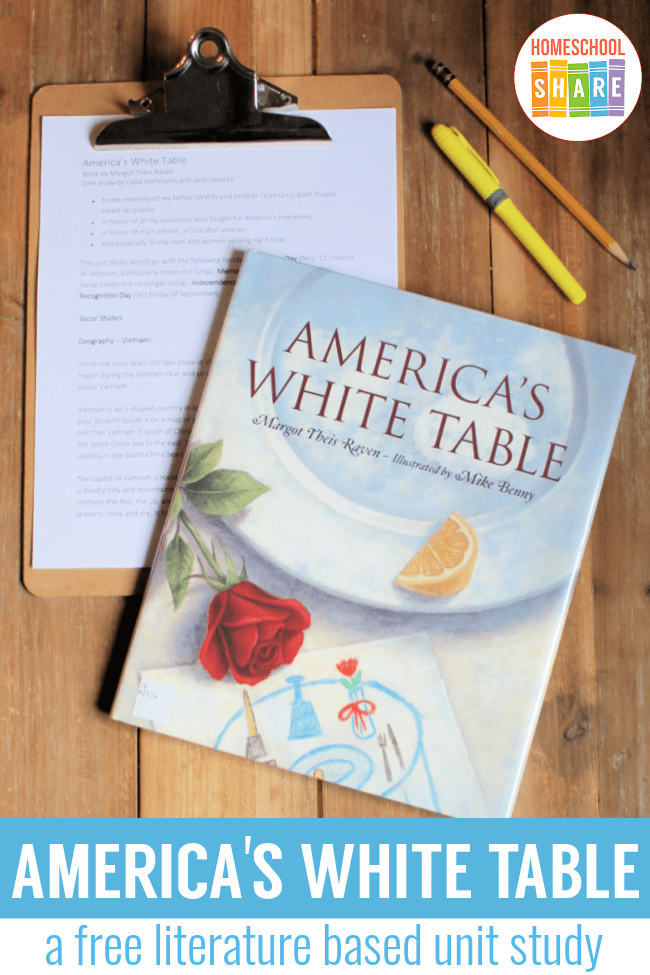
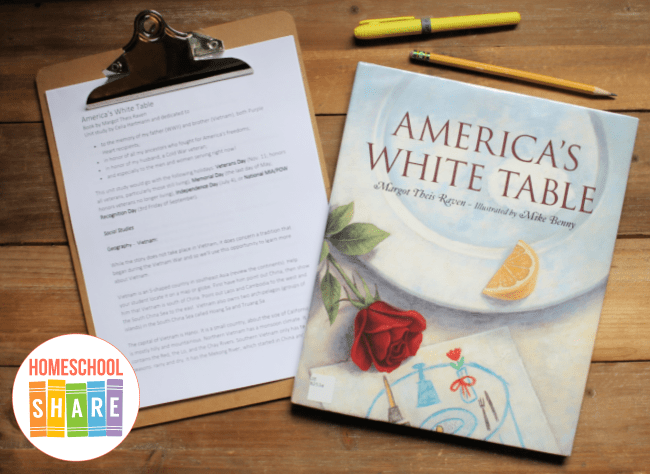
America's White Table
Author:  Margot Theis Raven  (also author of Angels in the Dust, another HSS unit)
Illustrator:  Mike Benny
Summary:  Three children set a special white table in memory of service members fallen or missing in action, and especially in honor of their Uncle John, a POW in Vietnam.
ISBN:  1-58536-216-6

A literature-based unit by Celia and dedicated

Thank you, thank you, thank you!
 

This unit would go with the following holidays:  Veterans Day (Nov. 11; honors all veterans, particularly those still living), Memorial Day (the last day of May; honors veterans no longer living), Independence Day (July 4), or National MIA/POW Recognition Day (3rd Friday of September).


Social Studies

Geography -- Vietnam:  
 

While the story does not take place in Vietnam, it does concern a tradition that began during the Vietnam War and so we'll use this opportunity to learn more about Vietnam.  

Vietnam (also written VietNam and Viet Nam) is an S-shaped country in southeast Asia (review the continents).  Help your student locate it on a map or globe.  First have him point out China, then show him that Vietnam is south of China.  Point out Laos and Cambodia to the west and the South China Sea to the east.  Vietnam also owns two archipelagos (groups of islands) in the South China Sea called Hoang Sa and Truang Sa.

The capital of Vietnam is Hanoi.  It is a small country, about the size of California.  It is mostly hilly and mountainous.  Northern Vietnam has a monsoon climate. It contains the Red, the Lo, and the Chay Rivers.  Southern Vietnam only has two seasons:  rainy and dry.  It has the Mekong River, which started in China and then flowed through Laos and Cambodia before flowing through southern Vietnam.  In Vietnam, the Mekong River splits into nine tributaries or branches, and so it is known as the Nine Dragons (Cuu Long) River.

It has a large population, despite it's small size.  The Vietnamese have many religions and many places to worship, but most of the people of Vietnam are without Jesus Christ as their Lord and Savior.  Pray for them this week, that they would come to know the One True God and accept his son Jesus as their personal savior.

Many of the Vietnamese people where triangle-shaped hats that are made of bamboo.  These hats are called non la.


Outline Map of Vietnam at Enchanted Learning.  
Color the Vietnam flag at Enchanted Learning (Members Only).


Websites for more information on VietNam:
 
http://www.vietnamembassy-usa.org/learn_about_vietnam/
http://en.wikipedia.org/wiki/Viet_Nam
http://www2.lhric.org/pocantico/vietnam/book.htm   (This is an informative "picture book" created by a second grade class.  All drawings are kid-made on a computer program.)


Holidays - Veterans Day

 
Veterans Day is a day set aside to honor and thank all men and women who are serving or have served in military, whether during war time or during a time of peace.   It is mainly for men and women who are living, to recognize that while they did not die in the line of duty, they too sacrificed much for our freedom.  We often also take this time to honor and remember those military men and women who have died.  (Though Memorial Day is when we really honor the memory of those military men and women who died in the line of duty or as a result of wounds sustained during active duty.)

Near the end of World War I, which was also known as "The Great War," the fighting troops (the Allied Nations and Germany) agreed temporarily stop fighting one another.  When two enemies agree to stop fighting it is called an armistice.  The governments of those fighting will later sign a peace treaty to formally stop the war.   The World War I armistice went into effect the 11th hour of the 11th day of the 11th month....11:00 a.m. November 11, 1918.  This day became known as Armistice Day.  The following year, President Wilson proclaimed the first Veterans Day (November 11, 1919) with the following words:

 
To us in America, the reflections of Armistice Day will be filled with solemn pride in the heroism of those who died in the country’s service and with gratitude for the victory, both because of the thing from which it has freed us and because of the opportunity it has given America to show her sympathy with peace and justice in the councils of the nations…
 

And so each year, on Veterans Day, we thank those we know who served in the military.  We tell them how much we appreciate that they served so that we can continue to live with freedoms few other countries have.

(Note to parent:  the correct use is Veterans Day, not Veteran's Day or Veterans' Day.)


Enchanted Learning has a Veterans Day booklet you can print out (Members Only). This one contains a bit of info on WWI,  WWII, Vietnam, Korea, and Kuwait and Iraq.  

 
Websites:

The History of Veterans Day


Click here to print out a Veterans Day Teacher's Guide from the VA's office.  (You will need Adobe Reader to access these PDF files.)  These files are for public school teachers and principals, but you may find something useful for your own students.  Personally, I felt the student packet for Grades 4-7 was the only thing worth printing for me and my children.  It has some history, a maze, an "unscramble the words" puzzle (a great go along for this book), the Pledge of Allegiance and respect of the flag, etc.  The student packet for grades 8-12 is similar, only more detail (reading) and does not have the maze and puzzles.


Branches of the United States Military:  Can your student name any of the five branches of the American military?  Four of them were mentioned in the story.  The five branches are:  Army, Navy, Air Force, Marine Corps, and Coast Guard.  Collectively these are known as our Armed Forces.    All these different branches help keep us safe and protect our freedoms every day.  During times of war, they help defend.  During times of peace, they help keep the peace.  During times of trouble (like earthquakes, famines, etc), they provide help to the people of the area affected.  The Army does this over land, the Navy over the sea, the Air Force from the air.  The Marines are a separate division of the Navy and fight on land or sea.  The Coast Guard helps to protect (or guard) our coast lines.

If you are a member of Enchanted Learning, you can print out this Veterans Day book that contains simple information on each of the five branches.


History -- Vietnam War:  Despite the various feelings about the war, your child should know about the Vietnam War (Conflict, whatever).  What is to follow here is my personal feelings about the war and the script I will use with my children.  You may need to adjust for your views.

The Vietnam War happened about 40-50 years ago.  Vietnam was two countries then, North Vietnam and South Vietnam.  At first they fought for their independence from France.    After that war was over, North Vietnam wanted to rule South Vietnam.  America tried to help the south by sending some of our military men over.  We helped them for more than ten years!  Most of the men who went over to fight were young, just out of high school and many of them died while trying to help the South Vietnamese.

As with any war, some soldiers get captured by the enemy.  When the soldiers get captured, they are called prisoners of war, or POWs.  Sometimes, some of the soldiers never come home and we don't know what happened to them.  Those men are said to be missing in action, and are called MIAs.  

In the end, we weren't able stop all the fighting, and our American troops left Vietnam.  South Vietnam had to surrender to the North.

There are many people we know who were in that war, including your Uncle Larry.  During the war, many Americans were mad that our men went over to help and that they fought for so long, and when the men came home they were treated unfairly.  They were only doing what their president asked and were trying to help the Vietnamese people to have some of the freedoms we have.  But when they came home, they were not treated with the respect and honor that veterans deserve.  Like Katie in the story, just the fact that the men fought when asked by their country makes them a hero in my book!  But many people didn't think they were heroes.  It's really sad because those men left their homes and families and went to Vietnam to fight because that's what our government asked them to do.  


History of the White Table:  Read the author's note at the end of the book.

Websites to read more about the book and the "the white table" tradition.
 
http://www.gale.com/servlet/ItemDetailServlet?region=9&imprint=785&titleCode=SB34&cf=p&type=4&id=192298
http://www.washtimes.com/national/20050527-111322-6581r.htm
http://www.signonsandiego.com/news/world/iraq/memorial/20050527-1315-whitetables.html


More info on the River Rats (the Red River Valley Fighter Pilots Association):
 
http://www.rrva.com/


Language Arts


Vocabulary
 
call to duty -- helping your country by doing whatever needs done (whether by being a soldier or by helping out at home)
honor -- as a verb ("to honor a soldier's pure heart"), to show great respect or esteem
fate -- outcome, final result
sorrow -- a deep distress, sadness, or regret especially for the loss of someone or something loved
rescue mission  --  when a group of soldiers go across enemy lines to bring back some other soldiers who have been captured.
enemy lines --  an area that the enemy controls
wounds -- injuries
persuaded -- urged or pleaded
gratitude -- the state of being grateful, thankful, or appreciative
freedom -- being free or liberation from slavery or from the power of another
birthright -- a right, privilege, or possession to which a person is entitled by birth      
liberty -- the state of being free or the positive enjoyment of various rights and privileges

Prepared Crossword Puzzle *note- if the words have a space (such as enemy_lines), there is also a space in the puzzle.


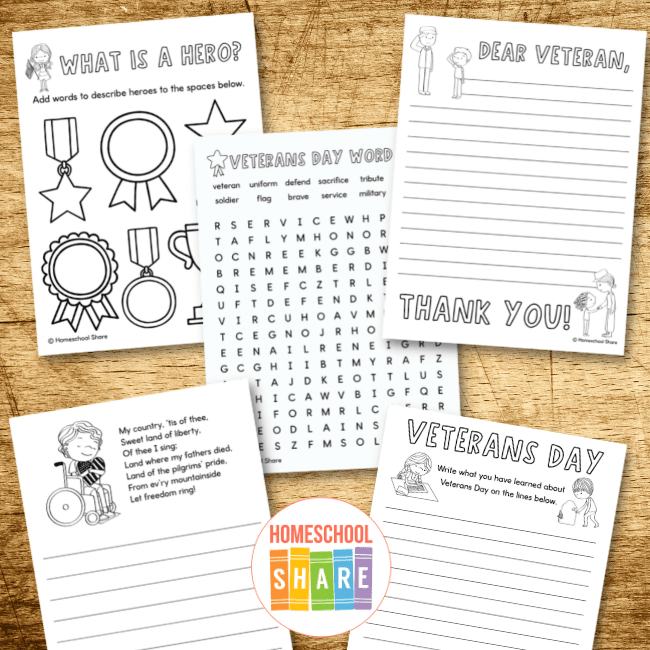
Word Association:   Help your student make a list of words that describe or words that you associate with the word veteran.  Some words might be:  hero, brave, honor, freedom, courage, soldier, respect.   Afterward, if you can, print out the page from this PDF file that has the "unscramble the word" puzzle.


Italics:   Your child might notice several uses of italics throughout the story.  If you've studied the use of italics for the names of ships, you might want to remind your student of that use of italics and ask if there are a bunch of ship names in this book?!    No, there other reasons we might use italics.  Just like the author did in this book.  In this book the author used italics:  

 
1)  to differentiate between the main story and the story Mama tells about Uncle John.  The author chose to show the story of Uncle John in italics -- it makes it easier to see when the children interrupt Mama, doesn't it?

2)  to emphasize "It was just a little white table..."  The author uses this phrase at the beginning of almost every page in the story.  

3)  to emphasize a particular word.   When the author does this, we change the tone of our voice slightly (called inflection) when reading it aloud to be able to hear the emphasis.

 
"But I didn't know what I -- a ten-year-old-girl -- could ever put on the table that was as important as each veteran's gift of freedom to me."

"And that's when I knew what I could put on the table:
My promise to put the words from my heart into a little book
about America's White Table."
 

4) to indicate the thoughts of a person.   In this case, the author chose to use italics in a slightly different way -- to give a 'voice' to the soldiers who died in the war.    

 
"Remember us, please....
we are real people like your Uncle John and Mike
who left families and friends, homes and dreams of our own
to protect your birthright of liberty from disappearing
as easily as sunlight from a glass."


Initialisms:    Our story gives and defines two initialisms:  MIA and POW.   An initialism is a special type of abbreviation in which only the first letter (or first few letters) of each word in a group of words is used to abbreviate the phrase.  Initialisms are pronounced by saying each letter.  

To help him understand how an initialism is made and pronounced, have your student write out the words missing in action.  Then have him underline the first letter of each of the words (ie, the initials).  Next, have him write the letters he underlined, but use a capital letter for each (MIA).  Now have him read each letter aloud.....em eye ay.   Have him repeat for prisoner of war, POW.

Intialisms have been used for a long time.  Have you ever seen a picture of Jesus on the cross, with the letters INRI posted above him?  The letters stand for the Latin phrase, Iesus Nazarenus Rex Iudaeorum ("Jesus the Nazarene, King of the Jews").    Click here to see The Crucifixion of Christ, which clearly shows the acronym.  Here is another.  

Has your student ever seen the ichthys (Christian fish) symbol?       The word ichthys is an initialism, although each letter represents a Greek word.

 
According to Wikipedia,
 

I   is the first letter of the word Jesus in Greek: Ιησούς

CH   are the first letters (in Greek one letter) of the word Christos (Χριστóς), Greek for Christ

TH   are the first letters (in Greek one letter) of the word THeou (Θεoύ), genetive case of Θεóς, Greek for God

Y   is the first letter for Yios (῾Υιóς), Greek for son. (the "῾" (the is called a rough breathing mark) here is a part of the vowel, and is not included in ICHTHUS)

S   is the first letter for Soter (Σωτήρ), Greek for saviour.

 
So the ichthys means Jesus Christ, Son of God, Savior

(FYI ... an acronym is a special type of initialism in which the letters spell a word that can be said, instead of saying just saying each individual letter.  Some examples are:   NASA (National Aeronautics and Space Administration),  NASCAR (National Association for Stock Car Auto Racing), UNICEF (United Nation's International Children's Emergency Fund), and SCUBA (self-contained underwater breathing apparatus).


Interview a Veteran:   If you know a veteran, you may wish to have your student interview him or her.  Help your student write out questions beforehand.  Help your child understand that sometimes soldier see some awful things and that it's hard for them to talk about.   Click here for sample questions.   Most veterans would be honored to tell of their service.

If you have an older student and you know a veteran who served in war time, particularly WWII, I strongly urge you to have your student interview the veteran.   We are rapidly losing our WWII veterans, and with them, we are losing their story.  The Library of Congress has a Veteran's History Project.  They ask that the interview be recorded either by audio tape recording or by video taping the interview.  This would then be submitted for permanent record to the LOC.   Read more about it by clicking here.   The site will tell you how your student can participate and give you forms and tips for the interviewing process.


Copywork:   See the Music lesson for one copywork idea.   Another idea would be to have your older student write out the following quote and explain what it means:

Let every nation know, whether it wishes us well or ill, that we shall pay any price, bear any burden, meet any hardship, support any friend, oppose any foe, in order to assure the survival and the success of liberty. - John F. Kennedy, 1961 inaugural address


Writing/Narration:   Ask your student to write/narrate what the word  hero  means to him.  Or ask him write about someone who is a hero to him and why that person is his hero.


MUSIC

...Samantha wrote out the words of "My Country 'Tis of Thee" as a tribute in song.  


In 1831, Reverend Samuel Francis Smith was inspired to use the melody of God, Save the Queen (a patriotic song for England) and give it new words.  In the space of half an hour, it became the American patriotic song that we adults know so well.  Has your student ever heard this song?  Sing it with your student this week.

For more info, to read the lyrics, or to be able to listen to a MIDI version of the tune, visit CyberHymnal.org
.

Click here to listen the song being sung (RealAudio or MP3 versions).

For copywork, you may wish to have your student copy the first stanza or the entire lyrics of the song in her best hand-writing, as Samantha did.


MATH  -- math lessons contributed by Helena Gosline

 
Count by 5s/Multiply by 5s/Add 5:   Since there are five branches of service, take this opportunity to teach or review skip counting by 5, adding 5 to other numbers, or multiplying by 5 using word problems. 
 
For Example:  There are 5 branches of service.  At the Veterans day party there were 5 men from each branch.  How many men were there in all?  (25)
 
(Since the book only listed four branches of service, you could do this with 4s instead of 5s. )
 

Graphing:   Ask members of your family, church, and/or friends if they served in any of the branches and if so which branch.  Then make a graph and determine which group you know the most/least people from.   An older student may wish to also ask if they are a veteran of WWII, Korean, Vietnam, Cold War, Gulf War, Operation Enduring Freedom, or Operation Iraqi Freedom and do two graphs.

 
Circle:  The table in the book was a circle.  You may wish to explain that a circle is measured in a unit called degrees.  A complete circle is 360*.  Half of a circle is 180*.   You could also make a pie or pizza and use it to teach fractions.  If you did the graphing lesson, you could create a pie graph of the data. 


SCIENCE

Tears:  Our story mentions the tears of the families.  Today we're going to do discuss two questions:  Why do we have tears and why are the tears salty?  

Our eyes must have moisture all the time.  So God gave us tear glands to make fluid (tears) for the eyes.  The fluid comes out of the tear ducts in the corner of our eye.  The tear gland is called the lacrimal gland.  The tear  ducts are called the lacrimal ducts.  Fluid (tears) keeps the eyes moist and helps keep our eyes clean and free from infections.  Think of the washer fluid sprayed on the windshield of our car, that's what the tears in our eyes do for us...except our blinking eyelids is what moves the fluid around for us instead of a windshield wiper!  If our eyes did not stay moist, we would become blind.

There are different kinds of tears.  The first kind, we've already talked about...the moisture in our eyes.  This kind of tear is called basal tears.   Sometimes we cry because we got something in our eye.  This could be a bit of dust or the juice of an onion.  These kinds of tears are called reflex tears.  God designed our eyes to make extra tears when something gets in them, so that whatever is irritating them can be washed out.  We also cry tears when we are very happy or sad.  These kinds of tears are called emotional tears.  

Sometimes people get "dry eyes."  This is when the body doesn't make enough tears to keep the eyes moist.  When this happens they can buy "artificial  tears" at a pharmacy.  They squeeze a drop or two into the eyes whenever the eyes feel dry.  (You might wish to discuss the importance of never putting anything in your eyes.)

At the bottom of this page, there is a diagram of the eye that shows the tear glands and tear ducts.  Here is another that could be printed out and colored.


Now, on to our next question....why are tears salty?  (You may have already explored this topic with FIAR Volume IV's The Hickory Chair.)

The simple answer is because our bodies are salty!  If we took out all the salt in our body, we would have about a cup full of salt.  All the fluids in our body have some amount of salt in them. That's why when we sweat or cry, the liquid tastes like salt....the salt is coming out of our bodies.  

Our body must have salt.  And it isn't by chance that our bodies need salt, God designed it that way!  Salt actually helps to fight infection.  

In the summer time, when we sweat a lot, we lose a lot of fluids and salt.  We need to replace those!  That's why it's important when we sweat a lot to drink water.  Water has some salt in it, though we can't really taste it. Sometimes we also drink Gatorade or PowerAde; they have more salt in them.

In our everyday activities, where we are not sweating a lot, we get plenty of salt in the foods we eat and the liquids we drink.  We have to be careful not to add too much extra salt to our foods.


The Colors of Light:    There are many colors mentioned in the story: the white cloth, the yellow lemon, the black napkin, the red rose and ribbon.  Does your student know how we get colors?

Sunlight, which scientists call white light, actually contains all colors.  Light travels in waves that we cannot see.  So within the sunlight are waves of color.  

Like sunlight, the "color" white also contains all colors.  Similarly, the "color" black is the absence of any color.   Objects absorb or reflect colors.  The color an object absorbs is the color we see.  For example, grass reflects the green color in sunlight and absorbs the other colors in sunlight...so the color we see when we look at grass is green.  

The main colors of light are red, blue, and green.  (Not to be confused with primary colors in art, which are called the primary colors of pigment:  red, blue, and yellow.  Technically red, blue , and green are called the primary colors of light, but I chose to use the word main instead so as not to confuse younger students!  You may however wish to discuss this with your older students.)  Combining these colors creates more colors.   Do this experiment to show how combining makes new colors:

 
3 flashlights
4 pieces of cellophane (two red, one blue, and one green), large enough to fit over the end of the flashlights.
a dark room
a white wall or large piece of white paper taped on the wall

Cover one flashlight with the red cellophane (may need to use two pieces of red), another with the blue, and another with the green.  Turn out the main light and shine the flashlights onto the wall so that you can see the three separate colors.    Now shine the red and green so that they overlap.  You should see yellow where the two colors overlap!  Now do the same with the red and the blue.  You will see magenta (a pinkish-purple).  Repeat with blue and green, and you will see cyan (a light bluish-green).  Ask your student what color he thinks will appear when you make all the colors overlap?  (Hint:  We already discussed a "color" that was really the absence of color and a "color" that was really all colors put together.)  Combining the red, blue, and green will give you white.

For more information and more experiments, visit "How Light Works" at HowStuffWorks.com  There are 14 pages of more in-depth info that you may wish to share with your older student.


Websites

 
Exploratorium has lots of experiments with light and color

As does, Teach-nology

Enchanted Learning has information on color


Books

 
The Usborne Big Book of Experiments, pp. 66-71
The Ben Franklin Book of Easy & Incredible Experiments:  Activities, Projects, and Science Fun, pp. 107-13  (This book shows you how you can use three microscope slides to make your own prism.)
The Usborne Book of Science Experiments, pp. 16-18
Genesis for Kids, "Day 1: God Made Light"


Bible


Military men and women sacrifice much in order to protect America's freedoms.  Some of them even give their lives.  Jesus sacrificed His life, so that we would have a way to live eternally with our Father in Heaven.  


Culminating Activities

At the end of this unit, plan a special dinner with the family (perhaps invite some extended family or even a veteran).  Help the students set up a White Table of Remembrance in memory or honor of a loved one or in honor of our current brave countrymen who cannot be home with their families this day.  Let the oldest student explain what the table is for.  Then let the remaining students take turns reciting the significance of each item on the table.  Sing My Country 'Tis of Thee.  

There are many men and women serving our country right now.  They would love to hear from your family.  Help your student write a letter to them, thanking them for leaving their families to help to keep us safe.  Tell them about the story your read.  If you are able, make a care package to send to a soldier.

At the website AnySoldier.com you can request the name of a solider to whom you can send a care package.  It will be distributed to someone that person's unit who did not receive any mail that day.  The distributor emails the site with a list of things that unit needs.


Possible Go Alongs:
 

H is for Honor: A Military Family Alphabet by Devin Scillian  (Download the Teacher Guide for this book by clicking here.  Must have Adobe Reader.)

The Wall by Eve Bunting  (The story of a boy who travels with his father to visit the Vietnam Veterans Memorial to see his grandfather's name.)

Wall of Names:  The Story of the Vietnam Veterans Memorial by Judy Donnelly (series: Step Into Reading: Step 4)

Vietnam (series:  A True Book) by Shirley Wimbish Gray

Vietnam (series:  A Ticket To) by Karen O'Connor

Vietnam (series:  Enchantment of the World) by Terri Willis (more suitable for older students, 144 pages)


Bunny Trails and/or possible Research Projects for older students:

 
Vietnam:  Dong Son Culture, 1000 - 1 BC

Vietnam has many different animals.  Perhaps your student could research and learn about some he may never have heard of before.   Llangurs, Rhinopithecus, salanganes, selenartos, civet cats may be some.

What are our freedoms?  Have your student study the Bill of Rights or the basic freedoms we have based on the Declaration of Independence - life, liberty, pursuit of happiness.

Military Cemeteries:   The Tomb of the Unknown Soldier, Arlington Cemetery, Flanders Field

Military Service Awards, Ribbons, and Medals

War Memorials:  Each war has a memorial in Washington, DC.  If you live close, visit them, especially the Wall.  And older student could research the Vietnam Veterans Memorial (the Wall).

Patriotic Symbols:  the American flag, eagle, Uncle Sam, Statue of Liberty, poppies (Flanders Field), yellow ribbons.

 
Websites:    http://americanhistory.mrdonn.org/Symbols.html
                    http://www.history.ctaponline.org/center/hsscm/index.cfm?Page_Key=1386
 
http://www.enchantedlearning.com/history/us/symbols/index.shtml

Patriotic Music:  Star Spangled Banner (Francis Scott Key), America the Beautiful, God Bless America, Taps (Daniel Adams Butterfield),   etc.

 
There are a few illustrations in the story that show the flag being flown for Veterans Day.  Perhaps your older student might like to research the various flags used in the history of America:  the Boston Liberty flag, the Don't Tread on Me flag, the Betsy Ross Flag, the Grand Union Army Flag, the POW/MIA flag

Flag Etiquette

Adopt a POW / MIA:  Does your family (or even your older student!) make webpages?  Perhaps you could adopt a POW or MIA and create a webpage for him.   Celia has done this.  Here is a link to her webpage:
http://freepages.military.rootsweb.com/~hartmann/      Visit Operation Just Cause to request the name of a  POW or MIA that you can create a page for.  


Materials and information on this website belong to the original composers. It may be used for your own personal and school use. 

Material may not be used for resale © 2005-07 HSS