Affiliate Disclaimer
We sometimes use affiliate links in our content. This won’t cost you anything, but it helps us to keep the site running. Thanks for your support.
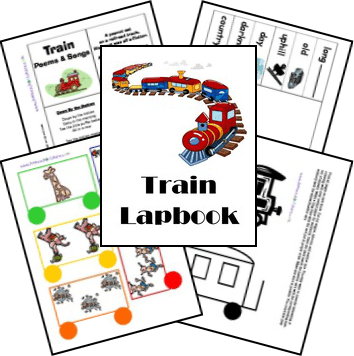
Choo! Choo! Preschoolers are coming through! It’s time to make a Train Lapbook.
Thanks to Robin Diedrichs for creating this Train lapbook for Homeschool Share.
Train Lapbook Objectives
- Exposure to rhyming words.
- Learn the concept of opposites using pairs of words from various train books.
- Learn train words that begin with the letter T.
- Learn how to write the letter T.
- Recite Philippians 4:13.
- Become familiar with train songs and poems.
- Learn the names of different types of train cars.
- Match numbers to correct amount of animals.
- Match correct picture with vocabulary words from train books.
- Develop fine motor skills by cutting and pasting.
- Identify the following shapes: circle, square, rectangle, triangle, and octagon.
Train Lapbook Printables
Train Rhyming Words Window Book
Pairs of rhyming words from Chugga-Chugga Choo-Choo and Train Song are included in this window book.
Rhyming pairs: back/track; rails/trails; blows/goes; here/engineer; freight/late; caboose/loose; steep/deep; wide/side; wait/freight; and bound/sound.
Even though your student may not be able to read most of these words, you can read them to him and you can practice rhyming together.
Writing T T-book
Write the letter T in the book.
What Begins with T?
Use these instructions to learn how to fold this type of book. Alternatively, you could simple cut out the pages, stack them together, and staple.
Introduce or review the letter T. What sound does it make? Train, trestle, ticket, ties, track, turntable, tower, tunnel, and tank–all of these train words–start with the letter T.
Train Vocabulary Flag Book
This is another tricky fold. You can find the instructions here.
Match the words and the images to learn these new words: locomotive, engineer, freight, caboose, station, all aboard, bridge, rail, passenger, roundhouse, conductor, and box car.
Special Kinds of Train Cars Side by Side Book
Learn four different kinds of train cars with this mini-book. Cars include: hopper, tank car, gondola car, and cattle car.
Shape Train
Create a train from the shapes!
Train Poems and Songs
Enjoy singing these fun songs together.
Train Opposites Flapbook
Using the book, Train Song, your student should match the opposites in the flap book.
What Is a Crummy Matchbook?
Learn this funny name for one of the train cars.
Circus Train Counting Cards & Pocket
Use these animal cards and pockets to practice counting to ten.
Additional train activity ideas are provided in the lapbook download.
Train Lapbook Video
Watch this video to see a finished Train Lapbook!
How to Get Started with the Train Lapbook
Follow these simple instructions to get started with the Train Lapbook:
- Check out train books from your local library or buy Chugga-Chugga Choo-Choo and Train Song.
- Choose and prepare the Train Lapbook printables you want to use with your preschool student.
- Enjoy a week of hands-on learning with your preschool student.
Download Your Train Lapbook
Simply click on the image below to grab your free Train Lapbook.
More Transportation Themed Resources for Your Preschool Student
Are you looking for more transportation themed resources for your preschool or kindergarten student? Try these!