Google
 
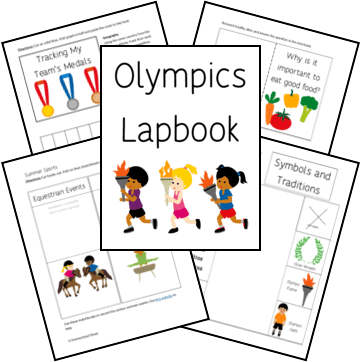
Summer Olympics 2008 Lapbook

Summer Olympics 2008 Unit Study & Lapbook

Submitted by Louise Fadina
Photos contributed by Heather L.


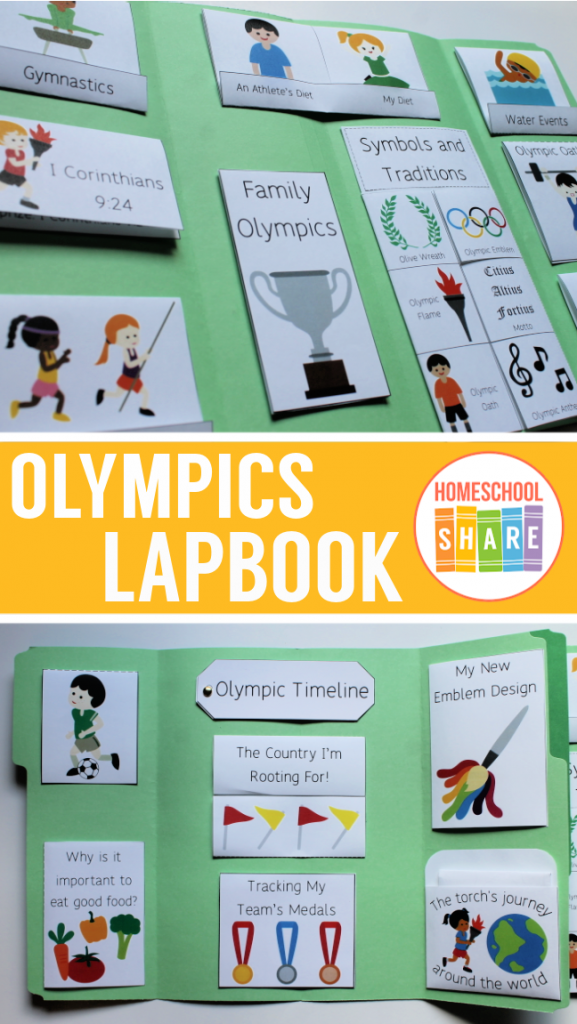
Lapbook Templates
 

Bible verse pocket and card
 
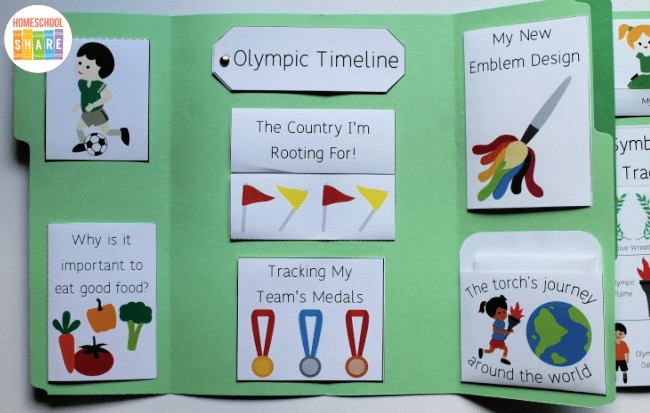
Torch's Journey Pocket
 
Olympic Timeline Fan with dates
 
Flag of China Minit Book
 
My Team Twice Folded
 
Olympic Timeline Fan blank
 
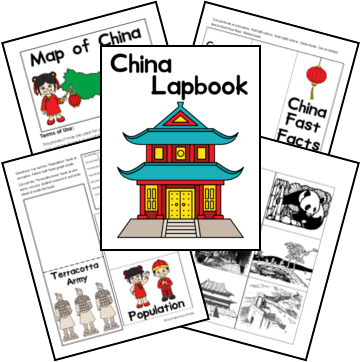
China Shutterfold
 

My Team Medals Won Bar Graph
 

Compare & Contrast Diets Matchbook
 

My Name in Chinese Matchbook & Oath Matchbook
 

Famous Olympians File Folders
 

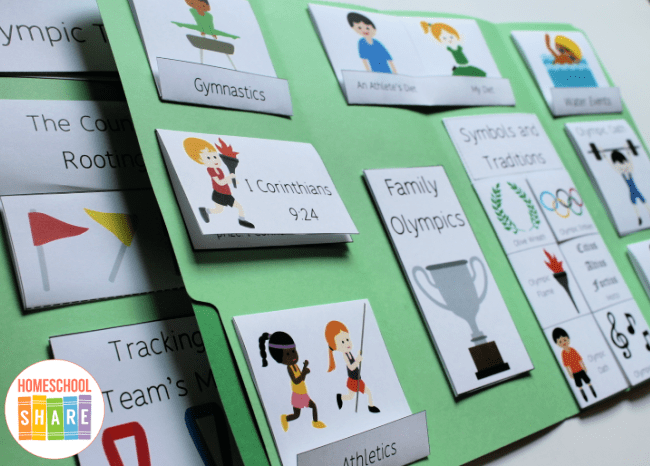
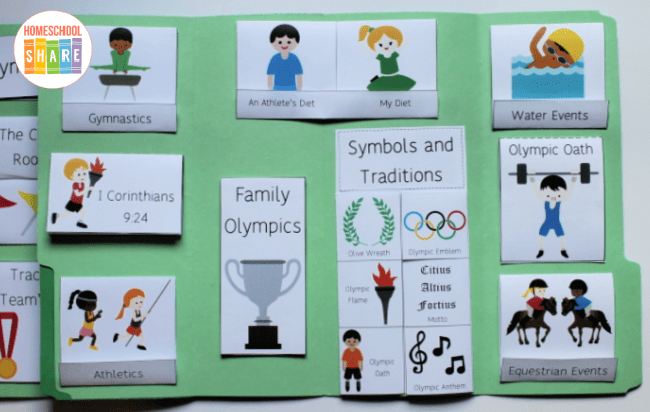
Family Olympics Chart Trifold
 
Symbols and Traditions of the Olympics Flap
 
Clip-art Images for Decoration
 
Summer Sport Matchbooks
 
Track and Water Events Shape Books    


Bible
 

1 Corinthians 9:24

“Do you not know that in a race all the runners run, but only one gets the prize? Run in such a way as to get the prize”. Discuss this verse. This verse is not talking about a physical race, but a spiritual one and the prize is salvation. What can we learn from athletes that can help us as we seek to run this spiritual race? Some of the things we can learn may include working hard, being disciplined, not cheating, making the most of your time, not getting sidetracked and not giving up. Discuss these character traits with your children; using real life applications from their lives or yours that may help illustrate this even more.


Lapbook components:
Bible verse pocket and card (in NIV and KJV)


Social Studies


Geography
China is the largest country in Asia and the third largest in the world next to Russia and Canada.

The Chinese flag is a solid red background with five gold stars in the upper left corner. The design was adopted in 1949 following a nationwide competition where over 3,000 entries were submitted. The large star is said to symbolize the leadership of the Chinese government and the four smaller stars the four classes of people. Red is generally recognized as the color associated with Communism and gold is said to symbolize the yellow race of the Chinese people.

Flag of China Coloring Page


China’s written language system is one of the oldest in the world. A number of different dialects are spoken in China but the most common is Mandarin. There is no alphabet in the Chinese language, only characters. A character could be a word or a part of a word. There are about 20,000 characters in the Chinese language. In High school children are required to learn up to 3500 of them. However, if you learn the 1000 most frequently used Chinese characters you can create about 3000 words with them.


Learn to write 1-12 in Chinese

Find your name in Chinese


Lapbook Components:
Flag of China Minit Book

China Shutterfold

My Name in Chinese Matchbook


Plot the route of the Olympic torch:
The Olympic torch is traditionally started in Olympia, Greece where it is lit. From there the Torch will visit 23 different countries ending in a tour of China. The places visited in order are:

Olympia, Greece

Beijing China

Almaty, Kazakhstan

Istanbul, Turkey

St.Petersburg, Russia

London, England

Paris, France

San Francisco, USA

Buenos Aires, Argentina

Dar es Salaam, Tanzania

Muscat, Oman

Islamabad, Pakistan

New Delhi, India
Bangkok, Thailand

Kuala Lumpur, Malaysia

Jakarta, Indonesia

Canberra, Australia
Nagano, Japan

Seoul, South Korea

Pyongyang, North Korea
Ho Chi Minh City, Vietnam

Hong Kong

Macao, China

…and a tour of many of the different provinces of China.


Using a map, plot the route that the Olympic torch will take.


Lapbook components:

Pocket to store map of Torch's journey
 

Pick a team:

Have each student pick a country to support during the Olympics. Here is a list of all 135 competing countries for you to choose from.  Have the student research the flag of the country, find the country on the map, and research other interesting facts about their chosen country. You may want to have them listen to their country’s national anthem and also find out in which competitions their country will be competing.


Lapbook components:
My Team Twice Folded


Find other resources to use with the study of China or the study of your student's chosen team in HSS's Country Lapbook.


History
The very first Olympics for which written records are available were held in 776BC in Olympia, Greece. At the first Olympics the only event was the 200yd dash, called a stadium. This was the only event until 724 BC. The Olympic games were held every four years from 776BC to 393AD when they were abolished by the then Emperor Theodosius I. A campaign to revive the Olympics
was started in France in the late 19th century. The first Modern Summer games started on March 24 1896 in Athens, Greece.

Olympic Timeline with dates
Olympic Timeline blank


Symbols and traditions of the Olympic games
Motto – The Olympic motto is “Citius – Altius – Fortius” which is Latin for “ Faster, higher, stronger”. The meaning behind this motto is intended to focus on trying your best and not on winning first place.


Olympic Emblem & Flag– The emblem consists of five interlocking rings (blue, yellow, black, green & red) on a white background. It was designed in 1913 by Baron Pierre de Coubertin (the founder of the modern Olympics). Each of the five rings represents one of the significant continents in the world, and each color was chosen as at least one of them appeared on the flag of each country in the world. They are interlaced to represent the idea the games are universal and bring countries together.


An Olympic flag is raised in the opening ceremony of each Olympic games. On it are the same Olympic rings on a white background. At the closing of each Olympic games the mayor of the host city presents the flag to the mayor of the next host city. This mayor then keeps the flag in his town hall until the next Olympic games.  Printable Olympic Flag


Olympic Flame – The ancient Greeks considered fire to have sacred qualities, and in the ancient Olympic games a fire was kept burning throughout the games. The fire was reintroduced during the 1928 games and has remained a part of it ever since as a symbol of peace between the continents. The flame is lit at the site of the ancient Olympic games in Olympia, Greece and continues on a tour of many of the participating countries ending at the home of the current year’s Olympic games.


Olympic Oath – During the opening ceremony one athlete recites the oath on behalf of all athletes. It states, “In the name of all competitors, I promise that we shall take part in these Olympic games, respecting and abiding by the rules that govern them, in the true spirit of sportsmanship, for the glory of sport and the honor of our teams”.


Olive wreath – The Olive tree was sacred to the ancient Greeks and therefore a reward of a wreath made from a branch of this sacred tree was considered great.

Make an Olive wreath


Olympic Anthem – This is also know as the Olympic Hymn and was composed by Spyros Samaras with words from a poem by the Greek poet Kostis Palamas. It was performed for the first time at the Games of 1896 and was declared the Olympic Anthem in 1958. Lyrics


Lapbook Components:

Symbols and Traditions of the Olympics Flap

Oath Matchbook


Science

This unit lends itself well to a discussion about general health fitness and diet. Discuss the major food groups.  Discuss what each food group provides our bodies and why we need it. An athlete’s diet has specific needs including increased carbohydrates.  Discuss why this is (increased output of energy). 

The recommendation for a child's diet is as follows

Grains
* 4- to 8-year-olds need 4–5 ounce equivalents each day.
* 9- to 13-year-old girls need 5 ounce equivalents each day.
* 9- to 13-year-old boys need 6 ounce equivalents each day


Vegetables
* 4- to 8-year-olds need 1½ cups of veggies each day.
* 9- to 13-year-old girls need 2 cups of veggies each day.
* 9- to 13-year-old boys need 2½ cups of veggies each day.


Fruits
* 4- to 8-year-olds need 1–1½ cups of fruit each day.
* 9- to 13-year-olds need 1½ cups of fruit each day.


Milk and other Calcium Rich Foods
* 4- to 8-year-olds need 2 cups of milk (or another calcium-rich food) each day.
* 9- to 13-year-olds need 3 cups of milk (or another calcium-rich food) each day.


Meats, beans, fish, and nuts
* 4- to 8-year-olds need 3–4 ounce equivalents each day.
* 9- to 13-year-olds need 5 ounce equivalents each day.
 

Food pyramid for young children


Print the food pyramid for athletes and compare what your child should consume to what an athlete should consume.
 

Lapbook component:

Compare & Contrast Diets Matchbook


Math
 

Pick a country to support (see Geography section). Record the number of events they participate in and the number of medals they win. This information can be displayed in a bar graph.


Lapbook component:
Bar Graph


Language Arts

New Words
Learn the terms for the different sports played in the summer olympics.
 

Archery- the sport of shooting arrows with a bow  

Badminton- a game played on a court with light long-handled rackets used to volley a shuttlecock over a net

Croquet- a game in which players hit a wooden ball through a series of hoops; the winner is the first to traverse all the hoops and hit a peg

Equestrian- horse riders compete in three disciplines—dressage, jumping, and eventing

Fencing- the art or sport of fighting with swords (especially the use of foils to score points under a set of rules)

Field Hockey- a game resembling ice hockey that is played on an open field; two opposing teams use curved sticks try to drive a ball into the opponents' net

Judo- a Japanese form of wrestling that combines techniques from many jujutsu schools

Lacrosse- a field game played by two teams of ten players each who use a long-handled stick with a net pouch on one end to carry or throw a ball into a goal

Modern Pentathlon- a sports contest consisting of five events-- fencing, pistol shooting, 200 m freestyle swimming, show jumping on horseback, and a cross-country run

Synchronized Swimming- combines swimming, gymnastics, and dance; teams of swimmers perform together

Triathlon- an endurance sports event consisting of swimming, cycling, and running over various distances

Weightlifting- a sport in which competitors attempt to lift heavy weights mounted on steel bars called barbells


Lapbook Component:
Sport Matchbooks

Famous Olympian Research
Research and learn more about a famous Olympian.  Record information in file folder minit books.


Art
 

Design a logo for the next Olympic games. You might want to pretend that the country you have been studying as part of this unit is hosting the next Olympics and design one with this in mind.

See previous logos

Lapbook Component
Cut and paste your student's logo into this Olympic Emblem minit book.


Just for Fun

Hold an Olympics competition with your family members.  Here are some ideas:  "Javelin" Throw (you can use a wooden dowel rod), Soccer Kick (who can kick the ball the longest distance),  Paper Plate or Frisbee Discus Throw, Cotton Ball Shot Put, Hoola-Hooping (who can hula-hoop the longest), Obstacle Course,  etc.  You could even make up your own three challenge triathlon or let your children invent a game!  Be sure to include
opening ceremonies, closing ceremonies and an award ceremony.

Lapbook Component
Log your results in this Family Olympics Tri-fold


Additional Resources
 

Library List (books have not been previewed)
Eric Liddell: Something Greater than Gold – Janet Benge

Eric Liddell: Olympian and Missionary – Ellen W. Caughey

The Flying Scotsman – Sally Magnusson

Hour of the Olympics – Mary Pope Osbourne

Ancient Greece and the Olympics – Mary Pope Osbourne

Olympics – Chris Oxlade

Olympics! – B.G Hennessey
Swifter, Higher, Stronger: A Photographic History of the Summer Olympics by Sue Macy

Cover Page Ideas
Find a Front Cover Page (or something for the back cover of your lapbook) from one of the following websites:

http://www.kidsturncentral.com/coloring/olympiccolor.htm


http://www.awesomeclipartforeducators.com/olympiccoloringpages.cfm