| about us |
what's new
|
unit studies
|
unit study helps |
fiar resources
|
indexes | lapbooking |
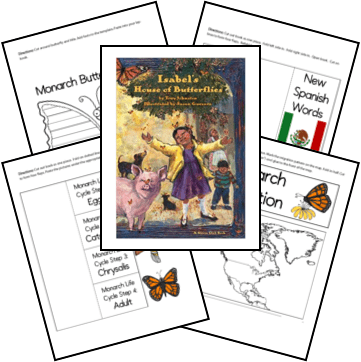
Isabel’s House of Butterflies
|
Author: Tony Johnston Illustrated by Susan Guevara ISBN:
1578051282 Summary: Outside her home in Michoacán, Mexico, grows
eight-year-old Isabel’s greatest treasure: an Oyamel tree. Here, every autumn,
a miracle happens – for Isabel’s tree is the wintering place for thousands upon
thousands of monarch butterflies that migrate from the north. When they flutter
down to roost, they transform Isabel’s tree into La casa de las mariposas
– The House of Butterflies. Research by Jodi Small Lapbook Templates by Tara Mitchell |
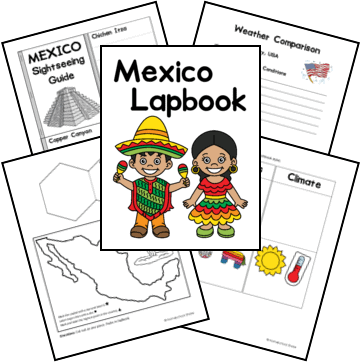
Geography – Mexico
Mexico is a large Spanish-speaking country in southern North America. Mexico’s capital city is Mexico City. It is one of the largest cities in the world, with a population of about 20 million people. Mexico's climate varies from hot deserts, forests, tropical rainforests, and some chapparal (along the northwestern coastline). A chapparal is a shrubby coastal area that has hot dry summers and mild, cool, rainy winters. Mexico is divided into 32 states. You can discuss with your student various aspects of the Mexican culture (clothing, food, holidays, the language, etc.) The city of Michoacan is in the mountains of the Sierra Madre del Sur.
Where in the world is Mexico?
Shutterfold
Mexico Flag Simple Fold
Social Studies – Poverty
Isabel’s family lived in a one-room house. They are dependent on the tourists for their money and food. They are able to grow vegetables and raise their pigs for some food. Imagine if your family lived in a house with only 1 room. The kitchen, living rooms and bedrooms were all together. I do not have money to go to the grocery store. The only things you have to eat are things you grow in your garden or animals you raise. You have very little clothing, toys and books. There are people al lover he world that live this way – even in the US, probably very close to where you live. What kinds of things can you do to help those in poverty near your home? Decide as a family one thing you can do and carry it out.
What can we do? --Use this book to brainstorm some ideas for helping those less fortunate than you.
Social Studies – Tourism
A tourist is someone that does not live in the area they are visiting. Many tourists each year visit Michoacan to see the migration of the Monarch Butterfly. What places would you like to tour or visit around the country or the world?
I Would Like to Visit Layer Book
Oyamel Trees
The Oyamel tree, or the Sacred Fir, is a fir tree that grows in the mountains of central and southern Mexico and western Guatemala. This medium-large evergreen coniferous tree has leaves that are needle-like and flat. The tree branches are used in religious festivals in Mexico, especially at Christmas. It is also the preferred tree for the Monarch Butterfly during the winter months.
Fir trees have a trunk, just like any other tree. They have long branches that start near the bottom of the trunk and gradually get shorter as they move up the trunk. They do not have leaves, but needles that stay green all year long. They have cones that grow to house the seeds for reproduction. Fir trees are popular as Christmas trees. Parts of a Fir Tree Matchbook
Experiment: Find a cone from a pine or fir tree in the cold months. The cones are closed up. Take it inside and set it near a fireplace, heater, or other warm place. The cones will open up and release the seeds.
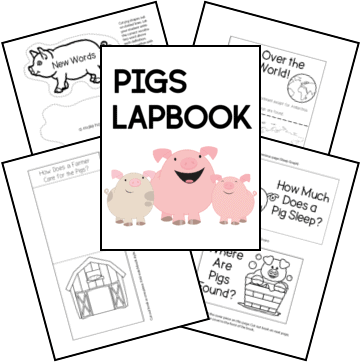
Pigs
Isabel’s family raised pigs that they took to market to sell the meat. Pigs are omnivores – they are both plants and meat. Pigs have large heads with a large snout. They have short legs and a short, curly tail. They do not have sweat glands, so in order to cool themselves, they lay in water or mud. They coat their skin in mud to use as a sunscreen.
Bacon,
ham, pork and sausage come from pigs. Bacon is taken from the sides, belly or
back of the pig. Arm, legs, or shoulders are used for ham. Lion, or the back,
is used for bacon, roasts, or chops. The ribs are used for spare ribs.
Pigs Flap Book
The skins of the pig can be used for leather. The “pigskin” refers to a football made from leather made from pig’s skin. Pigskin Matchbook
Monarch Butterflies
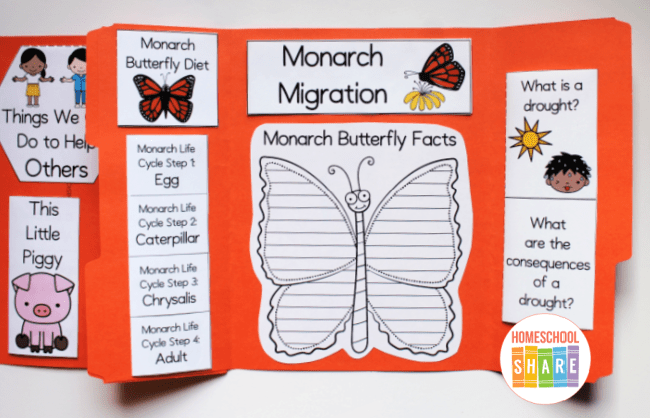
The Monarch has the unmistakable colors of orange and black. The Viceroy is similar in color and size, but the Monarch has an extra black stripe on the hind wing. The Monarch eats only the milkweed plant. Eating the poisonous milkweed plant makes the Monarch butterfly poisonous. Monarchs migrate from Canada to Mexico beginning in August until the first frost. They return north in the summer. God gave them a special instinct to know where to go as they migrate.
During its life cycle, the monarch goes through a metamorphosis, meaning complete change.
Life Cycle Craft
Supplies needed: a paper plate divided into 4 sections, crayons, glue, rice,
small shell pasta, small spiral pasta, bow tie pasta
1. In section one, have child draw a branch with a leaf on it. Glue the rice
on the leaf to represent the egg stage.
2. In section two, have student draw a branch with a leaf on it. Glue the
spiral pasta on the leaf to represent the larva (caterpillar) stage.
3. In section three, have student draw a branch with a leaf on it. Flue the
shell pasta on the leaf to represent the pupa (chrysalis) stage.
4. In section four, have student draw another branch. Glue the bow-tie pasta
on the branch to represent the butterfly.
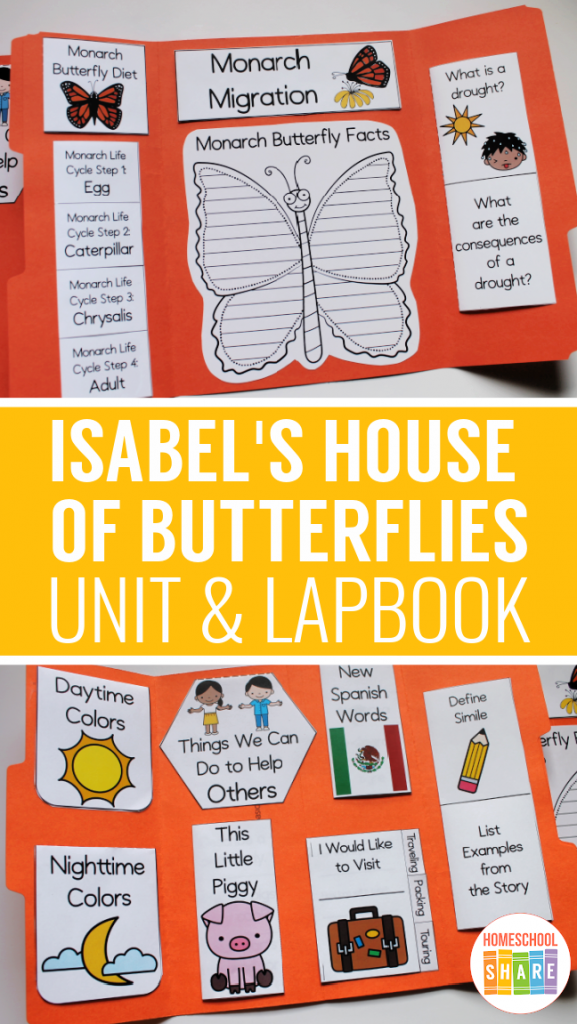
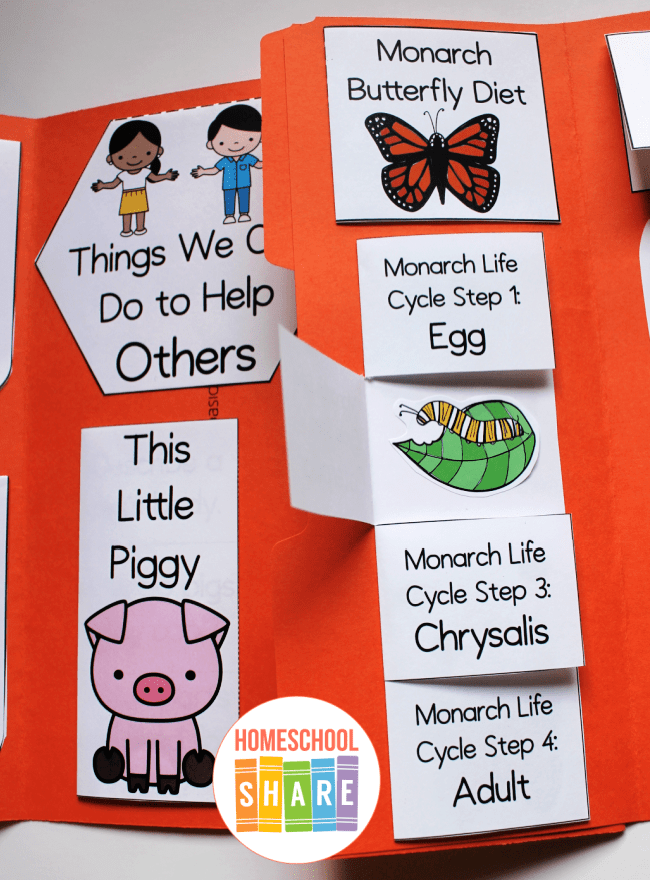
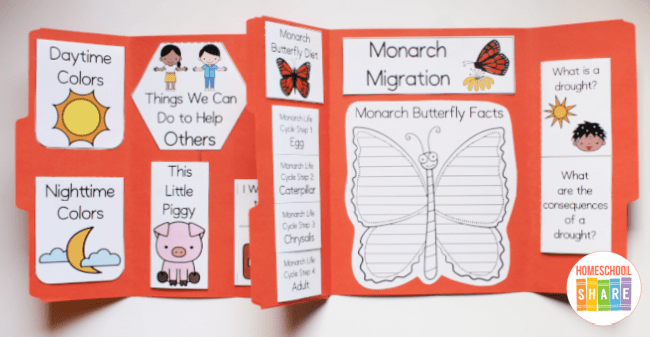
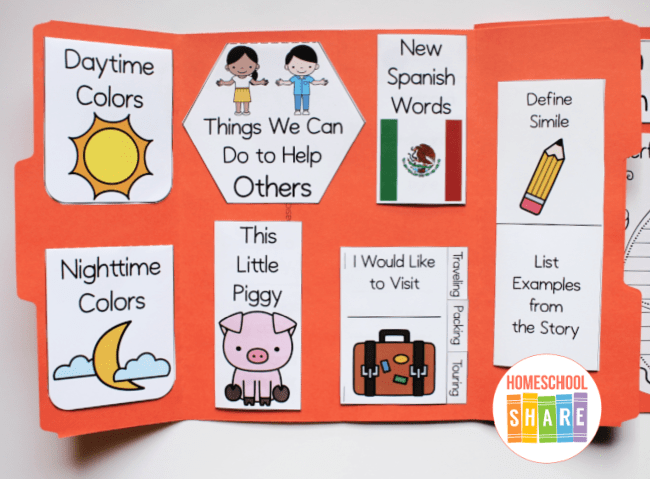
Complete the following printables for your lapbook:
Monarch Description
Monarch File Folders
Monarch Migration Map
Life Cycle
Monarch Coloring Page
More information about Monarch Butterflies
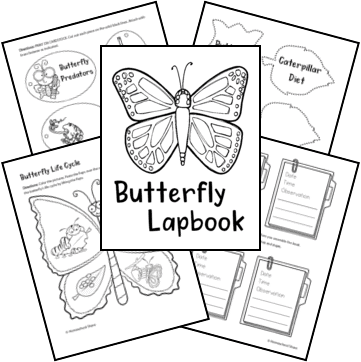
Butterfly Lapbook at Homeschool Share
Drought
A drought is a period of time when no rain falls. What are some consequences of not having rain? These include dying crops, fires, dust storms, rivers and creeks drying up, etc. Drought Split Matchbook
Counting
Younger students can count the butterflies or the number of tortillas on a specific page.
Problem Solving
Older students can make up their own math problems.
If Isabel and her mom sold ______ tortillas in one day and sold them for $_____. How much money would they make each day? Week?
If Isabel and her mom needed $_____ for the week and sold their tortillas for $_____, how many tortillas would they need to sell?
Symmetry
Look at a butterfly and notice the designs on each wing. The designs on the left wing are a mirror image of the designs on the right wing. Print out the butterfly pattern on cardstock. Fold in half and cut around shape. Using paint or bingo dotters, paint one-half of the butterfly. Fold your paper in half to create a mirror-image on the other wings. When dry, cut out your butterfly and add to lapbook.
Similes
A simile is a comparison of two or more things using the words “like” or “as”. There are numerous examples in this book.
‘…tree like a green church touching the sky…’
‘..voice splits stillness like a machete blow…’
‘…machete as bright as a slice of moon…’
‘…flop on petate like a broken butterfly…’
‘…whispering like dry grass…’
Simile Definition
Simile Illustration
Spanish Words
Use the Spanish Words Flap to record the meanings of the Spanish words used in the book.
Casa (kah-sah) – house
Mariposas (mah-ree-poh-sahs) – butterflies
Milagro (mee-lah-gro) – miracle
Tigre (tee-gray) – tiger
Color Wheel
Make a color wheel. Notice the colors blue and orange are opposite each other. This means they are complimentary colors. Primary colors are red, blue, and yellow. The secondary colors are colors that result in the mixing of two primary colors. Red and blue make purple, blue and yellow make green, and red and yellow make orange. In a color wheel, the secondary color and the primary color opposite it are called complimentary. When complimentary colors are placed next to each other, they make the other appear brighter. The shadow of an object will contain the object’s complimentary color. So, the shadow of a green apple will have some red in it.
Paintings
Look at the paintings in the book. Notice the colors used. Notice the material the paintings are on. They look like burlap or some kind of cloth material. Notice the colors used in the daytime paintings and compare them to the colors used in the nighttime painting.
COOKING
Use the following recipe to make corn tortillas (from All Recipes.com)
INGREDIENTS
1 ½ c. all-purpose flour
1 ½ c. cornmeal
2 tsp. baking powder
¾ tsp. salt
1 c. warm water (110 degrees F/ 45 degrees C)
DIRECTIONS:
In a large bowl, stir together the flour and cornmeal. Add baking powder and salt, and mix together well. Stir in water to form a crumbly dough. Work dough with your hands until it holds together. On a floured surface, knead dough until smooth. Divide dough into 10-12 pieces. Roll each into the shape of a ball. Cover lightly with saran wrap and let rest for 10-15 minutes. Flatten each piece of dough by hand, then roll into a 8 to 9-inch round. Heat a large skillet over medium heat. Lightly grease the hot pan, and place one tortilla in the pan. Cook tortilla until light brown, turning to ensure equal browning. Repeat with remaining tortillas.
LIBRARY LIST
Monarch Butterfly by Edana Eckart
Monarch Butterfly of Aster Way by Elizabeth Ring
Monarch Butterfly by Gail Gibbons
My Monarch Journal by Connie Muther
From Caterpillar to Butterfly by Deborah Heiligman
My, Oh My – A Butterfly!: All About Butterflies by Tish Rabe