| HSS Forum HSS Blog Ami's Blog - Walking By The Way HSS on Facebook | ||||||
| about us |
what's new
|
unit studies | unit study helps |
fiar resources
|
indexes | lapbooking |
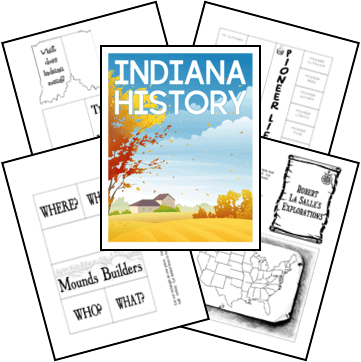
Indiana History
Research and Notebook
Resources by Jodi Small
Printables
Where are we?
Using a map of the United States, locate Indiana.
I
Research your family roots. How did your family arrive in Indiana?
Learn more about your city.
Notebook Resources:
Indiana Shutterfold
My City Tab Book
Design a Postcard (for your
city)
How Did My Family Get
to Indiana?
Family Tree Book
Other avenues for exploration
Learn about your county and the cities it encompasses.
Learn the counties that border yours.
State Symbols
State Flower - Peony
State Tree- Tulip
State Bird- Cardinal
State Motto - Crossroads of America (Why? Because we have more miles
of interstate per square mile than any other state)
State Nickname- Hoosier State
State Flag Information-
Our state flag was adopted in 1917. It is mostly blue. The golden torch
represents liberty and enlightenment. The thirteen outer stars represent the
original 13 colonies. The inner 5 stars represent the states that were admitted
to the Union before Indiana. The larger star above the torch represents
Indiana, the 19th state admitted to the Union.
Timeline
1000BC –
1650 AD – Indians lived and built mounds in Indiana and around Mississippi
1679 – LaSalle explored northern Indiana
1763 – English take over the French forst
1778 – George Rogers Clark leads Americans to take over English control of Fort
Vincennes
1787 – the Northwest territory established
1800 – Indiana Territory separates from the Northwest territory
1800 – Vincennes becomes the capital of Indiana Territory
1811 – William Henry Harrison defeated Tecumseh at the Battle of Tippecanoe
1812 – Battle of Mississinewa
1813 – Capital moved to Corydon from Vincennes
1816 – Indiana becomes the 19th state
1825 – Capital moved to Indianapolis from Corydon
1909 – Indianapolis Motor Speedway is built
1911 – First Indianapolis 500 race is held
1913 – State song adopted
1917 – Adopted State Flag
Notebook Resources
State Symbols Simple
Fold
State Motto Simple Fold
State Flag Coloring Page
State Bird/Flower Coloring Page
Start your Timeline Notebook
Page
*Cut
off area as indicated (on second page). Three hole punch first page. Tape
top of second page to bottom of first page and fold it up and write "Timeline
Notebook Page" as this will be your cover.
Other avenues for exploration
Time Zones in the U.S.
State Seal
State Song
Meet the First Indianians
~ the Mounds Builders
- lived
in the valleys of the Mississippi and Ohio rivers
-
Mounds were built in
different shapes and sizes. Some were the shapes of animals.
- Mounds
were used for different functions – burial grounds, religious temples,
underground forts or houses for protection
-
Bones have been found in mounds used for burial grounds
-
Farm tools, as well as
bone needles and clay tools have been found in the mounds proving they were used
for other functions as well
Where can
mounds be found?
Sugar Loaf mound – near Vincennes
Angel Mound – near Evansville
Mounds State Park – near Anderson (there are 10 mounds total)
Indiana
means “Land of the Indians”
The Indians that lived in what is now Indiana were from the Algonquian Tribe.
This includes the following:
- Miami – largest tribe in Indiana. Lived in wigwams made of bark and
animals skins. Grew corn, beans and squash. Hunted deer, buffalo, and bears
with bow and arrow.
- Delaware
- Shawnee
- Kickapoo
- Ottowa
- Wea
- Piankeshaw
- Chippewa
- Wyandotte
- Potawatomi
These
Indians were wanderers, following the wild animals as they traveled for food.
Notebook Resources
Mounds Shutterflap Book
Tribes in Indiana and What does Indiana mean?
Field
Trip Ops:
Mounds
State Park, 4306 Mounds Rd, Anderson
There are 10 mounds built by the Adena-Hopewell people. The Great Mound, almost
˝ mile in circumference, is believed to have been constructed around 160 BC.
http://www.in.gov/dnr/parklake/6705.htm
Angel
Mounds State Historic Site, 8215 Pollack Ave, Evansville
"Native
American Days"
- Angel Mounds' flagship event is back again! A weekend of fun will include
several demonstrators, including a dance circle and Indian market, as well as
food from a number of vendors.
http://www.angelmounds.org/
Etljorge Indian Museum
Early Explorers
European Explorers
French settlers from Canada traveled the St. Lawrence River (through Quebec, Canada and north of New York state), through the Great Lakes to the Ohio and Mississippi rivers. They traded with the Indians. The French knew that if they built forts along the waterways, they would be able to better trade with the Indians and have control over the waterways. The French and the Indians had formed a “business relationship” as far as trading for the items they needed. Fort Vincennes was one of the most successful forts. Other forts were Fort Miami, near present-day Fort Wayne, and a fort near present-day Lafayette.
Frenchman Robert La Salle learned several native American languages and learned of a “great river” the flowed south. Explorers from the time of Christopher Columbus were trying to find a way to China, and La Salle hoped this would be it. He was the first to record his travels in Indiana.
His first attempt brought him down the St. Lawrence River, through Lake Ontario where he portaged to the Ohio River. When he got to present-day Louisville, Kentucky, he encountered the Falls of the Ohio. His crew deserted him and he was forced to turn back.
His second attempt brought him down the St. Lawrence river to the Great Lakes (Ontario, Erie and north through Huron). After starting through Lake Michigan, he stopped in present-day Green Bay, Wisconsin, which they also called Green Bay. They then canoed down through Lake Michigan to the St. Joseph river, where he stopped at the south bend of the river. This is present-day South Bend. There is a marker at the site. After portaging across to the Kankakee River, he canoed to the Illinois River which led him to the Mississippi River. This took him down to New Orleans and the Gulf of Mexico. He had succeeded in his journey to find the “great” river.
Notebook
Resources
Why did LaSalle
Travel minit book (1 student)
Why did LaSalle Travel
minit book (2 students)
Map of LaSalle’s Travels
Battles
French and Indian War
As the English came
over to America, they settled on the east coast and moved west to settle. They
wanted to also trade with the Indians as the French people did, but the Indians
did not trust the English. The English had begun taking their land and forcing
them westward. This was the start of the French & Indian War. The English won
the war in 1763 and took over the French forts.
Revolutionary War
By the 1770’s, new
Americans wanted to be free from English rule and make a new country. This was
the start of the Revolutionary War. In 1778, George Rogers Clark led a group of
Americans to Illinois and Indiana to take over the forts from English rule.
They succeeded in taking control of forts in Illinois and started to move to
Indiana, but officials urged him to wait until spring. He did not want to wait
and traveled through snow and cold rivers, surprising the English at Fort
Vincennes. The Northwest Territory was formed including present-day OH, IL, MI,
WI, IN, and MN. Even after the Americans defeated the English and took over the
forts, the battles did not stop. The Americans still had to defeat the Indians
to take over the land.
Chief
Little Turtle
Little Turtle,
chief of the Miami Indians, defeated the Americans in a battle at Fort Miami.
President George Washington sent “Mad” Anthony Wayne to Fort Miami to regain
control of the fort. (“Mad” Anthony got his nickname because he took dangerous
chances during the Revolutionary War.) “Mad” Anthony defeated Chief Little
Turtle in the Battle of Fallen Timbers in Ohio, just over the border. At that
time, General Wayne built a new fort – Fort Wayne. Chief Little Turtle signed a
peace treaty and encouraged Indians to live in peace. Little Turtle did not
realize the number of settlers that would be moving into their land after the
peace treaty was signed.
In 1800, Indiana territory was established and Vincennes was made the capital.
Tecumseh and The Prophet at the Battle of Tippecanoe
After moving
their tribe from Western Ohio, Tecumseh and his brother, The Prophet, both
chiefs of the Shawnee tribe, began to fight the whites for land. They traveled
down the Mississinewa River to the Tippecanoe River where the Wabash begins
(near present day Lafayette.) They built Prophetstown, a place for the Indians
to join up for the battles. This poses a threat to General William Henry
Harrison, because Prophetstown is midway between Fort Vincennes and Fort Wayne.
This reduces the ability of free communication between the forts. Gen. Harrison
met with Tecumseh, The Prophet, and their warriors at the Battle of Tippecanoe
in 1811. There Harrison won, giving Harrison the nickname “Old Tippecanoe”.
War of
1812 and the Battle of Mississinewa
Soon after the
United States declares war on Great Britain, Chief Little Turtle, who encouraged
peace between the Indians and the whites, dies. The British join forces with
the Indians to take over American controlled forts. Battles are commonplace
throughout Illinois, Indiana and Ohio. Indians unsuccessfully attack Fort Wayne
and Fort Harrison (Vincennes) and Americans destroy Indian villages along the
Wabash River. The Americans destroy Prophetstown and other villages along the
Tippecanoe River. Then the Americans get the order to attack Miami Indian
villages along the Mississinewa River, but to guarantee the safety of the Indian
women and children. On Dec. 17, 1812, Americans led by Col. Campbell surprise
attack four Indian villages near present-day Jalapa. On Dec. 18, 1812, Indians
counterattack Campbell’s army forcing Campbell to retreat. Campbell’s army had
captured 34 women and children and allowed them to ride the horses, causing his
army to suffer frostbite in the deep snow and frigid temperatures. Although the
American army retreated, the Indians lost many of their people and the battle
for land.
The War of 1812 ended in 1814.
Frances Slocum
Frances Slocum was
born to a Quaker family and lived in Pennsylvania. She was kidnapped from her
home in 1778 at the age of 5, when a group of Delaware Indians robbed her family
for food and supplies. She was brought to Indiana and lived with the Indians
the rest of her life. Her husband was the chief of their Miami Indian tribe,
but he was totally deaf, so their tribe did not participate in the Battle of
Mississinewa. Frances’s Indian name was Maconoquah, meaning “Little Bear”.
Notebook Resources
Battle of Tippecanoe
Shutterbook
Indian Chiefs Twice Folded
Book
Field Trip Ops
Feast of the Hunter’s Moon, re-enactment of the
annual fall gathering of the French and Native Americans that took place at Fort
Ouiatenon, a fur trading post near present day West Lafayette, in the mid-1700s.
http://www.tcha.mus.in.us/feast.htm
Tippecanoe Battlefield & Museum, SR 43 off I-65, Battle Ground
http://www.tcha.mus.in.us/battlefield.htm
Field Trip Ops:
Battle of Mississinewa re-enactment,
http://www.mississinewa1812.com/
Northern Indiana Center for History,
http://www.centerforhistory.org/
Pioneer Life
Indiana Becomes a State
In 1800, Indiana
became a separate territory from the Northwest Territory, and Vincennes was
named the capital. On Dec. 11, 1816, Indiana was named the 19th
state of the United States of America. The first capital was Corydon, and in
1825 the capital was moved to be more centralized in Indianapolis.
Many people came from Scotland, Ireland and Germany to help build the Wabash and Erie Canal, which connected the Ohio River with Lake Erie.
Indiana became known as “The Hoosier State”.
Pioneer
life
- Clothes and beds made of animal skins
- Richer people had feather beds
- Cabins built near streams for water supply
- Cabins lit by candles or bear grease oil lamps
- Cabin floors of dirt
- Ate corn, deer and bear meat
- Children learned in a 1 room schoolhouse and did their lessons on slate
Notebook
Resources
Hoosier Flap Book
Pioneer Life Flap Book
Pioneer Creative Writing
Pocket
Field Trip Op:
Conner
Prairie, 13400 Allisonville Rd, Fishers,
http://www.connerprairie.org/
Civil War
Levi
Coffin and the Underground Railroad
Levi
Coffin grew up in North Carolina in a Quaker community. The Quakers wanted to
end slavery. While Levi was growing up, he saw many instances of slaves being
treated unfairly. In 1822, Levi’s brother-in-law asked him if he would like to
go west with him. Levi agreed knowing that he would be living in a state where
slavery was against the law. After traveling to Indiana, Levi moved back to North
Carolina with his family where he met his wife, Katy. After their first child
was born, Katy and Levi decided they did not want to raise him in a slave
state. They moved to Newport, Indiana near Richmond and opened a dry goods
store. The Coffins soon found out that Newport was an area where most slaves
passed on their way to Canada. Other families in Newport had set up safe
houses, and the Coffin’s house was considered “Grand Central Station” of the
underground railroad and Levi was the “stationmaster”. Levi learned the slavery
laws so he could keep slave hunters from entering his house without a search
warrant. On the second floor of the house, behind the bed in the girls room,
there was a small door leading to a windowless room. Levi then moved on to
Cincinnati where he continued helping slaves
Notebook
Resources:
Levi Coffin House Flap Book
Field
Trip Ops:
Levi
Coffin House, 113 US 27, Fountain City
http://www.waynet.org/levicoffin/default.htm
Israel Jenkins house, 7453 E 450 S, Marion
http://www.walnutcreekgolf.com/index.php?option=com_content&task=view&id=5&Itemid=21
Famous Hoosiers
Virgil Grissom
or “Gus”
- Born near Mitchell
- An astronaut
- Grissom Air Force Base named after him
Ernie Pyle
- Born near Dana, Indiana
- attended Indiana University
- became a journalist
- was a war correspondent during WW2
Wilbur Wright
- Born near New Castle
- Invented the airplane
Dan Quayle
- Senator of Indiana and US vice president under George H.W. Bush
- Born in Indianapolis
John Chapman or “Johnny Appleseed”
- coffee sack for a shirt and an old tin pot for his hat
- planted apple seeds and preached to pioneers throughout IN, OH, and IL
Eli Lilly
- lived near Greencastle, Indiana
- studied pharmacology at Depauw University
- opened a drug store in Indianapolis
- founded a pharmaceutical company in Indianapolis and committed himself to only
selling the highest quality medicines
Samuel Morris
- a Liberian prince who attended Taylor University
- died before graduating
Benjamin Harrison
- senator of Indiana
- 23rd President of the United States
William Henry Harrison
- led US forces to defeat the Indians in the Battle of Tippecanoe
- earned the nickname “Old Tippecanoe”
- the first governor of Indiana Territory
- 9th president of the United States
“Mad” Anthony Wayne
- earned the nickname “Mad Anthony” during the Revolutionary War
- defeated Little Turtle
- built Fort Wayne
Notebook Resources
Famous Hoosier Report
Pocket
Hoosier Hall of Fame
Matchbooks
Field Trip Ops:
President Benjamin Harrison’s home, http://www.presidentbenjaminharrison.org/
Grissom Air Museum, US 31, Peru, http://www.grissomairmuseum.com/home.html
Dan
Quayle Center and Museum,
http://www.quaylemuseum.org/
Lincoln Boyhood National Memorial, http://www.nps.gov/libo/
Wilbur Wright Birthplace & Museum,
http://www.wwbirthplace.com/
Ernie Pyle State Historic Site, http://www.in.gov/ism/StateHistoricSites/ErniePyleHome/index.aspx
Indiana
Authors
James Whitcomb Riley or “Hoosier Poet”
- Born in Greenfield
- Wrote poems about small town life in Indiana (“Little Orphant Annie, The Old
Swimmin’ Hole, and When the Frost is on the Pumpkin”
See When the Frost is on the
Punkin' Unit Study for James Whitcomb Riley Report Form
Gene Stratton Porter
- born in Wabash County
- was an author and wildlife photographer
- wrote Freckles, Harvester, Laddie, A Girl of the Limberlost
Charles Major
- born in Indianapolis
- wrote Uncle Tom Andy Bill, Bears of Blue River, A Forest Hearth
Booth Tarkington
- born in Indianapolis
- attended Purdue University
- wrote Penrod, The Two Vanrevels
Lloyd C. Douglas
- born in Columbia City
- was a Lutheran minister
- wrote The Silver Chalice, The Robe
Lew Wallace
- born in Brookville
- was a Civil War Colonel
- wrote Ben Hur
- died in Crawfordsville and is buried there
Field Trip Ops:
James Whitcomb Riley
House,
http://www.greenfieldin.org/about/gallery/riley.htm
Gene Stratton Porter State Historic Site,
http://www.in.gov/ism/StateHistoricSites/GeneStratton-PorterCabin/index.aspx
Is there more
than corn in Indiana?
What do we grow? Indiana is in the corn belt, growing corn to feed
cattle and hogs. Soybeans are also grown.
What do we mine? Coal and limestone
What do we produce? Northwestern Indiana is the largest steel making area
in the US
Pharmaceuticals and medical equipment – Eli Lilly
One of the leading states in production of Ethanol an Biodiesel
First automobiles
Elwood Haynes
- built his first car in Kokomo using bicycle wheels
- joined with the Apperson brothers to build one of the first automobiles
- founded Haynes Stellite Company in 1912
Studebaker brothers
- Clement and Henry Studebaker, Jr.
- automobile manufacturer based out of South Bend
Auburn Automobile Company
- founded by Charles Eckhart in Auburn
- also manufactured Cord automobiles
Notebooking Resources
Automobile Side by Side
More Than Corn in Indiana
Flap Book
Field
Trip Ops:
Elwood
Haynes Museum,
http://www.inkokomo.com/community/elwood_haynes.html
Studebaker National Museum,
http://www.studebakermuseum.org/
Auburn-Cord Duesenberg Museum,
http://www.acdmuseum.org/
Indiana
Government
You will need to do your own research for your representative and for the
senators since this information changes.
Age
Requirements:
35 for President or Vice President
30 for Senators
25 for Representatives
30 for
Governor
Notebooking Resources
Government File Folders
(mayor, senators, representative, governor)
Age Requirements Flap Book
Field
Trip Op:
February ~ Indianapolis State House (home school day)
Weather Records
Great “Tri-State Tornado” of March 18, 1925
- crossed south eastern Missouri, through Illinois, and southern Indiana
- 695 deaths were reported
- Continuous 219 miles was the longest ever reported in the world
- Harrison county in Indiana, only 4 deaths reported within our state
Palm Sunday tornado outbreak of 1965
- 10 tornados were reported in Indiana
- 162 deaths were reported
- Tornado came through Grant, Clinton and Howard counties injuring 800
Blizzard of 1978
- 20 inches fell during the storm
- Winds made drifts as high as 20 feet
- Indiana State Police closed all Indiana roads
- Travel was impossible
1816 – The year without a summer
- Snow and ice fell during 17 days of May destroying crops
- Snow in June finished off anything that was left
- First week of July, northern US suffered freezing temperatures
- August came with snow, frost and blizzards killing fruit trees
Notebooking Resource
Extreme Weather
Triangle
Sports
Indianapolis Motor Speedway
- built in 1909
- 2 ˝ mile track
- first race held May 30,1911, 500 mile race
- Indy 500 is held every year during Memorial Day weekend
- First Brickyard 400 race held in 1994
- Infield road course constructed between 1998 and 2000
- Formula One races were held from 2000-07
Hoosier Athletes
Larry Bird
- born in West Baden Springs (French Lick area)
- played basketball for Indiana University under Coach Bob Knight
- played professional basketball for the Boston Celtics (1979-1992)
- returned to Indiana as the Indiana Pacers head coach in 1997
Mark Spitz (not a born Hoosier)
- attended Indiana University
- went on to win 7 gold medals in the 1972 Olympic games
Notebooking Resource
Indy 500 Tri-fold
Field
Trip Ops:
Indianapolis 500 museum, 4790 W 16th St., Indy,
http://www.indianapolismotorspeedway.com/museum/
NCAA Hall of Champions, 700 W Washington
St, Indy,
http://www.ncaa.org/hall_of_champions/global/home.htm
Indiana Basketball Hall of Fame Museum,
http://www.hoopshall.com/
College Football Hall of Fame,
http://www.collegefootball.org/
Indiana Baseball Hall of Fame,
http://www.indbaseballhalloffame.org/