Google
 
Language Arts   Copywork- Hot Ai

Hot Air the (mostly) True Story of the First Hot Air Balloon Ride


  Author: Marjorie Priceman
ISBN:
0689826427

Summary:
Priceman tells the story of the successful 1783 liftoff of a hot-air balloon, invented by the Montgolfier brothers, a flight made even more special because of its passengers: a duck, a sheep, and a rooster.

Unit prepared by Kelly Cooper and Wende
Lapbook created by Kelly Cooper


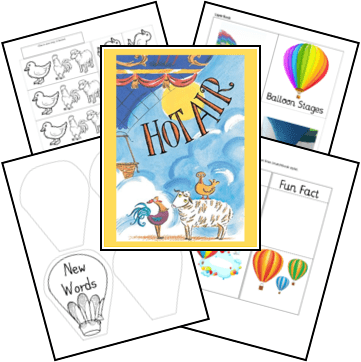
Lapbook Templates

Hot Air Balloon Paper
 
Hot Air Balloon Stages Layer
 
Animal Flap Book
 
Vocabulary Shapes
 
Famous People Cards/Pocket
 
Flight Graph
 
France Shutterfold
 
Fun Fact Matchbooks
 
Count by 3's
 
France Flag
 

Montgolfier Balloon Shape

Balloon- hot air rises
 

Language Arts

Copywork- Hot Air Balloon Prayer –

At the end of a hot air balloon flight, this prayer is often said. Have student copy this prayer in his best handwriting.   Use this Hot Air Balloon Paper, if desired.


The wind has welcomed you with softness.
The sun has blessed you with warm hands.
You've flown so high and so well that God has
joined you in laughter and set you gently
back again into the loving arms
of Mother Earth.


Vocabulary –

ambassador – a respected, accredited representative of one government to another
slender – slim; thin
demonstration – pointing out or proving
amateur – someone who does something for fun rather than as a profession
splendid – magnificent
aviator – one who flies heavier-than-air aircraft
Vocabulary Shapes

Reading the Story –

If you have a new or young reader at your house, you may want to take turn reading this story.   Mom can read the first few pages and then the student can read the pages with little text and animal sounds. 


Retelling the Story –

This story is told using panels. Have student make panels to use as sequencing cards to describe the elements of the story (beginning/middle/end).


Social Studies 


France –


This story takes place in France. Have your child locate France on a world map. France is a country in Europe, its capital being Paris. Is your child familiar with France? Discuss with your child some of the sites that may be seen in France such as the Eiffel Tower, Seine River, outdoor cafes, or artists on the streets. The Palace of Versailles was the official residence of the Kings of France from 1682 until 1790. It was originally a hunting lodge, built in 1624, by Louis XIII. Louis XIV beginning in 1669 expanded it. The palace was stripped of most of its furnishings during the French Revolution, and Tuileries in Paris became the royal residence. Versailles is now a national museum. If interest warrants, share some stories about France with your child, such as Madeline by Ludwig Bemelmans, or the Anatole series by Eve Titus (about a mouse in France).

France Shutterfold
France Flag
 

The Montgolfier Brothers –


This story is about the Montgolfier brothers, Joseph and Etienne, and their adventures in flying the first hot air balloon. Joseph Montgolfier, born in August 1740 and Étienne Montgolfier born in 1745 were brothers in a family of sixteen siblings! Their father owned a paper factory in France.

One day, Joseph had the idea to get some paper from the factory, make a large bag, and fill it with steam to see if he could make it rise. Instead he produced a wet mass of paper. Étienne then had the idea of making a bag float in the air with hydrogen gas obtained from sulphuric acid and iron filings. There was still no success. The brothers continued their experiments, and in 1782 Joseph achieved a small-scale success using a taffeta envelope filled with hot air rise to the ceiling. Now the dream of flying a hot air balloon seemed in reach for the Montgolfier brothers. With more taffeta, rope, they prepared a large-scale experimental balloon.


On June 4, 1783 Joseph and Étienne Montgolfier saw their hopes becoming reality with the first public demonstration. They made an 875 cubic yard balloon of cloth lined with paper and coated with alum as fireproofing, all held together by about 2,000 buttons. It took off from Annonay, France, rising to a height of 3,280 feet and traveling for 1.25 miles. The balloon flight was a success even though the brothers did not completely understand the physics of what was happening. They thought that it was the smoke that provided the lift for the light fabric balloon. Thus, the balloon was filled by smoke from a fire of straw, humidified wool and even of old shoes! The more dense the smoke, the better, they thought. Only later was it realized that it was the hot air provided by the fire that mattered, not the smoke.


For a second test, a new balloon of 1,531 cubic yards was built. The demonstration took place in Paris in the presence of King Louis XVI on September 19, 1783. Three passengers - a rooster, a duck and a sheep - were used in order to test the effect of high altitude on live creatures. The king was not impressed by the stench of the dense smoke, but this flight, too, proved to be a great success. The balloon rose to a height of 1640 feet and floated 1.86 miles.


On November 21, 1783, the Montgolfier brothers made another test. The balloon used measured 2,406 cubic yards, and was propelled by an iron furnace. This time two men, Jean-François Pilâtre de Rozier (a physicist) and François Laurent Marquis d'Arlandes, were the first human pilots on an untethered flight.  Their flight lasted 25 minutes, reached a height of 2950 feet, and landed 6.2 miles away.  The Montgolfier brothers’ persistence took their balloon from just a concept to a real flight in the span of one year!  

Montgolfier Balloon Shape


Famous People - King Louis XVI, Marie Antoinette, and Benjamin Franklin –

The book mentions these famous people being present for the flight of the Montgolfier Brothers hot air balloon in 1783. Discuss with your student a bit about these three people.


Louis-Auguste was born at Versailles on August 23, 1754. He married Marie Antoinette in 1770, and following the death of his grandfather Louis XV in 1774, he ruled as King of France. In 1789 he gathered together different representatives of France, including the clergy and the nobility, to discuss the financial problems of the country. Unfortunately, most did not agree with his solutions and the French Revolution began. Along with the rest of the royal family, Louis XVI was forced to leave Versailles in October 1789, six years after the balloon flight. After a failed escape attempt to Austria in June 1791, the royal family was returned to Tuileries and placed under house arrest. In August 1792, the King was suspended, and the following month, the monarchy itself was abolished when France was declared a republic. Found guilty of treason by the National Convention, he was executed on January 21, 1793.


Marie Antoinette was born in 1755.   She was a princess and archduchess, and the favorite daughter of Marie Thérèse, Empress of Austria.   Her mother took pride in strategically marrying off her children in ways that increased her empire. At the age of 15, in 1770, Marie Antoinette was married to Louis XVI,  the crown prince of France, the most prestigious throne in all of Europe.  France was then the most powerful nation of continental Europe, and the royal palace at Versailles the most opulent.  When King Louis XV died and her husband became King Louis XVI in 1774. Marie Antoinette, still a teenager became Queen of France. She died on October 16, 1793, also by execution.


Benjamin Franklin was born in Boston, Massachusetts on January 17, 1706. He was the tenth son of soap maker, Josiah Franklin. At the age of 12 Ben helped his brother work at a printing press, setting type and making pamphlets. He would then sell them on the streets.


In 1733 he started publishing Poor Richard's Almanack. Almanacs of the era were printed annually, and contained things like weather reports, recipes, predictions and homilies. Many of the famous phrases associated with Franklin, such as, "A penny saved is a penny earned" come from Poor Richard.


In the 1740’s he began to concentrate his efforts on science and inventions. In 1743 he invented a heat-efficient stove, called the Franklin stove, to help warm houses efficiently. Among Franklin's other inventions are swim fins, the glass harmonica (a musical instrument) and bifocals. In the early 1750's he turned to the study of electricity. His observations, including his kite experiment, which verified the nature of electricity and lightning, brought Franklin international fame.


It was just after this time that Franklin became more interested in politics and began working actively for Independence. Franklin was elected to the Second Continental Congress and worked on a committee of five that helped to draft the Declaration of Independence. Though much of the writing is Thomas Jefferson's, much of the contribution is Franklin's. In 1776 Franklin signed the Declaration, and afterward sailed to France, as an ambassador to the Court of Louis XVI.


The French loved Franklin. He was the man who had tamed lightning, the humble American who dressed like a backwoodsman but was a match for any wit in the world. He spoke French, though stutteringly. In part via Franklin's popularity, the government of France signed a Treaty of Alliance with the Americans in 1778. Franklin also helped secure loans and persuade the French they were doing the right thing. Franklin was on hand to sign the Treaty of Paris in 1783, after the Americans had won the Revolution.

Franklin returned to America when in his late seventies.  He became President of the Executive Council of Pennsylvania. He served as a delegate to the Constitutional Convention and signed the Constitution. One of his last public acts was writing an anti-slavery treatise in 1789. Franklin died on April 17, 1790 at the age of 84. 20,000 people attended the funeral of the man who was called, "the harmonious human multitude."

 
Famous People Cards/Pocket


History- Balloon Air Mail –

If your student would like to learn even more about hot air balloons, proceed with this lesson. 


A hot-air balloon carried the first airmail letter. In 1859, a Lafayette, Indiana postmaster handed a locked bag of 123 letters to John Wise, pilot of the balloon, Jupiter. Wise wanted to set a record for the longest balloon flight while he delivered mail to New York City on August 17th.  Wise ascended in his balloon to find only a small wind and it was blowing southwest not east. After traveling only 30 miles in five hours he admitted defeat and landed. The mail was then placed on a train to New York City, but the US Postal Service still counts his flight as the first airmail service in the United States. A few weeks later, using a different balloon, Wise did set the first long distance record of 809 miles, but he crashed just short of New York City. He lost all the mail in the crash the postal service decided that balloon-mail was not very reliable. Wise gave up the idea of being a flying mailman and flew observation balloons during the Civil War for the Union Army.


Science


How Hot Air Balloons Work

Does your child know that hot air is lighter than cool air, so hot air rises to the top? If so, he already understands the basic principle of what makes a hot air balloon rise. To keep the balloon up in the air, new warm air needs to be in constant supply. This is accomplished with a heat source located under the envelope, or balloon. The Montgolfier brothers burnt straw, wool, and even old shoes to create the heat. Today, hot air balloons use a propane gas burner to heat the air. The hot air rises and is collected in the balloon, thereby raising the whole unit up into the air. A basket attached to the balloon carries the passengers. Have your child duplicate the action of a rising balloon by holding a plastic grocery sack over a heater vent or steaming kettle.


Ask your child how he thinks the balloon would come down from the air. If he answered, “by decreasing the hot air” he is right! The balloon pilot can decrease the amount of heat made by closing off the valve in the propane tank. There is also a cord to open a valve at the top of the balloon that allows the hot air to escape.


So now your student knows how the balloon goes up and down (vertical), but how does it go from side to side (horizontal)? The wind blows in different directions at different altitudes. To move a particular direction, the pilot ascends and descends to the appropriate level and rides the direction the wind takes him. This makes flying a balloon a bit different than flying a plane, because you can’t simply aim and go. You really do blow with the wind!


For this reason, the landing crew need to be able to follow the balloon around from the ground, usually by car, to be in the right place at the right time for the balloons landing. The ground crew will look for an idle landing location, someplace flat, accessible, and with no trees or power lines in the way, and will communicate this spot to the pilot by a radio. The pilot will then get ready for the landing by reducing the amount of heat going into the envelope. The balloon with its basket of passengers will descend, hopefully to a soft landing, and then the balloon will be folded up and packed, ready for its next voyage. 


Neat balloon fact! :  “Pilot” comes from the first manned hot air balloon pilot– Pilatre de Rozier 

You can make your own hot air balloon like this homeschooling family did!

Fun Fact Matchbooks
Hot Air Balloon Stages Layer
Balloon- hot air rises


Ballooning Vocabulary –


Here are some words your student may encounter in his study of ballooning:

Aeronaut                     - a pilot of a “lighter-than-air” craft

Ambient temperature  - the temperature of the air outside the balloon

Ballast                         - the heavy material added to the gondola to make the balloon more stable

Buoyancy                    - the upward force that a fluid exerts on an object less dense than itself

Envelope                     - the fabric part of a Hot Air Balloon

Free balloon                - a balloon that has no exact steering, so it cannot travel in a set direction

Gores                          - the individual panels that make up the envelope of a balloon

Gondola                      - the basket attached to the balloon for holding the pilot and passengers

Hydrogen                    - a colorless, highly flammable gas formally used in Hot Air balloons

Load tapes                  - tapes sewn into a balloon Envelope by which the gondola is attached

Meteorology                - the study of weather

Nylon                           - high-strength man-made material used in the construction of balloon envelopes

Propane                      - a gas used in Hot-Air Ballooning
Rip panel                     - a panel in the envelope that can be opened rapidly to deflate the balloon upon landing

Vocabulary Shapes

Wind –


It was very important for balloon pilots to understand how wind works. Their safety depended upon it! Wind is air moving horizontally (side to side). What causes the wind? Air is made of tiny particles called molecules. As these molecules heat up, they expand, move faster, and spread out. When the molecules get cool, they contract, move slower, and stay together. So as the sun warms the air, the air rises. The cold air rushes in to take the place of the warm air. We feel this movement of air as wind.


Ducks –

One of the first passengers in a hot air balloon was a duck. Your student may enjoy a deeper study of  ducks.


Ducks are birds, and are also called "waterfowls" because they are normally found in places with water like ponds, streams and rivers. Ducks also have shorter necks and wings and a stout body. They can live from 2-12 years. 


Feet - Ducks have webbed feet that are made for swimming, acting like paddles.   Because of its feet, it doesn’t walk like we do, it waddles!  Their feet don’t get too cold in chilly water either because their feet have no nerves or blood vessels.


Feathers - Another special thing that the duck has is its waterproof feathers. There is a special gland that produces oil near the duck's tail which spreads and covers the outer coat of the duck's feathers, making it water-proof. Beneath the waterproof coat are fluffy and soft feathers to keep the duck warm. Ducks keep clean by preening themselves. They do this by using their bill and taking some of the oil and spreading it over those top feathers. A male duck is called a drake. The drakes are usually the brightly colored ones to attract the females.  Drakes will lose or molt their colorful feathers and will not be able to fly while the females are busy hatching the eggs. Female ducks are usually dull-colored and brown so that they can hide and camouflage from their enemies when they are in their nests.  The females also molt. They replace all their feathers and get new ones after their babies or ducklings are hatched.  Once they both have their new feathers though, they are able to fly again. Ducklings are able to fly within 5-8 weeks. Their feathers develop really fast. When the young are ready to fly, all the ducks will gather in flocks to migrate to their wintering home. When the ducks fly they usually do so in a "V-shape" or a long line.


Mouth - The duck's mouth is called a "bill". Normally, it is broad and flat and has rows of tiny notches along the edge called "lamellae". The lamella helps the duck to grip its food so that it will not slip off. However, ducks bills come in different shapes and sizes. The shape of the bill and body features will determine how the duck hunt for its food.  Ducks, which have broad beaks, are called shovelers because they use their bill as a shovel to sift their food for insects, snails and seeds from the mud. Some ducks have long and narrow beaks that are covered will saw-like edges, which help them to grab fish. Sea ducks usually have this kind of beak. Sea ducks are also divers.  Some ducks do not dive for food. Their beaks are broad and short. They are called dabblers. They eat plants, seeds, grasses and other small insects and animals that they find on or under the water. Usually they up-end and stretch their heads into the water to reach their food. Dabblers usually have shiny colored patches on their wings.  Dabbling ducks take off from the water in quick jumps.


Sound - Ducks give out a special sound. Not only do ducks quack, but some squeal too (like the Wood Duck).


Species - Ducks were domesticated by the Chinese many hundreds of years ago. There are still many different species of wild ducks. Most of the farm ducks are of a species called "Pekin”. Male and female Pekin ducks are hard to tell apart because they look almost the same. The male has two to three curly feathers on top. Pekin ducks have white or cream colored feathers and orange colored bills. They do not fly and do well in captivity.  The Pekin duck originated in China and is the most popular breed in the United States.


Migration - Some species of ducks migrate or travel long distances every year to breed. Usually they travel to warmer areas where the water does not freeze so that they can rest and raise their young. The distance may be thousands of miles away. Ducks are found everywhere in the world except the Antartica which is too cold for them.


Reproduction - Ducks usually look for a mate or partner in winter. The females will then lead the males to their breeding ground in spring. The breeding ground will usually be the place where she was hatched. The female builds her nest with grass or reeds or even in a hole in a tree. The male will guard their territory by chasing away other couples. Once the female lays 5-12 eggs, she will start to sit on her eggs to keep it warm so that they can hatch into ducklings. The males on the other hand, will be with the other males. The eggs will hatch within 28 days normally, except for the Muscovy, which takes about 35 days to hatch.


Predators - The mother duck will keep her brood of ducklings together to protect them from predators. Animals like the raccoon, turtles, hawks, large fish and snakes will eat the ducklings.


Sheep –

Another of the passengers in the first hot air balloon was a sheep. Here are some basic sheep facts to discuss with your student as interest warrants.


Who’s Who - The female sheep is called an ewe, the young are called lambs, and the male is called the ram. 


Anatomy - The sheep is an animal that has a thick coat of fleece on its body. Sheep have hoofs that are divided into two toes. They have a gland between their toes. The horns of the ram usually curved outward but not all rams have horns.


Life Span/Reproduction - The average life span of a sheep is about 7 years. Most lambs are born in spring. Ewes usually give birth to either one or two lambs at a time. She carries the lambs in her body for about 5 months before they are born. Ewes come into maturity to begin breeding at about 6 months old but they are not allowed to do so until they are about 1.5 years old. The lamb will stay with its mother until it is about 5 months old. At 6 months, they are considered fully-grown. However, we still call them lambs if they are less than one year old.


Sound - It says "baa-baa" or bleat.   A lamb knows its mother by her bleat, (baa-baa) sound.


Predators - The sheep have many natural enemies like the coyotes, the mountain lions, wolves and even the domestic dogs.


Food - They mainly feed on different types of grass. Sheep move around in large groups called flocks. They graze on fresh grass. In the olden days, a shepherd and his dog will watch over the flock. However, in modern times, some farms are so big that they have to go on horsebacks and motorcycles to herd them.


Uses - Every spring, the sheep are shorn for their wool. This means that their fleece (thick wooly coats) is shaved off. Spring is chosen because it is no longer cold and the sheep doesn’t need its fleece to keep warm like it does in winter. The fleece has to be removed in one single piece. This requires a lot of skill. The shearer must also be strong enough to hold the sheep in place. A good shearer takes less than 5 minutes to do this. He can shear as many as 125 sheep a day! Sheep are also used for meat, as well as leather, clothing and give us the raw materials for by-products, such as soap, lanolin, glue, tallow and catgut. Catgut is used in stringing tennis and badminton rackets. Lanolin is natural oil found in the sheep's fleece, which is used to make cosmetics and candle wax.

Animal Flap Book

Free Chicken Lapbook at HSS
Free Duck Lapbook at HSS


Math

Story Problems
A hot air balloon weighs 1,596 pounds. If the basket weighs 900 pounds, how much does the rest of the balloon weigh?
In the Montgolfier Brothers’ first flight attempt the balloon rose 3,280 feet.
In the Montgolfier Brothers’ second flight attempt the balloon rose 1,640 feet.
In the Montgolfier Brothers’ third flight attempt the balloon rose 2,950 feet.
Which flight rose the highest? Which flight rose the lowest? What was the difference between the first and second flight?
The first flight took the brothers 1.25 miles. The second flight took the brothers 1.86 miles. The third flight took them 6.2 miles away. Which flight took them the farthest distance? Find the difference between the first flight and the last flight.

Counting by 3s
Teach your younger student to count by 3s with the chicken, duck, and sheep.
Count by 3's

Flight Graph
Older students can graph various balloon flights on graph paper.

Flight Graph