| about us |
what's new
|
unit studies
|
unit study helps |
fiar resources
|
indexes | lapbooking |
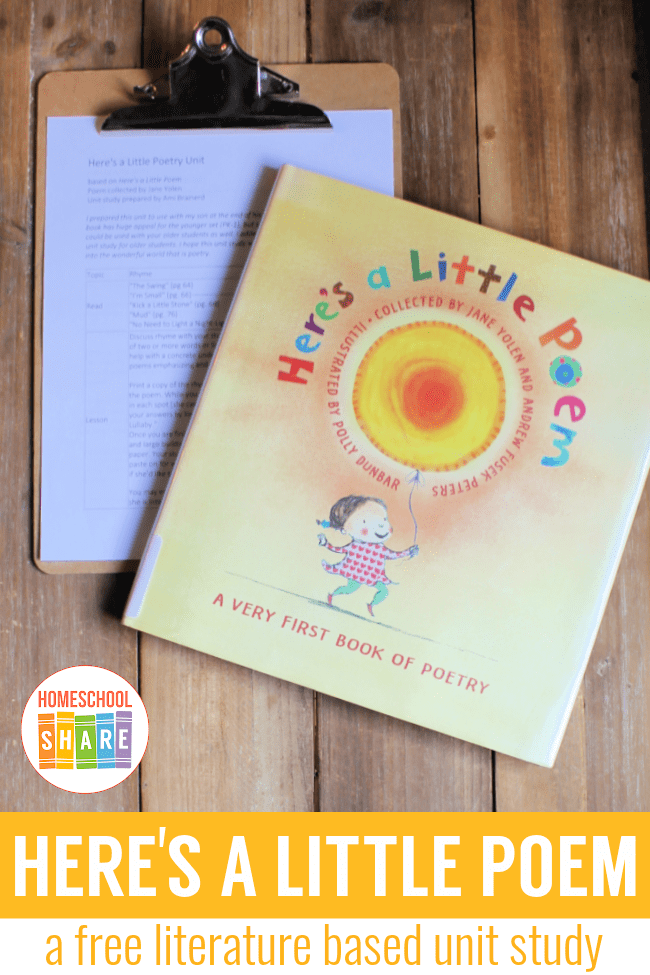
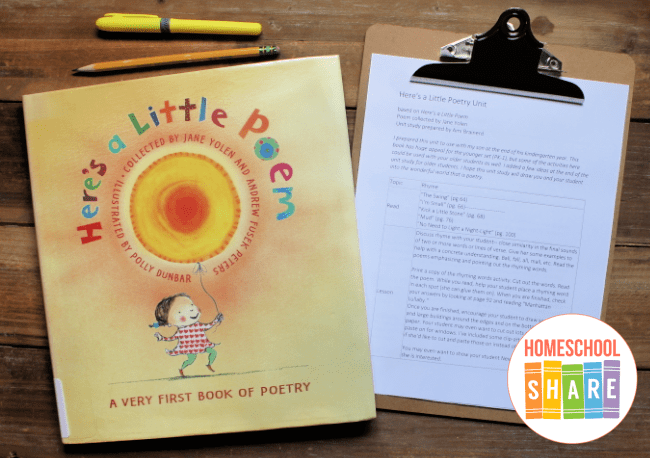
Here's a Little Poetry Unit based on Here's a Little
Poem |
I prepared this unit to use in April
with my son who will be at the end of his Kindergarten year. This book has
huge appeal for the younger set (PK-1), but some of the activities here could be
used with your older students as well. I added a few ideas at the very end
of the unit for older students.
This unit isn't found in any of our regular indexes because it's different.
You can use it as an add-on to your other daily lessons. I wanted it to be
a light, fun, fresh unit to introduce my son to the basics of poetry. I
hope it will inspire you and your students; I hope it will draw you into the
wonderful world that is poetry.
Please plan this unit in advance as many of the lesson extensions require
supplies you may not have on hand (like big boxes!).
| Topic | Rhyme |
| Read | "The Swing" (pg 64) "I'm Small" (pg. 66)---------------------- "Kick a Little Stone" (pg. 68) "Mud" (pg. 76) "No Need to Light a Night-Light" (pg. 100) |
| Lesson | Discuss rhyme with your student-- close
similarity in the final sounds of two or more words or lines of verse.
Give her some examples to help with a concrete understanding.
Ball, fall, all, mall, etc. Read the poems emphasizing and
pointing out the rhyming words. Print a copy of this prepared rhyming words activity. Cut out the words. Read the poem. While you read, help your student place a rhyming word in each spot (she can glue them on). When you are finished, check your answers by looking at page 92 and reading "Manhattan Lullaby" Once you are finished, encourage your student to draw some cars and large buildings around the edges and on the bottom of her paper. Your student may even want to cut out lots of rectangles to paste on for windows. I've included some clip-art vehicles in the file if she'd like to cut and paste those on instead of drawing her own. You may even want to show your student New York on the map if she is interested. |
| Lesson Extension | Read the poem "Mud" again
(found on page 76). Make some "mud" to play in! Mud Recipe 1/2 cup water 1 tablespoon oil 2 tablespoons brown washable paint Mix together; add 1/2 cup salt & 1 tablespoon cornstarch. Add flour (1 1/2 cup) slowly until soft & smooth. There won't be enough to wallow in, but your student may be able to make a mud pie. You may even want to let him put his toes in it. While your student is engaged in this sensory experience, have him give you some words that describe the mud he's playing in. Maybe this activity will even inspire a poem! |
| Topic | More on Sound- Onomatopoeia |
| Read | "Rickety Train Ride" (pgs. 78-79) "Bumble Bee" pgs. 58-59 |
| Lesson | Read "Bumble Bee" and discuss the words
that rhyme (review from your previous lesson). Read the poem
again. Ask your student if any of the words sound like what they
actually are (such as CRASH! BANG! RING...etc.). This is called
onomatopoeia-- the naming of a thing or action by imitation of natural
sounds. Ask your student to help decide what words in the poem
sound like a bee (buzz and hum); say those words together and really
emphasize your buzzing and humming. Read "Rickety Train Ride." Can your student pick the onomatopoetic words out of this poem? (clickety clack) Discuss trains. They make a lot of sounds that aren't mentioned in this poem, don't they? Write your words down on the patterns below to make your very own onomatopoeia train. Train Car Pattern with lines Train Engine Pattern with lines Train Car Pattern without lines Train Engine Pattern without lines |
| Lesson Extension | Option 1: If your student was interested in the poem, "Bumble Bee," take some time to learn more about bees, apples, and pollination. Our favorite non-fiction bee book is Are You a Bee? by Judy Allen
Option 2: |
| Topic | Repetition |
| Read | Read "After a Bath" page 82-83 You may also want to read these poems to add to your repetition discussion: "Bananas and Cream" (pgs. 12-13) "Baby in a High Chair" (pg. 23) "Berries" (pgs. 56-57) "Sleepy Song" (pgs. 92-93) |
| Lesson | Repetition is, simply, the act
or an instance of repeating. Tell your student to stand-up.
Tell him to raise his right arm to the sky four times. Now
try the left arm. Raise it to the sky four times. Now, try
the right leg...then the left leg. Now tell him to put it all together.
(Do this with him to help.) When, he's done tell him that he just
followed a pattern and he repeated the movement. What would it be
like if you asked him to put his right arm up twice, left arm up one
time, right leg up five times and left leg up 3 times. Would he be
able to do it as well? Can he remember those directions? Our brains like patterns. They like repetition. Our ears like it, too. That's why repetition is an important part of poetry. Read the poetry selections for today. Ask your student, what parts repeat? Help point out these parts if she can't find them. |
| Lesson Extension | Since you read "After a Bath"
why not have some water fun? If you can, set up outside (otherwise use the kitchen sink). Give your student a bucket or tub of water to play in. Make sure to include some fun toys, measuring cups, bowls, spoons, or plastic containers (usually a colander is a big hit, too). When your student is done, have her dry off each item with a towel. If you're outside, let her give them a SHAKE first. Another option would be to have your student help you give the dog a bath today. |
| Topic | More on Repetition or A Poem About Me |
| Read | Read "A Circle of Sun"
(pgs. 8-9) You may also want to read these About Me poems: "Something About Me" (pg. 10) "I Am Rose" (pg. 11) "Just Watch" (pg. 17) "I'm the No-No Bird" (pg. 28) "A Musical Family" (pgs. 48-49) |
| Lesson | Read the poetry selections for
today. Can your student help pick out the repetition? "A Circle of Sun" is such a fun poem! Using this prepared form help your student write a similar poem about herself. The first three lines will be -ing words The next four lines will end with verbs You have a little bit of freedom with the next few lines, but if your student is old enough to copy the original idea, go with this-- The next three lines should be actual concrete things your student can compare himself to The next two lines should be describing words The next two lines should be -ing words again The next two lines will end with verbs The last line is another concrete thing you student can compare himself to (this should be his favorite one) If you feel that the above activity is too hard for your young student, write a poem in the form of "I Am Rose". Simply insert your child's name. I Am ___________ and I _____________. It doesn't have to rhyme; just help your student record some things about herself. |
| Lesson Extension | Make an all about me booklet.
Print this prepared file.
Encourage your student to add illustrations to each page. Here are
some ideas Page 1- Write letters from your name in different shapes, sizes, and colors Page 2- Draw a birthday cake with the appropriate number of candles Page 3- Draw your face making your hair bigger than normal (and the appropriate color) Page 4- Draw your eyes Page 5- Draw all the things you like |
| Topic | List Poem |
| Read | Read "In Bed With Cuddly Creatures" on page 89 |
| Lesson | This poem consists of a list
of bedtime friends-- stuffed animals that the child sleeps with.
Does your student sleep with any bedtime friends? Who? Make
a list (verbal or written). Make other lists together; here are a
few possible ideas: My favorite foods Colors in my yard (the color word + the noun it describes) Toys in the tub Bugs in my house Toys on the floor My son could write a really funny poem about food on the floor after his baby brother eats dinner. I'm sure he'd also enjoy making a list of what he's going to do for the day. Once your student has a list (or has dictated a list to you), help him shape it into a poem. What order should the items go in? Encourage your older student to think about sound patterns as he composes. Go back to the poem and look at where the rhymes fall. Point out the alliteration (same initial consonant sound-- Peter Panda, Foxy Fred, Diddly Dog, etc. The poet did this on purpose. |
| Lesson Extension | Teddy Bears What does your student think the most popular stuffed animal is? A teddy bear, of course! Even Wes Magee, the poet, mentions his Peter Panda. Does your student have a teddy bear? You could also learn this famous rhyme (complete with motions, of course): Teddy Bear, Teddy Bear, turn around Teddy Bear, Teddy Bear touch the ground Teddy Bear, Teddy Bear show your shoe Teddy Bear, Teddy Bear that will do. Teddy Bear, Teddy Bear, go upstairs Teddy Bear, Teddy Bear, brush your hair Teddy Bear, Teddy Bear, turn off the light Teddy Bear, Teddy Bear, say goodnight! You could also snuggle up (with stuffed animals), read more poems together, and have a snack of teddy grahams. |
| Topic | Personification |
| Read | "Mrs. Moon" (pg. 96), |
| Lesson | Read and discuss "Mrs. Moon."
You may also want to read and discuss the poem, "Silver"
by Walter de la Mare; in this poem the moon is walking with silver
shoes. Is the moon a person?
No, of course not. But sometimes writers and especially poets like
to make things like the sun, moon, and stars seem like people. This is
called personification. In what ways does the poet make the
moon seem like a person? Choose an object in your house (the
couch, the computer, a clock) and personify it. Give it eyes and a
mouth. Give it a name. Discuss the ways you can make it seem
like a person (the hands on the clock...the alarm clock yells at
me...the washing machine hums a quiet song). Some favorite objects to personify are nature objects. If you have any plant life springing up outside, go get a few things and bring them in. How can they be personified (fingers? whisper? little mouths? long, thin arms reaching? etc.). Your older student may be up to the challenge of writing a personification poem. |
| Lesson Extension | The Moon This lesson extension can really go in any direction you would like. Make sure to check out moon and astronaut books from the library! The moon is a favorite topic among creative minds-- song writers and poets. What does your student know about the moon? Does it shrink? Is it made of cheese? Take some time to learn more about the moon. You may want to start with the Bible (the creation account in Genesis) and learn or review what day the moon was created. What questions does your student have about the moon? Research to find answers to his questions. How does the moon get its light? (it reflects light from the sun) What is the moon made of? Who was the first person to ever touch foot on the moon? What is a blue moon? If your student is ready, introduce moon phases. Help your student think of words to describe the moon. What does the moon look like? You may even want to let your student paint a imaginative picture (or realistic) of the moon. You could also discuss whether or not YOUR student would like to go to the moon. What are people called who travel in space? What else do astronauts do? Let your student draw/cut-out a space ship to glue on his moon painting if he desires. If the weather is right, go out tonight and observe/enjoy the moon together. Moon Information at Enchanted Learning Moon Printable/Coloring Page at Enchanted Learning Moon Phases Project with Oreo Cookies |
| Topic | It Doesn't Have to Rhyme |
| Read | "April Rain Song" (pgs. 74-75) |
| Lesson | Read the poem with your
student and ask him if he notices anything different about this poem.
It doesn't rhyme. So often we equate a poem with rhyme, but poems
don't have to rhyme! There are many other ways to incorporate
sound (alliteration, onomatopoeia, assonance, etc.). In fact,
oftentimes, poems that rhyme can be trite or cutesy because the rhyme is
forced. Discuss the reasons why you know this is a poem even
though it doesn't rhyme. You may want to read another rainy day poem-- "Rain" found on page 72. Compare and contrast the two poems. Which one does your student like better? Why? Another extension and exercise in critical thinking would be to compare this poem to the popular nursery rhyme, "Rain, Rain, Go Away!" Rain, rain, go away. Come again some other day. Little Arthur wants to play, In the meadow by the hay. What is the difference in the tone of the two poems? Which one does your student like better? |
| Lesson Extension | Absorbent/Non-absorbent After reading about the rain, take some time to explore the concept of absorbency. Explain to your student that something absorbent can take in or swallow up a liquid. Demonstrate this with a sponge. Let your student dip it in a bucket of water or hold it under a running facet. What happens to the sponge? Let your student squeeze the sponge to see how much water it absorbed. Now put a plastic plate in to your bucket of water. Does the plate absorb any water? Collect and try other objects from around your house. Ask your student, "If this were out in the rain, do you think it would absorb water? Let's dunk it in the bucket and find out if you're right." You may even want to chart your results. Be sure to discuss what material rain coats are made of and why. (You may want to dunk different swatches of fabric and include a piece of a plastic bag for this discussion.) |
| Topic | Details |
| Read | "Grandpa" page 38 "Chicks" page 35 |
| Lesson | Read the first poem with your student.
Discuss details. What are the details found in this poem?
How are grandpa's hands described? His skin? Why did
the poet chose to compare his skin to crushed paper? Crumple a
piece of paper and discuss how it looks like wrinkles. Poets have
new ways of saying things. These details give us something to
relate to -- rough as sacks, warm as pockets, crushed paper, etc. You may want to encourage your student to think of ways to describe her grandpa. What does it feel like to get a hug from grandpa? To hold his hand? What does his hair look like? His eyes? Your older student may even want to transpose these thoughts into a poem. Read "Chicks" and discuss the details. |
| Lesson Extension | Human Relationships- Grandparents Does the poet who wrote the poem you read today like her grandpa? How do you know? Grandpas (and grandmas) are special people. Help your student write a letter to a grandparent telling why she likes him (or her) so much. She may want to make a list poem! |
| Topic | It feels like... (sensory details- touch) |
| Read | "Cat Kisses" (pg. 32) "Ice Cream Cone" (pg. 52-53) |
| Lesson | Re-read the poem from the previous lesson,
"Grandpa." Review what your student learned about details.
Authors and poets want us to be able to experience a story or poem, so
they include details...details that help us to see, hear, taste, touch,
and smell. These are called sensory details. What kinds of
sensory details are in "Grandpa"? Read "Cat Kisses" and find the sensory detail. If you have a piece of sandpaper let your student touch it. Would she like a sandpaper kiss? Read "Ice Cream Cone" and look for sensory details. Does this poem make your student want an ice-cream cone? Why? |
| Lesson Extension | You can't possibly read "Ice Cream Cone"
and not have some ice cream! For the super adventurous, make some
ice-cream together. For the less daring, make sure you have a half
gallon of your favorite flavor on hand for this lesson. Who
knows...an ice cream cone may inspire your poet to write something
sweet!
You could also rabbit trail into this topic: Taking Care of Cats as Pets |
| Topic | Metaphor |
| Read | "Dream Maker" (pg 101) "Ivy Says" (pgs. 42-43) |
| Lesson | The point of this lesson is not so your
student can run around spouting off what a metaphor is. The point
is to introduce and encourage critical and creative thinking.
Please keep that in mind as you teach. A metaphor is a comparison of two things. You may not want to use the word metaphor, but definitely use the word comparison. What is a comparison? It shows how two things are alike. Give your student a pen and a pencil. How are they alike? Give your student an apple and an orange. How are they alike? Is your mom like a broom? Is your dad like a tree? Is your brother like a mouse? How are they alike? Read the first poem. Discuss how the moon is being compared to a coin. How did the poet make a connection between the moon and a coin!? Read the second poem. Explain to your student that the poet starts with the metaphor of the forest of legs. Is there really such a thing as a forest of legs? No, of course not. When would it seem like you're in a forest of legs? So what did the child do in order to solve her problem? What words does she use to describe her dad's legs? (trunk, bough) What word does she use for the action of making it safely to her dad? (climbs!) She uses lots of tree words to extend her metaphor. Try making some new connections (comparisons). Think of some different things/objects/people. Write them down on paper and put them in a dish or bag. Have your student pull two out. Can you think of a way to connect the two? Can your student? Don't get exasperated with this exercise. You may want to simply plan the pairs ahead of time and try to do it that way. Some ideas: Compare a frog to a stone; a leaf to a person; a fruit to a person; a seed to a child; a piece of popcorn to a child, the sun to glitter, etc. |
| Topic | Rhythm |
| Read | "Brother" (pgs. 44-45) |
| Lesson | Read this poem. It's so fun to read!
Why is that? It has a certain rhythm. You may even be
able to clap while you read the poem. Your student should be able
to hear the rhythm. Introduce that word-- rhythm.
Rhythm is a flow of rising and falling sounds in language that is
produced in verse by a regular repeating of stressed and unstressed
syllables. Ask your student if he can hear the pattern of sound.
Read the poem again. Play a Clapping Game. Tell your student to do what you do. Clap twice. Tap your head twice. Repeat until your student finds the rhythm. Ask, can you hear the repetition of the sound? Try it a different way. Pat your legs once, clap once, and snap twice. Can your student follow along? Now do a random set of movements. There isn't a pattern. It's harder to follow because we don't know or remember what is coming next. Keep on with rhythm patterns as long as your student is interested (or until your hands break off!). |
| Lesson Extension | Rhythm Instruments Just for fun, get out rhythm instruments (or make some) and make a parade in your home. Have fun! Homemade Instruments Sibling Relationships (and limerick writing) You may want to also read the poem on page 40-- "My Sister" and discuss sibling relationships. For your extra information, "My Sister" is a limerick and your older student may enjoy trying to create his own limerick. A limerick is a humorous poem five lines long in which the first, second, and fifth lines have one rhyme while the third and fourth lines have another. There are generally nine syllables in the first, second lines, and fifth lines with six syllables in the third and fourth lines. |
A Few More Activities for Older Students
Making up Words
Poets have the right to invent new words! Isn't that fun! Check
out the poem on pages 94-95. What is the new word? Encourage your
student to write a poem with a newly created word.
Two Word Poem
Most students constantly complain about LONG writing assignments.
Well, sometimes short ones can be challenging, too! Can your student
tackle the two-word poem? See page 50's "August Ice Cream Cone" for
an example. Remind your student that the title is going to be very
important.
Recipe Poem
Read and study Jane Yolen's poem on pages 54-55 ("Recipe for Green").
Point out sound devices, sensory details, etc. Can your student write a
recipe poem? Maybe she'd like to chose another color and try "Recipe for
Purple" or "Recipe for Orange" ...maybe even "Recipe for Rainbow!"
As a lesson extension, plant some seeds!