| HSS Forum HSS Blog Ami's Blog - Walking By The Way HSS on Facebook | ||||||
| about us |
what's new
|
unit studies | unit study helps |
fiar resources
|
indexes | lapbooking |
The Giant Jam Sandwich
Author/Illustrator: John Vernon Lord
ISBN: 0330303546
Summary: The people of Itching Down combat an invasion of wasps by trapping them
in a large strawberry-jam sandwich, in this nonsense tale.
Unit Study Prepared by Ami Brainerd
Lapbooking Component
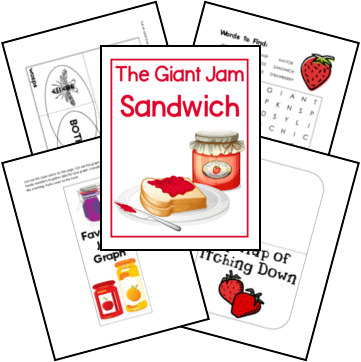
Itching Down Map minit book
Rhyme Time minit book
Prepared Venn Diagram
"Questions About Yeast"
minit book
"How to make a jam
sandwich" accordion book
Teamwork Matchbook
Problem-Solution Story Pocket
Recipe Pocket Template (this is not
included in the lessons/ideas)
You could also include a recipe pocket. If you make a yeast product
together, include that recipe on 3x5 card and put it in the pocket; you may also
want to include a recipe for strawberry jam, too. Make sure to include any
recipe you made together while studying this unit.
Page of Clipart (let your
student cut out the clips he would like to include in his lapbook); paste them
in blank spaces
Giant Jam Word Find (this is not
included in the lessons, just an extra)
SOCIAL STUDIES
Map Skills: Land of Imagination
If you've started a
Land of Imagination map to go along with your FIAR
studies, this would be a good time to pull it out and add Itching Down as a
location. Make a story disk (with a strawberry jam sandwich!) and place it
on your map. If you haven't made a land of imagination map, allow your
student some time to make a pretend map complete with islands, mountains, and
even train tracks if he desires. Make sure he adds a compass rose (North,
South, East, West) and labels Itching Down. He may even want to add a few
other pretend cities.
Another option would be to let your student make just a small map of Itching
Down and include it in your lapbook. Here is a
prepared minit book. Simply
cut out, fold in half and draw a map inside. Again, be sure to add a
compass rose.
Problem Solving
Discuss the problem in Itching Down (wasps!). How did the town people
solve this problem? (they held a meeting and asked for help).
Problem solving is an important life skill to possess. Discuss some
problems your family has encountered (maybe during a power outage or maybe
something as simple as when your child is trying to build a train track and
can't get the ends to connect) and how you used problem-solving skills.
You may also want to continue your discussion by determining other ways the
people of Itching Down could have solved their wasp problem-- have fun with
this!
Human Relationships: Community and Teamwork
Can your student remember some of the different ways the people worked
together to get rid of those pesky wasps? Could one man have done this job
alone? No way! Not even ten men could've done this job alone; it
took everyone working together including those who--
mixed ingredients to make the bread
dough (have your student count all the people who are on this page)
sewed a tablecloth
transported the loaf to the old brick
mill to bake
cut the slices of bread off the loaf
cheered others on
took the bread to Farmer Seed's field
buttered the bread
brought the jam
spread the jam
were in flying machines waiting to
lower the top piece of bread on the wasps
Use this prepared Teamwork Matchbook
for lapbooking. You may want to let your student write the definition, or
you may want to write down all the examples of teamwork from the story that your
student can remember.
LANGUAGE ARTS
Vocabulary List
pate- the top of the head
drove- to force
nuisance-
annoying or troublesome
hitch-
to catch, fasten, or connect by or
as if by a hook or knot
swell- to expand gradually beyond a
normal limit
"piping hot" - very hot
spoil- to damage
spade- a digging tool; like a shovel
whir-
to fly, turn, or move rapidly with
a buzzing sound
Prepared Vocabulary Crossword Puzzle
Rhyming Words and Listmaking
Ask your student if he notices anything special about this story and the way
it reads (it's written in couplets-- rhyming words at the end of two successive
lines). List some of the rhyming words and see if you can think of
MORE words that rhyme with those words. Have fun with this
Rhyming Dictionary.
If you'd like, extend your learning by completing this
Rhyme Time minit book. Cut out
the book as one piece. Cut out the title (Rhyme TIme). Fold the book
in half on the black line. Cut on the grey dotted lines to make
flip-flaps. Glue the title on the top. Ask your student to think of
words that rhyme with each word and let her write them in the book. For
example, "what rhymes with ate?" Open the flap and write a word that
rhymes. Continue until you are finished. Note: all the words
are found in the story, but you don't have to use the rhyming words from the
story.
Creative Writing: Problem-Solution Story
Encourage your student to write her own problem-solution story. First,
you will need to do a bit of brainstorming (answer the following questions):
1. What's the name of your town going to be?
2. Think of a pest (cockroaches, goats, mice, or even
peacocks or kangaroos!)
3. What is the problem with the pest? (this can
be realistic like it was with the wasps or ridiculous)
4. What is the solution going to be?
Once you have the above determined, your student is ready to write!
Fold your student's story like a letter (in thirds), and then fold it again in
half. Put it in your lapbook in this
Problem-Solution Story Pocket
ART
Perspective
Look at the illustration for, "They dived and hummed and buzzed and ate..."
Ask your student, "Which wasps in the swarm look like they are closest to you?
(the larger ones at the bottom of the page) Which ones look as if they are
far away? (the smaller ones at the top of the page) Artist make
things appear at different proximities by varying their size. As
your student creates illustrations, encourage her to use this same technique in
order to make things seem close or far away. Can your student find
other illustrations of the wasps in this book where the artist used perspective?
(Look at the one on the page that reads, "Suddenly the sky was humming!"
APPLIED MATH
Calendar Skills: Weeks/Years
At the end of the story it says, "And had a feast for a hundred weeks!"
Does your student know how many weeks is in a year? If not, teach him that
there are 52 weeks in a year. Then ask him, "How long did this sandwich
last?" You can go about the math in many different ways, but your
student should realize that it lasted at least one year. Did the sandwich
last two years (52x2= 104 weeks)...not quite, but almost!
SCIENCE
Wasps
(information from
ebeehoney.com and arizona.edu)
This story is all about the WASPS! Some of the most popular species
of wasps are mentioned below along with their defining characteristics.
Paper Wasps
Paper Wasp Coloring
Sheet
Yellow Jacket **I believe these are the type found
in our story**
Wasps Print-out (Enchanted Learning)
Your older student may also want to research Mud Dauber Wasps.
Wasp Stings
Normal reactions to stings includes pain, redness, itching and swelling at the
sting site. Ice, table salt, and products like Sting Kill® are helpful in
managing the symptoms. Symptoms can occur immediately after a sting, or may
take longer to appear. They last for several hours.
Benefits of Wasps
A few species pollinate plants and crops. Most eat pests such as flies
and caterpillars. Wasps should be left alone where they are if they are
not bothering people.
Venn Diagram or Chart Project
What are the major differences between bees and wasps? Your student may want to
make a Venn Diagram or chart comparing/contrasting the similarities and
differences in Honey Bees and Yellow Jackets (they look very similar).
Here is some Honey Bee information if your student would like to do this.
He could also research on his own to find out more (if he wants to make a chart
with Mud Daubers, Yellow Jackets, Paper Wasps, as well as different species of
bees.
Prepared Venn Diagram - Use this in
your lapbook or notebook (or as desired). Cut around the dotted grey
lines. Use the extra graphics around the sides to include in your lapbook
or notebook.
Honey Bees
Honey Bee Coloring
Sheet
Chemistry in the Kitchen: Baking Bread
(recipe from
www.allrecipes.com)
Mix 1/2 cup warm water (110 degrees F) with 1/3 cup white sugar and 1
(.25 ounce) package active dry yeast in a glass jar (so you can see the
action!). Leave it alone for 15 minutes then watch what is happening.
Do you see the bubbles? They are caused by gas-- since yeast is alive, it
can grow (when mixed with warmth, water, and sugar) and make the bubbles.
Yeast is the ingredient in dough that makes it grow (and grow!).
If you'd like to make some yummy bread (dinner rolls) continue on.
However, if your yeast mixture is not bubbling, do NOT continue on with the
recipe as your yeast isn't active (this happens sometimes when it's too old or
the water is too hot).
Add the yeast mixture, along with the rest of the ingredients to your bread
machine pan (if you don't have a bread pan, you can do things by hand); select
the dough cycle.
Sweet Dinner Rolls
1/2 cup warm milk
1 egg (room temperature)
1/3 cup butter, softened
1 teaspoon salt
3 3/4 cups all-purpose flour
When the cycle finishes, turn dough out onto a lightly floured surface.
Divide dough in half. Roll each half into a 12 inch circle and spread 1/4
cup softened butter over entire round. Cut each circle into 8 wedges.
Roll wedges starting at wide end; roll gently but tightly. Place point side down
on ungreased cookie sheet. Measure each roll and record your measurement.
Cover with clean kitchen towel and put in a warm place, let rise 1 hour.
Preheat oven to 400 degrees. Measure each roll again. What happened
to the rolls? Are they the same size? (record your answer if you are
going to use the minit book below) The yeast is causing them to
grow. Bake the rolls in the oven for 10-15 minutes, until golden.
After the rolls have cooled, break one apart. Do you see the small holes
inside? These are a result of the gas bubbles the yeast made.
After you complete this lesson, you may want to add the prepared
"Questions About Yeast"
minit book to your lapbook.
Your student will be asked to answer the following questions:
Why were there bubbles in the yeast, sugar, water mixture?
Why did the dough grow?
How much did the dough grow?
Why were there holes inside the baked rolls?
JUST FOR FUN
Make some strawberry jam! If the time of year is right, go strawberry
picking and come home and make some jam (you can find recipes on the Sure-Jell
box). Freezer jam is *very* easy. If it's not strawberry pickin'
time, you could always buy some frozen strawberries and make some jam.
Make sure you eat a bread, butter, and strawberry jam sandwich, too (perhaps on
homemade bread)! You'll find out why those wasps could not resist!
Teach your younger student how to make his own sandwich (it doesn't have to be a
jam sandwich); my five year old LOVES to make his own peanut butter and jelly
sandwich! :)
You can have your younger student explain to you the steps involved in making a jam sandwich. Record what he says in this Prepared "How to make a jam sandwich" accordion book. Instructions for assembly: Print file and fold in thirds (like a letter using the grey dotted lines as a guide). Cut around the template. Be very careful on the left side...do NOT cut through all the paper-- simply round off the corner(s) then only cut off the excess on the first piece without cutting on the fold. When you finish you should have a book that unfolds into three slices of bread (the first slice being your title page giving you two pages to record).