Affiliate Disclaimer
We sometimes use affiliate links in our content. This won’t cost you anything, but it helps us to keep the site running. Thanks for your support.
Learn more about deserts and the creatures who live there with our free Desert Animals Lapbook.
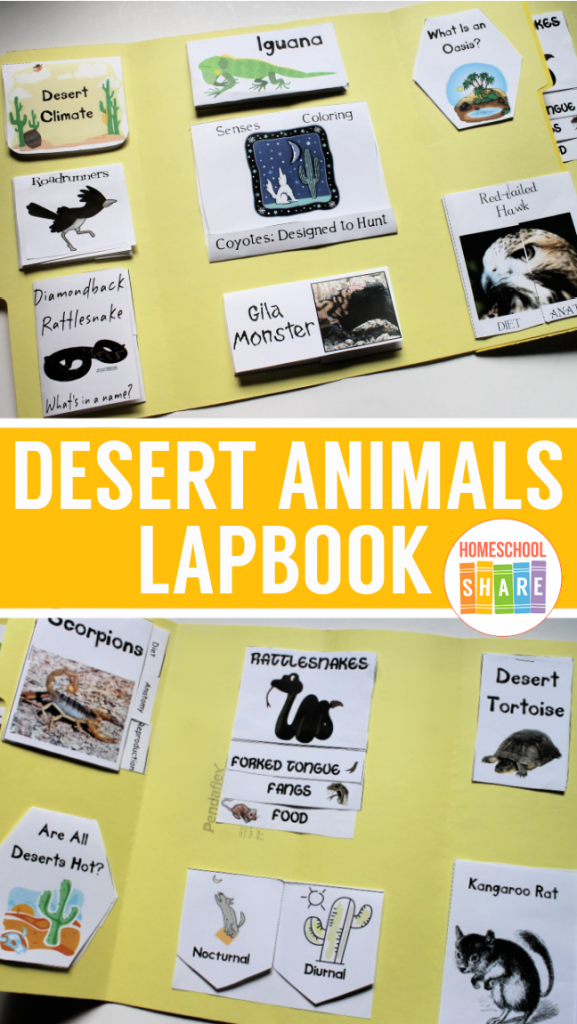
Thanks to Jodi Small for contributing this Desert Animals Lapbook to Homeschool Share.
Desert Animals Lapbook Lessons
Here are some sample lessons from the Desert Animals Lapbook:
Reptiles in the Desert
Gila Monsters
Gila Monsters are the largest lizards in the world and have venom that kill their prey. These nocturnal animals are usually eighteen to twenty-four inches long. Gila Monsters eat only meat – small mammals, birds, lizards and frogs. These poisonous lizards have round scales and have black and orange spots. Gila Monsters store fat in their tails, and then hibernate in the winter.
Desert Iguanas
Iguanas, a type of lizard, hibernate beginning early fall and are the last lizard to become active in the spring. They can grow up to sixteen inches long. The mother iguana will lay anywhere from 20 to 70 eggs, bury them in the sand, and leave them. When the eggs hatch, they catch their own food – insects – and live in nearby trees or brush. Some predators are birds of prey, foxes, snakes and people.
Western Diamondback Rattlesnakes
Diamondback rattlesnakes, named for their diamond-shaped pattern on their skin, are the largest snakes in the western US and may grow as large as six or seven feet long. They have a rattle at the end of their tails made up of flaps that make a buzzing noise when shaken. This rattling sound is a warning to enemies to stay away. The rattle is formed each time the snake molts, or sheds its skin.
Western diamondbacks live in southeastern California to central Arkansas and south to northern Mexico. They prefer dry, rocky areas. Although they hibernate in winter, they may occasionally wake up during when it’s warmer to warm up in the sun. They will usually return to the same den each year, and they usually hibernate in groups.
The diamondbacks forked tongue collects scents from the air and helps it to find its prey. Since they digest food very slowly, they need to eat only once every two to three weeks. They eat birds, rabbits, and rodents (mice), gophers, lizards, and other small animals.
Diamondbacks, like other snakes, have fangs which they use to inject venom into their prey. When the snake bites, the venom is pushed into the prey’s body with their fangs. The snake then lets it prey go, and after the venom has killed the animal, the snake finds it and swallows it headfirst.
Mother diamondbacks do not lay eggs. Rather, the babies grow inside her body for four to five months. She will have anywhere from six to twenty babies at a time. Babies are born without a rattle, but with venom.
Predators of diamondbacks are hawks, bald eagles, roadrunners, wild turkeys, coyotes, deer and foxes. But its worst enemy is the king snake. The king snake is immune to, or not affected by, the snake’s venom.
Desert Tortoises
The Desert Tortoise is an herbivore that can live 50 to 80 years. They spend most of their life underground in burrows to protect itself from the desert heat. They can survive as long as a year without water. When in danger of a predator, they can retreat into their hard upper shell. Their front legs have “armored” scales to be used for burrowing.
Females lay a clutch, or group, of 1 to 2 eggs, buries them with sand and leaves them. The temperature will determine whether the hatchlings, or babies, are male or female.
You can grab a copy of the entire Desert Animals Lapbook in an easy-to-print file at the end of this post.
Desert Animals Lapbook Printables
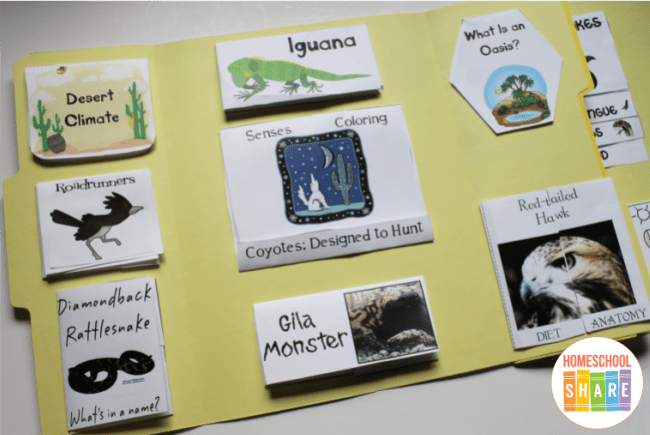
In addition to the lessons, the file includes these mini-books for your student to create a Desert Animals Lapbook:
- Coyotes: Designed to Hunt Matchbook
- Diamondback Rattlesnake Flap Book
- Desert Animals Cards & Pocket
- Nocturnal vs. Diurnal Flap Book
- Rabbit vs. Jackrabbit Venn Diagram Flap Book
- Tarantula Circle Book and Pocket
- Kangaroo Rat Matchbook
- Red-tailed Hawk Shutterfold Book
- Desert Questions Simple Fold Books
- Iguana Envelope Fold Book
- Rattlesnakes Layer Book
- Roadrunners T-book
- Scorpions Tab Book
- Gila Monster Flap Book
Desert Animals Book List
Grab some great books and read about deserts and desert animals together.
- One Small Square: Cactus Desert by Donald Silver
- Cactus Hotel by National Geographic Learning
- Deserts by Gail Gibbons
- Desert Giant: The World of the Saguaro Cactus by Barbara Bush
- Why Oh Why Are Deserts Dry? by Tish Rabe
How to Get Started with Your Desert Animals Lapbook
Follow these simple instructions to get started with the Desert Animals Lapbook.
- If you want, go to your local library and check out books about desert animals.
- Print the Desert Animals Lapbook.
- Choose and prepare the mini-books you want to use with your student.
- Enjoy a week of reading and learning all about the desert habitat and the animals who live there.
Desert Animals Lapbook Sample
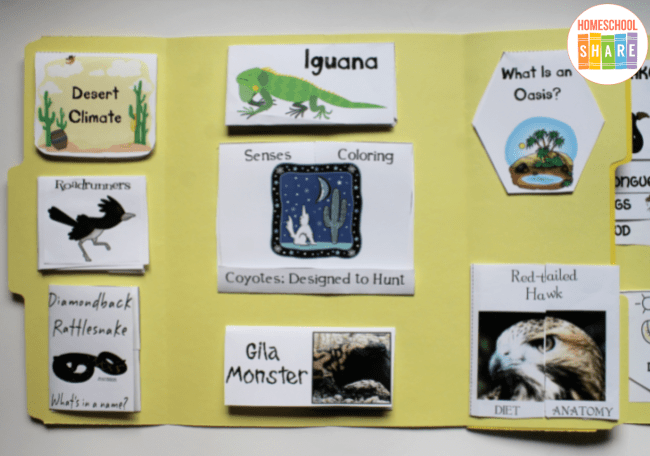
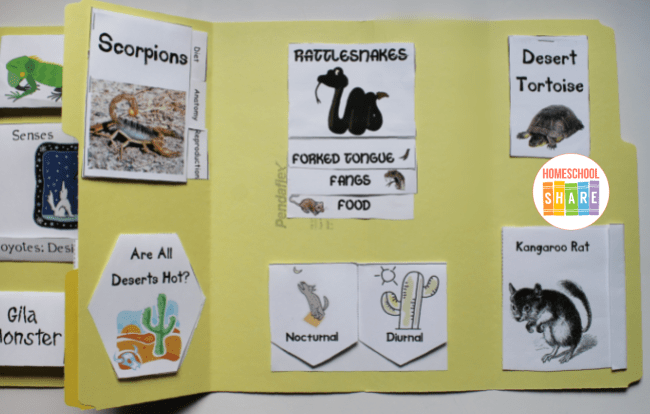
This sample lapbook was made with two file folders glued together. You can find more information here: How to Make a Lapbook.
Please don’t feel that you have to use every mini-book; pick and choose from the mini-books provided to best meet the needs of your student.
Download Your Free Desert Animals Lapbook
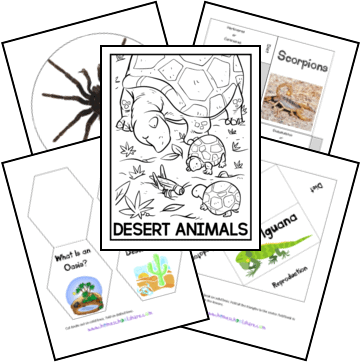
Simply click on the image below to access your free Desert Animals Lapbook.
Explore These Related Resources