| about us |
what's new
|
unit studies
|
unit study helps |
hss resources
|
fiar resources | indexes | lapbooking |
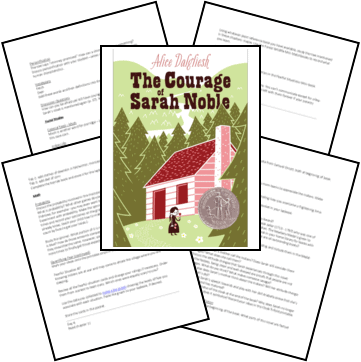
Courage of Sarah Noble
| Author:
Alice Dalgliesh ISBN: 0689715404 Unit prepared by Jimmie Lapbook prepared by Jimmie and Ami |
Lapbook Templates
Day 1
Read chapters 1-2
Language Arts
Alphabetical
Order
Alphabetize the names of the Noble children (Sarah and her siblings).
Do the same for the Robinson children. Use the Alphabetical Order Mini Book, if desired.
Vocabulary
Musket
Heathen
Savages
Mind (as in pay attention to)
Add these words and their definitions to moccasin shapes as you make a New Words book for your lapbook. When your book is completely finished, you can secure it by stapling on the left side.
Discussion Questions
Why would Sarah ask her dad to talk to her at night?
Why would it be hard to take the baby on the long journey to CT?
What is Sarah’s dad thinking or feeling on p. 5?
In the Robinson home, why does Sarah want to keep her cloak? (Is it really because she’s cold as she says?)
Later, why does Sarah ask for her cloak?
Why are the Indians called “heathen savages?” What does this mean?
Social Studies
Thirteen Colonies
Label all 13
colonies on a map. Make a line from MA to CT, the route that Sarah and her dad
took. Find printable
maps here.
Transportation in Colonial America
Transportation in Colonial America was very simple. There were few roads. Mostly people traveled on Indian paths by foot or by horseback. Later stage coaches were used by the wealthier colonists. Traveling was therefore slow, uncomfortable, and dangerous. Most colonists never traveled farther than their own communities.
Perceptions of Native Americans
Notice how the Indians are thought of by Sarah and her father. Discuss with your child the prejudices and stereotypes that existed. Indians were thought to be savages, barbarians, and inferior to Europeans. Indians were called red men because of their dark, ruddy skin. Many of the judgments made about Indians were simply the result of cultural differences in ways of living (dress, food, communication, etc.) Discuss with your child that different ways of doing things does not mean different cultures are bad or wrong. It just means they are different.
Science
Woodland Animals
Using whatever animal reference book you have available, study the woodland
animals mentioned in these chapters: owl, fox, and wolf. Use the
Forest
Wildlife Mini Matchbooks to record what you learn about each animal.
Math
Quantifying Fear
How can you quantify or measure something abstract like a feeling? It’s very subjective, but we can assign a value to levels of feelings.
Example -- How I feel about spinach:
1 = I love it and could eat it every day.
2 = It’s okay, but I wouldn’t ask for it.
3 = I don’t like it at all. It is disgusting.
Using a scale like this, you could measure your family’s feelings about spinach and even make math problems with those measurements.
Throughout this book, Sarah experiences fearful moments. Put yourself in her shoes, and assign a value to how scared you would feel. Mark your ideas onto the printable strips in the Fearful Situations Minibook. Use pencil because you may want to change your answers as you read the other fearful moments.
Fearful Situation #1: Sleeping outdoors in the woods with your dad while
hearing animal noises.
Fearful Situation #2: Sleeping on a quilt on the floor of an unfriendly home
with mean children.
Day 2
Read chapters 3-4
Language Arts
Vocabulary
Solemn
Add this word and its definition into the vocabulary minit book.
Discussion Questions
How is this night’s conversation about the night noises different from the night they slept outdoors in chapter 1?
“No love in that house”-- what does it mean?
“Too wise for your years” --what does it mean? What is her dad saying about her opinion of the Robinson home?
What are John Noble’s ideals for his home?
Social Studies
Log Cabins in Colonial America
Swedish immigrants were actually the ones who first introduced the log cabins to America. English settlers mostly lived in wattle and daub homes made from thin wooden boards The inside walls were filled in with wattle, a woven network of thin branches and saplings. Then the wattle was covered with daub -- clay, with added sand and straw (and sometimes animal dung). Daub insulated the houses against the long, cold New England winters. Source
Colonial Cooking and Meals
Cooking was always done over a fire. And since many families only owned one cast iron pot, they usually prepared one-pot meals such as bean porridge, soups, grain porridges. Often porridge was made from hominy (made from corn) and flavored with pork and vegetables. This basic diet of soups was supplemented with whatever meats, fruits, and vegetables they could raise or find.
Johnny cake is cornbread cooked over a fire.
(From Wikipedia – “the origin of the name is unclear, possibly from 'journey cake' as a bread easily prepared by travelers, or as a corruption of 'Shawnee cake', or based on a forgotten Indian word. “)
Fun for mom--
http://digital.lib.msu.edu/projects/cookbooks/html/books/book_01.cfm
American Cookery By Amelia Simmons (1798)
You can try your hand at cooking colonial food with some of the ideas found here:
Add your findings about colonial cooking in the Colonial cooking three fourths minibook template. Draw pictures, copy recipes, or write text. Save some room in the minit book for notes about corn (see lessons in day 3).
Science
Woodland Animals
Continue with the project from Day 2. Using whatever animal and plant
reference books you have available, study the woodland animals & trees mentioned
in these chapters: deer, birches, firs, woodchuck, and skunk. Use the Forest
Wildlife Mini Matchbooks to record what you learn about each animal and tree.
Deer
Birches
Firs
Woodchuck
Skunk
Math
Quantifying Fear
(continued)
Mark
your ideas onto the printable strips in the Fearful Situations Minibook.
Fearful Situation #3
Sleeping in a cave and hearing animal noises outside.
Day 3
Read chapters 5-6
Language Arts
Vocabulary
Palisade
Mortar & pestle
Add these words and their definitions into the vocabulary minit book.
Discussion Questions
Why would Sarah not admit she did mind staying alone while her dad built the house?
Why does Sarah get her cloak?
Sarah calls the Indian children foolish. Why? Would you call them foolish for this? Why or why not?
How would it make you feel if someone thought your name was too long or too hard to say and gave you a foreign sounding name instead?
How does Sarah’s relationship with and attitude towards the Indian children change in chapter 6?
Bible
What is the scary part of the story of Isaac? Look it up and read about it in Genesis 22.
Social Studies
Colonial Meals ~ Corn
Corn was a staple food all over North America. Corn is native to the Americas. It, along with beans and squash, make up what the Iroquois called “The Three Sisters” – the foundation of the Indian diet. Naturally the colonists learned about corn from the Indians already living in America. It became a mainstay of their diet as well. Dried corn could be stored through long winters when no crops could be grown. The dried corn was ground into cornmeal and used in various ways – to make hominy porridge, to make Johnny cake, etc. (When Benjamin Franklin lived in London, he had his wife mail him sacks of cornmeal because he missed it so much!)
The Indians also used all parts of the corn plant. The husks could be braided and woven to make masks, moccasins, sleeping mats, baskets or cornhusk dolls. Corncobs could be used for fuel, for game darts or for ceremonial use.
Add your findings about corn in the Colonial cooking three fourths minibook template. Draw pictures, copy recipes, or write text.
Lifestyle of Indians
Use the Indian lifestyle top tab book template to record Indian life as portrayed in the book.
Tab 1. home
Record what you learned about the Indians’ birch bark homes on this page.
Tab 2. clothing
Record what you learned about the Indians’ clothing on this page. (Leave room for Days 4 & 5.)
Math
Quantifying Fear
(continued)
Mark
your ideas onto the printable strips in the Fearful Situations Minibook.
Fearful Situation #4
Being home alone with Indians nearby.
Fearful Situation #5
Being surrounded by Indian children, all staring at you.
Day 4
Read chapters 7-8
Language Arts
Personification
The text says “chimney promised.” How can a chimney promise something?
Discuss personification with your student—when an inanimate object is given
human characteristics.
Vocabulary
Fetch
Dear
Add these words and their definitions into the vocabulary minit book.
Discussion Questions
How can you be afraid yet still have courage?
Sarah’s cloak is mentioned again (p. 37). Why? What does the cloak symbolize?
Social Studies
Colonial food – Mush
Mush is another word for porridge – a soupy mixture usually made from a grain, in this case corn.
Indian Life
Record Indian life facts in the top tab book
Tab 2. Clothes – (add) no night clothes
Tab 3. Diet – no plates; used hands (leave room for Day 5’s information)
Tab 4. Religion – Great Spirit
Bible
Is it okay to pray for a horse? For Indians? For people of other cultures, lands, faiths?
Is Christian prayer to God through Jesus the same as Indian prayer to the Great Spirit?
Consider these verses – 1 Tim. 2:5 and Acts 4:12.
Science
Maple Trees
Using whatever plant reference book you have available, study the tree mentioned in these chapters: maple. Use the Forest Wildlife Mini Matchbooks to record what you learn.
Math
Quantifying Fear
(continued)
Mark
your ideas onto the printable strips in the Fearful Situations Minibook.
Fearful Situation #6
Being left with friends of another culture. You can’t communicate except for a few words and signals. You possibly could be left with them forever if your parents encountered trouble and did not return.
Day 5
Read chapters 9-10
Language Arts
Vocabulary
Outlandish
Charming
Tiresome
Petticoats
Add these words and their definitions into the vocabulary minit book.
Discussion Questions
Sarah sleeps with her cloak (p. 43). Why?
Why must Sarah change into her dress and petticoat?
What was her mom’s attitude towards the moccasins? What would’ve happened if Sarah wore her deerskin clothes?
Social Studies
Indian Life
Indians top tab book
Tab 2. add clothes of deerskin in fall/winter, moccasins
Tab 3. add diet of corn
Complete the top tab book and store it for the lapbook.
Math
Probability
Discuss the probability involved in the moccasin game.
What is probability? What other games do you play that involve probability? (Yahtzee, for example-- you may even want to play it today.)
Experiment with probability. Make the spinner provided on the template. Spin it 36 times and record your outcomes on the graph provided. (If your child doesn’t already know, teach your child how to make tick marks counting up to fives. Then count by fives to get your totals.)
Study the spinner. What portion of it is red? What portion is yellow? What portion is blue? How do those amounts compare to your spinning results? Theoretically, they should be the same. However, you may have to keep spinning many, many more times to finally get those expected numbers.
Quantifying Fear
(continued)
Mark
your ideas onto the printable strips in the Fearful Situations Minibook.
Fearful Situation #7
Knowing Indians are at war and may come to attack the village where you are sleeping.
Review all the
fearful situation cards and change your ratings if necessary. Order them from
scariest to least scary. Which ones were equally scary to you?
Use the data you collected to
make a bar graph showing the levels of fear you associate with each
situation. Paste the graph to your lapbook, if desired.
Store the cards
in the pocket.
Day 6
Read chapter 11
Also read author’s note and quote from Samuel Orcutt, both at beginning of book.
Language Arts
Writing
Write a short story in which Sarah’s mom learns to appreciate the Indians.
Make her attitude change as Sarah’s did.
Or
Write a “When I
had Courage” story, telling how you overcame a frightening time.
Store your completed assignment
in a pocket in your
lapbook.
Newbery Award
Who is
John Newbery? What is a Newbery Award?
He was an
American book publisher and book seller (1713 - 1767) who was one of the first
to market books especially for children. The Newbery Medal is given to
outstanding American books for children. Look in your home library for books
with the Newbery Medal? Do you agree that these are all outstanding books?
Make a list of reasons why this book is outstanding and include them in the
Medal Shape Book.
Discussion Questions
What does Sarah’s mother call the Indians? Does Sarah still consider them savages? What does she call them?
Discuss the attitude changes that Sarah experiences through this novel.
To the Nobles, being clean and well dressed are proofs that people are not savages. What do you think? What makes someone savage?
What else does Sarah’s mother think about the Indians? Will her attitude change like Sarah’s did?
How does Sarah’s speech towards and play with her doll Arabella prove that she’s both a girl and has matured?
What is the status of the cloak at the end of the book? Why does Sarah no longer need it? What does it symbolize? Record your ideas in the Cloak Trifold printable.
Genre: Historical
Fiction
Read
the notes at the beginning of the book. What parts of this novel are factual
and which are created by the author? This kind of book is called historical
fiction. What other books have you read that are historical fiction?