| about us |
what's new
|
unit studies
|
unit study helps |
fiar resources
|
indexes | lapbooking |
Cooking Unit and Lapbook
Created by Wende and Ami
Recipe Book Suggestions
Better Homes and Gardens New Junior Cook Book (ISBN 0-696-011476)
Kitchen Fun, A Cook Book for Children by Louise Price Bell (ISBN 0-517-66927-7)
Rookie Cookie Cookbook by Betty Debman (ISBN 0-517-16246-6)
Fun Foods for Fussy Kids by Mumu Bienenstock and Mimi Bloch (ISBN 1-4027-0597-2)
Go Along Suggestions
Homer Price by Robert McCloskey
The movie Ratatouille
Encyclopedia Brown Takes the Cake! by Donald Sobol
Little Nino’s Pizzeria
Night of the Moonjellies
Duchess Bakes a Cake
Gregory the Terrible Eater by Mitchell Sharmat
The Seven Silly
Eaters by Mary Ann Hoberman
Mr. Twigg’s Mistake
by Robert Lawson
Lapbook Components
Introduction – Safety First
Cooking is a skill that should be learned and enjoyed by both boys and girls. In our fast paced, convenience driven society, cooking from scratch has almost become a lost art. It intimidates many to even think of preparing a meal that isn’t poured out of a box or grabbed from the freezer. Hopefully this unit will help children to learn early on that cooking is nothing to fear, and a great way to contribute to a happy, healthy family. Use these lessons as an ongoing home-economics program, taking on a lesson or two a week, or use them as a single unit, doing a lesson a day. While this unit was written for an 8 and 11 year old, some lessons can be toned down for younger children and others may be better suited for grades 4+, making this a unit the whole family can enjoy.
There are a few basic rules that need to be followed for a safe cooking experience. Discuss these with your child, demonstrating as needed. Older children can use rules for copywork or dictation in Kitchen Rules Mini Book.
Food-Borne Illness
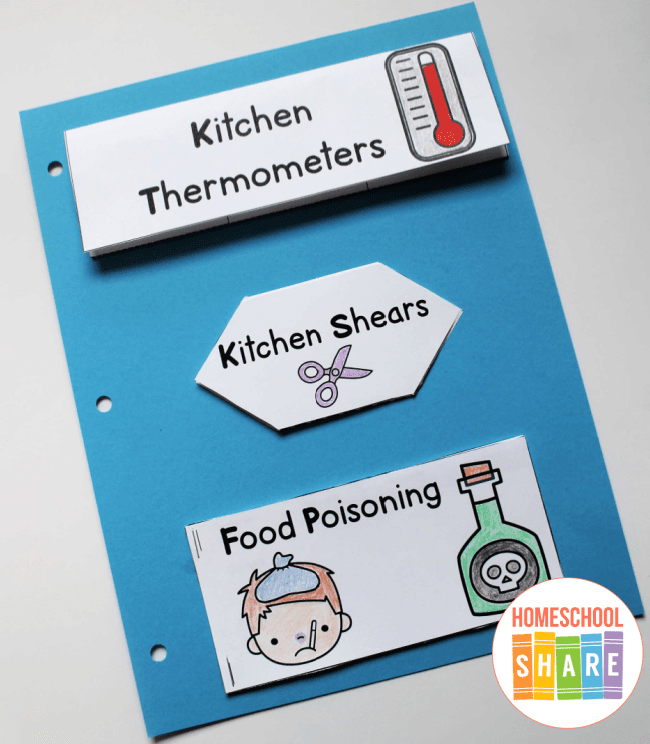
A food-borne illness is a disease transmitted by food. You may have heard on the news of food being recalled due to cases of food poisoning. Food poisoning is caused by bacteria, parasites, protozoa (one-celled animals), and/or viruses. The symptoms of food poisoning can include vomiting, diarrhea, severe abdominal pain, fever, headache, and even death. It is important to learn about these diseases before you start cooking so you can properly prepare food that won’t get anybody sick.
Bacterial Poisoning – Proper and thorough cooking will kill most harmful bacteria, but food that is not properly cooked, is left out at room temperature after being cooked, or is touched by contaminated hands or utensils can have unsafe levels of harmful bacteria. The most common food poisonings are botulism, E. coli infection, and salmonella. Botulism is found in improperly processed canned goods. Never use anything from a bulging can or that has a funny smell. E. coli infection is caused by undercooked ground beef, raw milk, contaminated water, or vegetables grown in cow manure. Salmonella is a bacterium found in poultry, red meats, eggs, dried foods, and dairy products that are not properly cooked and handled.
Parasite Poisoning – Pork products sometimes have a parasite causing a disease called trichinosis. You can prevent this disease by thoroughly cooking all pork products to an internal temperature of 160 degrees.
Protozoa Poisoning – Protozoa poisoning is not very common in this country. Drinking polluted water or eating vegetables that are grown in polluted soil causes Amebiasis and Giardiasis. Making sure your water is purified can prevent these diseases.
Viral Poisoning – Raw or undercooked shellfish such as oysters and clams can transmit a viral disease called hepatitis A. This virus comes from shellfish that are in contaminated waters. The disease can be prevented by thoroughly cooking all shellfish.
A cook should wear a clean apron to protect his/her clothes, and to keep dirt and germs moving from clothes to food. It is helpful if there are roomy pockets in the apron to hold utensils as needed. A cook’s hair should be pulled back or covered. This will help to prevent hair from getting in food, and also protect hair from getting caught in appliances. A chef wears a chef coat and a hat called a toque. It is important that a cook has clean, injury-free hands. Make sure fingernails are scrubbed as many germs hide under them. If a cook has any cuts or scratches on his hands, he should wear protective gloves. This is to protect both the food others will be eating and the injuries, which are subject to infection when in contact with raw meats and such.
Make or buy an apron and/or a chef’s hat for your student.
Take photo and glue in Dressing the Part Simple Fold, or use book to record information.
Optional Books:
Read Homer Price by Robert McCloskey. Discuss the different appliances, tools, and bake ware used throughout the book.
Take a walk through your kitchen and name all the appliances, both small and large. Appliances are usually electric and they make our jobs easier. Some of course will be obvious, such as the refrigerator, stove, oven, and microwave. Do you know the difference between a blender and a mixer? How about a grinder and a food processor? Do you have a bread machine, toaster, crock-pot, juicer, or electric griddle? These are all appliances that you might use as you learn to cook. Choose one appliance to study further. Look at the owner’s manual and name all the parts (most owners manuals can be found on line if you don’t have it handy). Research when it was invented and who first invented it. How did it change over the years? How did it make lives easier?
Familiarize your child with various kitchen tools and their uses. It may be fun to visit a kitchen store, or attend a Pampered Chef party looking at all the different tools available, or visit an online store such as Amazon. Identify and demonstrate the tools you use most commonly in your kitchen.
Measuring Tools – There are three basic kinds of measuring tools that you will need to accurately measure liquid and dry ingredients. Liquids of a ¼ cup or more are measured with a clear glass or plastic measuring cup with a handle, pouring spout, and clearly marked measurements. They are commonly available in 1 cup, 2 cup, or 4 cup sizes. Liquid and dry ingredients less than ¼ cup are measured with measuring spoons. Measuring spoons are metal or plastic and usually come in a set of four – ¼ teaspoon, ½ teaspoon, 1 teaspoon, and 1 tablespoon. In recipes you will see teaspoon abbreviated tsp or t, and tablespoon will be abbreviated tbs or T. Three teaspoons equals one tablespoon. The last kinds of measuring devices are measuring cups. These also commonly come in a set of four – ¼ cup, ½ cup, ⅓ cup, and 1 cup and are made of metal or plastic. Measuring cups are used to measure dry ingredients such as flour or sugar, as well as peanut butter and shortening. Sometimes you will come across a recipe that calls for a “dash” of something. A dash is a very small amount, like a sprinkle.
*Math connection – It is important to have a good understanding of fractions when cooking and baking. How many of the smallest measuring spoons would equal the largest measuring spoon? How many of smallest measuring cup would equal the largest measuring cup? If a recipe calls for 1-½ cups of flour, but you need to double the recipe, how much flour will you need? Make up your own word problems to review fractions. Young children love to play in water and can empty cups and spoons into each other to understand basic fraction principles.
Mixing Tools – Just about every recipe requires you to mix something. Learn to use the correct tool for the job. Mixing should be done in an adequately sized mixing bowl, preferably with a loop to hold on to. A wooden spoon is a good mixing tool for most jobs. They come in various sizes and shapes, they don’t scratch pan surfaces, and the handle stays cool. If you need to remove pieces of food from liquid, use a slotted spoon. If you are mixing something thick, use a heavy metal spoon. A rotary beater will beat, blend, and mix air into foods. A whisk is also used to incorporate air into foods and should be used to whip eggs, soufflés, and meringues. A whisk will also help prevent lumps in sauces and gravies. Most chefs prefer a whisk to a rotary beater.
*Activity – Get out five bowls, and each of the five mixing tools we discussed. Crack an egg into each bowl and scramble each one with a different tool. Cook each egg in a frying pan separately and chart your findings. Which egg was the fluffiest? Which egg was a consistent color throughout? Which egg tasted the best? Which tool was the best one for the job?
The Egg-sactly Correct Tool for the Job Graph Fold
Baking Tools – There are a few special tools that
will come in handy when you are baking. A sifter is used to combine dry
ingredients and remove lumps from ingredients such as flour or powdered sugar. A
pastry blender has several thin, curved metal pieces attached to a handle. It is
used to cut shortening into flour to make pastry. A pastry brush is a handy tool
to brush butter or sauces onto food. A rolling pin is used to roll out dough or
pastry. A variety of spatulas are needed for baking. A bent edged spatula is
used to remove cookies from a tray, or to turn pancakes, fish, or eggs. A
straight edged spatula is used to spread cake icings and to level dry
ingredients when being measured. A flexible rubber spatula is used to scrape
bowls and to fold ingredients into each other. Locate and identify each of these
tools in your kitchen.
Baking Tools Fan Book
Cutting Tools – Cooking often includes lots of cutting. There are specific tools to complete specific cutting jobs. One of the most important tools is a sturdy, non-porous cutting board. A very handy cutting tool is a pair of kitchen shears. They can be used to snip herbs, trim vegetables, and cut meat and/or dough. A peeler is also a necessity in every kitchen. They are used to remove the outer skin of fruits or vegetables, leaving the nutrients near the surface in tact. Peelers are also used to make pretty garnishes out of chocolate, carrots, or cheese. A shredder-grater is used to shred and grate foods such as cheese. They are made of metal, and usually have four sides with different size openings. There are many other cutting, slicing, and chopping gadgets on the market. Does the cook in your house have a favorite? No kitchen would be complete without a good set of knives. There are many different knives for various cutting tasks. Knife blades can be smooth or serrated (saw-toothed). The knife handle should fit comfortably in your hand, and the highest quality knives have hardwood handles. The most popular knives are chef knife (also called a French Knife), utility knife, slicing knife, and paring knife. The chef knife is a large knife that is used to cut, chop, and dice fruits and vegetables. A utility knife is a good all-purpose knife that can be used to cut up vegetables and cheese, or to trim fat off of meat. The slicing knife has a serrated blade and is used to cut meat, poultry, bread, and soft vegetables such as tomatoes. A paring knife is the smallest knife, and is used to peel fruits and vegetables.
Miscellaneous Tools – There are a few more tools that will round out a
well-equipped kitchen. Kitchen forks are used for turning or transferring meats
or poultry. Tongs are handy for handling food such as corn on the cob,
hard-boiled eggs, and baked potatoes, and are used for turning meats. Ladles are
like deep round cups on the ends of long handles. You use a ladle for dipping
and pouring things such as soups, sauces, gravies, or salad dressings. A baster
is a bulb at the end of a tube that uses suction to collect and move juices from
meat and poultry. A colander is a perforated bowl with heatproof handles that is
used to drain pasta, fruits, or vegetables. A strainer is like a colander except
it only has holes on the bottom, and is also used to drain foods. Other
miscellaneous tools could include a nutcracker, egg separator, juicer, potato
masher, pasta fork, etc. Review tool names and uses using
Cookware is items that are used on top of the stove. They include pots, pans, skillets, double broilers, and griddles. Cookware is made of metal, ceramic, or sometimes glass, and should distribute heat evenly and be easy to clean. Saucepans generally have one handle and pots have two handles, and they should all have fitting lids.
A double broiler is a smaller pan that fits into a larger
pan. Water is boiled in the bottom pan to cook the food in the top pan.
A skillet has a wide bottom and low sides, making it easier to stir foods that
need a lot of cooking surface.
A griddle is a variation of a skillet, but without sides. A griddle is used for grilling sandwiches, or making foods like pancakes or French toast. When purchasing cookware, look for items that are well made, easy to handle, and easy to store.
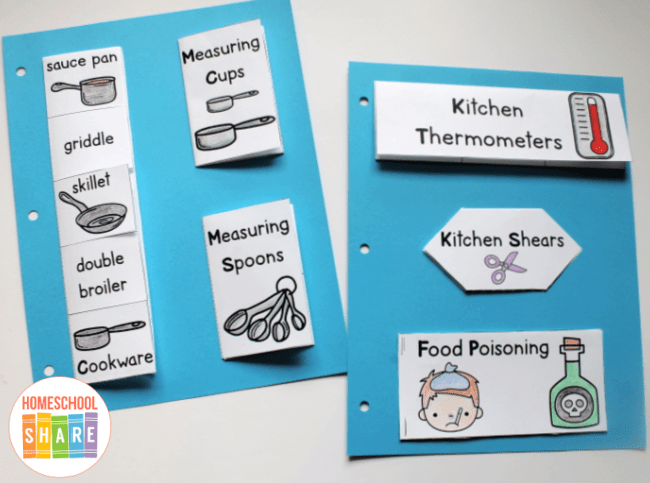
Kinds of Cookware Accordion Flap
Bake ware
Bake ware is items that are used in the oven. They include cookie sheets, cake pans, bread pans, muffin tins, pie plates, casseroles, and roasters. Bake ware is made of metal, glass, stoneware, ceramic, or even plastic. An important thing to consider when using bake ware is whether it has a dull or a shiny surface. A dull surface absorbs heat and the food baked on it will have darker, crisper crusts. A shiny surface reflects heat and the food baked on it will have softer, lighter crusts. When purchasing bake ware, look for items that are well made, easy to handle, and easy to store.
What's the Difference- Shiny/Dull Bakeware
Unit Review Activities
~Finish any incomplete lapbook components.
~Visit an appliance store. Compare prices and features of various models. Narrate your findings.
~Visit a professional kitchen such as a restaurant or technical school and compare their equipment to your home kitchen equipment.
~Make a list of kitchen tools, cookware, and bake ware that a person would need if moving to their first house. Visit a department store or Amazon.com to see how much it would cost to equip a new kitchen.
~Start or add to hope chest, including whatever kitchen tools you can afford.
Unit 2 – Why We Eat and the Food Pyramid
Optional Books:
Gregory the
Terrible Eater
by Mitchell Sharmat (early elementary)
Seven Silly Eaters by Mary Ann Hoberman
Mr. Twigg’s Mistake by Robert Lawson (fun chapter book about a box of cereal that accidentally had too many vitamins in it and the pet mole that ate it)
Do you know why we eat? Well, one reason is that it tastes good! Another reason is that it is a social event, with people gathering together for thousands of years to share meals and each other’s company. But there is another important reason too. Our bodies were designed by God to need fuel in the form of food so that all our organs and systems can work efficiently. The kind of fuel you put in your body is as important as the fuel you put into a car. While you can fill up the tank with any kind of liquid, it won’t necessarily run right, will it? Our bodies are the same way. If you fill them up with the wrong fuel, your hair and nails won’t grow correctly, your blood won’t circulate properly, your injuries won’t heal like they should, and your brain won’t function to its full potential. The foods we choose to eat should be full of nutrients that our bodies can break down and use to keep us healthy. No one food contains all the nutrients we need to be healthy, so it is important to include a lot of different foods in our diets. There are six main kinds of nutrients. We will discuss each one and its importance in our diets.
Eating a Variety of Foods Circle Book
Nutrients Tab
(record sources and functions of each)
Protein – Proteins are made of building blocks called amino acids. Proteins are found in meat, poultry, fish, milk, eggs, beans, nuts, and soy products. When we eat proteins from these plant or animal products, our bodies break the proteins down into its amino acids, and then convert the amino acids back into the kinds of proteins that our bodies need for specific functions. Proteins help to build up our hair, bones, muscles, fingernails, teeth, liver, and brain. They help to fight off germs, and help you to breathe and digest your foods. It is especially important to have a high protein breakfast to replenish the amino acids your body used while you were sleeping. What would a high protein breakfast include?
Minerals
– Minerals
are naturally occurring elements that are found in the earth. Animals eat plants
growing in mineral rich soil, so we obtain the minerals needed by eating both
the plants and animals. They are needed by our bodies for healthy blood, bones,
and teeth. They help our blood to clot, our muscles to work, and help our blood
carry oxygen from the lungs to the rest of the body. There are about 20
different kinds of minerals that our body needs. They are broken down into two
groups.
|
Macro (Bulk) Minerals |
Micro (Trace) Minerals |
|
Calcium Magnesium Sodium Potassium Phosphorus |
Zinc Iron Copper Manganese Chromium Selenium Iodine Boron Silicon Sulfur Vanadium |
Look at the nutritional labels on cereal or pasta boxes. How many bulk minerals can you find? How many trace minerals can you find? Locate all the minerals on a table of elements.
Fiber – Our bodies need fiber, which is a nutrient that can’t be digested. Fiber helps food to pass through the digestive tract, taking toxic substances with it. If the body did not excrete these toxic substances, disease would result. Fiber is found in whole foods such as fruits and vegetables, nuts, seeds, and whole grains.
Carbohydrates – Carbohydrates are the body’s chief source of energy. There are two kinds of carbohydrates, simple and complex. Simple carbohydrates, such as sugars, candy, jams, jellies, pastries, and syrups, are not good for us and should be kept to a minimum in our diets. They cause us to feel tired and we lose our ability to think properly due to lack of oxygen to the tissues. Complex carbohydrates, which are found in fresh fruits and vegetables, beans, pastas, and natural whole grains, give our bodies a constant flow of energy as compared to the short lived “rush” of simple carbohydrates. Unused carbohydrates will turn to fat to keep our bodies warm.
Vitamins – Our bodies need vitamins, found in foods in small amounts, to grow, heal, and stay healthy. There are many different vitamins, each doing an important job. The scientists that discovered them name vitamins, the very first ones were given letter names in the order they were discovered. Let’s discuss some of the vitamins and their specific functions:
|
Vitamin |
Needed for: |
Found in: |
|
A |
Eyesight Hair, teeth and bone formation Smooth skin Boosts immune system |
Fish liver oils, and green and yellow fruits and vegetables including apricots, broccoli, cantaloupe, carrots, dandelion greens, kale, peaches, sweet potatoes, pumpkin, etc. |
|
B1 (Thiamine) |
Helps convert food to energy Keeps nervous system healthy |
Dried beans, brown rice, egg yolks, fish, peanuts, peas, pork, poultry, and whole grains. |
|
B2 (Riboflavin) |
Helps convert food to energy Red blood cell formation |
Beans, cheese, eggs, fish, meat, milk, poultry, spinach, and yogurt. |
|
B3 (Niacin) |
Healthy digestive system Healthy skin Good circulation |
Beef, broccoli, carrots, cheese, eggs, fish, milk, pork, potatoes, tomatoes, whole wheat. |
|
B5 (Pantothenic Acid) |
Helps convert food to energy |
Beans, eggs, salt-water fish, pork, fresh vegetables, whole wheat. |
|
B6 (Pyridoxine) |
Formation of blood cells Helps nerves work properly Proper brain function |
All foods contain small amounts of B6. Highest contents found in carrots, chicken, eggs, fish, peas, spinach, walnuts, wheat germ |
|
B12 (Cyanocobalamin) |
Helps production of blood cells Keeps nervous system healthy Proper digestion |
Blue cheese, cheese, clams, eggs, herring, milk, seafood, tofu. |
|
Folic Acid |
Production of blood cells Especially important to women of childbearing age to prevent birth defects |
Broccoli, asparagus, leafy greens, legumes, yogurt, strawberries, bananas, whole grain cereals |
|
C |
Healthy bones and teeth Helps wounds heal Healthy blood vessels Smooth skin |
Green vegetables, berries, citrus fruits, tomatoes, sweet peppers |
|
D |
Healthy bones and teeth
|
Natural sunlight, fish liver oils, salt-water fish, dairy products with it added, eggs, oatmeal, sweet potatoes |
|
E |
The production of blood cells The production of muscle |
Cold pressed vegetable oils, leafy greens, whole grains, nuts, seeds, legumes, eggs, wheat germ |
|
K |
Healthy bones Helps clot the blood |
Alfalfa, broccoli, leafy greens, soybeans, cabbage, egg yolks, oatmeal, rye, wheat |
Fats – Fats give energy like carbohydrates, and also help the body grow. Some amount of fat is needed in our diets, but too much is not healthy. If our bodies don’t use all the fat we consume, it will lead to health problems. And if we don’t eat enough fat, we won’t thrive. Some fat we can see in our foods and other you can’t. Visible fats are butter, margarine, or the fat you can see on cuts of meat. Invisible fats are those found in eggs, whipping cream, avocadoes, and baked products. Older children can research the difference between saturated, unsaturated, monounsaturated, and polyunsaturated fats.
As you get ready to prepare your menus, keep all these nutrients in mind to make healthy, balanced meals.
Another way of monitoring your diet is to see how it checks out against the Food Pyramid. The food pyramid divides all the nutrients we need into different food groups, and tells you how many servings of each you might need to be healthy.
Discuss the food pyramid and the recommended servings from each of the food groups.
|
Number of Daily Servings |
Food Group |
Nutrients Found in These Foods |
Foods Included |
|
6 to 11 Servings |
Grain Group |
Carbohydrates, B vitamins, minerals, fiber |
1 slice of bread ½ cup cooked rice or pasta ½ cup cereal |
|
3 to 5 Servings |
Vegetable Group |
Lots of vitamins, fiber, carbohydrates, calcium, iron, magnesium, proteins |
½ cup chopped raw or cooked 1 cup of leafy greens |
|
2 to 3 Servings |
Fruit Group |
Vitamins, especially A, C, and D, carbohydrates in the form of fructose, fiber. Bananas have a mineral, potassium. |
1 piece of fruit ¾ cup of juice ½ cup canned fruit ½ cup dried fruit |
|
2 to 3 Servings |
Dairy Group |
Minerals including calcium, vitamins A and D, protein |
1 cup milk or yogurt 1 ½ to 2 ounces cheese |
|
2 to 3 Servings |
Meat Group |
Protein, minerals, B Vitamins, especially B12 |
2 ½ to 3 ounces cooked lean meat, poultry, or fish 1 egg ½ cup cooked beans 2 Tbs. peanut butter |
|
Use Sparingly |
Fats, Oils, Sweets |
Fats |
Candy, chips, cakes, cookies, etc. |
1. Complete lapbook components.
2. For one complete day, record all the food that you consume. Then compare your daily food intake to what is recommended. Are there any areas that need to be improved? Keep this in mind as you plan out your menus. Add a food pyramid print-out to your lapbook.
3. List the six basic groups of nutrients.
4. Make a set of nutrient flashcards. On one side write the nutrient name, and on the other side its functions. Quiz yourself or sibling using the cards.
5. Look through your pantry and find foods rich in each of the six nutrients.
6. Young children can build a food pyramid by cutting pictures of food out of magazines and gluing to a large triangle.
7. Have you ever taken a vitamin supplement? Why or why not?
8. How can a vegetarian avoid B12 deficiencies?
9. Older children can research individuals that contributed to the advancement of vitamins. Examples are Kanehiro Takaki, Christian Eijkman, Casimir Funk, Elmer V. McCollum, Joseph Goldberger, Robert R. Williams or Max Tishler.
10. Research diseases caused by vitamin deficiencies. Examples include rickets, beriberi, and scurvy.
11. Give an oral report about if is it better to get nutrients from foods or from supplements. Explain your answers.
12. Discuss how poor eating habits as a child can have an affect on your health later in life.
13. Older children can make posters or puppets to teach younger children about nutrients and/or food pyramid.
14. Visit a health food store or pharmacy. Ask about vitamins and other supplements.
Unit 3 – What’s the Plan?
In this unit we will learn some cooking vocabulary, how to read recipes, plan out a menu, and then take a shopping trip to purchase our ingredients.
These are a few of the many cooking terms you may come across while reading recipes.
Blend – mix two or more items together until smooth
Boil – cooking food until it reaches boiling point and lots of big bubbles form quickly
Broil – cook directly under heat source in the oven
Coat – to cover completely with a thin layer
Core – to remove the center and seeds from a fruit or vegetable
Cream – beat two or more items together until smooth and creamy
Cube – to cut into small squares
Dot – placing bits of food such as butter on top of food being cooked
Grate – cut food into very small pieces by rubbing it against a grater
Grease – to apply a thin layer of butter or oil on the cooking surface to prevent sticking
Knead – pressing, pulling and punching dough
Preheat – heating the oven to the correct temperature before putting food in to bake
Separate – usually referring to eggs, it is removing the yolk from the white
Simmer – heat liquid till there are lots of tiny bubbles
A recipe is like a formula that tells you what, how much, and how to combine ingredients. It will have an ingredients list, and instructions to create the dish. Sometimes recipes will also include serving size, nutritional information, equipment information, and/or possible variations to the recipe. You can find recipes in recipe books, in newspapers and magazines, on the Internet, and on food packages. The most special recipes are those tried and true favorites that have been handed down by family and friends. Start a recipe collection of your own. You can use something as simple as an index box and cards, or you can purchase a nice recipe box or book that you can add to throughout your life. Ask family members for their favorite recipes to add to your collection.
Planning a Menu
Let your student plan one meal. Have him use the
good nutrition guides he's learned to help create a balanced meal. After
he has written his plan down, check over it to make sure it is nutritious.
Help him locate recipes for each of the dishes listed. Have your student
go over each recipe and check each ingredient listened to make sure you have it
on hand. Make a
Shopping List for the
ingredients that need purchased.
An older student can plan an entire day's menu instead of just one meal.
Shopping
Trip
Take your student shopping to purchase the items needed for the planned
meal. Make sure your student takes her list! Your
student can include the receipt as well as the shopping list from the trip in
her lapbook, if desired.
You may want to take an older student comparison shopping (to more than one
place). You may also want to teach her how to figure out what the best
deal is on a product (brand name tomatoes vs. store brand vs. sale price on
another name brand OR how to tell how much per ounce. Is the bigger
bottle really a better deal?).
Picking Produce
It’s important to choose produce that is ready for cooking (and not
old). Choose six produce items that you frequently purchase and learn about how to
pick the best while at the store.
Picking Produce
Hotdog Book
Hotdog Book Directions
Navel Oranges
Oranges come in a variety of colors from orange to yellow green. Color is
not the important factor to consider when you are picking out oranges. Instead,
look for firm, heavy fruit that don’t have any soft spots.
Lemons
Lemons should be bright yellow, firm, and glossy. Do not purchase lemons that
are tinged with green (not ripe) or any that are too soft. The juiciest lemons
have thick skin (but that may be hard to determine).
Salad Greens
Salad greens should be crisp with firm outside edges. They should smell sweet
(not bitter). It’s best to buy greens that are unpackaged.
Spinach
Make sure the leaves are deep green; they should not be wilted or slimy.
Zucchini
Look for zucchini that is firm and heavy for their size. They should be bright
green and spot free. For the best texture, choose ones that are less than 8
inches long.
Sweet Corn
Pull back enough of the husk to check for tight rows of corn that cover the
entire cob. The silks should be a pale color.
Broccoli
The heads should be deep green and possibly tinged with purple. Do not buy if
the broccoli has yellow spots or if the leaves on the stem are wilted.
Onions
Look for full, heavy onions with flaky skins. Don’t buy onions with soft
spots or black spots.
Apples
Choose apples that are firm and brightly colored; they should also smell sweet.
Avoid apples with bruising.
Sweet Potatoes
Choose potatoes that are firm (no soft spots). Potatoes that are soft,
wrinkled, or sprouting are old and should be avoided.
Carrots
Look for smooth, firm carrots that are deep orange in color. Do not purchase
carrots that have cracks in them.
Pineapple
Look for pineapples that don’t have a green tint and that don’t have any soft
spots. Once you find one that meets that criteria, smell it. If it smells
good, buy it.
Green Beans
It’s best to buy them individually. Look for crisp, bright green beans that are
free from blemishes. Don’t buy beans that look wilted.
Peaches
Buy fruit that smells good. When you press on a peach, it should yield a bit.
Don’t buy rock-hard or mushy peaches.
Celery
Buy bunches of celery that are crisp and free of dark spots.
Grapes
Grapes should be attached to stems; they should also be smooth, plump. Don’t
buy grapes with broken skins or grapes that are wilted.
Pears
Look for pears that have stems attached. Buy pears that are firm and blemish
free. Pears will probably need to ripen for a few days at home before you eat
them or cook with them.
Mushrooms
Look for firm and smooth mushrooms. Avoid mushrooms that look damp or dried
out.
Strawberries
Buy local when possible. If not possible, look for bright red, plump berries
that smell sweet. Avoid berries that are soft, shriveled, or moldy.
Unit 4 – Let’s Get Cookin’!
Have your student peruse the cookbook you have chosen
for him and choose one recipe from each category to prepare. Once you have
the recipes selected, mark on your calendar when and what your student will be
cooking.
Beverages
Beverages are a simple yet fun treat to make. You may want to have
your student prepare a small tea time for your family or friends. Have her make
a beverage and a snack/appetizer for the occasion.
Breakfast
Breakfast foods
can include eggs cooked in a variety of manners, pancakes, waffles, French
toast, cooked cereals, muffins, potatoes, etc.
Bread
Baking
Basically, there are two types of breads- yeast and quick. Yeast breads are
dependent on yeast to rise and bake up beautifully while quick breads use air,
steam, baking powder, or baking soda as leaven. Encourage your student to try
preparing a quick bread as well as a yeast bread.
Appetizer and Snacks
Any small bite sized food served before a meal to whet the taste buds is
an appetizer. Sometimes, they are also referred to as hors d’oeuvres (finger
foods that don’t require any utensils). Appetizers can be served as
meal-openers, party foods, or afternoon snacks.
Desserts
Everyone’s favorite! Show your student how most cookbooks have
multiple dessert sections (cookies, cake, candies, pies, etc.). Let your
student choose an old favorite or new temptation.
Lunch
Have your student plan and prepare a lunch for your family. Lunches
are different for different families, but you may want to encourage him to make
sandwiches, pasta, or salads.
Dinner
Have your student plan and prepare a dinner for your family. Again,
different families have different kinds of dinners. Go through your own recipe
box as well as your student’s recipe book and discuss various options. You may
even want to encourage your student to try something new!
You may also want to have your student try her hand at Ethnic Cooking, Outdoor Cooking, or Food Preservation.
Have your student record her experiences with the recipes she tries in
these Evaluation Matchbooks.
Unit 4
–Finishing Touches
Setting the Table
Teach your student the proper way to set a table. Let your student
choose a table cloth to drape over the table. Add placemats, if desired.
You may also want to add a centerpiece (such as fresh flowers). Put one
plate on the table in front of each chair. Place forks to the
left of the plate. Place knives to the right of the plates. Spoons
go on the right side of the knives. Cups should be set above the knives.
So, basically- fork, plate, knife, spoon (and cup above the knife).
See diagram below.
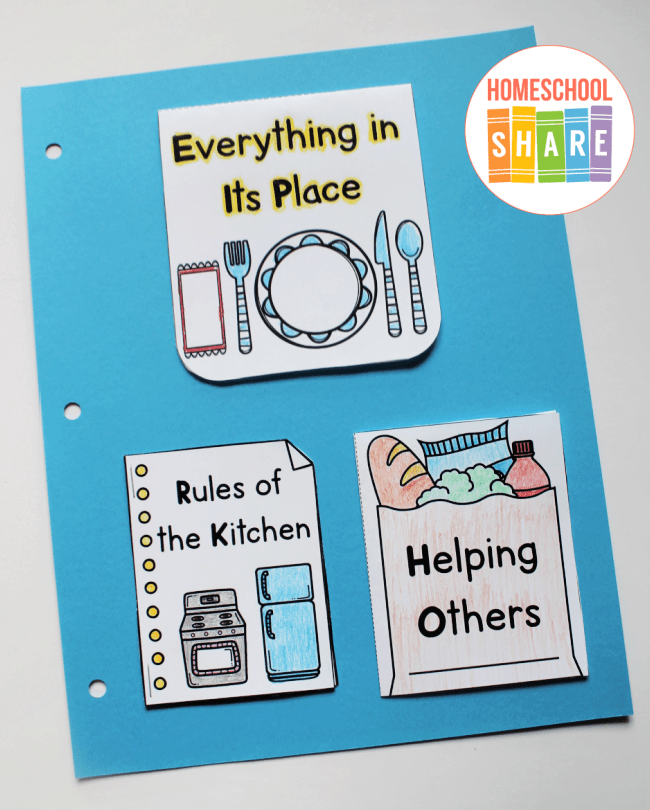
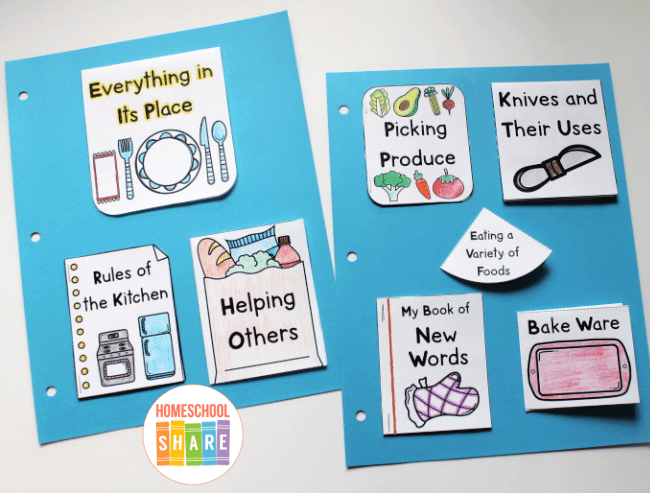
Everything in Its Place Simple
Fold

Garnishes
When serving a meal, the presentation of the food is
important to consider. You want the meal to look, as well as taste, appealing.
You can make a meal more appealing by paying attention to the colors of the food
and adding garnishes to foods with little color. Color not only appeals to the
eyes, but it also stimulates the appetite. You can use colorful paprika to
garnish pale fish, cheese, or eggs. Decorate plates with lemon wedges, green or
red pepper strips, or parsley sprigs. Orange twists, cucumber slices, or radish
roses can also add eye appeal to many foods. The one thing you want to try to do
is choose garnishes that duplicate the ingredients in the meal. It is fun to get
creative and make carrot curls, celery fans, or other interesting garnishes.
The following video is trying to sell a book, but it is worth watching to see
the various ways fruits and vegetables can be made into garnishes.
Unit 5 – Sharing your Cooking Talents
Good Manners
Discuss good manners and what is acceptable/not
acceptable in your home.
Here is a basic list:
1. Eat with a fork unless the food is meant to be eaten with fingers.
2. Don't eat too quickly and don't stuff your mouth full of food. It
is unattractive and you might choke.
3. Keep your mouth closed while chewing food. No one wants to see
your half-chewed food; no one wants to hear you chomping.
4. Don't say anything rude about the food being served.
5. Say thank you when you are served food, drink, or anything else.
6. If the meal isn't buffet style, show consideration by waiting until
everyone is served to eat.
7. Don't reach over someone's plate. If you need something (salt,
ketchup, etc.), ask for the item to be passed to you.
8. Keep your napkin in your lap. Use it to dab your mouth, if
needed. Don't use it to blow your nose. If you need to blow your
nose, go to the restroom to do that.
Source
Check out some books from your local library to read more about good manners.
Try to find
Poem Stew with poems selected
by William Cole (read Table Manners pg 59, Speak Clearly pg 32,
and My Wise Old Grandpa pg 10).
Minding My Manners
Fan
Hospitality
Being hospitable is making someone visiting your home feel welcome. What are some ways you can be hospitable? A big smile, a hearty welcome, and offering the guest something to eat and drink are ways of making people feel comfortable.
There are two kinds of guests, invited and unexpected. If you get unexpected guests you need to think quick on your feet, and put together some kind of quick snack such as veggies and dip, or a snack mix. Make your guest feel welcome, and not like an intruder (even if they are). The Bible tells us to “Use hospitality one to another without grudging.” (I Peter 4:9) This means that we should not be resentful with our unexpected guests, but should instead welcome them with warm and loving spirits.
If you have invited guests,
you have a little more responsibility. First you will have to invite your
guests, giving them information such as date, time, and place. It can be a
casual invitation made by phone or a more formal invitation sent in the mail.
You then need to choose a menu and decide how to serve it. You want to check
with guests prior to planning your menu to see if they have any special dietary
needs, such as a vegetarian or kosher diet, or if they are diabetic, or have
food allergies. You need to figure out seating arrangements depending on the
number of people who may be coming. If there will be more people than tables and
chairs, you may want to have a buffet style meal and some scattered seats so
people can wander as they eat. You should make sure your house is clean and tidy
before they arrive. When guests arrive, make sure they all know each other and
introduce people as needed. Take the guests’ jackets as needed and make sure
they are comfortable throughout their visit.
Helping Those in Need
There are many people who are physically or financially
unable to prepare healthful meals for themselves. Do you know somebody who
recently had a baby, or maybe surgery? Do you know any homebound elderly people?
Do you know of anyone that is in financial straights and would be blessed by a
free meal? Discuss with your parents and pray about providing someone in need
with a meal or special treat. Call a homeless shelter, retirement center, or
your church leader if you don’t know of anyone personally. Something as small as
a dozen fresh baked cookies or something as elaborate as a full-course dinner
could really put a smile on a needy person’s face!
Helping Those in Need Simple Fold
Unit 6 - Career Opportunities
There are many different career opportunities in the field of food. They can be divided into three main groups – food service industry, food handling industry, and business and education fields.
Food Service Industry
Food Service Industry jobs can be divided into four groups – Food Preparation, Customer Service, Sanitation, and Management. After reading about each one, reflect on which of the four areas interests you the most.
Food Preparation – A career in food prep can be found in restaurants, private clubs, hotels, hospitals, etc. You can climb the ladder from salad maker to assistant cook to cook. No previous skill is needed to enter this field, but it is likely that the more schooling and experience you have, the higher of a position you will start with.
Customer Service – This career entails working with the customers that visit the food establishments. To work in customer service you should have a friendly disposition and like to work with people. You might start out as a bus person that sets and clears tables, move to a waiter/waitress that serves food, and then advance to host, head waiter, and even assistant manager, or manager.
Sanitation – These are the dishwashers, pan scrubbers, and maintenance people that are responsible for keeping the kitchen, cooking equipment, serving utensils, and tableware clean and safe.
Management – In a management position you need to work with both employees and customers. Management positions include owner, assistant manager, manager, dietician, and executive chef. An executive chef is responsible for planning menus, ordering ingredients, and supervising kitchen staff.
Food Handling Industry
Food Handling Industry jobs involve harvesting, processing, transporting, and selling food products. After farmers harvest food, most products go to a processing plant. There are many jobs here including sorting, washing, peeling, slicing, grinding, roasting, and packing of the food products. After being processed, the food is delivered to food distributors, then wholesalers, and then food retailers. Once at the grocery store, there are people that stock the shelves, checkers that scan your purchases and take your money, people in charge of individual departments, people who advertise for the store, and also management positions.
Food Education and Business
The third food-related career area is Education and Business. There are many people who educate and communicate with others about food. Most of these careers require a bachelor’s degree.
Home Economics Teacher – These teachers work at all skill levels, educating students about nutrition, food preparation, and meal management.
Dietician – These are people that plan meals for hospitals, schools, and other large institutions, as well as supervise the purchase and preparation of food to make sure the meals are nutritious.
Nutritionist – A nutritionist is a kind of dietician that works directly with people to educate them about forming good food habits. A nutritionist may work at a weight loss center, health food store, a public health agency, hospital, or medical school.
Communications – If you like food and journalism, you may like a career in communications. Careers in this field include newspaper and magazine food editors and writers; television and radio food show hosts, or advertising agencies. People in this field need to be able to work well with other people, and to express themselves both orally and in writing.
Unit Review Activities
~Watch Ratatouille about a rat that dreams of becoming a renowned French chef.
~Think of other interesting food related jobs such as cake decorator, caterer, personal chef, food photographer, etc. and make a list.
~Find a person that works in the area that interests you the most and interview them about their job.
~Make a flow chart showing how food goes from the farm to the table.
~Compare and Contrast a Dietician and Nutritionist on Venn Diagram
~Make a list of at
least 5 food professionals that are seen on TV or have articles in magazines or
newspapers.
~Be a food critic and write your own article about a meal you
recently ate.
~Look through the classified ads of your local newspaper and identify the various help wanted ads for careers in the food industry. Cut them out and glue them into this Careers Bound Book.