| about us |
what's new
|
unit studies
|
unit study helps |
fiar resources
|
indexes | lapbooking |
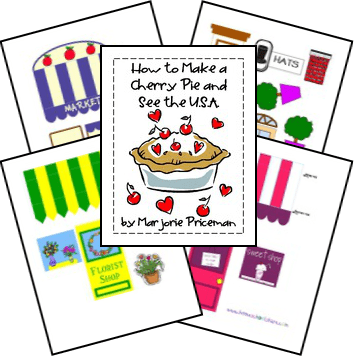
How to Make a Cherry Pie and See the USA
|
Author & Illustrator: Marjorie Price ISBN: 0375812555 Summary: It’s the Fourth of July and the stores are closed, so what’s a girl to do but hail a taxi and drive to a Pennsylvania mine to get the coal to make the steel to make the pan? And so it goes, as the duo races around the country finding the ingredients for, well, everything, including Hawaiian sand to make glass and New Hampshire granite for the pastry board. The trip is a madcap adventure, but there are many landmarks to observe, and children will get a sense of the breadth and scope of the country.
|
Lapbook Templates
Social Studies
Geography- Map the Route
On an outline map of the United States, map the route taken to get all the
necessary items to make the tools. Paste the pictures in the right places and
draw arrows from place to place. You may even want to number them. Older
children might also want to make note of what states they would pass through as
they travel from one location to the next.
Geography- The United States of America
Discuss the following with your student:
What is the motto of the United States of America? (In God We Trust)
What countries or oceans border the United States? (Canada, Mexico, Atlantic Ocean, Gulf of Mexico, Pacific Ocean)
How many states
are there? (50)
How large is the United States in land area? (3,615,123
sq. mi. or 9,375,720 sq. km.)
What are some
symbols of the United States?
Flag: The US flag has 13 stripes, 7 red and 6 white. They represent the original 13 colonies. There are also 50 white stars on a blue background, symbolizing the 50 states that make up the United States of America. The first flag was designed in 1777. The colors of the flag also have meaning. The red represents bravery, the white represents purity, and the blue represents justice.
Eagle: The bald eagle was chosen to be the national bird in 1782 by the Founding Fathers. They chose it because they felt it symbolized strength, freedom and courage. By the way, the word “bald” doesn’t mean that the bird has no feathers; rather, it comes from the old word “piebald” which means “marked with white”.
Liberty Bell: The Liberty Bell is a symbol of freedom in the US; it is made mostly of copper and tin. It was cast in London, England, in 1752. After arriving in the US, it cracked. It was recast using the same metal, but it cracked again. A third bell, cast from the same metal, also cracked. It rang when the Declaration of Independence was signed by the Continental Congress. It was last rung on February 23, 1846 for George Washington’s birthday celebration. The Liberty Bell now makes its home in Philadelphia, Pennsylvania.
The inscription on the bell reads as follows:
Proclaim liberty throughout all the land unto all the inhabitants thereof – Lev. XXV, v. x.
By order of the Assembly of the Province of Pensylvania [sic] for the State House in Philada.
National Anthem: The national anthem (or song) of the United States is the Star-Spangled Banner. It was written by Francis Scott Key in 1814 after he witnessed the shelling of Fort McHenry on September 13, 1814. It became the national anthem in 1931. Consider using the anthem for copywork this week.
White House: The White House is the home of the President of the United States. Its address is 1600 Pennsylvania Avenue in Washington, D.C. Every President has lived there except for George Washington. The White House had to be rebuilt and renovated after being burned by the British during the War of 1812.
Statue of Liberty: The Statue of Liberty symbolizes freedom throughout the world. It was a gift from the people of France and was dedicated on October 28th 1886. It is a statue of a woman holding a torch which symbolizes liberty. Its full name is “Liberty Enlightening the World”.
Pledge of Allegiance: The Pledge of Allegiance is s promise of loyalty to the United States of America. It was first published in 1892 to celebrate the 400th anniversary of the discovery of America. The Pledge was officially recognized by Congress on June 22, 1942; the words “under God” were added on June 14, 1954 by an act of Congress. The United States Code (4USC4) states that when saying the Pledge of Allegiance, people must be standing at attention, facing the flag with the right hand over the heart. Men are to remove their hats when saying the Pledge.
Pledge of Allegiance – you could use this for copywork if you haven’t done so before
For younger
children, you could show pictures of different symbols and talk briefly about
their significance. For older children, have them pick one and do a little
research on it to present in whatever way they choose – oral report, poster,
written report, PowerPoint presentation, model, or diorama.
Many different states are mentioned
in this book:
New York, Pennsylvania, Ohio, Louisiana, New Mexico, Washington, Hawaii,
California, New Hampshire, Maine, Vermont, Texas, Florida, South Dakota, and
Alaska. This would be a great time to start a state notebook (or add to it if
you already have one). HSS has
resources to use as you learn about different states.
Geography- Natural Resources
Natural resources are materials found in nature that are necessary or useful to
people. Some of the natural resources found in the United States include:
coal,
copper, lead, gold, iron, nickel, silver, oil, natural gas, timber.
Can your
student think of some of the resources the girl gathers in the story? Let’s take
a look at two of them:
Cotton- Ask your child what he/she thinks can be made from one bale of
cotton (which weighs approximately 480 pounds). Here is a partial list:
215
Jeans
249 Bed Sheets
1,217
Men's T-Shirts
1,256 Pillowcases
3,085 Diapers
313,600 $100 Bills (for more information about cotton and currency, check this out)
There is a wonderful resource called “The Story of Cotton” that you can download here (as well as other educational resources):
Oil/Coal- Two different forms of hydrocarbons, both of which are found underground. They come from a variety of plant material, which has been underground and changed by the pressure and temperature beneath the earth’s surface. The solid form is coal. The liquid form is oil.
Have your child research the different ways that coal and oil are used today. Put together a chart or Venn diagram showing the similarities/differences in usage.
Geography-
Famous Landmarks in the USA
As the girl travels from place to place, she has a chance to tour some of the
most famous landmarks in the United States.
Here are some famous American landmarks:
Devil’s Tower National Monument – proclaimed to be America’s first national monument by President Theodore Roosevelt in 1906
Mount Rushmore
– located in South Dakota and features the faces of four American presidents
Grand Canyon – known for its
immense size: 277 river
miles (446km) long, up to 18 miles (29km) wide, and a mile (1.6km) deep.
Interested in others? Check out this website.
Take the opportunity to research one (or more) and learn the history behind the landmark. Why is it important to our country? Which one would your child most like to visit and why?
History- July
4th
Ask your
student what the significance of July 4th is. (It is Independence
Day, the birthday of the United States of America.) The
events surrounding our country’s separation from England ended with the
Declaration of Independence (on July 4, 1776); we became our own country on this
day.
Talk about what kinds
of celebrations are traditional in your area. What does your family do to
celebrate July 4th?
In the story,
mention is made of a
rumor
about George Washington’s teeth. Does your child remember what that
rumor
is? What facts does your child know about George Washington? Read a book about
Washington and take note of some new facts about his life and career.
Record the facts in the George Washington shape book.
George Washington also has a connection to cherries! Is your student
familiar with the legend of George Washington and the cherry tree? Read it
to your student (included in George Washington minit books file) and discuss
what a legend is as well as the importance of honesty.
You can find more minit books for George Washington in our
President's Day Lapbook.
Geography- Mississippi River
Find the Mississippi River on a map. Talk about its significance in American
history – as a dividing line between east and west, for transportation of goods
and people. In the story, the girl takes a ride on a riverboat down the
Mississippi River. A riverboat is
a boat used for carrying
passengers or freight on a river. Talk with your child about the importance of
riverboats to life along the Mississippi River in the 1800s.
Science
Manufacturing
Go back through the book and ask your child why the girl is getting each
resource (Why does she get sand? -to make glass so she can make a measuring cup;
Why does she get oil? -to make plastic so she can make spoons to cook
with). Use the manufacturing minit book to reinforce what can be made from
various resources.
Have your older student research to learn more about one of the processes found in the book:
~the process of mixing coal and iron to make steel and make pie pans
~the process of spinning cotton into thread and weaving into cloth and making
into pot holders
~the process of carving wood into a rolling pin, sanding and sealing for use
~the process of turning oil into plastics to pour into spoon-shaped molds
~the process of cutting granite into a pastry slab
~the process of melting sand until liquid and pouring into a measuring-cup mold
Have your child
think of something that he knows how to make. Then have him write or dictate
the process to make that thing. It may be helpful to first brainstorm the
different steps of the process and make sure that those steps are in the proper
order to successfully complete the project. If desired, your child may
illustrate each step with his own drawings or with clipart. Then, for fun, have
someone other than your child follow your child’s directions exactly. For
example, if the directions say, “Put the peanut butter on the bread”, put the
jar of peanut butter on top of the loaf of bread! This is a great exercise to
learn how to be precise in recording the steps followed while conducting a
scientific experiment.
Chemistry: States of Matter
The girl in the story has to melt the sand in
order to make glass. Melting is changing a solid into a liquid (usually by
heating it). Find some solids in your house that can be melted (chocolate,
ice, wax, etc.) Discuss solids and liquids and find examples in your
house.
Does your student know that there are only three states of matter? Matter
is
something
that occupies space, has mass, and makes up the observable universe. Think of
things around you that qualify as matter. The three states of matter are
solid, liquid, and gas. You've already discovered solids and liquids. You
may want to boil some water to show your student gas (the steam).
Look up the suggested words in the dictionary with your child (or select your own words from the story). You can use the vocabulary lapbook component if you’d like.
hail – to attract someone’s attention
trolley – a cart used for moving something
gumbo – a soup thickened with okra that usually contains meat or seafood and vegetables
express – a fast train or bus that only stops at a few stations
interrupt – to stop or hinder for a short time
rappel – to descend a cliff by sliding down a rope
chisel – to chip away at something and form it into a desired shape
scenery – the natural surroundings of an area, such as trees, mountains, streams
process – to prepare or change by a series of steps
liquefy – to make something that is solid into a liquid
Second Person Point of View:
In second person point of view, the narrator tells the story to another character using "you". Second person is the least commonly used point of view in fiction stories. Can you and your child think of other examples of stories told using the second person point of view? (Some of our favorites are the books by Laura Numeroff like If You Give a Mouse a Cookie.) Discuss with your child why the author might choose to use the second point of view (perhaps to draw the reader into the story by making him or her feel part of the action).
Applied Math
Graphing:
Choose some cherry food products to taste. Some possibilities include: fresh cherries, cherry Kool-aid, cherry jello, cherry soda, cherry pie, dried cherries, black cherry ice cream, chocolate-covered cherries . . .
Poll family members (and others if you want) to see which cherry food is their favorite. Use tally marks to track the response. Using your data, make a graph (a pie graph might be fun) to illustrate which cherry food is the favorite.
Review units of measurement (cup, pint, quart, teaspoon, tablespoon). Have your child experiment to figure out how many cups are in a pint, how many teaspoons equal a tablespoon, etc.
Life Skills
Cooking:
Make your favorite
gumbo recipe so you can eat a bowl of it, even if you don’t dock in Louisiana at
lunchtime.
And don’t forget to try your hand at making cherry pie (using the recipe found
at the beginning of the book).
For more cherry recipes, check out this website.
Make a potholder using the cotton loops and loom. If that’s not possible, weave a placemat using two different colors of construction paper cut into strips.
For a fun field trip, visit a pottery studio and paint a piece of pottery to take home. Maybe you’ll want to make a mixing bowl that you can use when you make your cherry pie!
Here is a song you can sing to go along with the story (to the tune of “If You’re Happy and You Know It”)
If you
make a cherry pie, you’ll need supplies
If you make a cherry pie, you’ll need supplies
If you make a cherry pie, you might travel far and wide
If you make a cherry pie, you’ll need supplies!
Try making up your own verses to go along with the song! Use the book for inspiration!
Make your own
street
scene,
similar to what is found in the book!
For more fun learning about the
United States, try
this site.
If you are in the area, check out the National Cherry Festival.
You can read Marjorie Priceman’s thoughts about this book here.
The Corning Museum of Glass has all kinds of videos that you can watch on glass-making. You can find them here.