| about us |
what's new
|
unit studies
|
unit study helps |
fiar resources
|
indexes | lapbooking |
Cattle Lapbook and Unit Study
created by
Wende and Cindi Fry
Optional Book List
The Ox-Cart Man by Ronald Hall
What a Wonderful Day to be a Cow
The Story of Ferdinand by Munro Leaf
The story of a bull that would rather smell flowers than fight, but knew how to be tough when he had to.
The Promise by Tony Johnston
While helping her neighbor assist one of his cows in giving birth, Ramie hears a story of another birth helped by a young person interested in cows.
Stella’s Bull by Frances Arrington
Mary Wilson hears tales of a fearsome bull and blows the stories up in her mind until she finally meets the bull face to face.
Green Grass and White Milk by Aliki
An informative Let’s-Read-and-Find-Out Science book about the milking processes of yesterday and today.
All Alone by Claire Huchet Bishop
It was the job of ten-year-old Marcel to watch over the cows grazing in the French Alps, but an adventure begins when he hears another boy’s yodels. 95pg chapter book. Newberry Honor book.
The Usborne Book of Farm Animals by Felicity Everett
This book takes young children on a farmyard tour, introducing each animal in turn and showing how it lives, feeds, and rears its young.
The Kingfisher First Animal Encyclopedia by Jon Kirkwood
Brief description of various cows with illustrations.
Dadblamed Union Army Cow by Susan Fletcher
This book is based on a true story about a cow in the union army during the Civil War.
Blossom Comes Home by James Herriot
Cows by Julie Murray (series – Buddy books Animal Kingdom)
Cattle (Farm Animals) by Heather C. Hudak
Clarabelle – Making Milk and So Much More by Cris Peterson
Click, Clack, Moo (for the younger crowd)
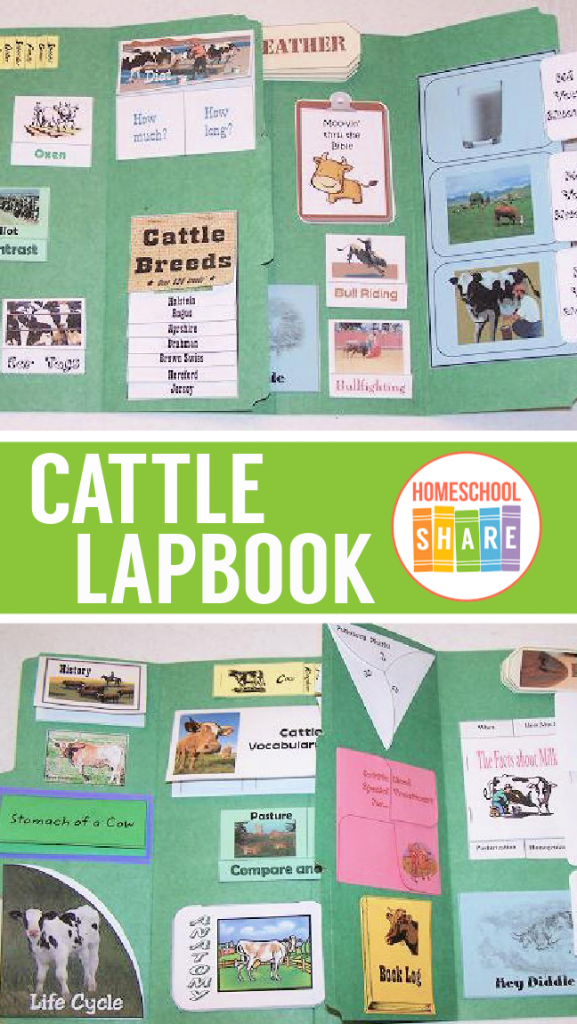
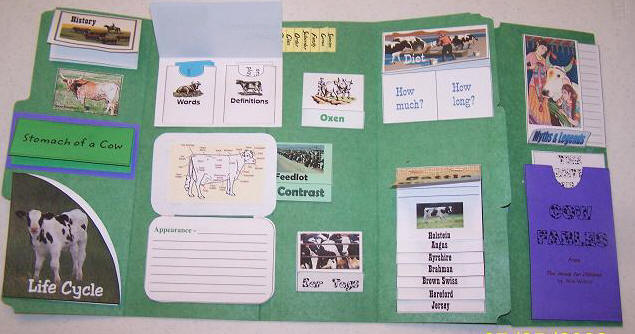
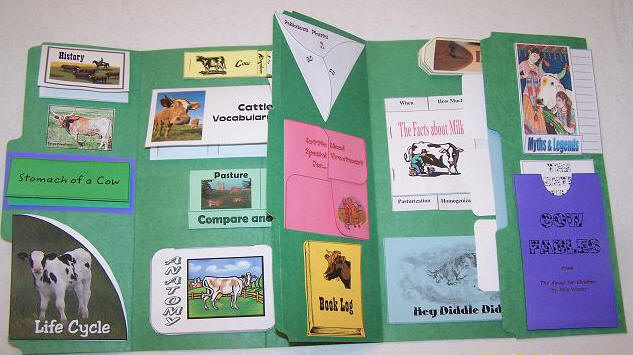
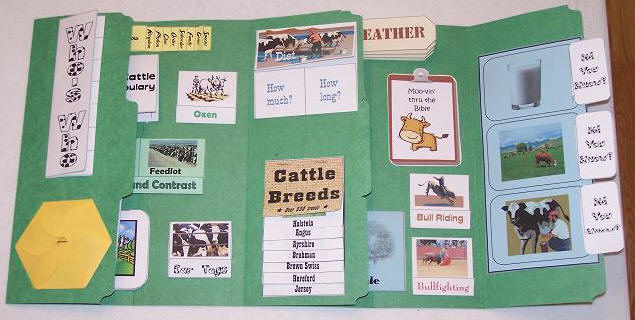
Lapbook
Components
1 Cattle Bible clipboards book
2 Classification Graduated Book
4 Vocabulary pockets and cards
7b Did you know pull-tab book (use here and in section 8 and 10)
9a Pasture and feedlots compare book
9b Cattle misc matchbooks (also used in section 10)
9c Special treatment petal book
10a Products and uses petal book
12 Aesop Fable Mini Books with Copywork
13a Hey Diddle Manuscript Copywork Bi Fold
13b Pretty Cow Cursive Copywork and Pocket
14 Myths and legends matchbook
Look up the bible verses listed in the mini-book and answer the questions.
1 Cattle Bible clipboards book
Kingdom – Animal
Phylum – Chordata (having backbones)
Class – Mammal (live birth, warm blooded, fur, milk for young)
Order – Artiodactyla (even-toed, hoofed animals)
Sub-Order – Ruminant (cud chewing)
Family – Bovidae
Genus – Bos (Cattle)
Species – B. taurus (domestic cattle)
2 Classification Graduated Book
3. Who’s Who
Cattle go by many names depending on the gender and age:
Calf – young cattle
Heifer – female cattle until they give birth
Cow – female cattle after giving birth
Bulls – male cattle of any age
Steer – castrated male cattle raised for beef
Oxen – large, heavy castrated male cattle raised as draft animals
Herd – a group of cattle, most animals naturally follow the smartest and strongest members of their herd
4. Vocabulary
bacteria – tiny one-celled organisms that play many roles in nature, on a dairy farm, bacteria break down plant material in a cow’s stomach or in an anaerobic digester, other bacteria can cause milk to sour
breed – a special group of animals that usually look alike
calving – cows giving birth, usually in the spring
cattle drive – when ranchers on horseback ride beside their cattle to move their herds to new pastures
cowhide – the skin of a cow, can be used to make leather
fertilizer – material given to plants usually by adding it to the soil, providing nutrients that will improve plant growth
gestate - to carry offspring in the womb
hardy – able to survive in a harsh environment
manure- waste material from animals
parasites – living things that feed off and live on other living things
pasture – land or fields with green grass
protein – an essential nutrient found in milk and in all living cells
silage – chopped and fermented corn or alfalfa plants that are stored in covered piles or silos and used for cow feed
vaccinated – given medicine to prevent diseases
veal - a calf raised for its meat, usually a milk-fed animal less than three months old
4 Vocabulary pockets and cards
5. History
Cattle have been domesticated throughout history and originated from Europe, Asia and Africa. Cattle were not native to the Americas, but were in fact brought to the Americas from Europe by Christopher Columbus in 1493. The first cattle in the United States were the Texas longhorns from Mexico. In the 1600’s the Pilgrims from Great Britain brought more cattle here. By colonial times, draft oxen were valued quite highly in America.
6. Anatomy
Appearance -
Cattle are large, hardy farm animals with heavy bodies, long tails, a thick coat of hair and cloven-hoofed feet. They do well in hot and cold weather. They can graze all day because of their muscular backs and legs. They are social animals that live in large groups called herds and graze together. They are also sensitive and easily frightened.
Colors – white, gray, brown, brownish red or black, solid-colored or spotted or multi-colored patches
Size – 57 – 66 inches tall and weigh 800-2500 pounds
Nose - They can smell things as far as six miles away.
Eyes - Located on the sides of their head, so they can see all around them.
Tail - Their tail is used to keep insects off their back.
Digestive System -
Cattle are ruminants, meaning they chew their cud. They have a huge four-chambered stomach. When they eat, the food passes down the esophagus to the rumen where it is broken down and formed into small balls of cud. As it desires, the cattle will return the cud back to its mouth, where it will be chewed up some more to further break up the fibers. It will then reswallow the food, where it will go through the rumen, on to the reticulum, then to the omasum, and finally to the abomasums, the true stomach. In the abomasums, enzymes are secreted and normal digestion takes place. All their chewing also produces a lot of saliva.
Teeth -
God designed the teeth of cattle in a certain way. Because they are grazing herbivores, they have no need for sharp upper canines like a carnivore has. Instead, they have teeth designed for grinding. Their bottom front incisors and canines bite against a horny pad in the upper jaw. The back molars are broad and high crowned, with enamel ridges for grinding. They have 32 teeth.
Horns -
Most cattle have horns, which they can use to protect themselves, but there are some hornless varieties. The horns are hollow with no branches. Cattle are called polled if they are born without horns. Most farmers dehorn their cattle when they are 3 weeks old.
Udders – Bags with four teats that hang down near the back legs and are where milk is made and stored. A calf drinks milk from the udders.
Feet – They have cloven-hoofed feet; this means they are divided into two parts. They also have hard coverings on their feet called hoofs.
Go to this website for 2 anatomy pictures of cows. You can print them, cut them out and glue into minibook below.
7. Reproduction and Life Cycle
Newborns –
Most cows have one calf at a time. Newborns weigh between 50-100 pounds. They stand up within one hour after birth. Calves drink their mother’s milk for 2-4 months, after that they graze with the older animals.
2 months to 2 years old -
Calves grow quickly. At 2 years old cows weigh about 1,100 pounds and can have babies. Cows gestation period is nine months, just like humans. Cows give milk for about 300 days after giving birth.
Adult -
Cattle stop growing at four years and can live up to 25 years. (see Anatomy for size)
DID YOU KNOW? One cow can fill 200,000 glasses of milk in its lifetime.
8. Diet
Cattle are herbivores (eat plants) and eat things such as grass, hay, corn, oats, alfalfa, leaves, shrubs, rolled grains, soybean meal, and corn silage. Cattle are also commonly fed some type of protein, sometimes in the form of pellets. Some plants are poisonous to cattle such as yew, hemlock and bracken. They can eat 40 pounds of food a day and drink 30 gallons of water each day.
Cattle graze for 6 to 9 hours a day. They wrap their tongue around a plant and snip it off with their lower teeth. They eat the top of the plants first, then the stems. Young plants are their preference because they are tender and easier to eat.
DID YOU KNOW? There are over 800 million acres of grazing land in the United States.
9. Habitats and Behavior and Care
Cattle live on farms, feedlots and ranches. They need to have shelter for protection from bad weather. They also need fenced pasture to keep cattle in and predators out. New pens can stress cattle; they need to be able to see their other herd mates. Cattle show affection by grooming and licking one another.
Ear tags are used to keep track of cattle. The tags show where the animals came from, where it has been and other animals it has been near.
Some cattle are vaccinated against diseases (illnesses). Special treatment is needed if cattle get parasites; these include lungworms, ticks and lice. Sharp stones, glass or nails getting caught in their feet cause hoof problems. Very warm weather can cause heat stress, cattle will pant and drink large amounts of cool water.
Mad Cow disease harms the brain of cattle and it can cause illness or death. The disease spreads when cattle eat the meat (protein) of another animal that had Mad Cow disease.
9a Pasture and feedlots compare book
9b Cattle misc matchbooks (also used in section 10)
9c Special treatment petal book
10. Uses
Milk –
A female cow begins to produce milk after she gives birth to a calf. She makes plenty of milk, as much as thirty to forty quarts a day, so there is enough for the calf and for the people to collect. A cow should be milked twice a day or she will be in pain, may get an infection, and will stop producing milk. The cow’s milk is stored in the udder, which is a bag with four teats. As you squeeze the teats, the milk squirts out. You can squeeze the teats by hand or use a milking machine. The milk that comes directly out of the cow is called raw milk. This milk has a lot of butterfat, which rises to the top. Up until the mid 1800’s, milk was drunk in its raw form. Many dairy cows produce milk for about five years.
Louis Pasteur, a French scientist, discovered that there was many harmful microbes in raw milk that could make it perish quickly, and he invented a process called pasteurization. When milk was pasteurized, it was heated to a temperature of 161 degrees for 15 seconds, and then quickly cooled, killing any harmful microbes. Milk you drink today is pasteurized.
During the 1800’s, the butterfat was scraped off the top of the milk and was used to make butter. Today, milk goes through a process called homogenization, which breaks the butterfat into tiny bits and combines it with the milk. This milk is called whole milk. Sometimes people don’t like the butterfat in milk, so milk is also available with some of the fat removed (1% and 2% milk) and with all the fat removed (skim milk). Farmers store milk in cold tanks until it is taken to a dairy plant by a tanker truck.
Dairy foods are a source of calcium and vitamin D.
Some examples of dairy foods are: cheese, ice cream, butter, yogurt and, of course, milk.
DID YOU KNOW? Cows must drink two gallons of water to make one gallon of milk.
Meat –
We get meat from all varieties of cattle. Meat from a young male is called veal, while all other meat is called beef.
Some examples of beef are: steak, hamburger, roast, jerky.
Leather –
The skins of cows have been used for making shoes, clothing (jackets, gloves), wallets, furniture, bags, and accessories for thousands of years. Leather lasts a long time. After the animal dies, the dead skin begins to lose water through evaporation, leaving the skin very stiff. The skin of cattle is made up of three layers, the outer layer or epidermis, the middle layer or corium and the bottom layer or flesh. The first step in making leather is loosening and removing the epidermis and the flesh, leaving only the corium. The corium is the part of the skin that is turned to leather. A process called tanning is then used to make leather strong, flexible, and waterproof. Up until the late 1800’s, the most common method of tanning was vegetable tanning.
With vegetable tanning, tannins derived from plants such as oak and chestnut trees were used. The leather was placed in baths of vegetable tannins, over a long period of time. Vegetable tanned leather can take up to two years to produce. This process softens the stiff leather, making it tough and durable, and leaves the leather colors ranging from a pale brown to a reddish brown, depending on the plants used.
After the tanning process, the leather was oiled, and depending on what it would be used for, was sometimes rolled or hammered. The leather was then finished to make it more attractive and to protect it. Traditional finishing processes include staining or coloring of the surface, dyeing, and/or embossing a pattern on the surface.
Beginning in the late 1800’s, chemical tanning began to replace much of the vegetable tanning. The tanning process took a lot less time with chemical tanning. And the use of chemicals revolutionized the leather manufacturing industry
There are various kinds of leather working kits available at craft stores. Your child may enjoy making his own leather wallet or bag this week.
Manure –
Manure is used to generate electricity and fertilize crops and gardens.
A anaerobic digester system is a group of separators, tanks and converters where microscopic bacteria eat cow manure and create methane gas. Methane is a flammable gas that is used to power generators to make electricity.
Other –
glue, gelatin, fertilizer, draft animals, rodeo bull riding, bull fighting…
Oxen are used as draft animals (plowing, hauling cargo, etc.). They are most often used in teams of two. Oxen can pull harder and longer than horses. Although they are not as fast as horses, they are less prone to injuries because they are more sure-footed.
You may choose to do a little research on rodeo bull riding and bullfighting.
10a Products and uses petal book
11. Breeds
There are over 900 breeds of cows and three main groups: beef, dairy and dual-purpose (beef & dairy).
Popular beef cows: Angus, Beefmaster, Charolais, Hereford
Common dairy cows:
Holstein – they make the most milk of any breed
Brown Swiss – milk is good for making cheese
Jersey & Guernsey – milk has a lot of butterfat
Holsteins – very good dairy cows, white with black spots.
Dutch belted cows – black with a white stripe around its body
Angus – beef cattle from Scotland, hornless, black coat, brought to US in 1873
Ayrshire – dairy cattle from Scotland, shades of red and white with spots, purebred
Brahman – beef cattle from India, large hump on their shoulders, gray, red or light black
Brown Swiss – dairy cattle from Switzerland, colors from chestnut to black, gray stripe down back
Hereford – beef cattle from England, brown coat on body with white markings on head and under belly
Jersey – dairy cattle from England, very heat tolerant, colors from light gray to creamy brown
12. Fables
12 Aesop Fable Mini Books with Copywork
13. Nursery Rhymes and Poetry
You can use these poems throughout the week for memorization, recitation, and/or copywork.
Hey
Diddle Diddle
Hey diddle diddle,
The cat and the fiddle,
The cow jumped
over the moon;
The little dog laughed
to see such sport,
And the dish ran
away with the spoon.
13a Hey Diddle Manuscript Copywork Bi Fold
Purple Cow
I've never seen a purple cow,
I never hope to see one,
But I can tell you anyhow,
I'd rather see then be one!
~Gelett Burgess
Pretty Cow
Thank you, pretty cow, that made
Pleasant milk to soak my bread,
Every day and every night,
Warm, and fresh, and sweet, and white.
Do not chew the hemlock rank,
Growing on the weedy bank;
But the yellow cowslips eat,
That will make it very sweet.
Where the purple violet grows,
Where the bubbling water flows,
Where the grass is fresh and fine,
Pretty cow, go there and dine.
~Jane Taylor
13b Pretty Cow Cursive Copywork and Pocket
http://pecuniarities.com/free-printable-templates-dairy-cow-milk-cartons-black-brown-tan-white/3759
14. Myths and Legends
Hindus believe in a sacred cow named “Kamadhenu”. She is the mother of all cows. Hindus will not harm cows. Hindu countries (such as, India and Nepal) let cows roam freely in the streets. Cows are decorated with flowers, paint and ornaments on special days.
The tomb of Tutankhamun in Egypt has cow statues inside.
14 Myths and legends matchbook
15. Websites
This “Animal Corner” website has some great information, pictures, diagrams and a quiz on cattle.