| about us |
what's new
|
unit studies
|
unit study helps |
fiar resources
|
indexes | lapbooking |
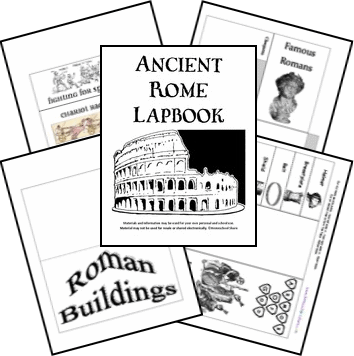
Ancient Rome Unit and Lapbook
Unit and Lapbook by Jodi Small
Library List
Brave Cloelia
by Jane Curry
Classical Kids
by Laurie Carlson
Who Were the Romans?
by Phil Cox (Usborne)
You Wouldn't Want to be a Roman Gladiator
by John Malam
Ancient Rome!
(hands-on crafts) by Avery Hart
Mystery of the Roman Ransom
by Henry Winterfeld
Detectives in Togas
by Henry Winterfield
Ancient Rome and Pompeii
(Magic Treehouse Research Guide) by Mary Pope Osborne
Mini-books to use as
desired
Vocabulary Minit Book
Roman Numerals Minit Book
Legend of Rome
The god, Mars, had twin boys. Romulus and Remus were abandoned and raised by a wolf close to the river Tiber. They were later adopted by a shepherd and his wife. When the twins grew up, they decided to build a city where the shepherd had found them, but they could not decide who would be in charge of the city. Romulus killed Remus, and named the city Rome after himself.
History
The city of Rome was founded over 3,000 years ago by farmers and fishermen settling near the river Tiber. Salt marshes surrounded the villages. Since salt was a valuable resource, Romans traveled by river to trade the salt and other goods with neighboring villages. As the Romans became more powerful, they began to fight for surrounding land. Soon all of Italy was under Roman control. They went on to conquer most of western Europe, Britain, North Africa and the Middle East.
Roman Republic
In the beginning, Rome was ruled by kings until King Tarquin was overthrown. They were so unhappy with him that they formed a republic, a government where no one person has complete control.
Patricians were rich citizens who owned land and had many slaves. They were also the leaders in government, the men of the Senate. The Senate gave advice to two consuls. New consuls were elected each year.
Plebeians were the ordinary citizens, most of whom were also wealthy. The Plebeians were those people who elected the consuls.
Slaves were the largest part of the population. They had no rights and little education.
As Rome gained more land, it was harder to govern as a Republic because there were too many disagreements within the government.
Roman Empire
Julius Caesar ruled for 5 years over Rome as a strong ruler. He passed laws to relieve hardship and reduce debt. He established the calendar that became accepted throughout the Roman world. This calendar included 365 days in a year and divided the year into 12 months. Many people feared he would be crowned king, so Julius Caesar was killed by several senators, including two of his close friends.
After Julius Caesar’s murder , the republic collapsed and emperors ruled Rome. Octavian was the first emperor of the Roman Empire. Julius Caesar considered Octavian his adopted son. Octavian avenged Caesar’s death by defeating Caesar’s enemies. In 27 BC he changed his name to Augustus, which means “respected one.” Augustus created order in the Roman Empire.
Emperors are similar to kings, and were sometimes worshipped like gods. Emperors did not wear crowns like kings did, but instead they wore laurel wreaths.
Laurel Wreath Craft
Use construction paper to make a strip that will go around your head. Cut
several small leaves out of green construction paper. Glue the leaves to the
strip, overlapping them some.
Make your own
laurel wreath and keep in
this pocket
Here is
a file with two pockets if you have two students (to save on paper)
Rome was the center of the Roman Empire. Rome is known as the Eternal City. Whatever the government in Rome decided was obeyed throughout the Roman Empire. This website has a good map of the Roman Empire.
Where was the Roman Empire? minit book (you will need to find your own
map)
The Roman Empire was at its strongest around AD 117. Romans were famous for
creating order. Everyone in the empire had to obey Roman laws and pay taxes.
In order to keep the empire united, when the Roman conquered an area, they built
a Roman fort and soldiers were assigned there. The soldiers made sure Roman
laws were being obeyed.
Architecture
The ancient Romans were experienced builders. Some of their buildings lasted for over 2,000 years. The Romans borrowed many ideas from the Greeks, but they also invented new ways of building things. Their buildings often had rounded arches and domes. They built sturdy bridges and tunnels. The Romans invented concrete by mixing cement, sand, gravel and water.
How is
concrete made? Minit book
Here is
a file
with two minit books if you have two students (to save on paper)
The Colosseum is one of Rome’s famous ancient buildings. It was an amphitheater used for sporting events that seated 60,000 spectators. Gladiators would fight each other or wild animals for sport. A gladiator is someone trained to fight in hand to hand combat. They usually fought to the death. There were also chariot races and Roman plays in the Colosseum.
What happened at the Colosseum? Minit book
What’s a Gladiator? Minit book
Another famous Roman structure was the aqueducts. These were structures that carried water from springs into the city for cooking, drinking and bathing. Ancient Rome contained eleven aqueducts, some underground and some above ground.
The Pantheon was a temple used for worshipping gods. On top of the Pantheon is a huge dome covered in bronze. This building is still in good condition today and is used as a Christian church.
The Romans built many roads. Trenches were dug where the road should go. They would first place large stones with gravel on top. Then they put sand and cement on top of the gravel. Finally a layer of flat stones were fitted together and packed down. They would build the roads higher in the middle so the water could drain off onto the sides.
Military
A Legion was a group of about 6,000 Roman fighting soldiers. Legions were divided into Centuries, a unit of 80 soldiers. Each Century was commanded by a Centurion. A Roman Centurion wore a helmet, armor, belt, sandals and carried a shield and sword. They were responsible for training their own men. The training was strict for soldiers as they learned to march carrying heavy equipment. Soldiers were trained to use their swords, shoot arrows, throw a javelin and use a sling. They were trained to be deadly fighters.
Sometimes, Roman soldiers used a formation called a testudo, or tortoise. Men stood side by side with their shields above their heads and around the outside of their group protecting the entire group from an enemy’s arrows.
Other military machines were:
- Onagri – catapults. They could hurl 60 pound rocks over ½ mile.
- Flamethrowers. They could shoot twelve-foot burning darts up to 2,000 feet.
- Ballista – cross bow. Some needed 10 men to operate. They were loaded with rocks or metal bolts and shot out at 115 miles per hour.
Language
Romans spoke Latin, which spread throughout the empire and became the official language. Many of the words we use today come from Latin.
- Dentist comes from the Latin “dent” meaning tooth.
- Marine comes from the Latin “mar” meaning sea.
- Total comes from the Latin “Totus” meaning whole
- Corpse comes from the Latin “corp” meaning body
Famous Romans
Cleopatra (69-30 BC)
Cleopatra ruled Egypt along with one of her brothers, until her brother forced her out. Julius Caesar helped her become queen of Egypt. Caesar and Cleopatra fell in love and she followed him to Rome. After Caesar’s death, she returned to Egypt. She again fell in love with Marc Antony, a supporter of Julius Caesar, but an enemy of Octavian. Antony and Octavian went to war and Antony was defeated. Rather than be put to death, he committed suicide. Cleopatra, knowing she too would be taken to Rome as prisoner, also took her life. Shortly thereafter, Rome defeated Egypt.
Caligula (AD 12-41)
Caligula, or Gaius Julius Caesar Germanicus, was born into royalty. He was a bad emporer, killing anyone he wanted to. One time he paid his soldiers for a battle by ordering them to collect seashells as their reward. He wanted to make his horse a consul, draped the horse in purple and demanded people bow down to his horse. After he built a temple to himself and thought he was the god Jupiter, his guards murdered him.
Nero
Nero became Emporer when he was just 16 years old. Nero thought his mother Agrippina had too much power over him, so he tried to poison her. It didn’t work because Agrippina had taken a little bit of poison everyday and was immune. He tried to build a ceiling to collapse over her bed and sent her on a boat ride designed to sink, neither worked. Finally he ordered his soldiers to stab her. At the end of his reign, the Romans came to hate Nero and so before he could lose his throne, he committed suicide.
Famous Roman leaders minit book
Pompeii
Mt. Vesuvius was a dormant volcano, when in AD 79, it erupted. Volcanic rock, called pumice, and thick ash covered the town of Pompeii. Dust and gas made it difficult to breathe and many people died. By the end of four days, eight feet of ash piled on top the town. Finally, Mt. Vesuvius erupted poisonous gas, ash and rock which raced down the mountain destroying everything and everyone that was left. The entire town was covered.
Most of what we know about the daily life of the Romans came from discoveries found where the city of Pompeii used to be. In the beginning, as things were found from the city, they were sold. In 1860, the first official excavation was begun. They found city streets and houses and people and animals that were buried in the hardened ash.
Roman Life
Houses were plaster with high, narrow slits for windows to keep out burglars. In the middle of the larger homes was a courtyard, called an atrium. This is where the families greeted friends. There were often gardens behind the atriums and bedrooms opened onto the atrium.
Families did not own much furniture. There were beds and couches. There were some tables, stools and benches, usually made of bronze. They used braziers, small bronze heaters, to burn charcoal for heat. There were murals painted on the walls or mythological scenes or family members.
Within the city, there were temples, workshops, a basilica that contained offices and courts, public bathhouses and lavatories. Cities were crowded and dirty. Most houses had no plumbing, however, aquaducts brought water into the public areas.
Farm life outside of the city consisted mainly of farming. Some crops that were grown were grapes, olives, turnips, apples and wheat.
Romans ate fruit, fish, rabbits, eggs, and vegetables. They baked bread and cakes in brick ovens and hung their pots over a wood fire. Families would recline, propped on one elbow, on a couch to eat.
Try a Roman recipe:
Modern Roman Libum Recipe (serves 4)
1 cup plain, all purpose flour
8 ounces ricotta cheese
1 egg, beaten
bay leaves
1/2 cup clear honey
Sift the flour into a bowl. Beat the cheese until it's soft and stir it into the
flour along with the egg. Form a soft dough and divide into 4. Mold each one
into a bun and place them on a greased baking tray with a fresh bay leaf
underneath. Heat the oven to 425° F. Bake for 35-40 minutes until golden-brown.
Warm the honey and place the warm cakes in it so that they absorb it. Allow to
stand 30 minutes before serving.
Families often lived together – grandparents, mothers, fathers and children. The fathers were the heads of the families. They served in government. They arranged their daughters’ marriages, usually to a man much older than they were. Children played with balls, dolls, marbles and board games. Children could begin school at age seven. Most boys and the girls of wealthy families could go to school. When boys were sixteen, they got their first shave and haircut.
Roman men and boys wore short, belted tunics made of linen in the summer and wool in the winter. Girls wore short tunics also, and long tunics called stolas when they were older. Women wore beautiful jewelry, cosmetics and perfume.
tour of a Roman
town
floor plan of a Roman house
Roman Gods
Romans worshipped the same gods as the Greeks, but they gave them different names. People prayed to these gods, and brought offerings to them.
- Jupiter – Master of all gods and the god of the sky
- Juno – Wife of Jupiter and protector of women
- Mars – God of war
- Ceres – Goddess of the earth, crops and grain
- Neptune – God of the sea
- Venus – Goddess of love
- Diana – Goddess of the moon and of hunting
- Mercury – Messenger of the gods
- Vulcan – God of the underworld, fire, volcanoes, and metalworking
Roman gods and goddesses minit book
Christianity
Read Matt. 27:1-14. Jesus was considered a rebel against the Roman government and was ordered to be crucified by Pontius Pilate, the current Roman Governor.
Read Acts 22:22-29. Paul was a Roman citizen.