| about us |
what's new
|
unit studies
|
unit study helps |
hss resources
|
fiar resources | indexes | lapbooking |
Wombat Stew
|
Author: Marcia K. Vaughan Illustrator: Pamela Lofts ISBN: 1865044482 Summary: Wily, wild Dingo dog catches a poor, woebegone Wombat and decides to make Wombat stew. But the other animals try to save Wombat by insisting that the stew will not be complete without blops of mud (says Platypus), feathers (says Emu), flies (suggests lizard), ``slugs and bugs and creepy crawlies'' (says Echidna), and gumnuts (says Koala). Much to the animals' delight, the concoction tastes so terrible that Dingo howls and runs away, never again to sing about ``yummy, chewy, Wombat stew.'' |
Unit Prepared by Sharon Pickard
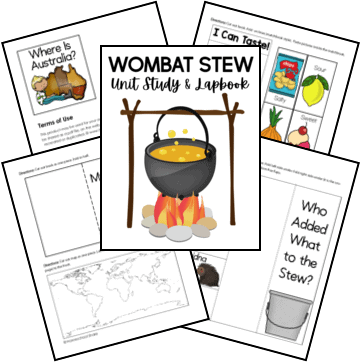
LAPBOOK COMPONENTS
by Sharon, Wende, and Ami
Friends Accordion Book
Word
Cards and Pocket
Short Vowel Minit Book
Vocabulary Layer Book
Plot Triangle
Book
Flag of Australia Minit Book
Names for Australia
HWOT font
Primary font
Blank
Who Am I Cards and
Pocket
I Can Taste Minit
Book
Marsupial
"Pouch" Book
Koala Blank Book
Possible Cover
Page
Australian Animals Layer Books
Dingo
Koala
Wombat
Emu
Platypus
Echidna
Lizard
Kookaburra
BIBLE & CHARACTER
Good Friends
The other animals were good friends to wombat, they saved his life. Discuss with your child what makes a
good friend. You may want to refer to some stories in the Bible of good
friends-- Jonathan and David are a good example of friendship (you may also want
to discuss Ruth and Naomi).
Friends Accordion Book
LANGUAGE ARTS
Choral Reading
After a few readings of this book, your student should be able to "read"
some parts along with you. Be sure to pause to indicate where your student
should chime in with the right phrase. Use your finger under the
words (as a guide) to show your student the words that you are reading together.
Fun with Words
Isn't this book fun to read? Enjoy language with your student.
Go back through the story together and search for all the words that end with
‘y’.
| brewy | chewy | lumpy | crunchy | munchy | muddy |
| yummy | gooey | billy | creepy | spicy | chilly |
| toothy | snappy | cracky | tummy | chappy | blacky |
Using the
prepared word cards, let
your student sort the words with similar vowel sounds.
1. brewy, chewy, gooey, toothy
2. lumpy, crunchy, munchy, muddy, yummy
3. billy, chilly
4. snappy, cracky, chappy, blacky
Discuss the words with your student. Are they "real" words? No!
Some of them are made up. Encourage your student to make up some words,
too. Let him add them to the similar vowel lists (if you completed that
activity). You can extend this activity by helping your student
write his own rhyming verses similar to the ones found in Wombat Stew.
Lapbook Activity-
Short Vowel Minit Book
Recipe Writing
Have your child dictate how to make wombat stew (make sure to record this
for her if she can't write yet). Another fun option would be to let your
student invent a recipe for something she KNOWS she won't like. If you are
making a lapbook, you may want to include these recipes in a pocket.
Memory /Listmaking
Can you remember what each animal added to the stew? Make a list.
You can use this
Prepared Worksheet. For a younger child (who doesn't write), you could
cut the animals off the worksheet and paste them on to a new page. Let the
child draw next to the animal-- what that animal added to the stew.
Vocabulary
Use the pre-made vocabulary cards to review/learn the words. You can
put these in a pocket (in your lapbook or scrapbook) or into a file box.
We use a small file box; each story we read, we make a card that includes a
picture, a description of the vocabulary word, and the name of the story we are
sharing. You can file these cards in alphabetical order and play games with
them. We play a listening game. I introduce the words and
meanings before we read the story. Then, I set the cards out in front of
my student. When he hears me read a word, he picks up the card and hands
it to me and we review what the word means.
Vocabulary Cards for file box
Vocabulary Layered Book for
lapbook
Introducing Verbs (Action Words)
The author includes different ways that each animal moves. Look at the
text and point out these words. Tell your student that these action
words have a special name-- verbs. Action verbs tell us what the character
is doing.
Examples from the story:
Emu—waltzing, arched
Platypus—ambling, scooped
Lizard—sliding, snapped
Echidna—popped, bristled
Koala—climbed, shook
Dingo—danced, sang
You may want to act out these words with your student to help him remember that
verbs are ACTION words. You could also give your student brief commands:
run, sit, stand, walk, sing, dance, etc. Then log your activity on paper.
Autumn sang. Autumn ran. Autumn danced in the living room. Ask
your student to tell you what word in the sentence is the action verb.
Plot
This is a simple story, but it includes (as all good stories do) a plot.
Review or introduce the concept of plot.
Conflict- The problem is what we call the conflict. What is the
conflict in this story? (Dingo is going to eat Wombat!)
Rising Action- The events created by the problem. How the
characters) try to solve the problem. What is the rising action in
this story? (Wombat's friends add yucky ingredients to the stew)
Climax- The most exciting moment of the story! What is the climax?
(The stew is icky and Dingo is not going to be able to eat it!)
Resolution (or Denouement)- The final solution to the problem; the way the
story ends. How does this story end? What is resolved? (Wombat
is saved!)
Plot
Bookmarks from FIAR Circle
Lapbook Component:
Plot Triangle
Book
Alliteration
Alliteration is repetition of the same initial consonant sound. Some
writers choose alliteration because it can make a text more fun to read; others
may choose it because the repetition of sound helps the reader remember.
Point out the examples of alliteration to your younger student. Let your
older student find them herself:
Some examples from the text:
Big blobs and billabong mud
Bright Blue-Tongue
Creepy crawlies
Sliding of his sun soaked stone
SOCIAL STUDIES
Geography: Australia
Locate Australia on a map or globe. Make a map marker (a round circle
with a picture that reminds you of the story-- maybe a wombat?)
Australia is the sixth-largest country in the world. It is an island located in
the Southern Hemisphere, between the Indian Ocean and the Southern Pacific
Ocean. It's nickname is "the Land Down Under" and the capital of Australia
is Canberra. Australia is also home to The Great Barrier Reef--
1,000 miles of beautiful sea life including corals, sea anemones, sea stars,
fish, sea slugs, giant clams, seaweed, and sharks.
Map of Australia and Quiz
About Australia
Australian Flag
About Australia by Australian
children
Lapbook Components:
Flag of Australia Minit Book
Names for Australia minit book
HWOT font
Primary font
Blank
Dingo Fence
The main character in this story is a dingo. Dingo’s have caused so much
trouble for farmers that a huge fence was built across part of Australia to keep
the dingo’s out. The fence is 5320kms long and is the longest fence in the
world (the great wall of china is approximately 5,000kms long). The fence goes
through 3 states.
It is called the Barrier Fence in Queensland (approx 2500kms), Border Fence in New South Wales (approx 584kms) and the Dog Fence in South Australia (approx 2225kms).
The fence is 180cm (6feet) high. It is made of wire mesh which extends for 30cm (1 foot) below the ground. The fence is cleared to 5m on either side of the fence. There are star pickets every 9 meters (10yards). Originally the fence was maintained by the farmers but due to economic reasons it started to fall into disrepair. Today each section is the responsibility of the state government.
Here is a photo of the dingo fence, and a map of Australia with the fence marked. Please use to add to a report on the dingo fence or how ever you want.
SCIENCE
Australian Animals
Take some time to study each animal. The animals in Wombat Stew are
native to Australia and so found only in Australia. You can
learn facts about each animal on the Who Am I Cards.
Print up the Who Am I Cards on cardstock, colour if you want to and laminate.
Place the cards on the table writing side up. Read out the clues and try to
guess turn over to see the picture and check to see if you were right.
Learn even more from
Enchanted Learning:
Dingo
Wombat
Emu
Platypus
Echidna
Blue tongue Lizard
Koala
Kookaburra
more information about Australian Animals
Lapbook Component:
Dingo Layer Book
Animal Classification
If you are making animal classification cards, you get to add some
Australian animals from this story. Use the cards provided or make your
own.
Animal Classification Cards
If your student has studied animal classification before, you may want to help
him make a chart to classify the animals found in this story (note: two
groups of vertebrates-- fish and amphibians-- have not been included on the
chart).
| Birds | Mammals | Mammals-Marsupials | Mammals-Monotremes | Reptiles |
Your student might like to learn more about Monotremes (they lay eggs but feed
their young milk when they hatch). The duck-billed platypus and the spiny
anteater (or Echidna) are both are in this category. Both of these animals
are unique and found only in Australia and New Guinea.
Mammals
Monotremes
Marsupials
Australian Animal Reports
Let your student research more to find out about the animals included in
this story. Each form listed below has a three information boxes; one for
anatomy, one for habitat, and one for diet (or your student can add other things
instead).
Prepared Report Forms
Chemistry
Lesson originally written for
Stone Soup
Whether or not your child realizes it,
making stew is a lesson in chemistry. Stew is a mixture, which is the
combining of two or more substances in varying proportions, in which the
original components retain their original chemical properties. In other words,
when you put carrots, cabbage, and beef into a soup, you still end up with
carrots, cabbage and beef after you cook the soup. A mixture is different
than a compound in that a compound is two or more substances that
combined, make a new substance. Have your child identify each ingredient in the
soup before and after it is cooked.
Taste Buds
Would your student like to taste wombat stew? (NO!) Why do
some things taste good while other things taste bad? You can thank
your taste buds. Taste buds are sensory organs found on the tongue they
allow you to taste the sweet, bitter, salty, and sour flavors of your food.
Have your student go look at his tongue in a mirror. Can he see all the
bumps? The bumps are called
papillae (puh-pih-lee) and contain taste buds (about 10,000!). Taste buds
havevery sensitive microscopic hairs called microvilli (mye-kro-vih-lye). Those
tiny hairs send messages to the brain about how something tastes.
Source
Lapbook Activity:
I Can Taste Book
Taste Buds Tongue
ART
Medium
Look at the pictures; they are drawn with pencil or crayon. Can
your child determine which medium is used where?
Facial Expressions
The expressions on the animal’s faces are animated. Ask your child what the expressions show.
Illustrator Study
Pamela Lofts also illustrated Koala Lou by Mem Fox. If you can,
get a copy of Koala Lou and compare and contrast the illustrations.
MATH
Measurement in Cooking
Make a stew. Let your student help with the measuring of the
ingredients. Have your older student recopy the recipe and "double" it; he
will need to use fraction multiplication to accomplish this task.
JUST FOR FUN
P.E.
Act out wombat stew and make up your own dance.
Cooking
Make a stew for dinner, but leave out the wombat! :)
If you are lapbooking this book, include photos of cooking and the finished
product. Write out the recipe you used and add to any other recipes you might
have collected (see language arts and Maths). Maybe you could find a copy of
Stone Soup and read this. There are a few different versions of this folk story
around you can read
one on line.
Here is another
version. This story adds to the
working together theme seen in wombat stew – the animals worked together to save
wombat, in stone soup if all work together all are fed.
There is also a Wombat Stew Cookbook available . We got ours from Scholastic in
Australia; I had a quick look on Amazon, and it looks like it is rare in America.
My suggestion would be Ebay Australia for anyone interested in it. We love our
copy.
For a special treat make an
Australian Lamington (also affectionately known as a "lammy").
More
Animal Activities
Australian Animals
Coloring Book
Make a climbing koala
Listen to a kookaburra
About Australia
Unscramble the words Wombat Stew Puzzle
There isn't one bird named in the story but who appears on nearly every page?
Can you find it?
Library List
One Woolly Wombat by Kerry Argent
Possum Magic by Mem Fox
Sail Away, the Ballad of Skip and Nell by Mem Fox
Wombat Divine by Mem Fox (this is a Christmas story)
Stone Soup by Ann McGovern
Wombat Goes Walkabout by Michael Morpurgo
Koala Lou by Mem Fox