| HSS Forum HSS Blog Ami's Blog - Walking By The Way HSS on Facebook | ||||||
| about us |
what's new
|
unit studies | unit study helps |
fiar resources
|
indexes | lapbooking |
|
|
Written by Clyde Robert Bulla |
|
Bible Thesaurus One Hundred Hungry Ants by Elinor Pinczes A book of Fairy Tales by Hans Christian Andersen
Castle
by David Macaulay |
Henry and Mudge and the Long Weekend
by Cynthia Rylant A Medieval Feast by Aliki Blood and Guts by Linda Allison Miscellaneous books about cats Discovering Great Artists by Mary Ann Kohl Beautiful Stories of Shakespeare by Nesbit |

Language Arts
|
Science
|
Math |
|
Misc. |
||
|
Social Studies |
||
|
Art |
||
|
Book Report Flap Book |
||
| Vocabulary Cards (contributed by Kim K.) |
Note: Lessons are organized so that Language Arts, Math, and Character are covered for each chapter, followed by Social Studies, Science, Art, and Miscellaneous lessons that are generalized to be used for any chapter. As you move through each chapter, just choose a lesson or two from these subjects to cover, as most lessons will overlap throughout the book. There is plenty here to carry over each chapter for two days, making it a two week unit.
LESSONS BY CHAPTER
Chapter 1:
Language Arts
Have your child use these words in a sentence to show understanding. Write definitions in Vocabulary Flap Book.
Hitched – fastened or tied
Alley – a narrow passageway between city buildings
Personification
–
Personification is a
literary device in which the author elevates an animal or object to the level of
a human, giving it characteristics of a person. In this chapter we read, “The
wind made whispering sounds.” Can wind really whisper? The author has given the
wind a human like characteristic.
Homophone –
Introduce to your child what a homophone is. A homophone is a word identical
with another in pronunciation, but differs in spelling and in meaning. In this
chapter, the author used the homophones “here” and “hear”. Does your child know
what each word means? Have him look at the context of the sentences to decide.
The father said, “No kittens here.” The kitten cried but there was no one
to hear him. Can your child think of any other homophones? Some examples
include “ant” and “aunt”, “read” and “reed”, “be” and “bee”, “night” and
“knight”, etc.
Antonyms –
Antonyms are words that mean opposite things. The best place to look up
antonyms is in a thesaurus. There are many antonyms throughout chapter 1. Can
your child find any? Examples include cold/warm, black/white, never/always,
night/morning, easy/hard, etc. Can you find any others? Reading children may
enjoy trying to stump a parent by looking up uncommon antonyms in the thesaurus.
Record some antonyms in
My Antonyms
Staggered Book.
A simile is a figure of speech comparing two unlike things to each other using the words “like” or “as”. This is usually done to give the reader a better visual idea of the subject being written about. It was said that the grasshoppers “tasted like dry sticks.” The author is using the word “like” to compare grasshoppers to dried sticks. Have your child be on the look out for more similes as you read through this book.
Adjectives –
Many descriptive words are given about the cat. Words that tell us about a person, place or thing are called adjectives. Can your child find the adjectives describing the cat? It says that the cat was black with a snip of white, short, rough fur, pointed ears, and a funny, pointed face. Adjectives give us a good mental picture of what is being discussed.
Math
Use a cat’s body to figure out these word problems:
If there are 8 eyes, how many cats all together?
If there are 20 legs, how many cats all together?
If there are 6 tails, how many cats all together?
If there are 10 ears, how many cats all together?
If there are 53 tongues, how many cats all together?
Have your child make up his own word problems and solve them. Complete Cat Math Mini-Workbook.
Character –
The woodcutter’s daughter demonstrated disobedience by breaking the rule of “no kittens.” Consequences followed. Her father showed mercy by disposing of the kitten while his daughter was asleep. Hiding the kitten was deceptive and disobedient. She feared her father discovering the kitten. Knowing she was caught, the woodcutter’s daughter hoped to gain an animal companion while her father was away working. She probably was very lonely; in her eyes she reasoned why it was okay to disobey her father. What does the Bible say about obedience? Ephesians 6:1-2 says, “Children, obey your parents in the Lord: for this is right. Honor thy father and mother; which is the first commandment with promise;” It is a Christian duty for children to obey their parents promptly, habitually, and cheerfully.
Chapter 2:
Language Arts
Have your child use these words in a sentence to show understanding. Write definitions in Vocabulary Flap Book.
Weary – tired, fatigued
Grate – metal framework used to hold burning fuel
Your child may be interested to know that a famous fairy tale writer, Hans Christian Anderson, also lived in Denmark. As a young boy, he did not want to be a shoemaker like his father, but rather an actor or an author. You can read more about Hans Christian Anderson, and view some animated fairy tales here: http://www.andersenfairytales.com/en/main
Chapter 3:
Language Arts
Have your child use these words in a sentence to show understanding. Write definitions in Vocabulary Flap Book.
Eel – a fish having a long snake-like body
Soot – The black debris left from burnt wood or coal found inside chimneys.
Pity – pain over the sorrows of others; compassion
Castle Copywork Cursive Fold or Castle Copywork Manuscript Fold.
Castles
“Imagine walls of stone,
A moat circling ‘round,
Turrets standing tall,
And dungeons underground,
A drawbridge and a lookout,
A great hall and a king:
Living in a castle
Would be an awesome thing.” Jill Norris
We discussed similes in chapter 1. Remember, a simile is a figure of speech comparing two unlike things to each other using the words “like” or “as”. This is usually done to give the reader a better visual idea of the subject being written about. Can your child find any similes in chapter 3? In one simile, it says that the “man was as thin as an eel”. If your child can visualize an eel, he has a good idea of just how thin this man must have looked. Another simile used in this chapter is comparing the man’s voice to soft cream, and then to the smoothness of oil. Let your child feel some vegetable oil between his fingers, and he will have an understanding of just how smooth and slippery this man was.
Math
By the end of winter tell had one wall painted. By the end of spring he had another. How many months in a year? How many seasons a year? How many months in a season? How many months did it take Tell to paint one wall? How many months did it take Tell to paint two walls?
Have your young child count all the cats on the wall mural.
Chapter 4:
Language Arts
Vocabulary:
Have your child use these words in a sentence to show understanding. Write definitions in Vocabulary Flap Book.
Harness – A combination of straps and cords used to attach something to a body.
Crooks – Bends or curves.
Capitalization –
Use this chapter as an opportunity to introduce/review the rules of capitalization. Have your child locate all the words with capital letters throughout chapter 4. He should notice that the first word in every sentence begins with a capital. He should also notice that all proper names begin with a capital. Can he find the names of “Ketch” and “Tell”? Official titles should also be capitalized, such as “Master Chimneysweep”, and “Princess Florinda”. Explain to your child that while “Princess Florinda” is capitalized, being a title, “princess” all by it self would not be capitalized. And lastly, have him locate “Valentine’s Day”. Holidays are also to be capitalized.
Letter Writing –
The King sent a letter to the chimney sweep, with the King’s seal. A letter is used to communicate a very specific message. The King’s letter most likely included information such as who the letter was for (Kletch), what the purpose of the letter is (to request Kletch’s services), when the letter was written and when are the services requested, where is the receiver to go (to the palace), and why is there a need for said service (to clean the chimney). This kind of letter is called a business letter. This week your child could learn to write what is called a “friendly letter”, writing Valentines Day letters to family and friends. Be sure to include this information:
Heading (your address and the date the letter is written)
Salutation (who the letter is to)
Body (telling when, why, and what the letter is about)
Closing (such as Love, Truly Yours, or Sincerely,)
Signature
Seal (you could let your child use a rubber stamp to “seal” the letter)
Math
Calendar Skills:
Chapter 5:
Language Arts
Have your child use these words in a sentence to show understanding. Write definitions in Vocabulary Flap Book.
Shone – glowed, beamed,
Seized – took possession of.
Court – “ladies of the court” – residents of the palace
Common – “what a common cat!” – usual, ordinary
Your youngest
children may enjoy hearing nursery rhymes to go along with our story. Here are
two:
Pussy Cat, Pussy Cat
Where have you been?
I’ve been to London to visit the Queen.
Pussy Cat, Pussy Cat,
What did you there?
I frightened a mouse from under her chair.
The Queen of Hearts,
She made some tarts,
All on a summer’s day.
The Knave of hearts,
He stole the tarts,
And took them clean away.
The King of Hearts,
Called for the tarts,
And beat the Knave full sore.
The Knave of Hearts
Brought back the tarts,
And vowed he’d steal no more.
Print out and complete Nursery Rhyme Copywork Books if desired:
Queen of Hearts Manuscript Queen of Hearts Cursive
Pussy
Cat, Pussy Cat Manuscript
Pussy
Cat, Pussy Cat Cursive
Or, you can print rebus rhymes from www.enchantedlearning.com.
When two or more words are joined together to make a new word, it is called a compound word. Examples of compound words include sunset, raincoat, scarecrow, etc. Can your child find the compound words throughout chapter 5? They include: fireplace; something; snowdrift; broomstick; forehead; Cut out Word Cards and have child match them up to create compound words. Store them in pocket.
Chapter 5 gives us many examples of the different kinds of sentences. Sentences are classified according to the type of statements they make. A sentence may communicate a message that is declarative, interrogative, imperative, or exclamatory.
A declarative sentence makes a statement. It tells you something about a person, place or thing. It usually ends with a period. Some examples of a declarative sentence are:
Servants came running.
The cat ran under the chair.
An interrogative sentence asks a question. It ends with a question mark. Some examples of interrogative sentences are:
“What is the matter?” she asked.
“Where is the chimney sweep?”
An imperative sentence makes a command. Some examples of imperative sentences are:
“Take him away then,” said the princess.
“Ride him out of the city on a broomstick,” said the princess.
An exclamatory sentence communicates strong emotion or surprise. It usually ends with an exclamation point. Some examples of exclamatory sentences are:
“It’s only a cat!” said the servants.
“Bless me!” said the king.
As you read through this chapter, see how many different kinds of sentences your child can identify. Complete Sentence Types Cards and Pocket if desired.
Locate the page with the picture of Ketch being carried away on a broomstick. Examine with your child the shapes that make up the castle. Can he pick out the triangles and rectangles? Flat shapes that have three or more line segments are called polygons. Other polygons include the hexagon, pentagon, octagon, and square. Have your child practice drawing various polygons. Cut out various polygons from construction paper, and have your child glue them together to form a picture of a castle. Complete Name That Shape Simple Fold and Glue Polygon Castle to cover.
Chapter 6:
Language Arts
Have your child use these words in a sentence to show understanding. Write definitions in Vocabulary Flap Book.
Holiday – a day appointed by law or custom for the suspension of general business in commemoration of some event. “There is a half holiday for the Valentines parade.”
Skylight – a window in a roof or ceiling
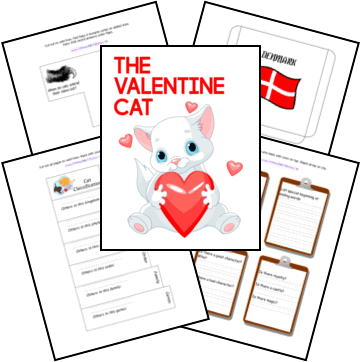
Have your child narrate the story. Type or write your narration of The Valentine Cat and put in a Heart Shaped Book.
Now that you have completed The Valentine Cat, have your child complete Book Report Flaps.
Hundreds of children marched in the parade. Explain to your child that one hundred are ten groups of ten children. Use one hundred pennies to line up and see how many children would be in each row if they marched by 2’s. How about if the marched by 5’s? By 10’s? A fun go-along book for this counting and dividing exercise is One Hundred Hungry Ants by Elinor Pinczes.
Bible
Read John 3:16: For God so loved the world, that he gave his only begotten Son, that whosoever believeth in him should not perish, but have ever-lasting life.
Read 1 Corinthian 13:
Love is
patient; love is kind and envies no one. Love is never boastful, nor conceited,
nor rude; never selfish, not quick to take offense. Love keeps no score of
wrongs; does not gloat over another’s sins, but delights in the truth. There is
nothing love cannot face; there is no limit to its faith, its hope, and its
endurance. In a word, there are three things that last forever: faith, hope, and
love; but the greatest of them all is love.
Read I John 4: 7:
Beloved, let us love one another: for love is of God. And everyone that loveth is born of God, and knoweth God.
We aren’t told in this story when it takes place, but judging by the clothing and architecture, it appears to be during medieval times, also called the Middle Ages. This is the period of European history beginning at the downfall of Rome in 476AD to about 1500AD. If you have “rowed” Five in a Row title Duchess Bakes a Cake, your child may remember a bit about the Middle Ages.
During the Middle Ages, the form of government and society that was set up was called the feudal system. It was based on the ownership of land. While the king of a region owned all the land, he could give possession of tracts to those who worked for and pledged allegiance to him. People were separated into different classes during the Middle Ages. There was the nobility, or vassals, which was composed of people having hereditary title, rank and privileges. The nobility included those that worked directly for the king, mainly having the job of protecting the kingdom. Then there was the clergy, who were in charge of the spiritual needs of society. And then were the peasantry, also called serfs, who worked for the nobles, cultivating the lands and performing the manual labor. Lastly, there were slaves. Many of the nobles owned slaves, who may have been prisoners captured in war, or people who actually sold themselves to the nobles in order to survive. The dream of the serf was to become a nobleman, and the dream of the nobleman was to become a knight.
There are many fascinating books about the Middle Ages. Some possibilities include:
Castle
by David Macaulay
Living in a Medieval Village by RJ Unstead
The Story of a Castle by John S. Goodall
A Medieval Feast by Aliki
Medieval Occupations – (in order of appearance)
Woodcutter - The woodcutter was a medieval profession that involved high risk and loneliness. He would live in the forest and live in temporary dwellings depending on where he was cutting down wood. His lord or overseer would give him other work to do depending on what needed done. Sometimes the woodcutter might have to build a bridge or other project, weed out and make clearings, collect and bundle wood, collect bark for the tanners, help in the sawmill or charcoaling wood for the castle. He was strong and brave and often thought of as being suspicious by the villagers. His job was dangerous. He could be hurt from falling trees, his tools, thieves, or wild animals in the forest. Just like any other job in the medieval city there were stages of wealth and success in the particular job. Not all woodcutters were peasants. Their wealth depended on the success of their crops. Some were woodcutters for the hierarchy, while some were independent woodcutters.
Farmer –The
farmer took his straw to market in a horse drawn cart. Where does straw come
from?
Straw comes from small grain like wheat or barley. Once the grain has been
threshed the by-product is straw which is used for bedding for animals.
If you have a
son keeping a Farm Notebook …review straw facts
Further farm interest: Childhood of Famous Americans: John Deere
http://www.photovault.com/Link/Food/mFarming/crops/Hay.html
Shoemaker – Tell was a shoemaker. A shoemaker is one who makes and repairs shoes. There were more shoemakers in a medieval city than any other job.
Palace Guard – They were the king’s personal military to protect his home.
Chimney Sweeps – Ketch was a chimney sweep, a peasant job. The job of the chimney sweep was to clean all the soot out from inside chimneys. The castle had many chimneys that needed cleaning. Chimney’s are as old as time so this occupation is one of the oldest in the world. Still considered “good luck” for a bride to seen by a chimney sweep on her wedding day or be blown a kiss any day!
King – The king is the ruler of a kingdom and the owner of all the land.
Queen – The king’s wife, who shared in the ruling as well as running her household.
Princess – The daughter of the king and queen.
Maid - a female household servant. A maid is always female;
Entertainers – The royalty and nobles would often hire entertainment. This entertainment could include dancers, jesters, or musicians such as the drummers, fiddlers, and horn players that marched in the parade.
Rabbit Trail
for older student…
Woodland Management /Controlling Forests/
Learn to chop wood or fell a tree (this might lead to discussion about Abe
Lincoln)
Learn how to clean your chimney
Learn more about the various jobs during Medieval Times
Medieval Punishments –
Long ago, the punishments for crime were
often different than they are today. How was Ketch punished for tricking the
king? He was carried out of the city on a broomstick. In the Middle Ages, the
powers that be would often use public humiliation and banishment as punishments
for crime. Do you think Ketch felt humiliated, being carried through the city,
past all the people, on a broomstick? How would you feel? Do you think the
punishment fit the crime? Other forms of punishment for petty crimes included
being publicly displayed in stocks, which were wooden frames with holes to
confine the ankles and wrists. Sometimes the punishments were very brutal, in an
effort to discourage others from breaking the law. It was common to have a hand
cut off for stealing. Sometimes criminals were branded with hot irons on their
face so that everyone could tell that they were criminals. How do punishments
today compare with punishments of the Middle Ages? Which do you think are
fairer? Which do you think are more effective? Record types of punishments in
Medieval Punishments T Book.
Denmark –
While The Valentine Cat doesn’t tell
you where it takes place, the setting resembles that of the illustrator’s
homeland, Denmark. Denmark is a country in Europe, part of what is collectively
known as Scandinavia. It is a flat country to the southwest of Sweden. It is
separated from Sweden by a narrow strip of water called The Sound. Denmark is
made up of many islands. The capital, Copenhagen, is on the largest island,
Zealand. The people of Denmark are called Danes, and the language is Danish. The
flag of Denmark is solid red with a white cross.
Fishing, shipping, and tourism are all important in Denmark. Danish farm products such as butter, cheese, and bacon are known throughout the world. Pork is Denmark’s biggest export.
Denmark is the oldest continuous monarchy in Europe, and has many royal castles such as the one pictured in The Valentine Cat. One of the most famous castles is Fredensborg Palace located north of Copenhagen. This palace evolved in the 18th century. The royal couple still resides and uses it the most of the four castles. It is still used for royal banquets.
Other famous sites in Denmark include the Copenhagen Waterfront, which is always a very busy fishing and tourism spot, as well as the Copenhagen Harbor sculpture, “Little Mermaid”, constructed in honor of the fairy tale by Hans Christian Andersen, who lived in Denmark.
Where in the World is Denmark? Shutterfold
Learn some Danish Phrases
Learn about Royal Castles in Denmark
Lots of Denmark Info
Valentine’s Day has been celebrated for centuries on February 14th. There are many legends as to why the holiday is celebrated, and there were several saints of this name, which the holiday has been said to be named after. One such saint was Valentine, a bishop living in Terni, Italy during the third century. Some say that he was killed because while marriage of the young men of Rome was outlawed, Valentine continued to perform marriage ceremonies in private. Others say that while he was in prison, he sent a love letter to a woman, signing it “From your Valentine”. Another legend says that young bachelors and maids would have pretend marriages on this day, marked by the giving of presents, growing out of the old notion that it was on February 14th that birds first choose their mates. Today, Valentine’s Day is celebrated by exchanging cards and candy among family and friends. How did they celebrate Valentine’s Day in The Valentine’s Cat? Have fun this week celebrating Valentine’s Day, by sending special decorated cards, making heart shaped cookies, and treating each other with a loving heart. Record information on Valentine’s Day Heart Slides and Pocket.
In Denmark,
Valentine’s Day is celebrated in much the same way as it is in America. They do
have some special traditions they follow. Early Danish valentines were created
on transparent paper, so when they are held to the light you could see the
lover’s exchanging gifts. Danish men send a “gaekkebrev” (joking letter) and
sign their names in dots, one dot per letter of the name. If the receiver can
guess the sender she receives a special egg on Easter day! A flower called a
Snowdrop is the Danes special resemblance of love. Danish people send each
other all sorts of snowdrops from candied, paper crafts, to fresh cut snowdrop
flowers. It seems sending pressed snowdrop flowers is the most popular.
Science
The Valentine Cat was a stray. Stray animals are those that do not have homes. People should be very cautious around stray animals. You can’t tell for sure if the animal is just temporarily lost, or if it has always been wild. Stray animals are usually hungry and scared, which can make them dangerous. They may carry diseases. Warn your children not to approach a stray animal. You may want to visit an animal shelter while sharing this book to see how some strays are taken care of and relocated to homes.
Pet Care –
Tell enjoyed having the Valentine Cat for a pet and he took good care of him. Pets are kept for many reasons including companionship, security, rodent control, and to be helpers. Pets are a big responsibility. They need water, food, shelter from the elements, and affection. They need to be protected from predators and diseases. Most need to be brushed and bathed, and cleaned up after. Ketch gave the Valentine Cat food and shelter, but was that enough? No, the cat was sad with Ketch because he was not kind. There are many different kinds of pets, such as cats, dogs, fish, birds, turtles, hamsters, etc. Does your child have any pets? Does he act responsibly for the care of them? As a side note, if you happen to be sharing this book during February, February is Responsible Pet Owner’s Month! For further information you may want to check this website. Have child complete Pet Care Tab Book.
Animal Classification –
The story we are reading is about a cat. All living things are grouped according to their varying characteristics. All living things are first separated into Kingdoms. Cats are members of the Animal Kingdom. The Kingdoms are then broken down into Phylum. Cats are Chordates, which means they have backbones. The Phylum then is broken down into groups called Classes. Cats are Mammals. Mammals share certain characteristics including being warm blooded, having fur coverings, live births and providing milk for their young. The Classes are further broken down into Orders, depending on what kind of eater the animal is. Cats are Carnivores, meaning they are meat eaters. These Orders are then broken down into even smaller groups, called Families. All cats, including both domestic and wild, are in the Felidae family. And the Families are then reduced down to Genus. Domestic cats are of the Genus Felis catus. The domestic cats are then broken up into over thirty different breeds.
Kingdom – Animal
Phylum – Chordates
Class – Mammal
Order – Carnivore
Family – Felidae
Genus – Felis catus
Complete Cat Classification Graduated Book if desired.
Also, as you learn more about cats this week, you may choose to complete Cat Fact Accordion Book, or complete individual books found throughout the lessons.
Cat Growth –
As with all mammals, cats are born by live birth. The mama cat will be pregnant for about two months, and will then give birth to a litter of kittens. They are born blind and instinctually know where to go to mama cat for milk. The first two weeks of their lives they mostly just sleep and eat. Usually around the fourteenth day of their lives, the kittens’ eyes will open and by the twentieth day they will try to walk around, dragging their hind legs. By the time they are a month old they will be able to walk, and will even play with each other a bit. They still depend on their mother for milk. By the sixth week, the kittens will learn to climb, eat out of a bowl, and will be very curious about their surroundings. The mother cat will wean the kittens (stop giving them milk) by the time they are two months old, when the kittens are ready to find new homes. How old do you think the Valentine Cat is when the woodcutter’s daughter found him? Complete Cat Growth Matchbooks and Cover if desired.
Cats are carnivores, which means they are meat eaters. By God’s design, cats have a natural instinct and are equipped with especially designed claws to catch prey, and sharp pointy teeth to kill their meal. What kind of foods did the Valentine Cat eat? Throughout the story, he ate grasshoppers, mice, eels, shellfish, bread, milk, and fish. Which food did he like the least? Cats don’t usually eat grasshoppers, but when very hungry they will move from their regular diet to whatever is available. Sometimes you will even see cats eating grass, to obtain nutrients or fiber that their bodies instinctually know they need. Complete What Do Cats Eat? Simple Fold.
Cats communicate with people in various ways. When they are hungry they say, “meow”. What did the Valentine Cat do when he was scared? When cats are scared, they will cry, hide, hiss, or scream. To show that they like you and that they are friendly, they will rub their fur up against your leg. How did Valentine Cat show Tell that he was happy? He purred. Does your child know what an arched back, or hair rising off a cat’s back mean? That he is angry! Complete Cat Communication Flap Book.
In chapter 6, the Valentine Cat is so happy to be back with Tell that he purrs. Has your child ever wondered how a cat purrs? A cat has little stretchable bands in its throat. When a cat is happy, relaxed, or satisfied, these bands in his throat vibrate. As the cat breathes, the air carries the sound of the vibrations to your ears. To demonstrate how a cat purrs, perform this experiment. Stretch a rubber band between your thumb and finger. Gently pluck the two strands between your fingers and watch them vibrate. If you gently blow throw them you will hear a purring sound.
Cat Eyes -
The Valentine Cat walked around the woods, farm, and village during the night. Did your child know that cats are able to see in the dark? The reason they can see in the dark is also the same reason that their eyes seem to glow in the dark. A mirror-like tissue called tapetum lucidum is located behind the retina in the eye of a cat. When light hits it, it reflects light back into the retina. This helps the cat to see better at night, and also causes the appearance of glowing in the dark. Complete Cat Eyes Lapbook Component if desired.
When the Valentine Cat was put into the chimney, he fought and spread his claws. Cats have four toes on each of their front paws, and one small toe further up its leg called a dewclaw. Cat claws are made of keratin, the same thing as your fingernails. When a cat wants to scratch, catch food, or protect him or herself, it will extend out its claws. Usually, though, a cat will keep its claws retracted into the pads and fur. Cats like to keep their claws sharpened and they do that by scratching at trees, furniture, or a scratching post. Has your child ever noticed how a cat walks? They swing their paws in front of each other, so they walk in a straight line. This is why cats can walk on narrow ledges or fences. Have your child try to walk like a cat, keeping one foot in front of the other. Complete Cat Claw Bi Fold.
A cat has fur that protects its skin and keeps its body warm. Cats rarely need baths because they are constantly cleaning themselves. They lick their fur with their rough tongues, and they lick their paws and use them like a washcloth. Cats continuously lose their fur, or shed. In wintertime they shed less to keep a warm coat on. Domestic cats will often swallow the hair that they lick, and these hairballs may gag or choke the cat. We can help prevent this from happening by brushing the cat regularly so the loose fur does not accumulate. Ask your child if he remembers what Tell saw on the kitten’s forehead after he washed his face? A heart! Complete Cat Fur Tri Fold if desired.
Anatomy (Human
Heart) -
There was a heart shape on the cat’s forehead, as well as heart shapes
decorating the city for the parade. Is your child familiar with the function of
the human heart? It is a strong muscle about the size of your first, and never
stops pumping. Your heart is actually two pumps that work side by side. The
right side pumps blood to your lungs, where it picks up oxygen. The left side
pumps the oxygen filled blood out and through your body more than 1000 times a
day. Your cells need oxygen to keep you alive. Each side of your heart has two
chambers, called auricles and ventricles. A fun and informative book about the
human body is Blood and Guts by Linda Allison. It includes many
experiments as well as instructions for dissecting a lamb heart, which is very
similar to a human heart. Maybe your child would like to create a model heart or
draw a sketch to add to your lapbook. Complete
Heart
Chambers Lapbook Component
if desired. Answer key:
1. Left auricle. 2. Left
ventricle, 3. Right auricle. 4. Right ventricle.
Lots
of info and printables about the heart
Fire for Warmth –
Tell wondered why
the Valentine Cat wasn’t staying warm next to his fire. Fires have been keeping
people warm for thousands of years. There are three things that are needed for a
fire. First needed is something to burn, called fuel. In The Valentine Cat
the fuel that was used was wood. What kind of fuel do you burn to keep warm? Do
you have a wood or coal stove, or maybe an oil or propane furnace? Discuss with
your child what the fuel source you use to heat your house is, and maybe even
show him where it is and where the source comes from. The second thing needed to
have a fire is heat to start the fuel burning. Thousands of years ago, before
matches were invented, people would use friction between two objects to create
enough heat to start a fire. Today, we can start a fire with matches, or with an
electrical spark. The third thing needed to burn a fire is oxygen. Without
oxygen, the fire will smolder out. As you read Chapter 4 of The Valentine Cat,
discuss with your child why a fire wouldn’t burn in the fireplace. The chimney
was clogged so no oxygen could get to the fire. Do an experiment to demonstrate
how a fire needs oxygen. Light a candle. Carefully place a glass jar over it,
cutting off its supply of oxygen. What happens? You may want to use this lesson
as an opportunity to discuss fire safety rules in your house. Keep in mind that
you need to take away any one thing, fuel, heat, or oxygen, to make a fire go
out. Review “stop, drop, and roll” with your children, and review your fire
emergency plan. Complete
Fire Triangle
Accordion.
Art
The illustrator of The Valentine Cat is Leonard Joseph Weisgard. He was born in New Haven, Connecticut on December 13, 1916. As a student in a public school in New York, at age 8, he realized children’s books lacked in great art. He studied art at Pratt University where he gained an appreciation for primitive, Renaissance, and Gothic Art. His art styles varied, as did his art supplies and color palettes. In 1939, the first of more than 24 books he illustrated/wrote with close friend Margaret Wise Brown was published. Mr. Weisgard died when living in Denmark on January 14, 2000. He was quoted as saying, “Books have always, for as long as I can recall, been a source of real magic in this wildly confusing world.”
Refer to Discovering Great Artists by Mary Ann Kohl.
Here are a couple of links to fun Valentine Pop-up Cards to make:
http://www.ruthannzaroff.com/mirkwooddesigns/popheart.htm
http://robertsabuda.com/popmakeheart1.html
Hands On Art -
Make a heart shaped Cat using various sizes of hearts (head is upside down
heart, ears is right side up heart, nose is heart, etc…) Patterns and ideas
found here:
http://www.dltk-holidays.com/valentines/mcat.htm
Examine the various crests and flags decorating the coach and town during the parade. Using red and white felt or construction paper, have your child decorate a room for Valentine’s Day, making his own crests and flags. Be sure to take pictures to include in lapbook.
Make a heart and paper Kitty Valentine Wreath
Traditional woven paper hearts
patterns
Lots of Valentine’s fun
bible and secular
Child’s
Personalized hand in heart keepsake
Just For Fun
http://www.dltk-holidays.com/valentines/crafts.htm
Beautiful Stories of Shakespeare by Nesbit (easier for younger children with sketches) HAMLET, page 95-104
Tales From Shakespeare by Charles and Mary Lamb (page 268-286)
Your child will probably at some point hear these famous quotes from Hamlet:
"To be, or not to be: that is the question." Act 111, Scene 1
"This, above all: to thy own self be true." Act 1, Scene 111
Expose your child to a picture of the William Shakespeare and discuss briefly who he was. Here are some links to help:
http://en.wikipedia.org/wiki/William_Shakespeare
http://www.william-shakespeare.info/william-shakespeare-biography.htm
http://www.pbs.org/shakespeare/works/work167.html
http://www.william-shakespeare.info/shakespeare-play-hamlet.htm
Cooking -
Plan a Danish Valentine party for your family from what you have learned this
week. Maybe you would enjoy serving some
Danish pastries.
http://goscandinavia.about.com/od/thingstodo/p/legoland.htm
Throughout the week have your child run, jump, climb, play, and curl up like a cat.
Glue Cat Joke Mini Shape Folds throughout lapbook.
Homeschool Share Tie-ins -
Princess Unit
Valentines Day
Castle Diary