| HSS Forum HSS Blog Ami's Blog - Walking By The Way HSS on Facebook | ||||||
| about us |
what's new
|
unit studies | unit study helps |
fiar resources
|
indexes | lapbooking |
Three Snow Bears
| Author/Illustrator: Jan Brett ISBN: 0399247920 Summary: Aloo-ki glances up from fishing and sees her sled dogs floating off on an ice floe. She races after them and comes upon an igloo. Being a curious girl, she goes inside only to find no one home. That’s because the polar bear family who lives there is out walking while their breakfast cools off. Aloo-ki eats some soup, tries on their boots, and finally crawls into the smallest bed for a nap. Meanwhile, Papa, Mama, and Baby Bear see her dogs adrift, swim out to rescue them and return home to find Aloo-ki fast asleep in Baby Bear’s bed. |
Unit and Lapbook prepared by Ami Brainerd
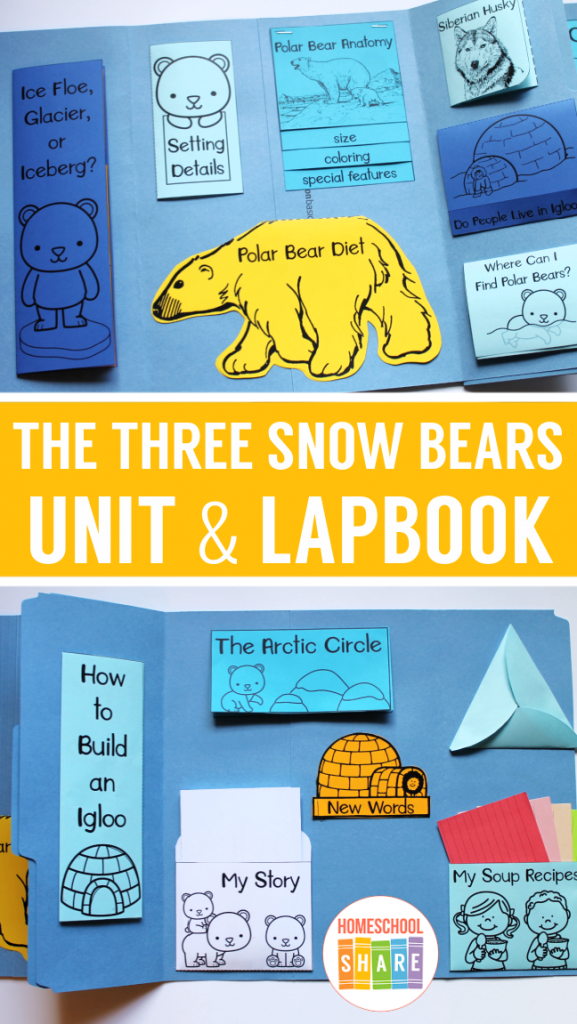
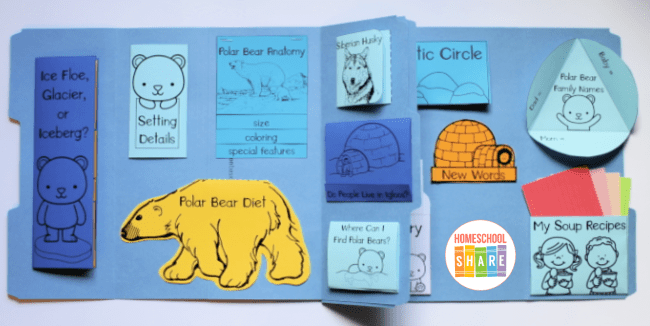
Lapbook
|
Canada Flag Simple Fold Minit
Book |
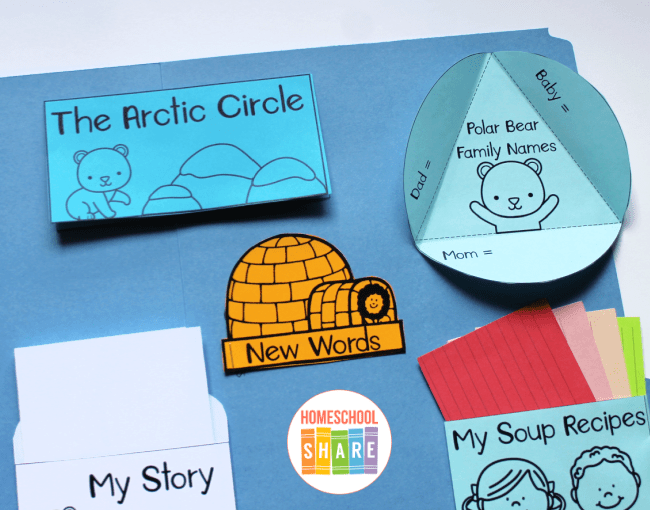
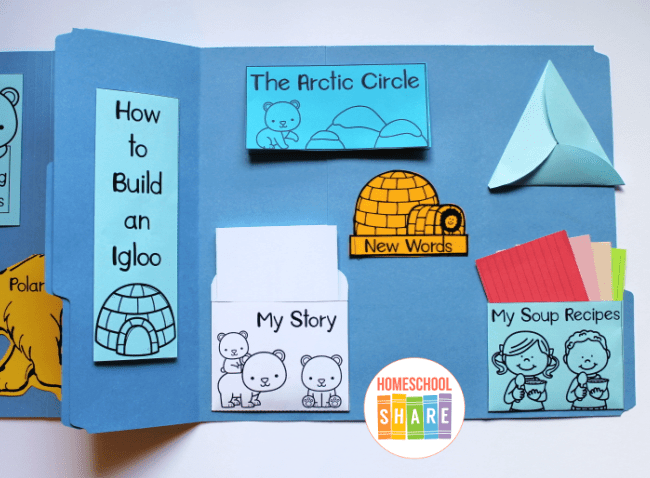
My Story Pocket |
|
Nunavut Territory
Flag Simple Fold Minit Book |
My Pre-writing |
|
Maps Twice Folded
Book |
Vocabulary Igloo Shape
Book |
|
Polar Bear
Family Names & Where can I find Polar Bears? (included in the same file) |
Imaginary
Lines & Arctic Circle Map (included in the same file) |
|
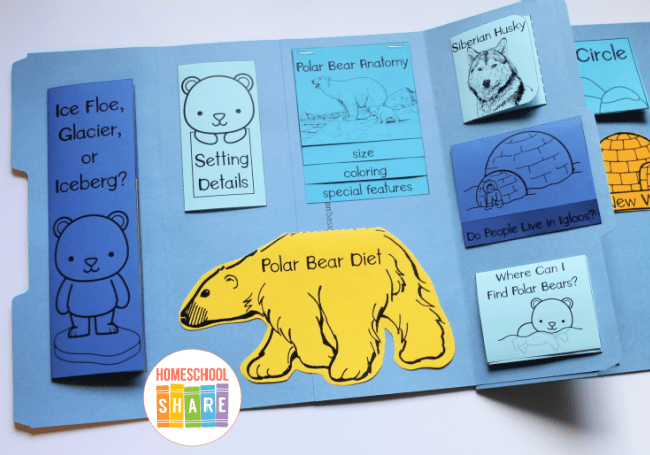
Ice Floe, Glacier, or
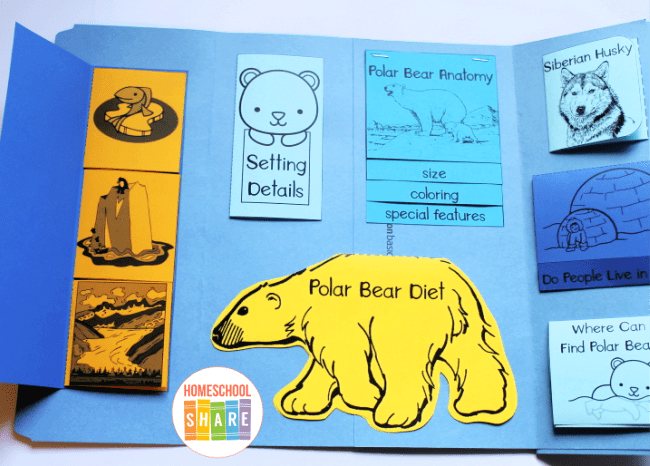
Iceberg? Side by Side Book |
Polar Bear Anatomy
Layer Book |
|
Venn Diagram (compare and contrast two versions of the story) |
Setting ~ Details
& Siberian Husky Tri-Fold |
|
Do People Live in Igloos?
Matchbook |
Polar Bear Diet Shape Book** |
|
Polar Bear Family Names
with text by Tristan Rowlee |
Soup Recipes Pocket
|
| Buidling an Igloo by Tristan Rowlee |
**I didn't have room in the file for
directions, so here they are: Fold book in half. Carefully cut
around polar bear shape. Cut out rectangles (on the dotted lines).
Discuss the facts with your student and let him paste them in the polar bear
shape book.
Other ideas
~watch the Jan Brett video and include your student's drawing in his lapbook
SOCIAL STUDIES
Geography: Nunavut
Territory (Baffin Island) in Canada
If you read the back flap of the book (hardcover), you will learn that Jan
Brett traveled to the arctic region of Canada to learn more in order to
write this book. Specifically, she went to Baffin Island found in Nunavut
Territory. Locate those places on your map or globe.
Baffin Island It is the largest island in Canada and the fifth largest island in
the world. The capital of Nunavut, Iqaluit, is located on the southern
coast.
Geographical Features
An older student may also want to mark the following on his map:
The island itself contains a rocky mountainous region, the highest peak being
Mount Odin.
The two largest lakes on the island are in the central south of the island
Nettilling Lake and further south Amadjuak Lake.
(See Science section for a lesson on animals that live on Baffin Island.)
Lapbook Components:
Canada Flag Simple Fold Minit Book
Nunavut Territory Flag Simple
Fold Minit Book
Maps Twice Folded Book
Inuit Culture
Inuit is a general term for a group of culturally similar indigenous peoples
inhabiting the Arctic regions of Alaska, Greenland, and Canada.
Clothing
The Inuit make clothes and footwear from animal skins. The anorak (parka)
is important. It is a type of heavy jacket with a hood, often lined with
fur to protect the face from freezing temperatures
and wind. In some groups of Inuit, the hoods of women's parkas (amauti) are made
extra large, to protect the baby from the harsh wind when snuggled against the
mother's back. Boots (kamik or mukluk) could be made of caribou or sealskin, and
designs varied for men and women. Look through the illustrations and
notice the parkas and the boots. You may want to point out to your
student that the mother bear's parka (as well as the baby bear's) dips down in
the front; this is a style worn by females (giving us a clue that baby bear is a
girl).
Food
The traditional food of Nunavut, also called "country food" is seal, caribou,
ducks, geese, ptarmigan, arctic hare, berries, clams, arctic char, cod, walrus
and some plants.
Inuit
Recipes
Shelter
An igloo is a dome like structure made
of snow blocks which are placed layer upon layer in a continuous circular line
(like a snail's shell!). Do the Inuit live in igloos?
Contrary to popular stereotypes, the Inuit do not live in igloos; they live a
permanent type of housing. The Inuit in Canada do make igloos, but they
are used as temporary shelters for hunting or recreation (such as a party or
holiday) .
Lapbook Component: Do People Live
in Igloos? Matchbook
Language
Seventy percent of Nunavummiut speak Inuktitut as their first language. If
you print out the informational pages (see links section) from Jan Brett, you will
notice many words in this language.
Geography: Arctic Circle
Discuss the imaginary lines on the globe. The Arctic Circle is an imaginary
line around the Earth (at about 66°33' North Latitude) that defines the boundary
of the Arctic. It marks the start of the area where, for at least one day each
year, the sun does not completely set (June 21) or rise (December
The arctic is the most northern part of the earth (and one of the most cold -
and one of the coldest places on Earth. At the center is the Arctic Ocean -
covered by a thick ice cap and surrounded by the northern parts of North
America, Europe and Asia. Show your student the artic circle on your globe.
22).
Lapbook Components:
Imaginary Lines & Arctic Circle Map
Geography: Ice Floe
What is an ice floe? It is a large, flat, sheet of sea ice that has
broken off contact with the coast where it was formed and is floating in open
water. See if your student can find ice floes pictured in the story.
How many can he count?
This may lead you and your student into a discussion of glaciers or
icebergs.
A glacier is a river of ice,
mostly on land. It is fed by snowfields in the mountains and flows down a
valley, like a very slow moving river, until it meets with the sea or a
lake.
An iceberg is a large piece of ice floating in water. It may have broken off
a glacier or it may have been part of an ice shelf (a continuous field of
ice usually floating on water but not moving).
Lapbook Component: Ice Floe, Glacier,
or Iceberg? Side by Side Book
LANGUAGE ARTS
Elements of a Story: Setting
The setting plays an important part in this story. Setting is
the time, location and circumstances in which a story takes place. Discuss
the setting of this story. How does it influence the story? It
changes tons of details from the original version, doesn't it? By moving
the story out of the forest and into the arctic, Jan Brett gets to create an
entirely different world! Look back through the story and help your
student determine the details that are a result of the setting (clothing, the
igloo, eating soup, the animals, etc.).
Lapbook Component: Setting ~
Details Simple Fold (includes two books in one file)
Re-telling a Story
Ask your student if this story is similar to another story he's heard before
(Goldilocks and the Three Bears). If possible, locate a copy of Jan
Brett's version of Goldilocks and the Three Bears. Make a
chart (or use the prepared Venn Diagram) to compare and contrast the details of the two
stories (the bear family, the intruder, the setting of the story, what the
intruder eats/does in the house, how the story ends, etc.). If your
student is excited about this exercise and seems to want more, locate other
versions of Goldilocks and the Three Bears. Read and discuss the
similarities and differences. Which version is your student's favorite?
Let your student retell the story, too! First, you will need to do some
pre-writing. Explain what pre-writing is. Tell your student that you
are going to "brainstorm" some ideas for a story-- that you are going to write
down your thoughts in order to organize them and gather ideas before you start
the actual story writing. Being prepared for writing usually makes the
story better. Make a list to help you with
your pre-writing.
Where will the story be set? This needs to be determined first (refer to
setting lesson).
Who will be the intruder?
What kind of bears or animals will your student write about?
What kind of food will they make?
In what three ways will the intruder violate the home of the animals?
What will happen when the animals find the intruder?
Lapbook Component: My Story
Pocket
Vocabulary
stroll- to walk in an unhurried way (demonstrate this word for your student)
ducked- to lower the head or body suddenly
fancy- not plain
mound- a small hill or heap of dirt or stones
adrift- without power or anchor
current- a fluid body constantly moving in a certain direction
Lapbook Component: Vocabulary Igloo
Shape Book
Speaker Tags
You can explain (to a young writer) that there are many ways to say the word
said. Read through the book and make a list together of all
the different words Jan Brett uses instead of said (yowled, cried out, shouted,
grumbled, murmured, etc.). The next time your student writes (or dictates)
a story, encourage him to replace a few of his "saids" with other words.
Letter Writing
Write Jan Brett a letter and let her know how you liked the book!
She will probably send you a letter back, so save some space in your lapbook for
her reply.
Jan Brett
Post Office Box 366
Norwell, Ma. 02061
Listmaking (just for fun!)
The Inuit have about 125 different words to describe and say the word “snow”;
this may highlight how important snow is to their culture. How many words do you
use to describe snow? Make a list and see!
SCIENCE
Biomes: Tundra
A biome is a group of plants and animals living in a certain environment.
Discuss the environment in this story. What's it like? The
type of biome is called tundra which is the coldest and driest of all the
biomes; it is also very large covering about one fifth of the land on earth.
A tundra is characterized as being
a treeless plain especially of arctic regions having a permanently frozen layer
below the surface soil. Even though you think plants wouldn't survive,
plants do exist! Plant life made up mostly of mosses, lichens, herbs, and
very small shrubs. (See next lesson for animals that can survive in
this type of biome.) With an interested student, explore the biome that
you live in. What is it called, and what is your environment like?
Arctic Animals
Look through the book . What animals does your student recognize?
Help him name the ones he doesn't. Discuss what must be special about
arctic animals (they can survive/withstand extreme cold temperatures), and
choose a few to learn more about!
1. Siberian Husky
The Siberian Husky is an affectionate, powerful, active, and muscular sled dog
from the Arctic. This hard-working dog is known for its incredible endurance. It
is a fast runner with a smooth gait. Huskies are often put on dog teams in the
Iditarod dog sled race in Alaska. It is also a very clean dog that
carefully grooms itself. Generally a quiet dog, the husky doesn't bark,
but howls and makes a woo-woo sound.
Anatomy
~medium sized
~long, thick, double coat (a short, dense, oily under layer, and a long, coarse
guard coat)
~variety of colors and patterns, usually with white paws and legs, facial
markings, and tail tip
~most common colors are black and white, grey and white, copper-red and white,
and pure white
~in some huskies, the eyes are two different colors (one blue, one brown); this
train is called a "pinto eye," a "parti eye," or a "split eye."
Lapbook Component: Siberian
Husky Tri-Fold (same file includes setting minit book)
2.
Polar Bear
Polar Bears are found in Canada, Alaska, Russia, Finland, Greenland, and Norway.
In Nunavut polar bears are most prevalent on Baffin Island where their are
plenty of seals for them to eat. Polar Bears can also be found
Anatomy
~ the largest land carnivores (meat-eaters) in the world
~ the largest members of the bear family
~ thick layer of fat (also known as blubber) under their skin helps them stay
warm
~ black skin helps absorb heat from the sun
~ round, compact body
~ black eyes, nose, and tongue
~ hair isn't white, it is actually clear
~ amazing sense of smell (they can smell a dead meal up to 20 miles away and a
live seal under three feet of ice)
~ very good swimmers using their front paws (with webbed toes) to paddle and
their back paws to steer
~when on the ice, their large feet are used as snow-shoes
Diet
~ a polar bear's primary food source is seal; it also hunts fish, seabirds,
reindeer, and walruses
~ in the summer they will also eat vegetation and berries
~ they do not drink water
~ polar bears eat a lot in order to stay fat (so they can keep warm)
~ a polar bear's stomach can hold up to 150 pounds (wow!)
Family Names
A mom is a sow. She gives birth to small (about the size of a rat) cubs.
The dad is known as a boar.
Lapbook Components:
Polar Bear Family Names &
Where can I find Polar Bears?
Polar Bear Anatomy Layer Book
Polar Bear Diet Shape Book**
(instructions at the top of the unit)
3.
Arctic Fox
This animal can usually be found where polar bears venture on the fast ice close
to land in their search for seals. Arctic foxes are scavengers, and often follow
polar bears to get their leavings. On Baffin Island, Arctic foxes are sometimes
trapped by Inuit.
Anatomy:
~fur of the Arctic fox is white during the winter and gray-brown in the summer
~20 inches long plus a 12 inch long tail
~long, bushy tail (sometimes called a sweep), helps the fox change direction
quickly and keeps the fox's feet and nose warm when it curls up to sleep ~sharp,
curved claws
~sharp teeth
~thick, insulating fur
~small ears
Diet:
~carnivores (meat eaters)
4.
Arctic Hare
These animals are found throughout Baffin island and hunted by foxes, wolves,
and lemmings.
Anatomy:
~about 21 inches long with a 2 inch tail
~weighs about 12 pounds
~powerful hind legs and huge hind feet (helping them leap on the snow)
~short ears
~their pure white coats molt to a gray-brown in summer
Diet:
~herbivores (plant eaters)
~diet consists of willow leaves, bark, shoots, other tree leaves, grasses, and
herbs
5.
Lemming
Found throughout Baffin Island. They are hunted by Arctic foxes, Arctic
wolves and the snowy owl. In the winter, lemmings dig complicated tunnel systems
through the snow drifts in order to get to their food supplies.
Anatomy
~small and mouse-like
~short tail
~pointed snout
~small ears
Diet
~grasses
~lichens
6. Arctic Wolf
The arctic wolf is also a year-round resident of Baffin Island. Arctic wolves often do not
hunt in packs, although a male-female pair may hunt together.
Anatomy
~smaller than other wolves
~thick, white fur
~three feet long with a tail (one foot long)
~strong jaws and sharp teeth
~their great senses (smell, eyesight, and hearing) help them hunt
Diet
~caribou
~lemming (especially on Baffin Island)
~they can hold up to 20 lbs. of food in their stomachs
7. Ringed Seal
Also known as also known as the Jar Seal (and as Netsik or Nattiq by the
Inuit), it lives
off-shore of Baffin Island within five miles of the land. During the winter, it makes a number of
breathing holes through ice which is sometimes eight feet thick! It visits
each hole and keeps them open and free from ice. In the summer, ringed seals keep to a narrow
territory about two miles from the shoreline. They will venture out a bit
further if pack ice moves in; they will follow it, drag themselves up to an
ice floe, and get some sun!
Anatomy
~light grey coat that is spotted black with the spots often being surrounded
with lighter ring markings
~no ears
~fully grown ringed seal weighs 180 to 240 pounds and is 56 to 67 inches
long
Diet
~ FISH! specifically: polar cod, herring, smelt, whitefish,
sculpin, perch, and crustaceans.
8. Snowy Owl
Anatomy
~20-27 inches long
~weighs about 3.5-4.5 pounds
~black bill
~round head
~lots of feathers on legs
~white with peppered dark spots; the male has more white than the female
~yellow eyes and very good eyesight
~fluffy feathers give silent flight making it easy to sneak up on prey
Diet:
~carnivores
~excellent hunters
~diet consists of small rodents (lemmings and voles), hares, rabbits,
ptarmigans, ducks, and geese
9. Other animals you may find on Baffin Island include long-range travelers
such as the arctic tern along with a variety of water birds: coots, loons,
mallards, and many other duck species.
Water species that visit Baffin Island in the summer are:
harp seals
walrus
beluga whales
narwhals
bowhead whales
APPLIED MATH
Comparing Sizes
The original story of The Three Bears, this book presents
us with the concept of small, medium, and large. You can use a
variety of household objects (maybe bowls, chairs, and shoes) as manipulatives
to present this concept to your young student. You can also
introduce or review the concept of small, smaller, smallest, etc. with
your student.
ART
Facial Expressions
Jan Brett does a wonderful job with facial expressions. Look through the
illustrations through the book and discuss the different facial expressions of
the characters. Ask your student, "How do you think this bear feels right
now?" If you have other Jan Brett books, you may want to look through
other books (Daisy Comes Home is another good example), and pick out characters
with great facial expressions. What kind of expressions can you see on the
faces of the characters? Surprise? Wonder? Confusion?
Watch the video to learn more about facial expressions and how to convey emotion through a character's eyes.
How to
Draw a Baby Polar Bear
You may also want to play the eyes game that Jan Brett shows in the video.
Turn around so that your student can't see you. Cover your mouth and
nose and think of an emotion. As you turn back around, display that
emotion on your face while keeping your mouth and nose covered. Can
your student tell your emotion simply by seeing your eyes? YES!
Isn't it amazing how important eyes are in illustrations?
JUST FOR FUN
Make a sugar cube igloo!
From Jan Brett's Website:
Mural to Color
Three Snow Bears Coloring Page
Polar Bear Facts
The Wonderful
Inuit People
Sled Dogs and
Owls
Bookmarks
Iron on Transfer
Greeting Cards