| about us |
what's new
|
unit studies
|
unit study helps |
fiar resources
|
indexes | lapbooking |
Twinkle, Twinkle, Little Star
| Author/Illustrator:
Iza Trapani ISBN:1 879085704 Summary: A little blonde girl gazes out of her window at a twinkling celestial object, greets it with the traditional childhood rhyme of the title, and requests that she might have her wish that night. Her wish comes true when the smiling star appears in her window and takes her on a magical ride through the sky. The combination of serene, lovely landscapes and a cartoon, smiley-faced star has a hodgepodge effect. Unit prepared by Rachel Harris Lapbook by Robin Diedrichs |
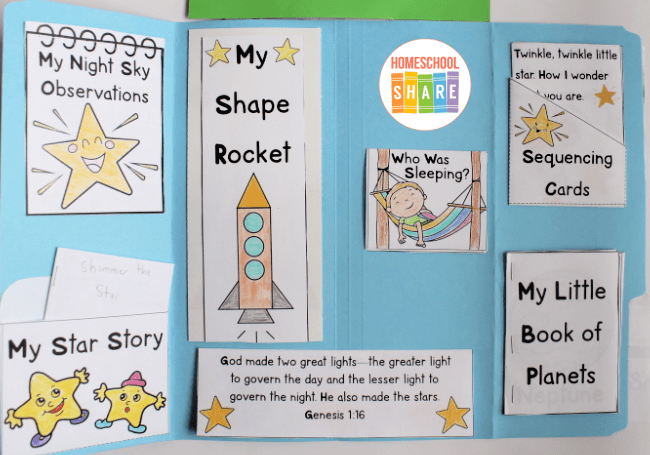
Lapbook Templates
Language Arts:
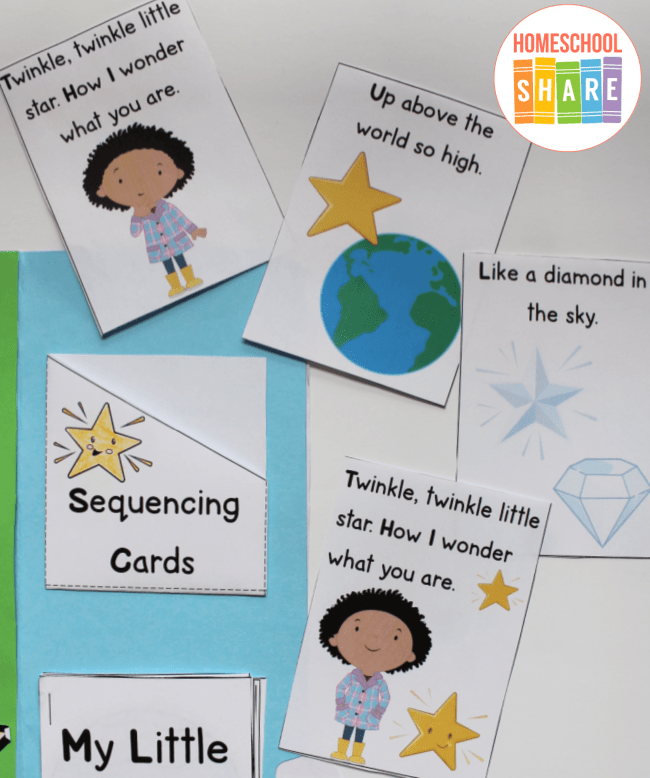
Describing Sights in Nature- In the story, and familiar song, the words “Up above the world so high, like a diamond in the sky” is a simile, comparing the star to a diamond.
Bring a blanket
outside with your child and stare up at the night sky. What does your child
think the stars look like? Can they see any shapes or designs with the stars?
Have fun with your child coming up with more examples of similes from other
stories or ones you make up yourself. You may want to extend this
opportunity by looking at clouds, flowers, and other sights in nature.
What do the clouds look like? Have fun with your student as you
observe God's wondrous works!
Go-along book:
It
Looked Like Spilt Milk by Charles Shaw
Comprehension and Learning to Pay Attention- After you read the story,
ask you student if he remembers who was sleeping. Can he remember?
Read through the story one more time and complete the
Who was
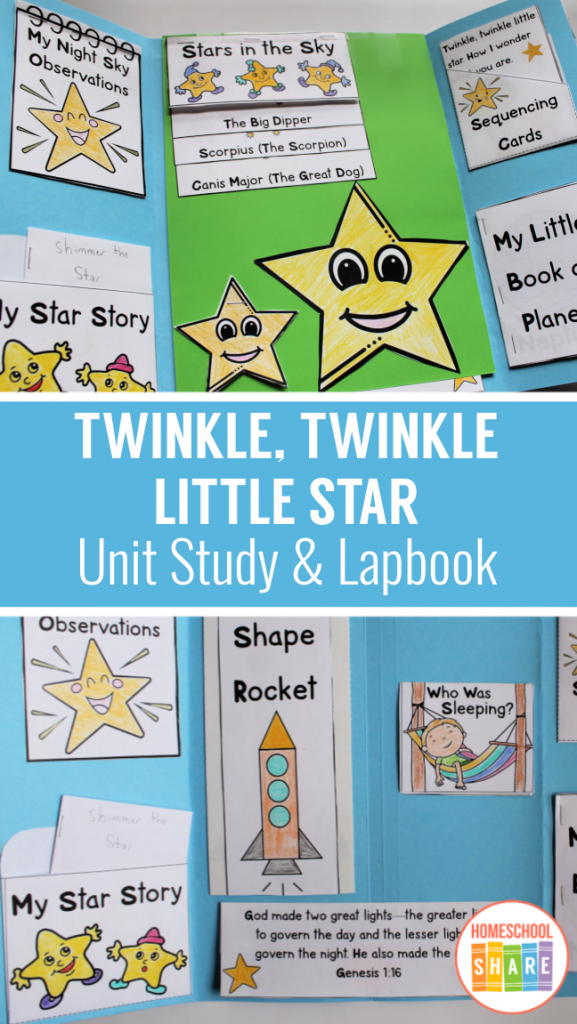
Sleeping? T-book
Letter S
Learn what sound the Letter S makes. Use the
S is for Star
book for reinforcement.
Vocabulary–
Orbit – the path taken by one body circling around another body (act this word out with your student)
Star – a natural body visible in the sky especially at night that gives off light or shines by reflection; a ball shaped gaseous celestial body of great mass that shines by its own light.
Twinkle – to shine or cause to shine with a flickering or sparkling light.
Harbor – a part
of a body of water protected and deep enough to be a place of safety for ships.
Art/Music:
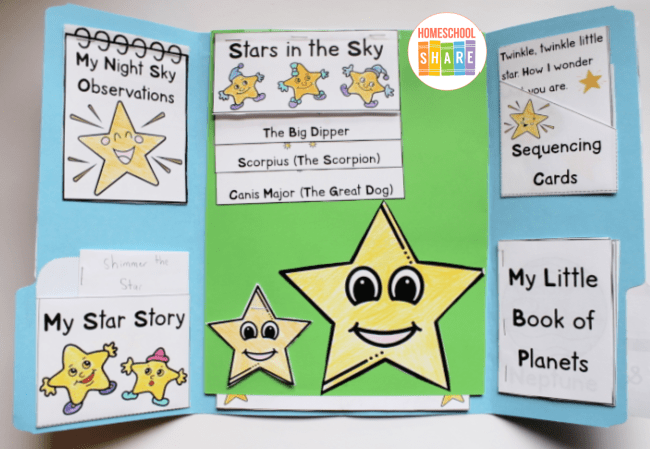
Personification in Art – Personification is defined as the representation of a thing or idea as a person or by the human form. This device can be used as a literary device or in illustrations. In this book, the illustrator uses personification with the star, acting as though the star could talk and take the little girl on a real adventure. Discuss with your child the likelihood of a wishing star coming to their window and taking them on a grand adventure! Pretend with your child for awhile, and ask them what sort of adventures they think a star would bring them on, or what they would like to experience. You may even want to help your student create and record a star story. To illustrate the story, let your student draw or color a star then add some google eyes. You can store the story in the My Star Story Pocket
Song –“Twinkle Twinkle Little Star” is a popular nursery rhyme, first
published in 1806. At the end of the book, they have the music notes for the
song, and the story broken down into verses to be sung. Go back with your child
and reread the story as a song! The melody of “Twinkle Twinkle” is a very
popular one, sharing it with the “Alphabet Song,” and “Baa, Baa, Black Sheep”
among others. Discuss this with your child and sing each one together, noting
how they each have the same melody. Can your child think of any other songs
that might have the same tune?
Learn some more songs and poems about space and stars --
Star and Space Poems & Songs
Layer Book
Science:
Planets –
In the story,
the star tells the girl to “see the planets – count them all, some are big and
some are small.” Can your child name all of the planets? Even though Pluto was
recently demoted from “star” status, it is still commonly included in children’s
stories and rhymes to remember the planets names, so you may choose to include
it here. The planets, in order from closest to the Sun, are: Mercury, Venus,
Earth, Mars, Jupiter, Saturn, Uranus, Neptune and Pluto. There are many
popular Acronymns to remember these names, including my personal favorite “ My
Very Educated Mother Just Served Us Nine Pizzas.” (If you desire to leave
Pluto out, you can learn "My Very Educated Mother Just Served Us Nachos.")
Can you child come up with any other fun acronymns to help remember the names of
the planets?
As far as size, planets are classified as terrestrial or Jovian. The
terrestrial planets are similar to Earth in size, and include Mercury, Venus,
Mars and of course, Earth. Jovian planets are much larger in size, and these
include Jupiter, Saturn, Uranus and Neptune.
Planets with Pocket
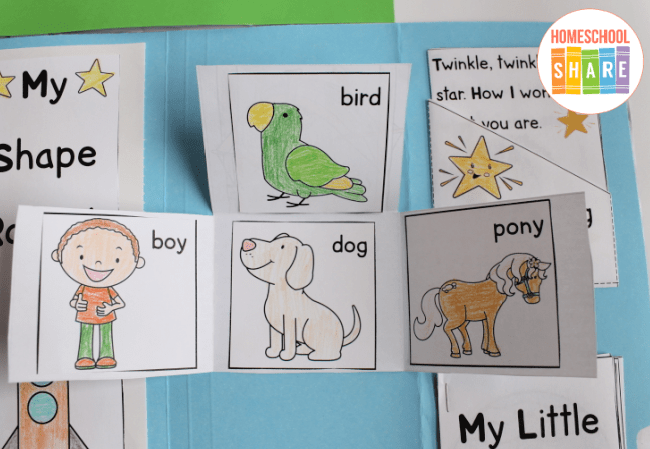
Animals – In the story, the star shows the girl “puppies in their bed and a pony resting in his shed.”
Has your child ever wondered what the difference was between a pony and a
horse? According to The Columbia Electronic Encylopedia, “a pony is actually a
small horse, officially any horse under 14.2 hands (58 in./ 145 cm) high.”Some
ponies are only 26 inches high!”
Has your child ever wondered how long a dog is considered to be a puppy? While
it can be common to call any small dog a puppy, regardless of age, traditionally
a puppy is a young dog, usually one less than a year old.
Biblical Application
God made two great lights—the greater light to govern the day and the lesser light to govern the night. He also made the stars. Genesis 1:16
Find this verse
in your preferred version or children’s Bible. Discuss with your child the
Creation story, and how God made everything around us. Go out on a clear night
with your child, and look up at the sky. Have your child try to count the stars
they can see… can they do it? Help instill a sense of awe not only for
the creation, but also for the Creator.
There are so many in the heavens, just like there are many people on the earth.
Yet each one of us is special, and while God created each and every star in the
sky, He also created each and every one of us. Tell your child how special they
are, and how loved they are by their Heavenly Father!
Bible Verse Simple Fold
Social Studies
(for older students)
In the story, the star tells the little girl that he guides ships to the harbor, and travelers find their way back home.
There are records of boats large enough to carry goods to trade as early as 3500 B.C. This time is said to be the “birth of the art of navigation.” While the earliest navigators tried to stay close to land and use landmarks easily identifiable, occasionally they did sail at night or away from land. These sailors were able to determine their location by observing the location of the sun during the day, and the North Star at night. It wasn’t until the 13th century that the first magnetic compass was invented, and that was only used when weather obscured the sun or North Star!
Historically, the North Star has been used for determining direction of the North and determining latitude in navigation. According to Wikipedia, “It always appears due north in the sky, and the angle it makes with respect to the horizon is equal to the latitude of the observer.” The North Star cannot be used for navigational purposes south of the equator, as it is only visible in the Northern hemisphere.
Math
Patterns
Let your student explore the idea of pattern making using the
Space Patterns Printable
Counting
Count to five with the
Counting Star
Measurement (for older students):
In
the story, the star tells the girl that they will fly “Higher than a bird would
go.” How high does a bird fly? According to an essay from Stanford University,
most birds fly below 500 feet except during migration. When migrating, however,
birds often climb much higher, with most migrating birds in the Caribbean flying
around 10,000 feet and migrating Whooper Swans in Northern Ireland flying around
29,000 feet!
How far is 500
feet? That is a little less than a mile, a little more than one and a half
football fields, and the height of a 50 story building. A foot is equal to 12
inches., which is the size of a standard ruler. Have your child grab a rule and
measure 12 inches and tell them that is only equal to 1 foot, where as a bird
normally flies around 500 feet in the air. You and your child can determine how
far you would like to take this. Maybe you can take out a long sheet of butcher
paper and measure how long that is, in comparison to 500 feet. Maybe your child
would like to measure how tall you are, or other tall items in your home. How
high is your home?
Just for
Fun! (ideas contributed by Robin Diedrichs)
Make a Space Bubble
1.Using dark plastic sheeting that you get in a hardware department, cut one piece 15’X12.5’ and fold it over lengthwise (dimensions should now be 7.5 X 12.5). Cut off 5’ from the width and save. Now your dimensions are 7.5 X 7.5.
2. With large piece of sheeting folded (7.5X7.5) tape the pieces of sheeting together on two of the open sides using duct tape. Tape the extra piece of plastic cut from the original piece of plastic to form a tunnel. Attach it to the open side of the large piece all the way to the left or right and attach the end of the tunnel to a box fan. On the other side of the tunnel attach a piece of plastic to form a flap for a door.
3. When the box fan is turned on it should blow up the plastic to form a bubble which you can crawl into.
4. You can hang things inside by attaching the item to fishing line and attaching the fishing line to a toothpick. Using a pin poke a small hole and then put the string through the hole and attach to the toothpick. You can hang stars and planets painted with glow in the dark paint.
Dress-Up
Make a space suit by making helmets from milk jugs and aluminum foil. Take sponges used to wash cars and strap them on your child’s feet using rubber bands. Make air tanks with soda bottles.
Make a Rocket
Using assorted recyclables have your child design and make a rocket. Another idea is to make a balloon rocket.
Run a thread a string through a straw and run the string all the way across your room. Next attach the end of a long balloon to the string. Blow up the balloon, move it to one side of the room, and let go. The straw and balloon will move across your room along the string. During playtime let your children blow up the balloon with a bicycle pump or with their mouth and launch it.
Another fun activity to do is to use Alka-Seltzer in a film canister to make
a rocket. Put a small piece of Alka-Seltzer and a small amount of water in
the canister. Put the lid on quickly and stand back. The lid will be
launched into the sky. Baking soda and vinegar will achieve the same
results. Wrap the baking soda in a small piece of toilet paper, drop it in
the canister, with a small amount of vinegar, put the top on, and stand
back. You can make a rocket shape to attach to the canister as well -
http://www-tc.pbskids.org/zoom/printables/activities/pdfs/filmcanisterrocket.pdf
. Oftentimes you can get the film canisters at a photo shop like Wal-Mart.
Make a telescope
Make a telescope from a paper towel roll. Have your child decorate the outside as desired. Put a double layer of black tissue paper on the end with a rubber band. Using a pin, have your child poke holes to make a constellation. When your child looks through the telescope while it is held toward a light source he/she will see the stars.
Constellations
Make constellations using a Lite-Brite.
Resources
Web Links:
Library List
Draw Me A Star by Eric Carle
The Glow in the Dark Night Sky Book by Clint Hatchett
Roaring Rockets by Tony Mitton and Ant Parker
My Picture Book of the Planets by Nancy Krulik
The Magic School Bus Lost in the Solar System by Joanna Cole or watch the movie