| HSS Forum HSS Blog Ami's Blog - Walking By The Way HSS on Facebook | ||||||
| about us |
what's new
|
unit studies | unit study helps |
fiar resources
|
indexes | lapbooking |
Time of Wonder
| Author: Robert McCloskey ISBN: 0670715123 Summary: Follows the activities of two children spending their summer vacation on an island off the coast of Maine. |
Literature Based Unit Study Written by Ami Brainerd (Art Lesson ideas from Wende)
Lapbook Templates by Lee Ann Slosar and Ami Brainerd
More Printables for Your
Lapbook
Land Form Cards from
Montessori
Materials
Geography: Islands and
other landforms
An island is a piece of land surrounded by water. You may want to take
this opportunity to teach your student about other various landforms that are
similar to islands yet different. Click
here for pictures matching the landforms. Your student can use the
terms and pictures to make index cards or a mini book.
island- a piece of land surrounded by water
isthmus-
a narrow strip of land
connecting two larger landmasses. An isthmus has water on two sides
atoll- a ring (or partial ring) of
coral that forms an island in an ocean or sea
archipelago-- a group or chain of
islands clustered together in a sea or ocean.
peninsula- A peninsula is a body of
land that is surrounded by water on three sides
cape-- a pointed piece of land that
sticks out into a sea, ocean, lake, or river
Geography: Maine
McCloskey wrote three books about Maine while living there-- Time of Wonder
(of course!), Blueberries for Sal, and One Morning in Maine. You may want
to check the other books out from the library and read them on the day you study
Maine.
On March 15, 1820, Maine became the 23rd state to join the U.S.A.
read tons
of Maine facts here
Maine
Flag
Maine state
flower/bird coloring page
Where is Maine?
Science: Different Types of Clouds
What is a cloud? A cloud is a collection of tiny water droplets or ice
crystals being carried by a current of air. Clouds indicate approaching
weather.
There are three basic different types of clouds including cumulus, stratus, and
cirrus. (Your older student may want to research beyond these three basic
types.) You may want to find some books
at the library or some pictures on the internet to illustrate each type of cloud
listed below.
Cumulus clouds are the puffy clouds that look like marshmallows, cotton,
or white cauliflower. As long as they stay small, they are indicators of
fair weather. When they grow, they can turn into thunderstorms.
Stratus clouds are low hanging, found in layers, and have the appearance
of a gray blanket. If they get low enough, they turn into fog.
l
light grey clouds that look like even sheets and cover all or
part of the sky. The clouds are made of itty bitty water droplets that
become larger as they collide with one another.
Cirrus clouds are the whitest, highest clouds. They are up high.
In fact, they are up so high they are made of tiny ice particles.
These types of clouds are seen before rain or snow.
Science: Deep
Water Currents
The general circulation of water in the Atlantic and Pacific is driven by deep,
slow-moving
currents of cold water that flow from the poles toward the equator. When sea
water freezes, its
salt separates from it.
Sea ice is fresh, but the water close to it is saltier than other water because
it contains the
salt that was removed during freezing. This makes the water denser. Water close
to the ice is also
cold, and this dense water sinks all the way to the ocean floor, flows away from
the ice and is
replaced by warmer surface water which then cools and sinks.
These deep water currents move only 2-3 yards a day. This experiment
shows you how to
make a deep-water current in a dish.
Supplies:
1. ice
2. food coloring
3. eye dropper
4. water
5. glass dish
6. aluminum foil
Directions:
1. Fill the glass dish with warm water, and leave it until the water has become
quite still. This
represents a warm ocean such as the mid-Pacific.
2. Wrap some ice cubes carefully in foil, making sure no melted water will be
able to leak out. Put
the foil package in one end of the glass dish and leave it until the water is
still once again. The
ice will start to cool the warm water.
3. Place a few drops of food coloring over the foil so the color trickles into
the water. What
happens to the color as it sinks to the bottom of the dish? This is how
deep-water currents carry
water toward the equator from the poles.
Science: Hurricanes
Hurricanes are the most powerful of all storms. They form over warm,
tropical seas when the water temperature is above 80 degrees F. They
are circular and vary in size. A hurricane can be 400 miles in diameter
with wind speeds of 125 miles per hour (or more!). Once a hurricane forms,
it follows a path *away* from the equator, usually growing in intensity while it
remains over warm water. They dissipate once they reach cool water
or land.
In the Atlantic, these storms are called hurricanes; in India and Australia,
they are named cyclones; in the western Pacific, they are called typhoons.
Make your own
hurricane! you need to plan ahead and order the twister tube (you can get
it from other places, too)
If your
student shows much interest in hurricanes, you may want to consider
Live & Learn Press' Hurricanes! Learn N' Folder (grades 3+)
Science: Ocean Life (porpoises, lobster, seal, crab, heron, etc.)
Your younger student may enjoy spending some time learning or reviewing the
creatures God created to live in the ocean.
You may start this lesson just by asking him who or what lives in the ocean and
he may remember some creatures from other books you have read together.
You could even make your own book. Just cut and paste pictures and
information from some of the following websites:
Ocean
coloring pages from Enchanted Learning (scroll down the page)
wonderful selection of ocean print-outs (you must register, but it is FREE)
Use these coloring pages to complete
a minit book on Ocean Life
Page 1 (includes Aggregate Anemone, Red Crab, Ruddy Turnstone, Pacific Walrus)
Page 2 (includes Callico Scallop, Blue Crab, Hermit Crab, Sea Grape)
Page 3 (includes Ochre Seastar, Loggerhead Sea Turtle, Frilled Anemone, Roseate
Spoonbill)
You may want to check-out the
ocean life forms and copywork pages on
Homeschool Share's Animal Forms page.

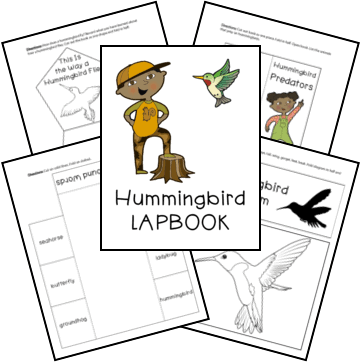
Science (and a little Math): Hummingbirds
Hummingbirds are small birds (females are about 8 inches) that can fly
forwards, backwards, and hover. Using a ruler, show your student how large
a hummingbird is. You may want to compare it to his own height.
These birds are absolutely one of God's incredible creations flapping their
wings 55-80 times each second allowing them to travel at speeds as fast as 25
miles per hour! If you want calculate how many times a hummingbird can
flap its wings in one minute (choose a number between 55-80 and multiply it by
60) 80 x 60 = 480 times! Have your students pretend to be hummingbirds-- using a
stop watch, count how many times they can flap their "wings" in one minute.
Are they as fast as hummingbirds? A hummingbird's heart beats about
250 times each minute, and it takes approximately 250 breaths per minute!
Using the stop watch again, compare that to your own student's heartbeat (pulse)
and breath. (Don't try to breathe like a hummingbird! I don't want
anyone to hyperventilate!)
You may want to check-out the
hummingbird report forms and copywork pages on
Homeschool Share's Animal Forms page.
Draw a Hummingbird Print-Out from Waterford Press
They eat little bugs and drink nectar out of flowers. They prefer red flowers, but will drink out of others as well. You may want to plant some of the following in order to attract them to your garden: Some flowers and plants that will attract hummingbirds to your garden are
Bee Balm (Monarda spp.)
Blazing Star (Liatris spp.)
Bleeding Heart (Dicentra spp.)
Cardinal Flower (Lobelia cardinalis)
Columbine (Aquilegia spp.)
Coral-Bells (Heuchera sanguinea)
Dame’s Rocket (Hesperis matronalis)
Delphinium (Delphineum spp.)
Fire Pink (Silene virginica)
Foxglove (Digitalis spp.)
Fuschia (Fuschia spp.)
Gilias (Gilia spp.)
Hollyhocks (Althea spp.)
Lily (Lilium spp.)
Nasturtium (Tropaeolum spp.)
Paintbrush (Castilleja spp.)
Penstemon (Penstemon spp.)
Phlox (Phlox spp.)
Red-Hot Poker (Kniphofia uvaria)
Salvia (Salvia spp.)
Sweet William (Dianthus barbatus)
print-out diagram of the Ruby-throated
Hummingbird
Science: Tide
Tides are the rising and falling of the sea.
During high tide, the water is deeper and comes further onto the beach. Another
name for high tide is flood tide. During low tide, the water is more shallow and
does not come as far onto the beach. Another name for low tide is ebb tide.
Tides are created because the Earth and the moon are attracted to each other
just like two magnets. The moon tries to pull on anything on the Earth to
bring it closer. The Earth is able to hold on tight to land, but it can't
hold on to its ever-moving water.
The Earth makes one complete turn every 24 hours. When a side of the
Earth faces the moon, the moon's pulling force causes a high tide. Since
the Earth is spinning, the area the moon pulls at changes. If you are on
the ocean beach and the moon is pulling on the water there, then you will
experience a high tide.
There are three types of tides caused by the moon's pull--
1. Diurnal Tides
One high and one low water per tidal day
This happens in the Northern Gulf of Mexico and Southeast Asia
2. Semi-diurnal Ties
Two high and two low waters per tidal day
Common on the Atlantic coasts of the U.S. and Europe
3. Mixed Tides
In certain shallow seas, the tides have a different pattern
One of the two daily tides is appreciably higher than the other or the time
between successive tides is unequal
Found in the Pacific Coast of North America as well as other areas
Click here for a
world tide map -- scroll to the bottom of the page
The sun also plays a role in tides. Your older student may want to
research about neap tides and spring tides to learn more.
Language Arts: Adverbs
An adverb is a word that describes an adjective or a verb. Adverbs
usually tell...how...
Make a list of all the -ly adverbs found in this book with your student.
He can save the list and use some in his own writings-- a good rule of thumb is
to include one adverb per paragraph (and NOT to use adverbs like very, much,
etc.-- stick with the -ly adverbs). You can also ask your
student to organize his list in alphabetical order.
Here are some adverb examples from the book:
slowly
silently
suddenly
softly
lonely
solemnly
gently
What other -ly words can your student think of to add to his list?
(wildly, quickly, sparingly, sadly-- the possibilities are endless!)
Go-along book about adverbs: Up, Up, and Away by Ruth Heller
Language Arts: Point of View (second person- you)
This story is unique because it is written in second person. Most
stories are written in first or third person (as you may have studied in the
past). This one, however, refers to the reader as if the reader was part
of the story. "You smile...you almost got feet wet that time...you can
hear an insect." Using the second person gives the book an entirely
different feel. What if McCloskey would've written from first person.
Can you and your student translate a few lines into first person? "I
smile...I almost got feet wet that time...I can hear an insect." What does
third person look like? "They smiled. They almost got feet wet that
time. They could hear an insect." What are the differences
between the three persons? Why do you think McCloskey chose 2nd person?
He wanted the reader to experience his experience. We almost feel like we
are there, and, in a way, we are because most of us have had similar experiences
as children. Maybe we have never been to Maine, but we know what a Time of
Wonder is and this book brings us back to that.
Language Arts: Repetition (-ing words)
This story uses lots of -ing words for repetition. Let your student
make a list. For an extra challenge, have your student put the list in
alphabetical order.
cackling
shackling
battening
tolling
slamming
lessening
hauling
gazing
gliding
snorting
unfurling
migrating
feuding
Language Arts: Vocabulary
Silhouette – the outline of an object formed by its shadow
Glacier – a large body of ice moving slowly across the land
Quartz – a kind of shiny rock
Skiff – a small light sailing ship
Pennant – flags on ships tapering to a point or swallowtail
Schooner – a sailing ship with two masts and fore and aft sails
Language Arts: Drama
*Create a skit for the hurricane scene in the book (use sound effect tapes
from your library), let
your older students transfer the text into characters and dialogue.
Bible Memory Verse: Psalm 46:10
"Be still and know that I am God."
(What is a wonder?
Do you take time
to ponder the beauty of the world around you that God has created?)
Art: Caldecott Award
Time of Wonder was awarded the
distinguished Caldecott Award in 1958. The Caldecott Medal was named in honor of
nineteenth-century English illustrator Randolph Caldecott. It is awarded
annually by the Association for Library Service to Children, a division of the
American Library Association, to the artist of the most distinguished American
picture book for children
Here are some discussion questions you may want to use with your student.
1. Why do you think this book won the award?
2. What emotions do you feel as you look at the pictures? (happy, afraid,
secure, calm, wonder, etc.)
3. Do the illustrations go well with the story?
4. Do you like the illustrations? Why or why not?
You may also want to compare this book (and illustrations) to McCloskey's, Make
Way for Ducklings which also won the Caldecott Award.
Art: Mock illustrations
Light--
Let your student try to create the same effect as McCloskey created on pages
42-43. Paint a night time scene with a light illuminating through the
window.
Movement--
Pages 44-47 are good examples of showing motion in pictures. Have your
child illustrate pictures of movement by emulating McCloskey's style.
Stars (Splash Technique)--
On pages 28-29, the background appears to be watercolors possibly painted
over a textured fabric. The stars are painted using a splash technique.
Have your student paint a watercolor scene. After it is completely dry,
dab an old toothbrush into acrylic paint; flick the bristles at the picture to
duplicate the speckled stars in Time of Wonder. Your student may want to
practice this on a scrap piece of paper first (so he learns how to do it before
he accidentally ruins his beautiful watercolor scene).
Drawing Rain--
On pages 10-11, the parallel rain lines draw your eyes to the circular splashes
in the water. Encourage your student to practice drawing some rain like
this. Look through other books at different ways rain is illustrated.
Math: Time
If you have already taught your student how to tell time (practice
worksheet), you can create story
problems using seconds, minutes, hours, days, weeks, etc.—how many minutes are
in a day? In a week?
Clock Puzzles from bry-back
manor
Clock Worksheet from
bry-back manor
Clock Worksheet II
from bry-back manor
Other Avenues of Learning:
Video (Time of Wonder)
Seasons
Family Vacations
Have a “time of wonder” each day and take the time to find answers to questions
Native Americans
Find out where animals go in the winter
Printables from waterford
press
Ocean Life Picture Scramble Printout 1
Ocean Life Picture Scramble Printout 2
Ocean Life Picture Scramble Printout 3
Ocean Life Picture Scramble Printout 4
Ocean Life Picture Scramble Printout 5