| about us |
what's new
|
unit studies
|
unit study helps |
fiar resources
|
indexes | lapbooking |
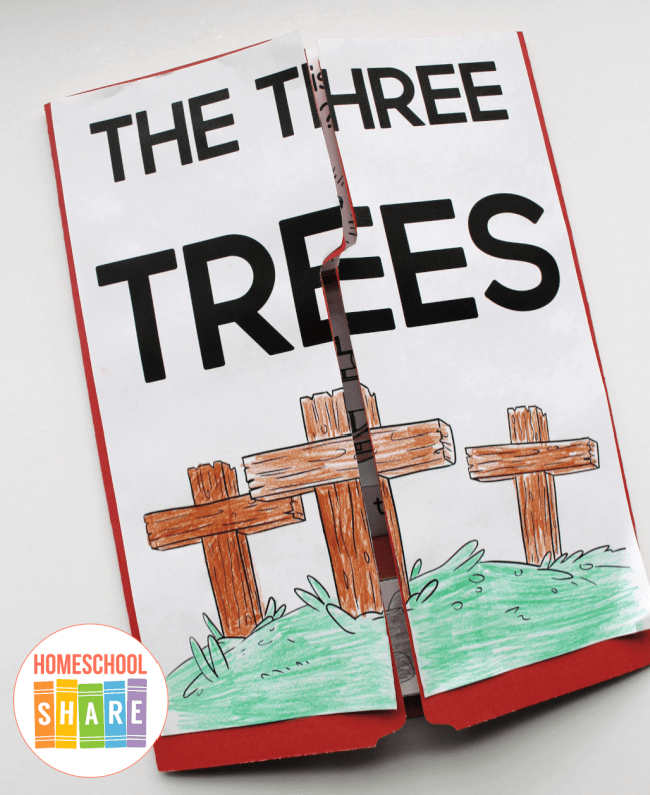
The Tale of Three Trees
| Author: Angela
Elwell Hunt Illustrator: Tim Jonke ISBN: 0745917437 Summary: This best-selling children’s book tells the Easter story from a new and unusual point of view. Children will be deeply touched as they understand, perhaps for the first time, the significance of Christ’s life and his atoning sacrifice on the cross. Unit and lapbook by Kelly Cooper |
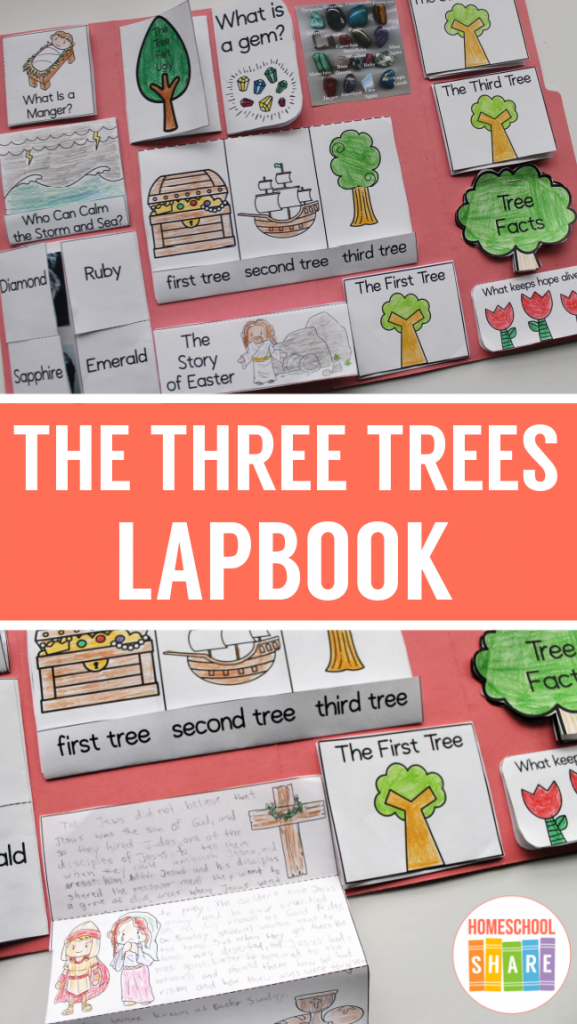
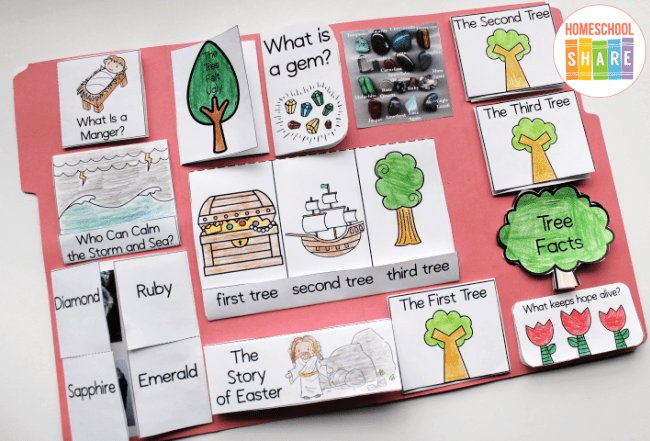
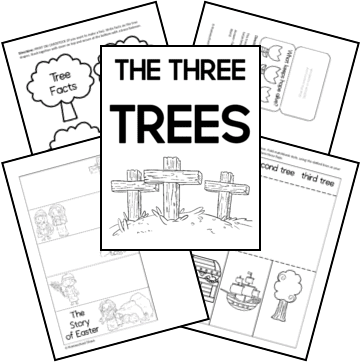
Tale of Three Trees Lapbook Templates (24 pages total)
Bible
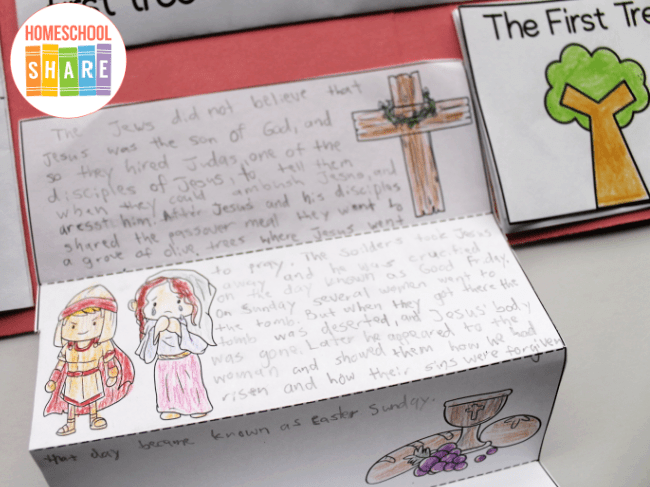
Easter Story
Read the Easter story from the Bible. You may want to read from
one gospel each day for four days.
Matthew 27:55-28:10
Mark 15:40-16:14
Luke 23:47-24:35
John 19:38-20:21
~Complete Easter Story Layer Book
God's Plans
Discuss with
your children what they want to be when they grow up? Do they know
that God has special plans for them? What were the dreams that the trees
dreamed? What was the master plan for each tree? Read and
discuss Jeremiah 29:11. You may even want to make it a memory verse for
the week. Jeremiah 29:11 'For I know the plans that I have for you,' declares
the LORD, 'plans for welfare and not for calamity to give you a future and a
hope.
~Jeremiah 29:11 to your
verse mini-book, if desired
Hope
The three trees
nearly forgot their dreams. Abraham was also given a dream that he almost gave
up on. God promised him a son and even though he tried on his own, God was
faithful and did a miracle. Read and discuss Genesis 17:1-21, Genesis
18:1-14, and Genesis 21:1-7.
How we keep the dream in our
hearts is through faith and hope in God. Abraham is an example of this (see
Romans 4:16-21). He had faith in God (God does not lie). He chose to believe God
despite what Abraham could see and understand (Sarah was old and she had never
had a child before) “in hope against hope he (Abraham) believed. There are two
kinds of hope-- godly and worldly. Godly hope trusts God no matter what and
trusts God’s word. Worldly hope looks at things naturally based on one's
own reasoning and what one can see and hear.
~Complete What Keeps Hope Alive? mini-book
~Add Hebrews 11:1 to your verse mini-book, if desired
Treasure (1st Tree)
Discuss treasure with your children. What do they think of as
valuable? What does the Bible say about things of value on the earth?
Read Matthew 6:19-21 together and discuss. "Do not store up for yourselves
treasures on earth..." What are worldly treasures? What are treasures in heaven?
What does it mean "for where your treasure is, there your heart will be also."
~Complete Treasure Matchbook
~Add Matthew 6:19-21 to your verse mini-book, if desired
Jesus Calms the Sea (2nd Tree)
Read Matthew 8:23-27 together and discuss.
~Complete Jesus Has Authority Shutterfold
~You may use the image on page six to make a mini-book of the Bible story, if
desired
God Works ALL Things Together
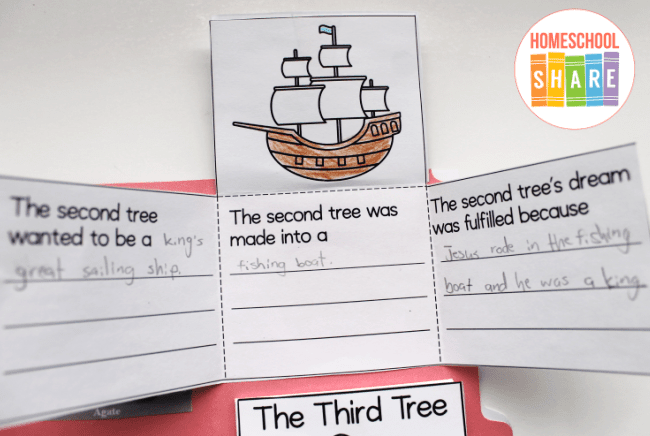
The first tree wanted to hold treasure, but instead he was made into a
manger. How was his dream fulfilled? He held the greatest treasure
ever- baby Jesus! The second tree wanted to be a strong sailing ship and
carry kings, but he was a smelly fishing boat instead. How was his dream
fulfilled? One day he carried the King of Kings! The third tree
wanted to grow tall and point to God. Instead she was cut down and made
into lumber (wood used to build with). The tree felt ugly, harsh, and
cruel. But was this tree beyond the reach of it's Maker? How was her
dream fulfilled? She was made into a cross that held Jesus and pointed
people to God.
~Complete T-books and The Tree Felt Ugly Book
You can use this story to explain Romans 8:28 with your student. Read it
together. Sometimes God's good isn't what we would want or expect.
Sometimes God's good is very difficult, but it is BEST.
~Add Romans 8:28 to your verse tab mini-book
God's Love
At the end of the story, the book says that God's love did something for
each tree. Can your student remember what? Discuss this in light of
Romans 8:28 and Jeremiah 29:11.
~Complete large matchbook
God's love can change everything including humans! Discuss the
Easter story and how Jesus didn’t deserve to die, but He did so we can be
forgiven of our sin (Romans 3:23). Jesus was without sin, but
He obeyed His Father and gave up His life. How much of our lives does God
want? Our WHOLE lives! Read and discuss Matthew 16:34,
"If anyone wishes to come after Me, he must deny himself, and take up his cross
and follow Me." Discuss what it means to deny yourself and take up your
cross and follow Jesus.
~Add verses to your verse tab mini-book, as desired
~Complete God's Love Side by Side
Science
Coniferous Trees
What kind of trees are the trees in this story? There are two
basic kinds of trees-- coniferous and deciduous.
The word conifer comes from the Latin words conus (cone) and ferre (to bear). The word literally means cone bearing. Coniferous trees have needle
-like or scale-like leaves. Unlike deciduous trees they don’t lose their leaves in the fall or winter. Evergreens also produce pine cones (not fruit or flowers). Some needles are very soft to the touch others are prickly and pokey.There are different ways to classify (or group) trees to
determine whether they are deciduous or coniferous:
By seed
Does this tree produce fruit/flowers or cones?
You know what fruits and flowers are, but did you know that the pine cone is actually where the tree makes and protects the evergreen’s seed? Cones are made up of many scales. Scales are a kind of shelter for the seed. When it's time, the scales of the cone open and the seeds fall to the ground. Because the seeds sit on the scales and are not totally protected, conifer trees can also be grouped as gymnosperms. The word gymnosperm means naked seed.
By leaf
Are they thin and pokey
Broad leaves have more of a surface so they can gather more sunlight. A tree with flat, wide leaves also loses a lot of water because of evaporation. There are other trees that have needle-like or scale-like leaves. We often just say that they have needles. They are long and thin. Trees with needles need less water because this shape slows down the evaporation of water so the tree doesn't lose as much. Trees with needles can grow in areas that other trees can't, but they still need just the right amount of sunlight for the tree to produce food. Conifers grow in a triangle shape so that more of the tree needs can be exposed to the sun.
How they lose their leaves
Many trees lose their leaves when the weather gets
cool. Deciduous trees have leaves that fall to the ground all at once and grow
back again when the weather gets warmer. Other trees (evergreens) have leaves or
needles that fall off a little at a time. These types of trees are always
growing new leaves. As the needles become older, they drop off the tree to
make room for new needles that will replace them.
~Complete Tree Facts tri-fold
Precious Stones
The first tree wanted to become a chest filled with precious stones.
Precious and semi-precious stones are also known as gemstones. A gemstone is a rock or mineral that is used for
adornment. It has three qualities that make it a gem vs. an ordinary rock or
mineral: rarity, beauty, and durability. Being rare or particularly
beautiful increases the value. How durable (or hard) it is, assures that it
will last a long time.
Some examples of gems are garnets, diamonds, sapphires, emeralds, and amethysts.
~Complete Jewel Shutterfold
~Complete What is a Gem? Simple Fold
~Use chart to discuss semi-precious stones, if desired
Mountain Habitats
A habitat is a type of place where plants and animals naturally live and
grow. If your student has studied other habitats (pond, desert, rain
forest, ocean, etc.), review what you have learned together. Mountains can
be found all over the world and on every continent; they are even found under
the waters of the ocean! Mountains are also a habitat. Mountain
habitats are different than other types of habitats. Each mountain can
have a unique set of inhabitants, so different mountains around the world are
homes to different plants and animals.
This folktale probably originated in North America in the Appalachian mountains
which are a mountain range
in the eastern United States, running from Pennsylvania to Alabama. Have your
child find the Appalachian Mountains on a United States map. This region has a
very unique culture with stories, songs, dances and games that carried on for
generations.
If you'd like, learn more about the animals that live in the Appalachian
Mountain habitat. What animals does your student think he might find
there? Here are a few of the critters that live in this habitat:
Mammals
Beaver
Eastern Cottontail Rabbit
Eastern Gray Squirrel (and many other types of squirrel)
Black Bear
Striped Skunk
White-tailed Deer
Snow-shoe Hare
Eastern Cougar
Birds
Wild Turkey
Wood Duck
Great Horned Owl
Screech Owl
Red-shouldered Hawk
Northern Goshawk
Warblers
Mourning Dove
Amphibians
Salamanders
Eastern Newt
Wood Frog
Spring Peepers
Reptiles
Black Rat Snake
Common Garter Snake
American Copperhead
Broad0headed Skink
Eastern Box Turtle
Common Snapping Turtle
Fish
Speckled (or Brook) Trout
Darters
Minnows
~Use photos of animals to design your own lapbook component, if desired
~Use photos of Appalachian Mountains and map to make a Appalachia mini-book, if
desired
Social Studies
Occupations~ People and Places
Carpenter
Discuss what a carpenter is--
Lumber
yard
A lumber yard is a place to sell lumber and wood related products used in
construction and home improvement projects.
Shipyard
A shipyard is a place for building, maintaining, and repairing ships and
boats. Usually, a shipyard is positioned near a large inland river, harbor, or
shoreline.
~Complete People and Places Accordion
Language Arts
Vocabulary- Manger
The first tree was fashioned into a manger for animals. Did you know that
the word "manger" probably comes from the French word "manger" which means to
eat?
~Complete manger simple fold
Genre: Folktales
Stories that are told rather than read; they are passed down from one generation
to another generation. Maybe your child has played “Whisper Down the Lane”
before. If not, play this game to demonstrate how a story can change, sometimes
only slightly and sometimes not, as it is told and retold again. As folktales
are passed down, the stories take on characteristics of the time and place in
which they are told, as well as the personality of the person telling the tale.
Here are some common characteristics of folktales. Which characteristics do you
find in Tale of Three Trees?
Use this list to explore other folktales.
~Universal and timeless themes or morals, such as sharing, compassion, being gullible, etc.
~They speak to our need to understand and make sense of our existence (such as tales about creation)
~About the common person, something anyone rich or poor could relate to.
~Supernatural elements that may include magic, witches, wizards, dragons and/or other mythical creatures
Read other folktales to give your child a good taste of this genre. Here are some suggestions:
Best Loved Folktales of the World by Joanna Cole
Favorite Folktales From Around the World by Jane Yolen
Anansi Tales (African Folk Tales) by Eric Kimmel (and others)
Why Mosquitoes Buzz in
People's Ears
by Verna Aardema
Russian Folk Tales by James Riordan
Extras
~Get
a woodworking (carpenter) project for the kids to complete or take to a Home
Depot or Lowe's Kid Clinic to complete a wood-making project
~Paint a wooden cross to put in the house to remind you of the Easter story
~Printables-
http://msssbible.com/newtestament/crucifixion.htm
~Resurrection
Lapbook
~Give your child a
Resurrection Basket
1. Palm leaf for
Christ’s triumphant entry into Jerusalem.
2. Animal Crackers for the unleavened bread of the Passover Feast.
3. Chocolate coins for the pieces of silver Judas accepted to betray Jesus.
(You could also substitute with 30 silver pieces-- 30 nickels)
4. Lollipop sticks for the nails in His hands and feet. (upside down in
basket)
5. Grape juice for the blood he shed. (single serving boxes)
6. Sponge for the vinegar-soaked sponge Jesus drank from.
7. Cross to represent the cross Christ died on.
8. Black cloth for the darkness that covered the Earth at His death.
9. Bath product such as bubble bath and washcloth for the perfumed shroud in
which Christ was buried.
10. Hollow chocolate eggs for the empty tomb on Easter morning.
11. Green grass for the new life we have in Jesus.
12. Fluffy marshmallow candy for the cloud into which Jesus ascended.
~ Bake Resurrection Rolls
Read Matthew 27:57-61
These are fun rolls to make with your child and serve a dual purpose. Not only
are you cooking together, but you are also teaching a Bible lesson.
Preheat Oven to 350
degrees
Ingredients:
Crescent rolls
Melted butter
Large marshmallows
Cinnamon
Sugar
1. Give each child a triangle of crescent rolls. The crescent roll represents
the cloth that Jesus was wrapped in.
2. Give each child a
marshmallow and
tell them it represents Jesus who died on the cross for us.
3. Have them dip it in melted butter to represent the oils they anointed Jesus
with.
4. Roll it in sugar and cinnamon to represent the spices they used.
5. Then wrap the marshmallow in a crescent roll just like they used the fine
linen cloths.}
6. Put the wrapped Jesus in the tomb (oven at 350 degrees) for 3
days (12-15 minutes). When the rolls are cool enough, the children can
look inside and see that Jesus is not there – He is risen! (The marshmallow
melts and the roll is puffed up, but empty). Do not undercook, as the rolls will
sink and not be hollow.
7. Now read
Matthew 28: 5-8 (see the Bible lesson for more scriptures to read)