| about us |
what's new
|
unit studies
|
unit study helps |
fiar resources
|
indexes | lapbooking |
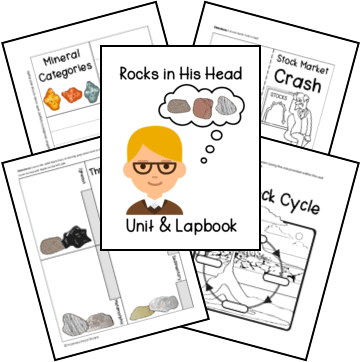
Rocks in His Head
| Author: Carol Otis Hurst Illustrator: James Stevenson ISBN: 0-06-029403-5 and 0-06-029404-3 Summary: A young man has a lifelong love of rock collecting that eventually leads him to work at a science museum. This story is based on the life of the author's father. |
A unit prepared by
Celia Hartmann; lapbook component prepared by Ami Brainerd
Target grade for unit: 4th grade, but can be adapted for younger or older.
Recommended go alongs: One of our favorite books is How
the Earth Works: 60 Fun Activities for Exploring Volcanoes, Fossils,
Earthquakes, and More
by Michelle O'Brien-Palmer. I highly recommend
it, even though it contains Evolutionary content. It contains games, recipes,
and more. The Name that Rock! Bingo, Rocks & Minerals Trivia Cards, Rocks &
Minerals Information Cards, and the Crystals & Gems Fact or Fiction cards would
all make great additions to your week of sharing this book! You
can make pockets to hold the cards and place them in your lapbook.
LAPBOOK
View Celia's completed Lap-N-Note
BIBLE / CHARACTER
Jesus is the ROCK: 1 Corinthians 10:4 tells us that Jesus is our rock. Matthew
7 and Luke 6 talk about the house built upon the rock that was not moved. Why
would God, in His Word, choose to compare Jesus to a rock? If we build our
lives around Jesus, then we have firm foundation for our lives and it will still
be standing after the storms of life. What happens if we don't build our lives
on a rock?
¤ Complete prepared lapbook/notebook component:
Bible Verse Matchbook Minit
This week, sing one of these hymns:
Rock of Ages
The Shadow of the Rock
Sweetly Resting
Research Ideas: Research gems, minerals, and stones found in the Bible. Some
ideas:
The breastplate of Aaron (Exodus
39:10-14)
The gems in the foundation stones of the New Jerusalem (Revelation 21:19-20)
This website has a list of different minerals and stones mentioned in the Bible,
each with a link to more information about that mineral or stone.
SOCIAL STUDIES
Geography -- Springfield, Massachusetts:
The city of Springfield sits on the Connecticut River near the border of
Massachusetts and Connecticut. It is the third largest city
in Massachusetts. Over 30 states
have a place called Springfield. Springfield, Massachusetts has the distinction
of being the first to have that name. It was founded in 1636 by William Pynchon, who named it after the village in England where he was born. The town
was half-destroyed forty years later during King Philip's War. In 1936, the
city was flooded by the Connecticut River, which reached record heights. This
was during The Great Depression. The city is known as the birthplace of
basketball, as James Naismith invented the sport there in 1891. It was also the
birthplace of writer Dr. Seuss (Theodor Seuss Geisel).
Source
Have your student locate Massachusetts on a map or globe.
Massachusetts Facts, Maps, and Symbols at Enchanted Learning
¤
Use prepared component to add to your lapbook or notebook:
Massachusetts Minit Book
Folding Directions: Fold in half (using center line as your guide). Unfold.
Fold the areas (one of the left and one on the right) in to the center. Cut
strips apart. Let your student write her answers underneath each strip, so she
can flip the flaps for review. When she is finished, fold sides back in the
middle. Refold center line. You should have one long rectangle book. When you
open it, you should see all eight flip-flaps.
Geography -- New Hampshire, Nevada, and Connecticut: The book also
briefly mentions these states. Locate them on a map or globe. Discuss their
capitols and major cities, surrounding states, major mountains/rivers/lakes,
etc.
New Hampshire Facts, Maps, and Symbols at Enchanted Learning
Nevada Facts, Map and Symbols at Enchanted Learning
Connecticut Facts, Map and Symbols at Enchanted Learning
Remember how the author's father mentioned finding garnets in Connecticut?
Garnets are Connecticut's official "State Mineral." Here is a link to some Garnet
Mines in Roxbury, Connecticut
Hobbies and Collections: A hobby is something that someone enjoys doing
in their spare time. Some people collect things (rocks, sea shells, coins,
stamps, bells, dolls, etc.), while others pursue a sports activity (golf,
horseback riding, etc.) or do something artistic (painting, making crafts, play
music). If your student or someone in your family has a hobby or collection,
discuss why that person chose that as a hobby. Be sure to discuss if anyone's
hobby is related to their career choice.
Occupations: This story allows for discussion of several occupations,
including gas/filling station owner, mechanic, janitor, director, mineralogist,
curator.
History
-- Henry Ford and the Model T:
Henry Ford was born July 30, 1863 in Dearborn, Michigan. His family farmed.
From early on, he did not care for farm work but instead enjoyed tinkering with
the machines. He loved to take apart everything so he could understand how it
worked. He became quite good at repairing machines that ran by steam and at
repairing watches.
When he was 16, he left home, moved to Detroit, and began work as a
machinist apprentice. He apprenticed for three years and returned to Dearborn.
After that, he worked on steam engines and his father's farm equipment,
supplementing his income by working in a factory in Detroit. In 1888, Henry
married Clara Bryant and ran a sawmill to provide a steady income.
In 1891, Henry became an engineer with the Edison Illuminating Company in
Detroit. Finally, he was able to pursue what he loved--working with machines.
Just two years later, he was promoted to Chief Engineer. At this time, he
began experiments on internal combustion engines. (Less than 10 years earlier,
the first car with an internal combustion engine had been built, and Henry
realized this was the future of automobiles.) This experimenting led to the
creation of the Quadricycle. Click
here to see it. Or
here. It doesn't look like much of a car does it?! It was called a
Quadricycle because it ran on four bicycle-like tires. It was not the first
automobile to have been built in the world, but it was Henry's first and it
created a desire to make more.
At that time in history, automobiles were very expensive to buy, and so only the
very rich could afford one. In 1903, Henry Ford created the Ford Motor Company.
He proclaimed "I will build a car for the great multitude." Five years later,
in October 1908, his dream came true. He introduced
the Model T, an automobile that was not only reasonably priced, but was also
easy to operate, reliable, and efficient. It began a new era of personal
transportation: the Motor Age.
In the beginning, the cost of a Model T was $950. That was a lot of money to
folks back then, but it was far less than the price of the other cars. Despite
the low cost, Henry Ford strived to produce the car quicker and with standard
parts so that the cost could be lowered. Early on it took over 12 hours to make
a car, but in just six years he was able to cut the production time down to 1.5
hours. The Model T was produced for 19 years, until May 1927. Before that time
period ended, Henry Ford's company was able to make a Model T every 24 seconds
and the price of the car was reduced to $280.
Henry was able to do this by using techniques that allowed for mass production.
The Ford Motor Company was the first to use a conveyor belt-based assembly line
to make the production process more efficient. This allowed workers to be
quicker: each worker put on a section of the car before it moved to the next
worker to receive another. Henry paid higher wages to his employees, $5 per
day, which almost double what other car manufacturers paid! Workers who were
paid more than average were more loyal to the company and less likely to quit
their job. By cutting the work day from 9 to 8 hours, Henry operated his
factory 24 hours a day using three shifts of workers.
By 1918, half of all the cars in America were Model Ts.
His ideas for mass production continue today in all areas of business, and the
Ford Motor Company continues to make automobiles today. (Source: TheHenryFord.org and
About.com's
Inventors and The
Ford Motor Company.)
¤ Complete prepared lapbook/notebook component: Henry
Ford Report Form and Pocket
A blank form has been prepared as well as a form with writing prompts. Choose
whichever one will suit your needs. To assemble the pocket: Cut out as one
piece. Fold the back up. Fold the side flaps around the back. After your
student completes his report, fold it in thirds so it will fit into the pocket.
Video Go-along: Henry Ford by Issembert Productions/Schlessinger Media
or Henry Ford by American Institute of Education. If you view the
Schlessinger one, be prepared to discuss Ford's "flawed" side......his campaigns
against the Jews (anti-Semitism) and his admiration of Adolph Hitler. It was
also noted that outlaws Bonnie and Clyde preferred to drive a Ford, so you may
need to discuss them as well.
History -- Stock Market
Crash & The Great Depression: The
Stock Market Crash of October 29, 1929 was one event that helped trigger The
Great Depression. A stock exchange is a place where company stocks are bought,
sold, or traded.
A company needs money and things to start and to continue operating. One way to
get money is to sell "shares of stock" in the company. The company finds people
to invest money in it. They give the company money to start/operate and then
they own a share of the company. If the company does well, then their share of
the company's stock is worth more than what they initially invested. If they
sell their share, then they get more money back than they first put into it and
they have extra money. But the opposite is also true...if the company does NOT
do well, then their share becomes worth less than what they initially invested.
If the company continues to not do well, then an investor might sell his
stock before it becomes worth very little. This means he will not get back all
the money he first put into it.
Most stocks are bought and sold using a stock exchange. During the 1920s, the
most important stock exchange was the New York Stock Exchange in Manhattan, New
York. During the 1920s, the stock market did very well. Many people purchased
stocks and the value of the companies increased. Between 1920 and 1929, the
value of stocks quadrupled. That means if a person invested $1 in 1920, then in
1929 it was worth $4. People thought this was a great way to make money and so
they borrowed from banks so they could invest even more money in the stock
market.
Then the stock values began to fall and on October 24, 1929, a day that has
become known as Black Thursday, people began to panic that the value would
continue to fall and so many of them sold their stocks. Over the weekend, still
more people panicked at the thought that their stocks would soon become totally
worthless and they decided to sell as soon as the stock exchange opened on
Monday, October 28. They did so and the day has become known as Black Monday.
Almost 13 million stocks were sold that day. This made the value of the
remaining shares in the stock market fall even more. The next day, October
29--Black Tuesday--was even worse--over 16 million shares were sold. One month
later, the market had fallen by almost 40%, a value of $100 billion. Over the
next few years, the market continued to decline, though not as quickly as these
three "Black" days. By mid-1932, the market had lost almost 90% of it's value.
It took over 20 years for the stock market to recover. Here
is a chart that shows the decline of the stock market.
Many banks went out of business. People who had money in those banks lost it.
Those who had lost money in the stock market also lost the money in their bank
accounts and also could not pay back what they had borrowed. People were
unable buy as much food or clothing, and they did not have money to buy extras
like cars. Because there was less items being purchased, companies began to
close and people lost their jobs. Those without jobs could not afford to buy
even the necessities. To make matters worse, during the early 1930s, the
Midwestern United States experienced a severe drought that become known as the
Dust Bowl. Farmers were not able to produce food to sell. Many lost their
farms. This time period that followed the stock market crash is known as the
Great Depression.
The Great Depression did not just affect America, but much of Europe too. It
was a time of no work, little food, etc. Prices of necessities were high and
the money families had was low. People learned to make do with whatever they
had or to use old things in new ways.
It was not until the United States entered WWII at the end of 1941 that the
Depression ended in America.
Sources: PBS'
Stock Market Crash
About.com 1929 Stock Market Crash
¤ Complete prepared lapbook/notebook component:
Stock Market Crash Minit Book
Let your student record what he has learned. Cut out as one piece, fold in
half, and add to your lapbook.
History -- Chess: No one is sure where or when the game of chess
originated. Many centuries ago, it was played in China, India, and Persia.
When the Moors (Arabs) invaded Persia, they learned the game. Later the Moors
invaded Spain, and then the Spaniards began playing it as well. From Spain, it
spread throughout Europe. The Europeans changed some of the rules of the game
and also changed the pieces to reflect their life. If your child has already
studied Medieval Europe, he may recognize: pawns represented the serfs, the
rooks are castles, the bishop represents the church, and then of course there
are knights, queens, and kings. Source
LANGUAGE ARTS
Idioms: The phrase "rocks in his head" is an idiom. An idiom is an
expression or phrase that does not mean exactly what it says. All cultures use
idioms. Explain to your student that to say that someone has rocks in their
head, does not literally mean that there are rocks inside of his head. It
means that someone thinks the other person (the one with "rocks in their head")
must be really dumb.
¤ Complete prepared lapbook/notebook component (see Art lesson for
description):
Idioms Triangle Book
You can use the book with clip-art or the blank book and let your student draw
her own art work (or both!). Have student write an explanation of what the
idiom really means under each triangle fold.
Assemble.
Websites and books to further explore idioms:
http://en.wikipedia.org/wiki/Idiom
http://www.idiomconnection.com/head.html
Print this worksheet for your student.
Heavens to Betsy, A Hog On Ice, or Thereby Hangs a Tale are
all books by Charles Earle Funk and explain the origins of some of our curious
sayings. The Scholastic Dictionary Of Idioms by Marvin Terban is
another good one.
Be sure to get some Amelia Bedelia books for the family read
aloud this week!!! Every Amelia Bedelia contains idioms. Examples...when
Amelia was to draw the drapes, she literally drew a picture of them! And when
she was to dress a chicken, she literally dressed the chicken up in clothes!
Too funny!
Repetition:
A few phrases in this book are repeated several times. After a reading (or two)
can your student tell you what they are?
1. When someone comments on the fact that he must have "rocks in his head,"
the man says "Maybe I have."
2. Sometimes after the above comment, and other times, he pulls a rock out of
his pocket and says, "Take a look at this one."
Discuss with your student why the author would use these repetitive phrases.
What is she trying to tell us/show us about the main character? What can we
infer?
If you've completed the lesson on idioms, remind your student what it meant when
someone said, "You've got rocks in your head!" Instead of being offended, this
rock-loving character responded with, "Maybe I have." We learn that he was
always thinking about rocks.
We also learn (by repetition of the second phrase-- "Take a look at this one.")
that he always had rocks in his pockets! He loved rocks. I mean he really
loved rocks, and he was excited to show others his precious rocks. Relate this
to your student by talking about things that we carry around with us (photos in
a wallet, a wedding ring, etc.). Does your student carry something around that
he loves?
These phrases become a familiar and integral part of the story. They help
develop the character. At the climax of the story, these phrases are brought
back into play. Mrs. Johnson and the board of directors realize that they don't
need someone to work at the museum who has a college degree. They need someone
who has rocks in his head and rocks in his pockets...someone who LOVES rocks!
Then, for one final hurrah, the writer pulls the end of the story together by
using a form of the repetition again-- "Maybe I am....maybe I am." and "Take a
look at this one."
¤ Complete prepared lapbook/notebook component:
Repetition Pull-Tab
Careful
Labeling: A couple times in
the story, it mentions how the man carefully labeled the rocks. Why is it
important to label things carefully and correctly? It makes things
easier to find. It makes it easier to remember details. Discuss any of your
child's reasoning. Discuss too the labeling of things that are not rocks and
what happens if it is not labeled correctly. What happens if a pharmacist
labels things wrong? Or a doctor puts the wrong name on a chart? What if the
salt gets labeled as pepper?
If you do not have a rock collection that you can carefully label this week,
gather up some of your students small toys. Sort them into groups, give him
small containers to put them in, and have him label them: cars, balls, blocks,
etc. Arrange them on a shelf and point out how easy it is to find just what you
want--and how easy it will be for him to put his toys away! ;)
Synonyms: Ask your student to write down synonyms for the word 'rock.'
Boulder, stone, pebble, gravel, sand, etc. are possible answers. Have him
illustrate each one. Note that although all are words that mean rock, they
conjure up different images. Discuss how using a more precise synonym instead
of a basic word can help give the reader a more precise image.
¤
Complete prepared lapbook/notebook
component:
Synonyms Minit Book
Vocabulary: Go over any words from the story that your student may not
already know. These might include:
quarries (singular=quarry): A large open-air pit where sandstone, marble,
slate is made, often by cutting or blasting the rock material to the shape
desired. Here
is a public domain picture of a quarry if you would like to print and add to
your lapbook/notebook. (Note: A quarry is not the same as a gravel pit.)
Here are two YouTube videos that show blasting at a quarry, the second one shows
twice (once at regular speed, and then in slow motion). First
Second
Here is a third video that shows a rock saw cutting stone at a quarry (the
video is very long, you need really to only watch a little bit of it).
slag: Metal is often mixed in with non-metal material in a rock. Slag
is the non-metal material left after being separated from the metal. Slag is
can be used in road paving material and cement.
garnet: a hard, glassy mineral that is used as gemstone. Usually a deep
red in color, but comes in a multitude of colors. In the past it was said that
garnets come in all colors, except blue. That changed in 1990 when blue garnets
were discovered in Madagascar. They have since been discovered other places as
well, but the blue garnet is extremely rare and very valuable.
stock market: Defined in the history lesson.
mineral: Defined in the science lesson.
attic: the part of the house or building that is directly under the
roof.
mineralogist: a person who studies minerals.
janitor: the caretaker of a building who cleans and makes small repairs;
a custodian.
curator: a person who manages or oversees a collection at a museum.
mineralogy: the science or study of minerals
¤
Complete prepared lapbook/notebook component:
Vocabulary Words
Directions: Cut square out as one piece. Cut each balloon out and write one
word/definition on each. Place the balloon titled Vocabulary Words on
top of the stack and staple where indicated.
ART
Medium: In art, the medium is the material that the artist used to draw
or paint the picture. In this story, illustrator James Stevenson used two
media. For his drawing medium, he used ink and for the paint medium, he
used watercolor.
Drawing Idioms:
This should be a fun project for your student. Have your student draw the
literal meanings of idioms. For example, for "hold your horses" he could draw a
picture of a person holding horses. For "out of the frying pan and into the
fire" he could draw someone climbing out of a skillet and headed toward a fire.
For "lost my head" he draw a person without a head. For "a piece of cake," he
can draw a slice of cake. If you're lapbooking, he could draw the picture on a
flap and then lift up and write the real meaning. If your student does not
like to draw, you could instead
use some of these clip art idioms (Broderbund grants permission to use for
educational purposes) and have the student write the meaning under the flap.
¤ Two
items for your lapbook or notebook have also been prepared. One contains four
idioms and the other is blank, ready for your student to draw or for clip art to
be glued on the flap. See language arts lesson above.
MATH
Percent: Out of the hundreds of rocks in the museum, he says that only
10 or 11 are better than the specimens he has. If we assume that the museum
has 200 rocks, what percent is 10? 11? What if the museum has 300 rocks?
If your student has not computed percents yet, you could turn it into a
subtraction problem to practice borrowing.
SCIENCE
Rocks: Wiki defines a rock as being "an aggregate of one or more
minerals. (A rock may also include organic remains and mineraloids.)"
(Aggregate means that it contains a mixture of minerals. A mineraloid is
similar to a mineral but does not have a crystalline structure.) The science
of studying rocks is called petrology.
Anyone wishing to collect rocks should know the three rock groups: igneous,
sedimentary, and metamorphic.
¤
Use the prepared
shutterfold for intrusive/extrusive to add to your lapbook/notebook.
Experiment: Melt some candy-making chocolate
(either disks or part of a block) over low heat. Point out that the melted
chocolate is like magma. Pour some of the chocolate into a candy mold. (If you
don't have a candy mold, you could use one of the thin, flexible ice cube trays
or possibly just a few paper mini cupcake liners that can be peeled off the
candy.) Allow candy to harden (placing in the refrigerator or freezer will
quicken the process, although this may cause white streaks in the candy that
will not affect the taste). Remove the candies from mold and discuss how this
now-solid chocolate candy is like igneous rocks.
Research Idea: Have your student research to learn more about the 5 kinds of
igneous rocks (granite, diorite, gabbro, periodotite, and pegmatite) and the
differences between them (the minerals from which they were made).
Experiment #1: (Works best if you do first thing in the morning, so you have
several hours to observe.) Take a see-through bottle (the glass bottles of
Lipton tea work well, an applesauce or salsa jar would work too) and have your
student place inside various sized rocks (get a variety of whatever will fit
into the mouth of the jar). Add some soil and a bits of mulch if you have any.
All of these items should fill your jar no more than half way full. Add
water so that the jar is about 3/4 full. Place lid on jar and close tightly.
Now have the student shake the jar several times. Place the jar in a place
that can be easily observed. Note that at first the jar is very dark and
cloudy. Over several hours you student will observe how first the larger rocks
settle on the bottom, then the smaller rocks, then the bits of mulch and soil
and eventually the water becomes clear again. Be sure to check it several
times over the course of about 24 hours and have your student write his
observations.
Experiment #2: (Works best if you freeze a Snickers bar for several hours or
the night before.) Take a Snickers bar and break it in half. Point out the
different layers, they are made of different size items. This is similar
to sedimentary rock.
Experiment #3: Have your student layer peanut butter between graham crackers,
keep layering until it is three or four graham crackers high. Discuss how the
layers are like sedimentary rock. To make the layers more visible, use both
regular and chocolate graham crackers and use some chunky peanut butter for one
of the layers.
Research idea: Have your student research to learn about the 6 main kinds of
sedimentary rocks (congolomerate, sandstone, shale, limestone, gypsum, prophory
rock) and the difference between them (their appearance).
Experiment #1: Make Rice Krispies Treats according to the box (or
click here). As you are doing so, talk about the different ingredients,
comparing them to different kinds of rocks. Point out how the marshmallows and
butter change form once heat is applied. Discuss how you use the wax paper (or
buttered spatula) to apply pressure to the mixture. When they are done,
discuss once again how metamorphic rocks change with heat and pressure--just
like the treats.
Experiment #2: Take two or three pieces of different colored taffy and place
between two pieces of wax paper. Have your student smush until the pieces are
well-mixed together and marble-like. (We used Laffy Taffy, which is not easily
pliable, and we ended up tossing the wax paper and using our hands to stretch
and pull and smush!)
Research idea: Have your student research and learn about the two kinds of
metamorphic rocks (foliated and non-foliated) and the difference between them
(foliated has banding or layers and non-foliated does not).
Alternative recipes to use for experiments this week (and some are a bit
healthier too!), from homeschool veteran and author Cindy Downes (The
Checklist).
¤
Complete the
prepared tab book
on the three different types of rocks and add to your lapbook or notebook.
For even more fun and more reinforcement of the concept, you could also complete
Jimmie's rock pyramid diorama. My oldest really enjoyed using a combination of
Jimmie's "extras" and her own drawings to decorate the pyramid. Be sure to
print out all the parts you will need.
Directions for Pyramid Diorama ROCKS
Pyramid Diorama Title 3 Types of Rocks
Pyramid Diorama Blank Template
Pyramid Diorama -- Igneous Rock
Pyramid Diorama Igneous Extras
Pyramid Diorama Metamorphic
Pyramid Diorama Sedimentary
Pyramid Diorama Sedimentary & Metamorphic Extras
Research Idea: Within the story and again at the end, several different rocks
are shown and labeled.
They are:
Hematite,
Muscovite,
Sphalerite,
Garnet,
Fluorite,
Quartz,
Calcite,
Pyrite,
K-spar (feldspar). Have your student research several of these rocks to
learn more about them. Which kind of rock is it? What color is it? Where can
it be found? What is it used for? Is there an interesting fact about it?
¤
Use the
prepared shape book and place in your lapbook or notebook. Cut out each
shape, stack together, and staple where indicated on the cover.
The Rock Cycle: Well, now, that your student has learned about the
three different kinds of rocks, he is ready to learn about the rock cycle and to
review the kinds of rocks. Like the water cycle, the rock cycle is an on-going
process. Print out a diagram of the rock cycle. (Here are some: ETE's
Earth Floor,
Wiki,
Matt Willard)
The six steps of a rock cycle are:
¤ Add the rock cycle diagram
(or have your student draw his own) to
the
prepared component to place in your lapbook or notebook.
Your student may enjoy
playing a game of Rock Cycle Dice. You will need to first designate seven
areas as "stations:" Earth's Interior, Soil, River, Ocean, Clouds, Mountains,
Volcano. At each station, the student will roll the die for that station and
follow the instructions. A fun, interactive way to reinforce the concept of the
rock cycle.
Websites for more information:
Minerals: Rocks can be made of one or more minerals. Wiki defines a
mineral as being a "naturally occurring, inorganic solid with a definite
chemical composition and a crystalline structure." Whereas, "a rock is
an aggregate of one or more minerals. (A rock may also include organic remains
and mineraloids.)" (Aggregate meaning that it contains a mixture of
minerals. A mineraloid is similar to a mineral but does not have a crystalline
structure.)
The science of studying minerals is called mineralogy. Remember? The father in
our story became the Curator of Mineralogy? His job would be to determine a
mineral's origin and how it was formed, as well as classifying them.
There are about 4,000 different kinds of minerals, but only about a hundred of
them are common. Minerals can be broken down into three categories:
¤
Complete prepared lapbook/notebook component:
Minerals Layer Book
Instructions: Cut out each piece. Layer them in order (smallest to largest) and
staple at the top. Let your student use the information above each heading to
write about that category of mineral.
Mineral Websites:
The Mineral Information Institute
gives permission to print (for classroom use only) copies of
their beautiful 8.5x11 full-color poster of minerals. (Please note this
file also contains an 8.5x11 full-color poster on crystals as well, which can be
used in the Crystals lesson below. Also note that there is reference to
"millions of years.")
The Image Site: Even your youngest child can enjoy looking at pictures of
different minerals. There is plenty of information for students of all
ages.
Wiki's List of Minerals to learn more about different ones.
Research Ideas:
Research the man known as the
Father of Mineralogy: German scientist
Georg Bauer, whose pen-name was Georgius Agricola (1494-1555).
Research the tests used to identify a mineral (color, streak, transparency,
luster, hardness, cleavage, fracture, specific gravity / density, crystal form).
Science -- Crystals: Has your student
rowed Snowflake Bentley (FIAR, Vol. 4) yet? If so, remind him of what he
learned about snowflake crystals.
Many things have a crystalline structure. The atoms of a crystal form in a
definite, repeating pattern and so the outside that we see takes on that
pattern. This repeating pattern is called a crystal.
The word 'crystal' comes from a Greek word that means clear ice. Many crystals
are transparent (clear enough to see through). Crystallography is the science
of forms and structures of crystals.
Using
a small illuminated/field microscope or even a magnifying glass, examine
salt (table, rock, kosher, Epsom) and sugar (white or raw). Each are crystals.
Experiment: Grown crystals. You can either
purchase a
Crystal Growing Kit or grow your own crystals. Here's an easy one that is
also quick:
Add a half cup of Epsom salts to a bowl. Add a half cup of the hottest water
that comes out of your tap (do NOT use boiling water!!). Stir for about a
minute. The mixture should go from cloudy to clear but it will still have some
undissolved salt on bottom. Place in a refrigerator several hours. It will
form pin-like needles that are very fragile. Take pictures and add to your
lapbook/notebook. (It might be fun to repeat the experiment, but using a
narrow glass. Is there any difference? Also, to make it easier to handle the
needle crystals, you could try adding some of the mixture to butter bowls lids
or drink lids. This will give a base by which you can pick up and examine the
crystals better.)
You may want to purchase some geodes for this week. (Home
Training Tools has geodes for $2 each.) Not all geodes have crystals in
them, but even if they don't you can still look at the interesting minerals
inside. Be sure to place the geode inside an old pillowcase to protect the eyes from
flying fragments and then crack open the geode with a hammer. Take pictures and
add to your lapbook/notebook.
Research Idea: Have your student research the seven crystal lattice
systems/shapes (isometric/cubic, tetragonal, orthorhombic, hexagonal, trigonal,
triclinic, and monoclinic).
Crystal Websites:
You may wish to print the
Mineral Information Institute's crystal poster if you did not do so in the
minerals lesson. (Permission is granted to print for classroom use only.
Contains Evolutionary content.)
Crystal Gallery of Photos at About.com If you don't have a microscope,
check out these photos.
Lots of recipes for growing crystals of all kinds.
The Image Site: technical crystal information. If you have an high
school student in the house that would like to learn about crystals too, this
site would be good for those student who have had/are part way through
Chemistry. Click on "next" to continue reading through the pages. This first
link also contains the Moh's hardness scale.
Science -- Gems: A gemstone is a rock or mineral that is used for
adornment. It has three qualities that make it a gem vs. an ordinary rock or
mineral: rarity, beauty, and durability. Being rare or particularly
beautiful increases the value. How durable (or hard) it is, assures that it
will last a long time.
Some examples of gems are garnets, diamonds, sapphires, emeralds, and amethysts.
Research Idea: Have your student research birthstones and make a listing of
each month's associated birthstone.
Gem Websites:
The Image Site: Even your youngest child can enjoy looking at picture of
different gems. There is plenty of information for students of all ages.
Wiki's information and pictures of gemstones.
Just for Fun
Start a rock collection -- don't forget to carefully label!
Purchase the Rocks & Minerals Lapbook by Learn'n'Folder to add to your
lapbook.
Purchase a rock tumbler (or borrow one from a friend!) and allow your geologist
to find the hidden beauty within rough rocks. Note: this process takes many
days. You may want to start the process the first day of rowing and 4-6 days
later (may be longer, depending on the tumbler you purchase), the first of four
stages will be done. The entire process goes through 4 stages and takes a few
weeks.
Clean with a toothbrush! Mark an old toothbrush with a Sharpie to designate it
as a cleaning brush and set your child to work.
Learn to play chess!
Purchase a
"Geology Field Trip in a Bag" ($7.95) from Home Training Tools ($7.95) and let your student identify rocks, minerals, fossils, and gemstones. They
also carry a
Rock Study Kit ($15.95) that has a few specimens each of igneous,
sedimentary, and metamorphic rocks.
Field Trip Ideas
Possible Bunny Trails
The story mentions that he found
rocks in different states. Does your state have an official "State Rock,"
"State Gem," or "State Mineral?" Have your student research and learn more
about your state's.
http://www.jewelrymall.com/stategems.html
Possible go along books & websites
Rocks and Minerals (Reader's Digest Pathfinders) by Tracy Staedter.
Large and colorful! However, it does contain Evolutionary content.
Rocks and Minerals (DK Smithsonian Handbooks) by Chris Pellant.
Colorful, close-up pictures. Excellent field guide. However, it does contain
Evolutionary content.
Looking for Diamonds by Brenda Seabrooke. In this beautiful
picture book, Amy visits her grandparents who live in the country. She takes
morning walks with Grandaddy and "they always look for diamonds, that special
moment when the sun caught fire in a drop of water and glittered with color." While
this book is not about rocks, it is a beautiful picture book and if you read it
after you've talked about rocks, gems, and minerals awhile, your child just
might recognize these that are mentioned:
talcum,
coal,
quartz, moss
agate,
ruby,
emerald,
sapphire, and
topaz.
Home Science Tools' Experiments with Rocks -- Experiment with frozen rocks,
sponge rocks, and bubbling rocks.
Eclectic Homeschool's page of Rocks & Minerals Unit Study Resources
HomeSchoolMom's page of geology links
Brooke-Weston College's awesome virtual rock identification project for the older student or the serious rock hound. This site shows you one of 12 rocks and allows you to "perform" three tests (close examination, acid, and scratch/hardness) on each rock. Then using that information, you can identify the rock. After you are all done, test how well you remember the rocks by sight! Take an identification test!
Core Knowledge's information, activities, and worksheets about rocks (This is a PDF file to download; you must have Adobe Reader to download.)
RECOMMENDATIONS FOR EXTENDING INTO A GEOLOGY UNIT
If your student enjoyed learning
about rocks with this unit and if he seems particularly interested in studying
geology,
Cindy Downes has a free 12 week unit on her website. She uses The Geology Book (Wonders of Creation), Brighty: Of the Grand Canyon as the core texts.
Also, we are currently using
God's Design for Heaven and Earth: Our Planet Earth (God's Design Series) by Debbie and Richard Lawrence as our
main science text. We supplement with The Geology Book (Wonders of Creation)
and the
How the Earth Works book previously mentioned.
The God's Design series is similar to Jeannie Fulbright's Apologia
elementary text, only not as colorful.